Vestervig Abbey: A Medieval Augustinian Church in Denmark


Site at a Glance
- Rating
- 4.6
- Popularity
- Low
- Country
- Denmark
- Primary era
- Medieval
- External website
- Open
- Eras represented
- Medieval, Early Modern, Modern
- Civilizations
- Danish
- Site type
- Religious
- Remains
- Church
On this page15 sections
History
Vestervig Abbey is a medieval religious complex in Denmark, established around 1059 during the early Christian development of the region. Vestervig stood near the western end of the Limfjord, where the waterway met the North Sea, and had been an important trading location during the Viking period. The surviving church is a Romanesque basilica, a church with a high central nave and lower side aisles, built in the medieval period by Augustinian canons.
Thøger and the beginnings of Christianity
Around 1030, Thøger, also called Theodgar, settled at Vestervig after serving as chaplain and adviser to Olaf II of Norway. Olaf, also known as Olaf Haraldsson, was the Norwegian king later venerated locally as Saint Olaf. Thøger was a Christian missionary associated with the early conversion of Scandinavia. At Vestervig, he built the first church in Thy using clay and wattle-and-daub, a construction method based on a wooden framework filled and coated with earth-based material. He also taught Christianity to the local population.
Tradition connects Thøger with a spring in the Vestervig marketplace. The spring was believed to have appeared where he slept and came to be regarded as miraculous. A church was built beside it, and people continued to drink the water in the hope of healing illness into the nineteenth century. A related tradition places another spring at the nearby farm of Randrupgård. Thøger is said to have told a local farmer to set up a cross where none had stood before, after which water emerged from the ground. People attributed restorative powers to the spring, and a cross was later erected there.
Thøger died on 24 June 1067. A delegation from Vestervig then sought his recognition as a local saint from Bishop Albrik of Viborg. After initially expressing doubt, the bishop approved the process. King Svend Estridsen objected because Thøger had been a close adviser of his former enemy, Olaf II. On 30 October 1117, Thøger’s remains were transferred into the church for public veneration. A later tradition says that Thøger appeared to the priest and revealed that a leg bone had remained in his former grave. The bone was recovered and placed in the reliquary.
The church associated with Thøger and the sacred spring, together with the abbey church, became a destination for local pilgrims. Thøger’s reputation as a healer spread beyond Thy, and he became the patron saint of the diocese associated with Vestervig.
Diocesan centre and Augustinian community
Vestervig became the seat of a bishop in 1059, when Vendsyssel, the region of northern Jutland north of the Limfjord, was established as a diocese after the death of Bishop Val. The see later became known as the Diocese of Børglum. It was eventually transferred to Børglum, where the abbey replaced Vestervig as the diocesan seat. Silting in the western Limfjord obstructed shipping from the North Sea and brought much international trade to an end. Børglum’s coastal access may consequently have become more useful.
Augustinian canons had established themselves at Vestervig no later than 1140 and probably came from England. Augustinian canons were members of a clerical community following the Rule of Saint Augustine, combining communal religious observance with pastoral and charitable work. At Vestervig, their activities included teaching, preaching, assisting poor and sick people, and conducting services of prayer and song. They followed vows of poverty, chastity, and obedience, and also helped establish Børglum Abbey.
The scale of the abbey church has been associated with a possible cathedral function as well as its role as the church of the Augustinian community. The building also served as a landmark for maritime navigation, linking its religious purpose with Vestervig’s position beside the Limfjord and the North Sea.
Dissolution and later parish use
Denmark officially adopted Lutheranism in 1536, and Vestervig Abbey was dissolved. The canons either became local residents or left the country, possibly moving south towards Germany. The abbey became crown property, after which parts of its accumulated estate were sold or leased to landowners.
Most of the abbey complex was destroyed by fire in 1703, while the church survived. Local tradition attributes the fire to a candle that ignited salvaged paper in the buildings on New Year’s Eve. The story links the incident with the abbey’s owner, Peder Møldrup, who was said to have forcibly taken goods from a shipwrecked captain.
St. Thøger’s Church was destroyed in 1752. The former abbey church then became Vestervig’s parish church. It remains affiliated with the Evangelical Lutheran Church of Denmark and the Diocese of Aalborg. The church and its surroundings also preserve traditions associated with the abbey, including the story of a canon who abducted a local farmer’s wife and was later killed by her husband inside the church. According to the legend, bloodstains remained on the floor and reappeared during periods of regional hardship, even after the floor was replaced.
Remains
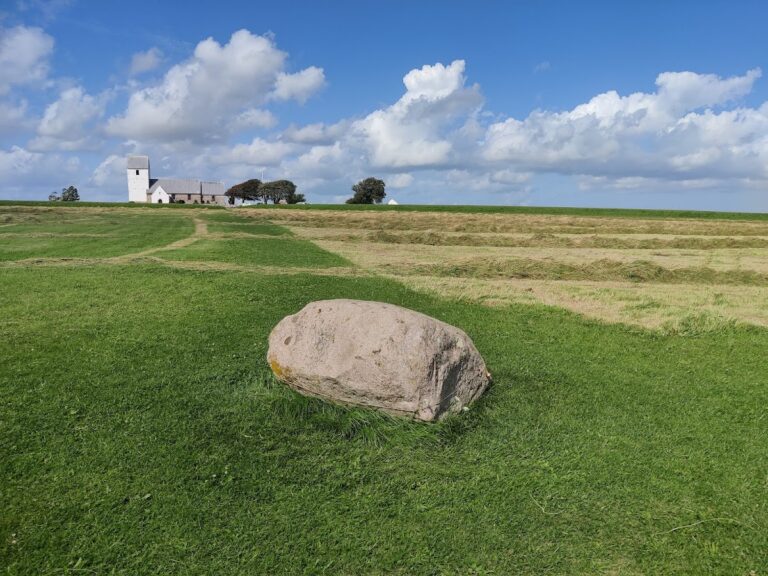
Vestervig’s surviving church is a large three-aisled Romanesque basilica built chiefly of red brick. Its exact construction date is uncertain. A western tower was added during the Gothic period, and the main entrance now passes through the tower’s western portal. A second portal is set in the south wall. Neither entrance portal is original. The choir and apse, the usually semicircular end of the church, were reconstructed between 1917 and 1921 in forms believed to reproduce their original appearance. The original transepts, or cross-arms of the church, were not restored, and the nave roof was extended over the side aisles.
Exterior and medieval fabric
Brick church and tower
The church’s red-brick construction, long central nave, and lower side aisles express the Romanesque arrangement of the former abbey church. Its unusually large scale has been connected with the possible cathedral role of Vestervig and with the needs of an abbey church. The Gothic western tower altered the medieval exterior and provided the principal entrance. The building’s position and height also made it useful as a maritime landmark.
Reliefs and sundial
An exterior relief shows two human figures and two grotesque creatures, which have been interpreted as possible devils. Another relief appears above the priests’ entrance and may have come from an altarpiece originally made for St. Thøger’s Church. On the south side, a well-preserved sundial discovered in 1917 is divided into thirteen intervals. It marked the canonical hours of terce, sext, and none, traditional prayer times observed approximately in the mid-morning, at midday, and in the mid-afternoon.
Interior furnishings and decoration
Font, pulpit, and altarpiece
The church contains a Romanesque baptismal font made of soapstone. Its basin, dating from 1575, is of South German origin and depicts the Annunciation. The pulpit was produced between 1608 and 1610. The late Baroque altarpiece was originally intended for Viborg Cathedral and has the Crucifixion of Jesus as its central subject.
Paintings, tombstones, and bells
Several medieval tombstones and epitaphs remain inside the church. Frescoes from different periods include decorative and figurative works. Their subjects include Saint Veronica with the Sudarium, the cloth traditionally believed to bear the miraculous image of Christ’s face, and a pig playing the bagpipes. The tower retains two bells from the abbey period. One was cast by Sven Andersen in 1513, while the other was made by an unknown bell-maker during the fifteenth century. A Marcussen & Søn organ was installed in 1978.
Churchyard and surrounding remains
Grave associated with Liden Kirsten and Prince Buris
A grave in the churchyard is marked by a 3.40-metre-long slab with additional gravestones at both ends. It dates to around 1200. Scientific examination in 1962 identified the remains as those of a man aged approximately 50 to 60 and a woman aged approximately 35, and found no evidence that the grave was royal.
Local tradition identifies the burial with Liden Kirsten and Prince Buris, an ill-fated couple celebrated in a Danish folk song. The grave remains part of a marriage custom in which newly married couples place the bridal bouquet there after the wedding ceremony.
Barrow, mill, and sacred spring
An Iron Age burial mound, or barrow, was uncovered north of the church. Nearby are the Klostermølle mill and the ruin of another church building traditionally attributed to Saint Thøger. The sacred spring associated with Thøger lies near the church and preserves the connection between the surviving religious centre and the traditions surrounding his early ministry.
Kappel and the alleged tunnel
A nunnery existed at Kappel near Vestervig. Local tradition says that the canons built a concealed tunnel between the abbey and the nunnery. Masonry fragments said to have been found beneath the fields between the two sites have been cited in support of the story, but systematic excavations have not tested the claim.