Trans Church: A Medieval Romanesque Village Church in Denmark


Site at a Glance
- Rating
- 4.6
- Popularity
- Low
- Country
- Denmark
- Primary era
- Medieval
- External website
- Open
- Eras represented
- Medieval, Early Modern, Modern
- Civilizations
- Danish
- Site type
- Religious
- Remains
- Church
On this page12 sections
History
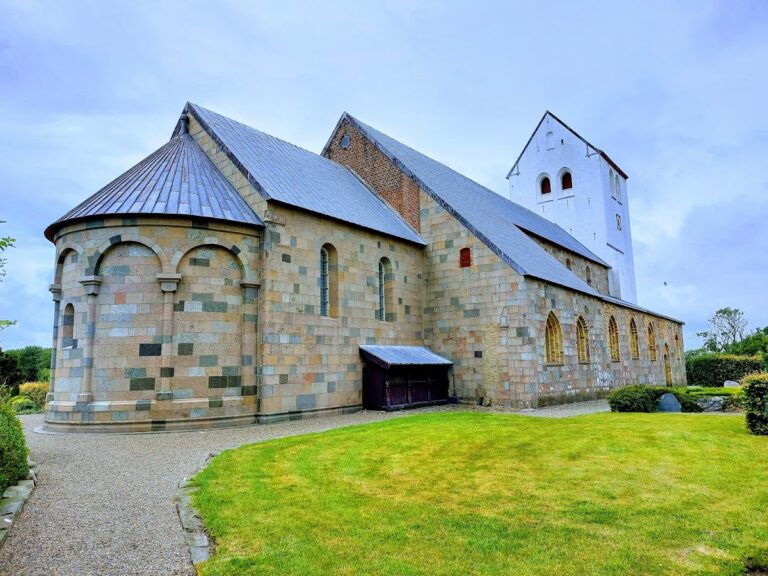
Trans Church is a medieval village church in Denmark, probably built as a Romanesque stone church during the twelfth century. Its heavy masonry, round-arched openings, and relatively small windows reflect the Romanesque period, and the building is approximately 900 years old. Several wooden churches probably stood on the same site before the present church. Today, Trans Church belongs to the Danish Folk Church, Denmark’s established Lutheran national church, and to the Diocese of Viborg, an administrative territory governed by a bishop.
Medieval origins and estate ownership
The first written mention of the church dates from 1350, in a register of the Diocese of Ribe. By 1446 at the latest, it belonged to the nearby Herpinggård estate. The successive owners of the estate furnished and altered the church over the following centuries, linking its history to the local landed estate.
In 1671, King Christian V transferred Trans Church, together with the other parishes of the local hundred, to Henrik Ruse. Christian V was the Danish king who ruled during the later seventeenth century. Through this transfer, the church became part of the Barony of Rysensteen. Under the Juel-Rysensteen successors, it was sold back to the estate owner and changed hands several times. Its connection with Herpinggård ended in 1914.
Repairs, fire, and changing use
Repairs in 1796 to 1798 brought larger windows to the church, and further work followed in 1830. A fire on 29 September 1912 destroyed the entire furnishing of the chancel, including the altarpiece and pulpit donated by estate owner Hans Krabbe in 1655. Kneeling benches, altar rails, altar candlesticks, and communion vessels were also lost. The damaged medieval altar table was later removed, and the chancel was redesigned in the Neo-Romanesque style.
A major renovation in 1963 to 1965 included archaeological excavations beneath and around the church. The work examined earlier churches and changes made during the preceding centuries. Most of the furnishings were removed during the renovation, including the pews, galleries, and the chancel furnishings installed in 1913. Further repairs took place in 1977 and 2006. After the 1964 to 1965 restoration, the church was furnished in a minimalist wooden style.
Since the eighteenth century, Trans Church has shared a pastor with Fjaltring Church. Since 2008, it has formed part of Havsogne, meaning “sea parishes,” together with Ferring, Fjaltring, and Vandborg. Coastal erosion has washed away much of the original settlement. The church once stood in the center of the village, but it now stands approximately 100 metres from the steep North Sea coast.
Remains
Trans Church consists chiefly of a Romanesque nave and chancel built from substantial granite blocks, with limestone and flint used as supplements. A later tower occupies the west end. Beneath and beside the building, excavations have revealed remains from earlier wooden churches, former burials, and craft activity connected with the construction of the church.
Early remains and churchyard
Wooden churches and bell frame
Archaeological investigations south of the present church identified remains of at least two earlier wooden churches and a bell frame. Several graves from a former churchyard lay beneath the floor of the present building. Investigations in the churchyard revealed 35 burial places from earlier periods, together with tools and other finds that illuminate activity around the successive churches.
Craft remains and coins
A smithy lay beneath the present chancel, while lead-melting pits marked the work of craftsmen involved in constructing the church. The excavations also produced 83 coins. The oldest is a rare runic coin from the time of Svend Estridsen, the Danish king who died in 1076, before the construction of the present church.
The churchyard is enclosed by a white picket fence and contains relatively few graves. The archaeological burial places and associated finds provide evidence for earlier use of the site beneath and around the standing church.
Stone building and interior
Nave, chancel, and tower
The nave is the principal space for the congregation, while the chancel surrounds the main altar. At Trans Church, the chancel is slightly narrower than the nave and is separated from it by a chancel arch, the transition between the two spaces. The arch is built of bricks in monastery format. The chancel and nave have flat board ceilings, while the tower room has a vaulted ceiling.
The tower was added at the west end during the Late Middle Ages. Its lower part is made of granite blocks, and its upper part uses fieldstone and brick. From about 1800, the tower also served as the church porch. The original entrances in the south and north walls of the nave, along with several Romanesque round-arched windows, have been blocked up.
Font and triumphal cross
A granite Romanesque baptismal font dating from about 1150 remains in the church. Its decorative motifs belong to the stone-carving tradition of western Jutland. A seventeenth-century triumphal cross, a large cross traditionally placed at the boundary between nave and chancel, is also preserved.
Pulpit and altarpiece
The pulpit was carved in 1655 by the master carver Kristen Spend. Its rich Renaissance ornament belongs to the European artistic style that developed from the fifteenth century onward. The pulpit stands on the south-west side of the chancel arch, where a pre-Reformation side altar once stood, and it is entered through an opening in the wall from the chancel. Its biblical inscriptions and painted colour scheme were reconstructed after 2013. The chancel contains an altarpiece painting by Niels Bjerre, dated 1913, showing the risen Christ and Mary Magdalene.
Medieval altar canopy and ship model
A medieval altar canopy from the thirteenth century had been incorporated into the 1655 altarpiece. Its surviving remains were transferred to the National Museum in 1903, where they have been preserved. The canopy is among the few known Danish examples of its type. A model of the three-masted ship Christine is also preserved in the church. Jens Helmig, pastor of Trans and Fjaltring from 1935 to 1939, donated the model.