Dueholm Priory: A Hospitaller Religious House in Denmark


Site at a Glance
- Rating
- 4.4
- Popularity
- Low
- Country
- Denmark
- Primary era
- Medieval
- External website
- Open
- Eras represented
- Medieval
- Civilizations
- Danish, Knights Hospitaller
- Site type
- Religious
- Remains
- Monastery
On this page7 sections
History
Dueholm Priory in Nykøbing Mors, Denmark, was founded in 1370 by Sven, Bishop of Børglum, for the Knights Hospitaller, a Catholic religious and military order whose members also operated hospitals and charitable institutions. The priory stood just outside the town on land given to the diocese by Lady Mette Pedersdatter. It was dedicated to St John the Baptist and Mary Magdalene, and became an important religious and charitable institution on the island of Mors.
Foundation and Hospitaller community
The priory was administered by a prior and belonged to the Order of St John, which is why it was also known as St Hans Priory. In 1380, the Hospitallers received rights to St Clement’s Church in Nykøbing. At its height in the early sixteenth century, Dueholm housed twelve brother priests under the leadership of a prior. The prior was often a secular nobleman who acted as the institution’s advocate in worldly affairs.
The hospital was run by non-monastic brothers of the order. They followed religious lives while caring for the sick, giving Dueholm a role that extended beyond worship. Its population was relatively transient. Noble families sometimes placed younger sons at the priory for a period, after which they might leave to marry or fight, join the lay brothers in hospital service, or become knight-monks and enter the priesthood.
Schools, hospitals, and local administration
Dueholm maintained a school between its mill and the town. It was regarded as Nykøbing’s second school, while the first had been built during the reign of Christian II. The priory also supervised St Jørgen’s Leper House outside Nykøbing. That institution remained separate and had its own lay-brother staff, but priests from St John took turns celebrating Mass there each day.
A prolonged conflict with the townspeople centered on Holy Ghost Hospital, which the town had established and staffed to care for the poor and sick. The dispute involved control of the hospital’s income and rights over property built and administered by the townspeople. In 1445, Christopher of Bavaria, King of Denmark, recognized the town’s rights to the hospital property.
Dueholm had obtained papal permission to complete Holy Ghost Chapel in St Clement’s parish. Bishop Gert supported the priory and prohibited laymen or their helpers from receiving benefits from hospital donations. The dispute intensified until Christian I ordered that the parish priest of St Clement’s be allowed to celebrate Mass in the hospital chapel. Since Dueholm appointed that priest, the decision gave the priory spiritual control over the hospital, which it later took over from the town. Dueholm subsequently acquired many properties in Nykøbing and the surrounding area.
Records, closure, and later use
Two letter books preserve parts of Dueholm’s archive. The older collection was copied before 1527 and contains letters from 1371 to 1539, including Bishop Sven’s grant founding the priory in 1370. The copies were made as the original letters deteriorated. A younger letter book, copied in 1527, includes a list of people who arrived at the priory and the places from which they came. These surviving letters illuminate the daily life of the religious community and the people around it.
After the priory closed, a 1591 inventory listed many documents that had survived, while another inventory covered the archive of Trinity Chapel. After 1587, the letter books passed from Elle Krastrup, widow of Thygge Sandberg of Kvelstrup, to the local magistrate. They were recopied in the eighteenth century and later passed to government officials because they helped establish land ownership. The wider Dueholm archive had been moved to Dueholm Castle, where it was destroyed when the castle burned during its sack in 1627.
St Jørgen’s House, including its chapel, was closed and demolished in 1527. The dispute over Holy Ghost Hospital reappeared in 1528, when the town appealed to Frederick I, accusing Dueholm of unlawfully obtaining the hospital through a papal grant and of failing to care adequately for the poor and sick.
The Reformation in Denmark was the sixteenth-century transition from Catholic Christianity to Lutheran Protestantism under the Danish crown. It brought the confiscation and secularization of religious houses and their property. In 1536, Dueholm Priory and its income-producing estates passed to the crown, although the institution was secularized rather than immediately abandoned because the townspeople wanted its hospital services to continue. The priory was finally disbanded in 1556 after the death of its last secular prior, Jakob Jensen, while the hospitals continued to operate.
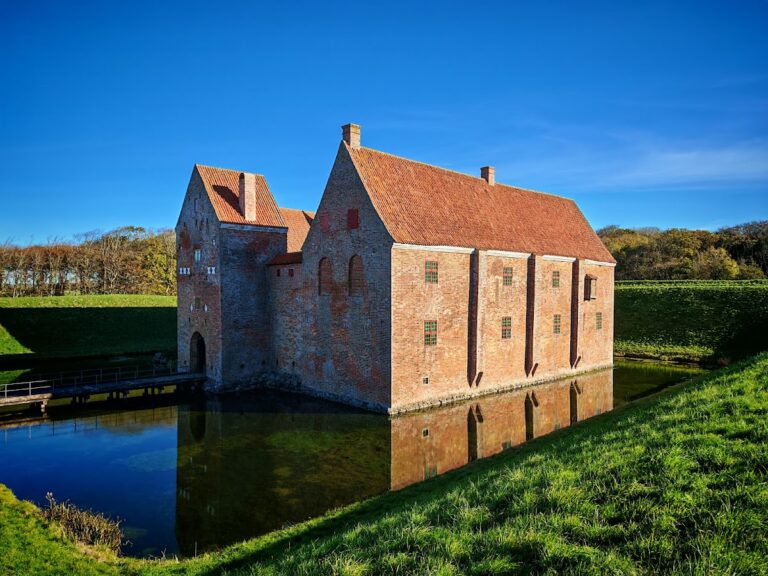
After Thisted County was organized, the former priory buildings were converted into a manor house for the local magistrate. The manor estate was later divided into smaller holdings. By 1901, only the west range of the former priory remained preserved. It was later restored and now forms part of the Morsland Historical Museum.
Remains
The surviving remains consist chiefly of the restored west range, together with sections of wall and foundations incorporated into later buildings. The wider complex included a mill, a school, the priory’s hospital facilities, and associated religious institutions around Nykøbing. These surviving elements reflect the priory’s combination of religious, charitable, educational, and administrative functions.
West range
The west range is the principal preserved part of Dueholm Priory. Some of its windows, formed with Gothic arches, were still intact by 1901. The range was later restored and now houses the Morsland Historical Museum. Other parts of the priory survive as wall sections and foundations incorporated into later buildings.
Mill, school, and hospital buildings
A mill stood within the priory complex, with the school located between the mill and the town. After St Jørgen’s House was closed in 1527, the mill became known as St Hans Mill, a name connected with the Hospitallers. Holy Ghost Hospital included Holy Ghost Chapel in St Clement’s parish, whose completion and religious control formed the focus of the priory’s dispute with Nykøbing. St Jørgen’s Leper House also had a chapel, but it was demolished when the house was closed and torn down in 1527.
Nearby sites