Vazelon Monastery: A Greek Orthodox Monastic Center in Türkiye
Site at a Glance
- Popularity
- High
- Country
- Turkey
- Primary era
- Medieval
- Eras represented
- Medieval, Modern
- Civilizations
- Ottoman
- Site type
- Religious
- Remains
- Monastery
On this page9 sections
History
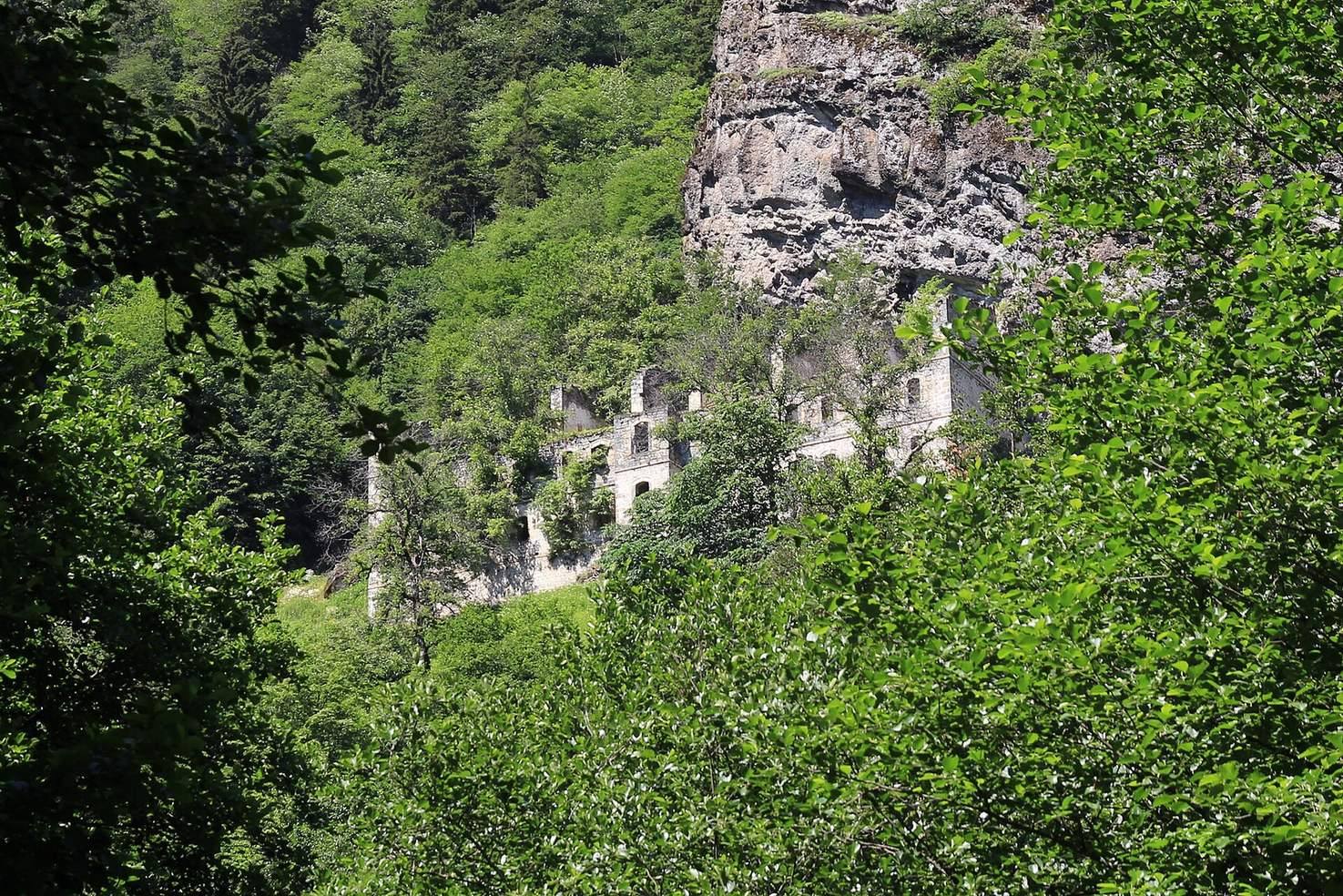
Vazelon Monastery is a ruined center of Greek Orthodox monastic life near Maçka in Trabzon Province, Türkiye. Greek Orthodox Christianity is the Eastern Orthodox tradition practiced by Greek churches and communities. Probably dedicated to John the Baptist, the monastery originated in the late Roman period, but its foundation date is unknown. The years AD 270 and 317 have been linked to early activity or references to the monastery, not confirmed as its founding.
Late Roman and Byzantine periods
Around the sixth century, Persian forces of the Sassanid Empire, a major rival of the Byzantine Empire, raided Vazelon, killing monks and destroying part of the monastery. In 565, Justinian I, the sixth-century Byzantine emperor, ordered repairs. The Byzantine Empire was the eastern continuation of the Roman Empire, ruled from Constantinople. During conflict with Persia, Justinian also used Vazelon’s high-altitude position as a lookout post near the frontier. Byzantine emperors later supported the monastery’s expansion during the seventh and eighth centuries.
Under the Empire of Trebizond
After the Fourth Crusade captured and sacked Constantinople in 1204, the Byzantine Empire fractured. The Pontus region became part of the Empire of Trebizond, a medieval state that endured until the Ottoman conquest in 1461. Its emperors funded Vazelon through the Middle Ages, making it one of the major Pontic monasteries to receive generous endowments. Its location on a route to Trabzon, a historic trading port, and amid fertile land helped support its wealth. The monastery influenced surrounding villages and retained some control there into the 1890s; it held much of its land and wealth until 1923.
Monks kept the records now known as the Acts of Vazelon from the eighth through the nineteenth centuries. These writings preserve accounts of donations, land sales, wills, monastic decisions, armed conflicts, and dealings with local people. They also name ordinary people and their occupations, illuminating everyday life in medieval Pontus. In the Byzantine and Trebizontine periods, people often donated land in exchange for commemorative prayers and continued to use the property much as they had before. Rural nuns could own fields and threshing floors, and women inherited property and took part in transactions, although men conducted most dealings with the monastery. Donors came from different levels of society, and some gave wine rather than land.
Individual records reveal both personal circumstances and the monastery’s connections across the region. In the thirteenth century, Zoe Chaldena gave property for the salvation of souls, and her name and her husband’s were entered in the monastic diptychs, lists of people commemorated in religious services. In 1261, a woman donated inherited land after five of her sons had been kidnapped and she could no longer manage it. George Gabras, a member of a prominent aristocratic family, sold Vazelon property he owned in Matzouka in 1344 or 1345. The records describe raids on Pontic villages by nomadic Turkmen groups, as well as Persians and Turks donating or selling land to the monastery and witnessing transactions.
Names in the Acts reflect the region’s varied population. About 12 percent of the names recorded before 1261 had non-Greek origins; across the Empire of Trebizond’s 257-year history, the proportion rose to about 60 percent. Recorded backgrounds included Armenian, Kartvelian (South Caucasian, including Georgian), Turkic, Persian, Arab, Slavic, and Italian. The records also place Turks in central Trabzon by 1432 at the latest, including among local landholders, and show Turkic and Mongolian influence on court titles by the thirteenth century. Agricultural details include a farmer’s thirteenth-century will listing a plough and an eliktrin, a tool for working sloping fields. Threshing floors and simple watermills were also used in the area.
The monastery’s annual feast on 21 June combined religious observance with singing, dancing, and social gatherings for villagers connected to Vazelon. Monastic documents now survive in collections in St Petersburg and Ankara. During the Russian occupation of Trabzon in 1916–17, some documents were taken to St Petersburg. The Ankara collection came from the Greek Philological Society of Constantinople, dissolved after 1923; Turkish authorities redistributed its historical manuscripts in the early 1930s. The Turkish Historical Society holds Vazelon’s cartulary, a collection of records concerning an institution’s property and transactions.
War, abandonment, and the continuation of the tradition
Vazelon continued its religious activity under Ottoman rule and into the First World War. In 1916, after Russian forces took Trabzon and Ottoman troops retreated, Turkish soldiers brought Greek civilians from the Trabzon region to the monastery and killed them. Some of the women were raped before they were killed. The last abbot was Panaretos Topalidis. During the violence and destruction of 1922, the acting superior, Dionysios Amarantidis, rescued an icon showing the beheading of John the Baptist. After the Greek–Turkish population exchange, which sent most surviving Greek Orthodox residents to Greece and transferred Greece’s native Muslims to Türkiye, Vazelon was definitively abandoned in 1923. Vandalism later contributed to its ruin.
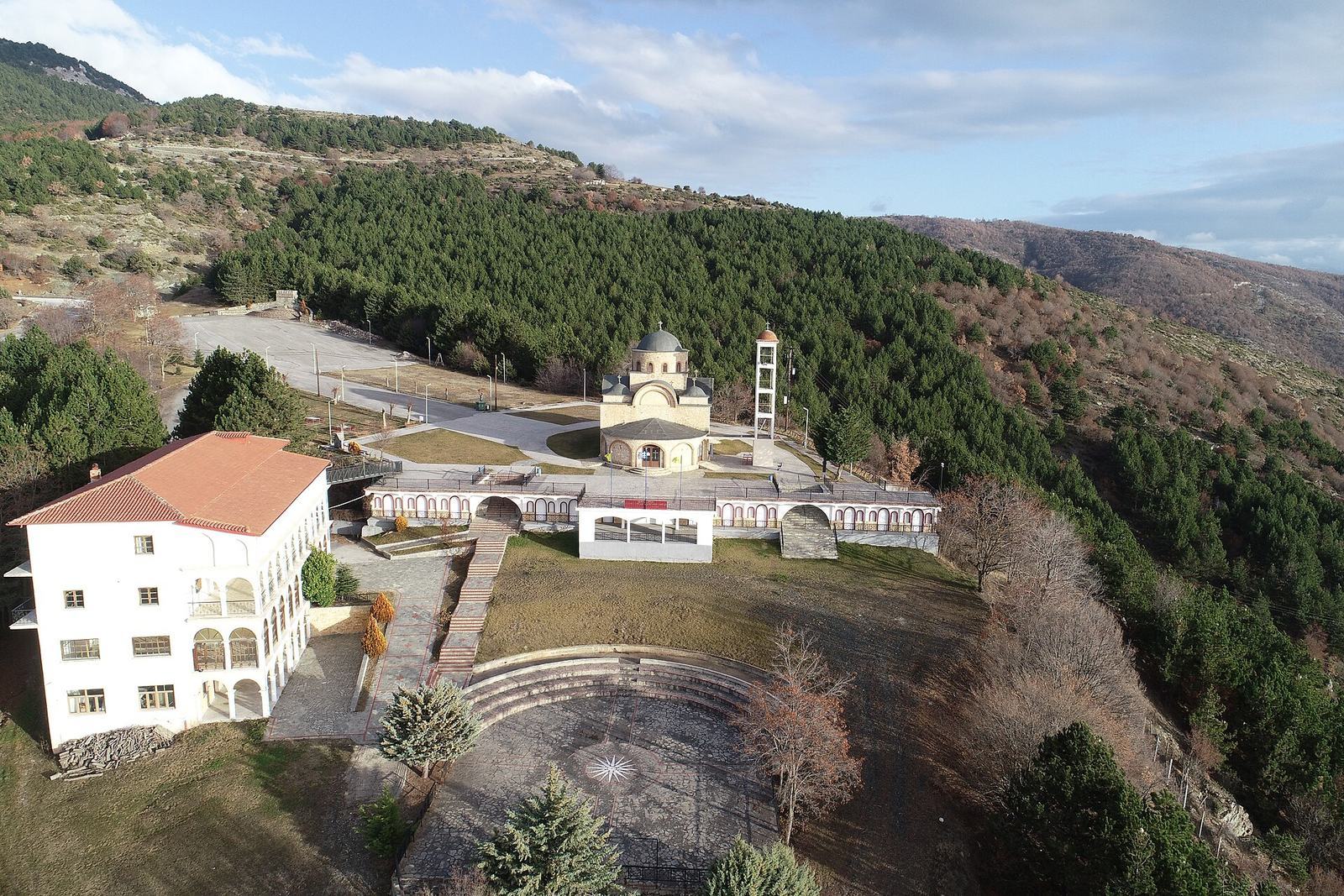
Pontian Greek refugees in Macedonia renewed Vazelon’s monastic tradition at a successor monastery near Agios Dimitrios, Kozani. Efforts to establish it began around 1970, the year the rescued icon was transferred there after being kept in monasteries in the Serres area. Construction at the successor monastery was underway in 1997.
Remains
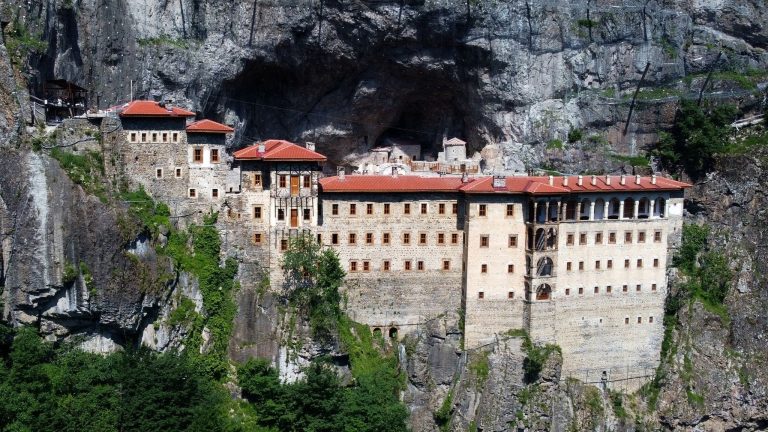
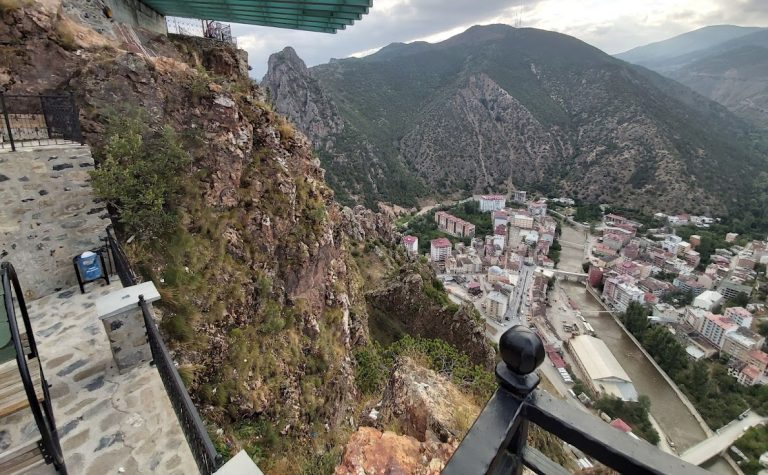
The ruins stand in the forested Pontic Mountains, about 40 km south of Trabzon and 20 km from Maçka. Rivers cross the surrounding valleys, and nearby mountains reach roughly 2,500 m. The complex includes a multi-storey stone main building and two chapels. Its surviving masonry reflects construction with local stone and lime mortar.
Main building
The main building’s surviving structures date to a rebuilding in 1410. It originally had four stories, and three levels of rooms can be identified among the visible remains. The exterior walls are thicker than the interior partitions, and the masonry may include local granite. The numerous rooms included a dining hall and kitchen, as well as a cistern for collecting water. Access was once provided by a suspended wooden ladder that could be drawn inside at night to deter intruders; stone stairs replaced this arrangement around 1800.
Chapels
Cave church
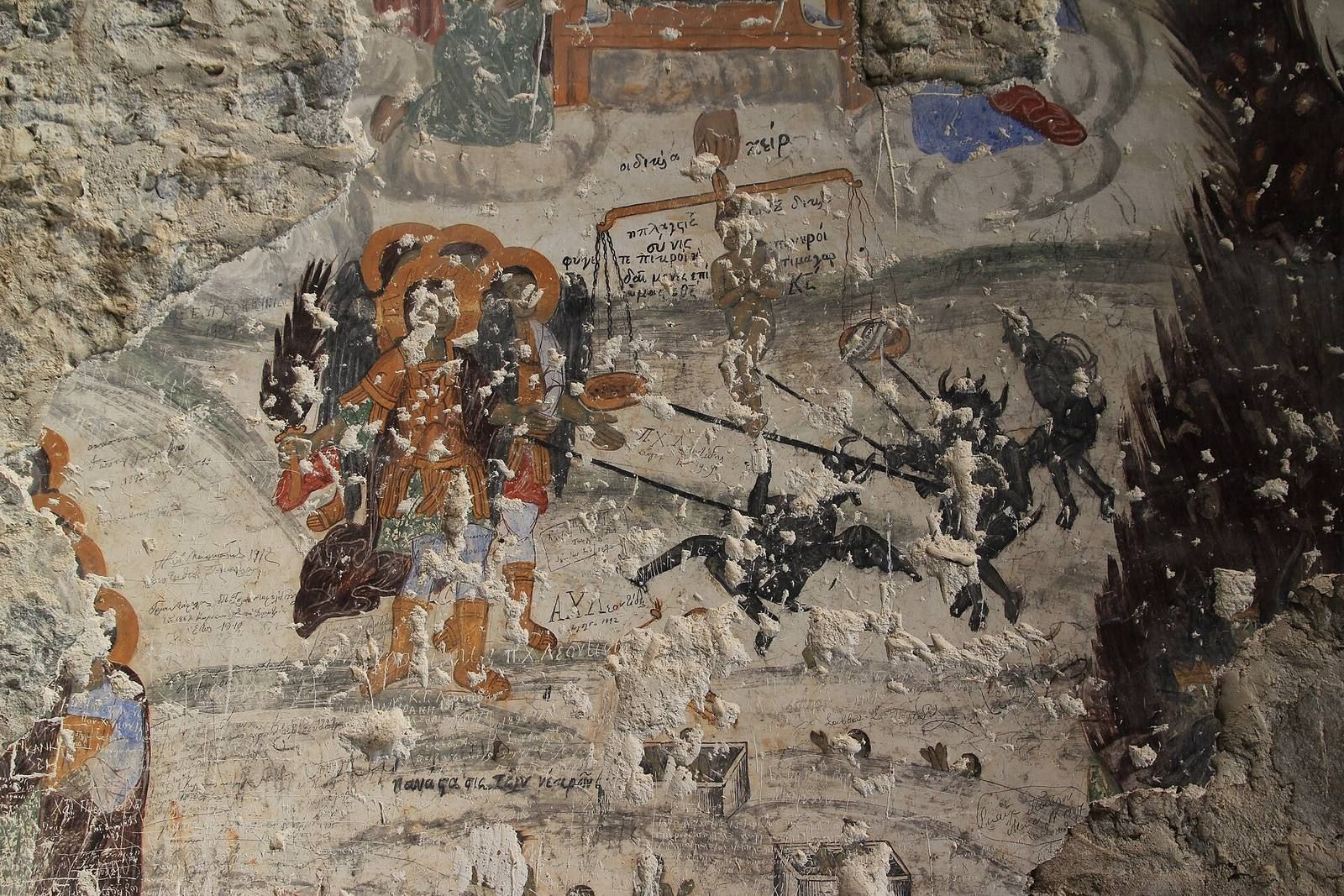
One chapel is a church built into a cave at the top of the monastery. The north exterior wall of the main church carries frescoes depicting Heaven, Hell, and the Last Judgment. Other surviving paintings include an image of the infant Jesus in a cradle and further scenes of the Last Judgment, Heaven, and Hell. The surviving frescoes are damaged.
Chapel of Elijah
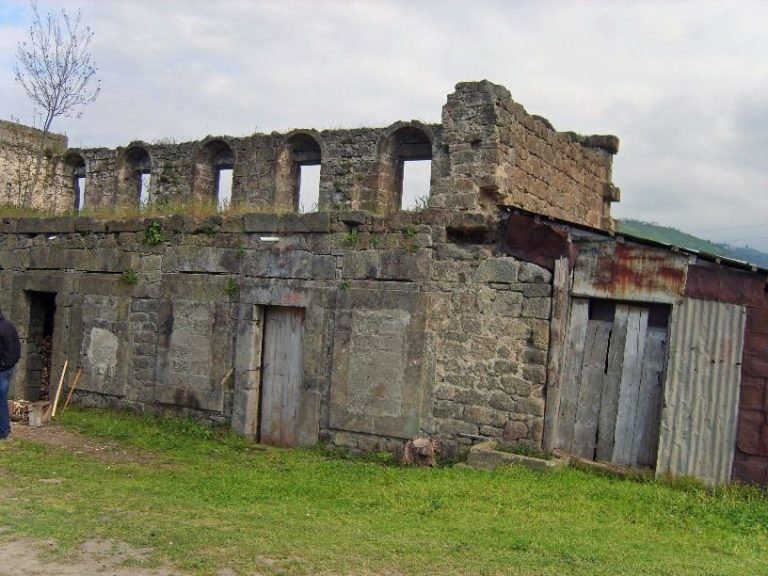
A second chapel stands about 30 m north of the main complex. Medieval texts call it St Elijah, and it may date to 1219. Chrysanthos, a metropolitan, or senior bishop, of Trebizond in the early twentieth century identified the chapel as dedicated to the prophet Elijah after consulting monastery texts. Its religious paintings depict Christian figures.