Vatican Grottoes: Papal Burial Complex Beneath St. Peter’s Basilica
Site at a Glance
- Popularity
- Very High
- Country
- Vatican City
- Primary era
- Early Modern
- Eras represented
- Classical, Medieval, Early Modern, Modern
- Civilizations
- Papal States, Roman
- Site type
- Religious
- Remains
- Tomb
On this page12 sections
History
Origins and expansion
The Vatican Grottoes are an underground complex beneath St. Peter’s Basilica in Vatican City. They took shape during the sixteenth century and later became a burial place for popes and other figures. Around 1590–91, underground rooms were built beneath the new basilica.
Antonio da Sangallo the Younger proposed an underground space to Pope Leo X after Raphael’s death in 1520. Between 1538 and 1546, Sangallo planned to raise the basilica’s nave floor by 3.2 metres to improve its lighting. Vaults beneath the raised floor would form accessible rooms.
In 1592, Pope Clement VIII renovated the medieval crypt, named it the Clementine, and arranged an altar near St. Peter’s tomb. In 1616–17, Pope Paul V added straight corridors leading to the Confessio, the shrine area associated with St. Peter’s tomb, and to chapels. During the seventeenth century, Pope Urban VIII oversaw four small oratories at the bases of the pillars supporting the dome.
After the mid-twentieth century, additional chapels were created for Irish, Polish, and Lithuanian communities, for the patron saints of Europe, and for Mexico. In 1979, a large archway was opened to expose the front of the Confessio and the Niche of the Pallia. Pallia are woolen vestments worn by the pope and certain archbishops.
The tomb and its investigation
Catholic tradition places St. Peter’s tomb in the Vatican necropolis, an ancient burial ground north of the Circus Vaticanus, with the Via Cornelia between them. The necropolis dates from the late first century BC to the fourth century AD and is distinct from the Grottoes. Emperor Constantine built an early basilica on the site of the present church, positioning its apse around the tomb on the hillside.
Pope Pius XI wanted burial as close as possible to the Confessio. After his death in 1939, his successor, Pius XII, ordered archaeological excavations around St. Peter’s tomb to investigate its authenticity. The work began secretly in 1940 and continued for ten years, including during the Second World War. Excavators identified a first-century empty tomb beneath a religious monument below the basilica’s altar. An inscription in Greek was interpreted as saying, “Peter is here.” In 1950, Pius XII announced that the tomb of the Prince of the Apostles had been found.
Further study by archaeologist Margherita Guarducci followed in 1953. Bones belonging to a man estimated to have been about 60 to 70 years old had been found in a wall recess, wrapped in purple cloth woven with gold thread. A small container for human bones, an ossuary, had also been found in the tomb. The bones were thought to have come from a wall niche and to have been transferred to a small shrine in Constantine’s time. Pope Paul VI later judged that they were probably St. Peter’s remains.
Burial traditions and later changes
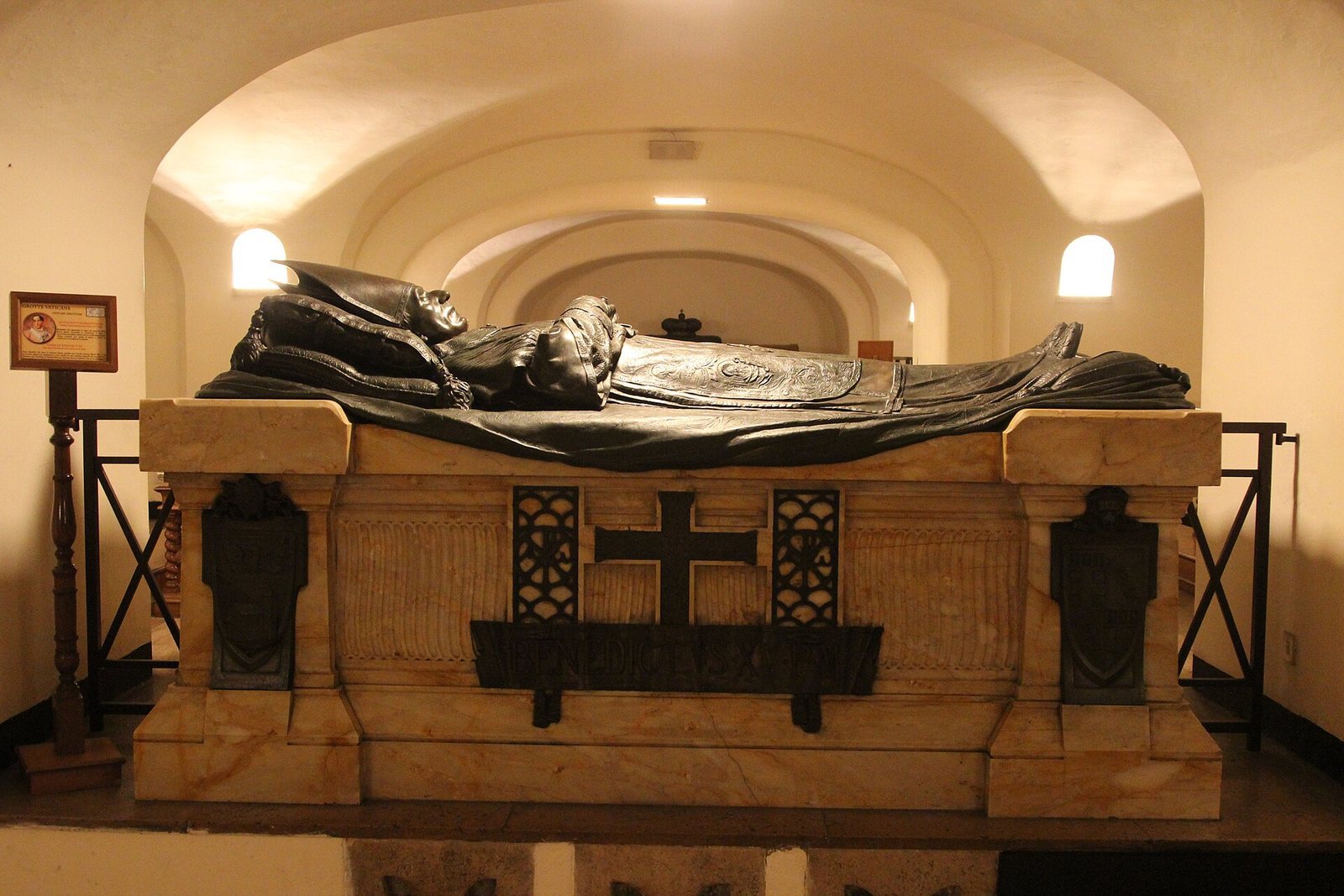
Burial near St. Peter’s tomb was sought by popes, rulers, religious figures, and early Christians. The Grottoes came to hold the burials of popes as well as Holy Roman Emperor Otto II, Queen Christina of Sweden, Queen Charlotte of Cyprus, members of the Stuart family, and Cardinal Rafael Merry del Val. Cardinal Josef Beran’s remains were returned to the Czech Republic in 2018 and buried in St. Vitus Cathedral in Prague.
Some popes first buried at St. Peter’s were later moved elsewhere. Eugene IV was transferred to San Salvatore in Lauro; Calixtus III and Alexander VI were moved to Santa Maria in Monserrato degli Spagnoli during construction of the new basilica; and Pius II was transferred to Sant’Andrea della Valle in 1614. Other popes chose burial outside the Vatican: Pius IX at San Lorenzo fuori le Mura, Leo XIII at St. John Lateran, and Francis at Santa Maria Maggiore.
Pope John XXIII was moved from the Grottoes to the basilica after he was declared blessed in 2000. John Paul II was buried on 8 April 2005 in the niche previously used for John XXIII; his remains were transferred to the basilica in 2011. Benedict XVI was buried in the former vault of his predecessor on 5 January 2023.
Remains
Plan and central shrine
The Grottoes lie beneath part of the central nave, about three metres below the basilica’s present floor. They extend from the high altar to roughly the midpoint of the nave, occupying the space between the current floor and the level of the fourth-century Constantinian basilica. Their span follows that of the older church. Branching niches, side corridors, and chapels form the layout. The older area follows a church plan with a central aisle and two side aisles; the newer area includes a semicircular end with chapels and funerary monuments.
The Confessio and Clementine Chapel
The chapel of St. Peter forms the layout’s focal point. Above it are the papal altar and Michelangelo’s dome; below it, in the underground necropolis, lies the tomb associated with the apostle. The tomb is beneath the altar in the area of the Confessio. Behind the Clementine Chapel’s altar, a grille covers white marble marking the tomb. Pius XI’s tomb is almost opposite the Confessio, to its left, while Pius XII’s is aligned with the shrine’s rear and the corresponding chapel.
Burial monuments and artworks
Papal tombs
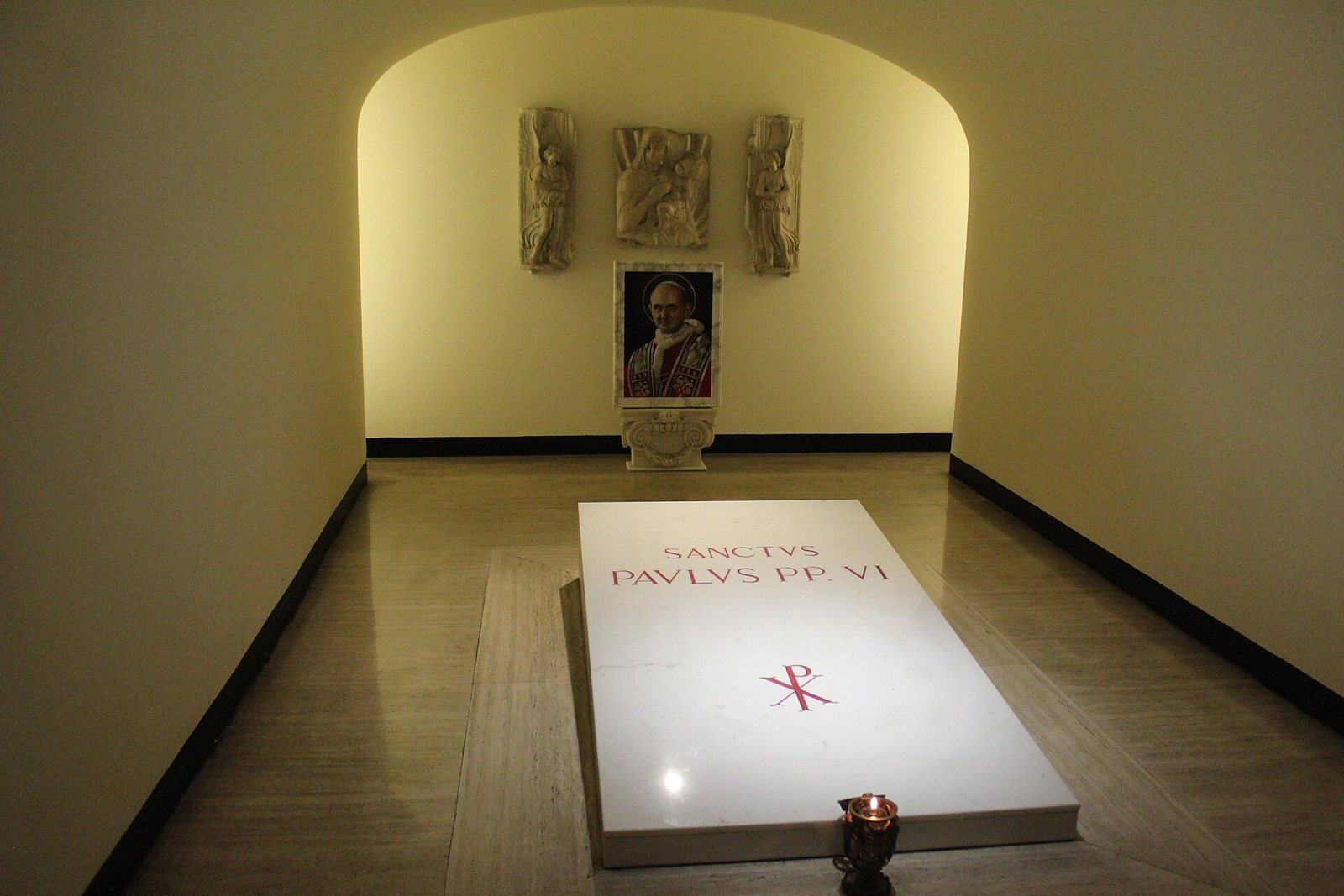
John Paul II’s grave occupied the niche previously used for John XXIII. Its setting was remodelled to resemble a monastic cell, and a large slab of white Carrara marble covered the grave. The tomb of Pius VI is enclosed in an early Christian sarcophagus, with a marble sculpture by Antonio Canova showing the pope in prayer.
Royal and other burials
Otto II’s tomb stands at the far end of the Grottoes beside the tomb of Pope Julius III. Other tombs belong to Christina of Sweden, Charlotte of Cyprus, and members of the Stuart family. A further tomb is attributed to a child of the Julii family.
Art and decoration
The Grottoes contain funerary monuments and artworks from the earlier basilica, including Pope Boniface VIII’s tomb by Arnolfo di Cambio, Cardinal Berardo Eroli’s monument by Giovanni Dalmata, and fresco fragments attributed to Pietro Cavallini. Frescoes, mosaics, sculptures, and inscriptions are also associated with the earlier church, including Christian mosaics dating to before the fourth century.
Monuments in the Treasury
The Treasury of St. Peter’s, accessible from the upper basilica’s right nave, holds the sarcophagus of Junius Bassus and the bronze tomb of Pope Sixtus IV, made by Antonio Pollaiuolo in 1493.