Uvac Monastery: A Serbian Orthodox Monastic Complex in Serbia


Site at a Glance
- Rating
- 4.8
- Popularity
- Low
- Country
- Serbia
- Primary era
- Early Modern
- External website
- Open
- Eras represented
- Medieval, Early Modern
- Civilizations
- Ottoman, Serbian
- Site type
- Religious
- Remains
- Monastery
On this page13 sections
History
Uvac Monastery is a Serbian Orthodox monastery in Serbia, in the Uvac hamlet of Stublo, whose earliest church was probably built in medieval Serbia during the first decades of the fifteenth century in the Raška architectural tradition. The monastery stands near the Uvac River in the Zlatibor region, on the boundary of the municipalities of Čajetina and Priboj, and belongs to the Eparchy of Žiča, a territorial diocese of the Serbian Orthodox Church.
Medieval Foundation
Local tradition attributes the foundation to the Nemanjić dynasty, Serbia’s major medieval ruling family, which was closely associated with the establishment and patronage of Orthodox monasteries. The surviving historical and archaeological evidence points more specifically to a small church founded by an unidentified local nobleman for a nearby pastoral settlement. The church occupied a frontier zone between the Serbian Despotate and the Bosnian states during the fifteenth century. The Serbian Despotate was the medieval Serbian state that continued after the fall of the Serbian Empire under rulers known as despots.
The establishment of the church has been interpreted in connection with the religious conditions of this borderland. Bogomil beliefs, a medieval Christian movement regarded as heretical by the Orthodox and Catholic churches, were spreading from territories controlled by Bosnian feudal lords. The church may therefore have served the Orthodox population of the surrounding area, although the founder and the precise purpose of the foundation remain unidentified.
Expansion in the Sixteenth Century
The small church later grew into a monastic complex. Major construction in 1572 and 1573, followed by further work in 1580, enlarged the church and added residences, monastic cells, auxiliary buildings, and other facilities. The community was probably female for part of the sixteenth century. A memorial book associated with the Monastery of the Holy Trinity near Pljevlja records two nuns, Ana, also known as Janja, and Marina.
Uvac became connected in local tradition with Janja, regarded as a saintly protectress of the weak. The surrounding population consequently called the church Janja’s church. This name preserves a regional religious tradition rather than a confirmed historical identification of Janja with a particular figure.
Late in the sixteenth century, the expanded monastery was burned and damaged, apparently during the campaign in which Mileševa was destroyed and the relics of Saint Sava were burned. Saint Sava, a member of the Nemanjić dynasty, had founded the independent Serbian Orthodox Church. The damage did not end the community permanently, and normal monastic life probably resumed within one or two years.
Seventeenth-Century Renewal
A further rebuilding and enlargement began between 1615 and 1618. Coins struck between 1611 and 1614 were found in the archaeological layer associated with this work. Construction affected the church, courtyard, and economic buildings, and probably continued until the middle of the seventeenth century or longer.
The monastery reached its height during the first half of the seventeenth century. It received numerous visitors and high-ranking Serbian Orthodox clergy, reflecting its active religious life and regional standing. Parts of the Church of the Nativity of the Mother of God were probably painted between 1620 and 1622. The painters appear to have belonged to the circle of the Hilandar monk Georgije Mitrofanović, although the attribution may instead refer to talented followers. Hilandar, on Mount Athos, was an important centre of Serbian monastic and artistic activity.
Destruction and Abandonment
At the end of 1697 or in the spring of 1698, the monastery was systematically looted, burned, and destroyed. Valuable objects, church furnishings, household goods, food, and grain were removed before the fire. This destruction ended the monastery’s active life, and the complex remained in ruins for more than three centuries.
The ruined site was described by the hieromonk Dionisije Popović in 1856. During the third decade of the twentieth century, the priest Eustatije Karamatijević recorded the remains of a large church and other buildings at Uvac. These descriptions preserved knowledge of the abandoned complex before archaeological investigation and conservation began.
Archaeology and Revival
Archaeological and conservation work began in 1994 under the National Museum of Užice, with specialists from monument-protection services in Belgrade and Priboj. Research conducted from 1994 to 1997 confirmed that the church had been enlarged in successive phases and that it formed part of a wider monastic complex.
Reconstruction also began in 1994 with state assistance. A small consecration was held, and liturgy was celebrated again on the feast of the Nativity of the Mother of God in September 1995, after roughly two and a half centuries of abandonment. On 21 September 1998, the substantially restored monastery was formally returned to the Serbian Orthodox Church and became a metoch of Studenica Monastery. A metoch is a monastery or dependent monastic estate placed under the authority of another monastery or ecclesiastical institution. Uvac is a protected cultural monument of Serbia and now has an active monastic community.
Remains
Setting and Church Layout
Uvac Monastery lies on the right bank of the Uvac River, in a valley between Crni Vrh and the southern rocky slopes of Zlatibor. Ribnica Lake is nearby. The complex developed around a single-nave church, a simple building with one longitudinal interior space. Its earliest form belonged to the Raška architectural school, a medieval Serbian church-building tradition that combined a longitudinal plan with Byzantine and western influences.
During the sixteenth-century enlargement, sections of the north and south walls were removed and broad rectangular choir projections were built on both sides. The original apse, the rounded eastern end of the sanctuary, was enlarged. Builders also constructed a synthronon, a set of clergy seats arranged in the sanctuary apse, together with an upper seat. White slate was used in the altar area, on the floors of the choir projections, in parts of the altar, and probably in porches and other parts of the complex.
Seventeenth-Century Church Additions
The rebuilding of the seventeenth century added supporting pillars and a dome over the central part of the church. The dome rested on a cubic base. A western narthex, or entrance vestibule, was also added and covered by a blind dome, a domed vault without an open central structure or normal exterior lighting function.
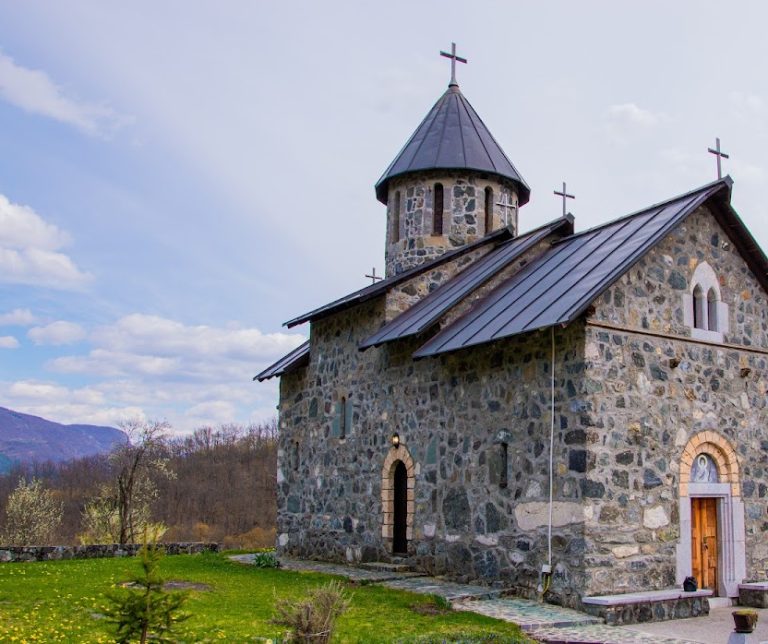
Stone and wood formed the principal building materials. Gray-black serpentinite was used in the church and foundations, while pine timber, and less frequently oak, was used for roofs and many auxiliary structures. The original roofs were covered with small pine shingles. The reconstructed church retains stone walls and pine-shingle roofing, restoring the principal religious and architectural form of the complex.
Refectory and Economic Buildings
A large refectory stood south of the church. Its lower level was a basement, while the upper dining hall was large enough for many monks and guests. Construction also continued in the courtyard and among the economic buildings after the main church work had been completed. Together, these structures show that Uvac developed beyond a single church into a complex that accommodated communal religious life, residence, storage, and dining.
Fire Deposits and Recovered Objects
The seventeenth-century fire severely affected the physical remains. Wooden upper structures, roofs, roof coverings, the iconostasis, furnishings, choir stalls, and other wooden elements were destroyed. The intense heat changed the serpentinite in the foundations and in the Church of the Nativity of the Mother of God to a red-orange colour. In the examined areas, layers of ash and burning measured approximately 2 to 10 centimetres thick.
Heating stoves collapsed into basement areas, carrying ceramic vessels with them, and some of those vessels survived intact. The destruction layers also contained utilitarian iron and ceramic objects, charred seed prepared for sowing, numerous horseshoes, several tobacco pipes, and carpentry and cooperage tools. The seed had not been sown when the fire occurred. Beneath stones from the north choir projection, the tools and other material preserve evidence of the monastery’s practical and agricultural life at the time of its destruction.
Fountain, Paintings, and Church Furnishings
Before the final burning, a finely shaped tuff fountain on the south side of the church was demolished. Rubble from the church later covered its remains. The church’s wall paintings were almost entirely destroyed by the ruin and fire, but conservators recovered about a hundred fresco fragments from rubble and pieces of tuff. These fragments permitted partial reconstruction of figures of the Archangel Michael and Saint Simeon, along with ornamental elements.
Excavation also revealed a rich group of stone and marble church furnishings. The finds included an elaborate ambo rosette, fragments of marble liturgical furnishings, a baptismal font, and candleholders. An ambo is a raised platform or pulpit used in Christian liturgy. These surviving pieces provide material evidence of the church’s ritual interior and its successive phases of use.
Vine and Reconstructed Complex
An old grapevine stood on the eastern side of the church and once spread around the monastery courtyard. It later became wild, fell to the ground, and climbed into nearby trees. Its survival became a physical reminder of the long period between the monastery’s destruction and revival. Alongside the conserved archaeological remains and reconstructed church, it forms part of the material history of Uvac’s abandonment and renewed religious life.
Nearby sites