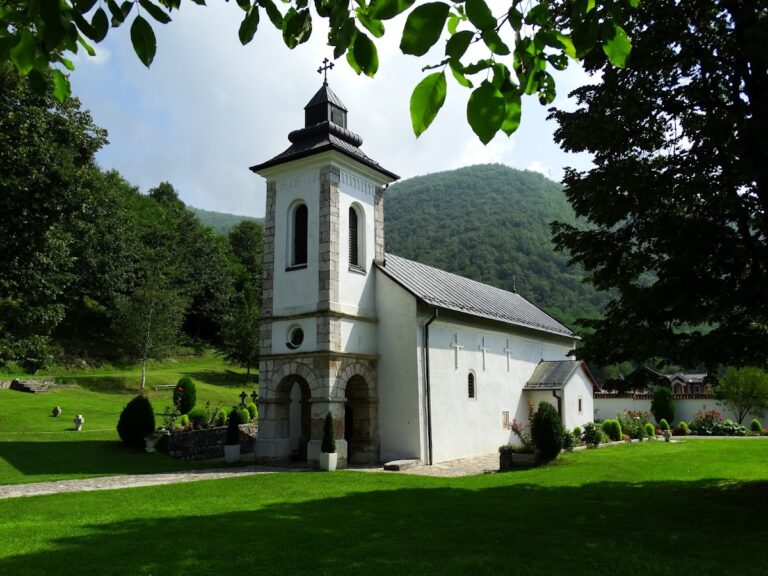
Holy Trinity Monastery near Pljevlja: A Serbian Orthodox Religious and Cultural Center


Site at a Glance
- Rating
- 4.9
- Popularity
- Low
- Country
- Montenegro
- Primary era
- Early Modern
- External website
- Open
- Eras represented
- Early Modern, Modern
- Civilizations
- Ottoman, Serbian
- Site type
- Religious
- Remains
- Monastery
On this page9 sections
History
Holy Trinity Monastery is a medieval Serbian Orthodox monastery complex near Pljevlja in Montenegro, affiliated with the Diocese of Mileševa and still inhabited by a monastic community. Its exact foundation date is unknown, but the monastery probably existed before the Ottoman conquest of Pljevlja in 1465. A church, probably built of wood, stood on the site by that time. The complex is associated with the religious, educational, and cultural history of Orthodox Serbs from the Middle Ages to the present.
Medieval origins and early wealth
A tradition attributes the foundation to a ruler of the Nemanjic dynasty, the medieval Serbian ruling house closely linked with major Orthodox monasteries. This attribution is considered unlikely because Nemanjic rulers generally founded larger complexes known as lavras. The tradition instead points toward a local nobleman as the probable founder. Before the Ottoman conquest, the monastery was wealthy and well organized. Its property included almost the whole Pljevlja plain and parts of the surrounding plateaus. The settlement of Pljevlja developed on land associated with a monastic hay store, while the district called Mahala Gumna preserves a connection with grain threshing.
Sixteenth-century restoration
Holy Trinity was restored during the sixteenth century. A lost inscription named Visarion as its first founder, together with his brother Sava and his son, Bishop Nikifor, and also recorded a later rebuilding by Abbot Joakim. Visarion headed the brotherhood in 1544 and worked to strengthen the monastery’s economic position. His donor portrait survives inside the church. Early references include a 1537 record associated with the monk Sava and a 1573 reference to the monastery. Abbot Vasilije led the brotherhood in 1541, while a manuscript was copied at the Breznica River in Pljevlja in 1579 during the abbacy of Nikodim.
Further rebuilding took place in 1592 through the work of the monk Georgije, his son Ananija, and Vojin, identified by an inscription as Georgije’s nephew and a sipahi, an Ottoman cavalryman who commonly held land or revenues in return for military service. A fresco of Vojin was placed beside the gate as a donor image. In 1595, Father Strahinja of Budimlje painted the nave and sanctuary, creating the wall-painting cycle that remains inside the church.
Learning and manuscript production
During the seventeenth and eighteenth centuries, Holy Trinity was regarded as one of the most notable educational centers in the Polimlje and Tara regions. For centuries it served as a local center of literacy, religious learning, manuscript copying, and literary activity. Its scriptorium, a workshop where manuscripts were copied and decorated, was especially active in the sixteenth and seventeenth centuries.
Monk Gavrilo was an important copyist. Manuscripts associated with his work remain at the monastery, while others are preserved in Vienna, Saint Petersburg, and Prague. The miniatures in Gavrilo’s Psalter were made by Jovan Kyr Kozma, described as one of the major Serbian painters of the seventeenth century. Patriarch Varnava, born Petar Rosić, developed his literacy at Holy Trinity. After completing the Spiritual Academy in Saint Petersburg, he initiated the construction of the Church of Saint Sava in Belgrade.
Destruction, rebuilding, and modern history
The monastery was repeatedly destroyed and rebuilt. In 1876, a narthex, or church entrance vestibule, was added to the building. This alteration made the former entrance, with its 1592 restoration inscription, the central doorway, and the small dome was enlarged.
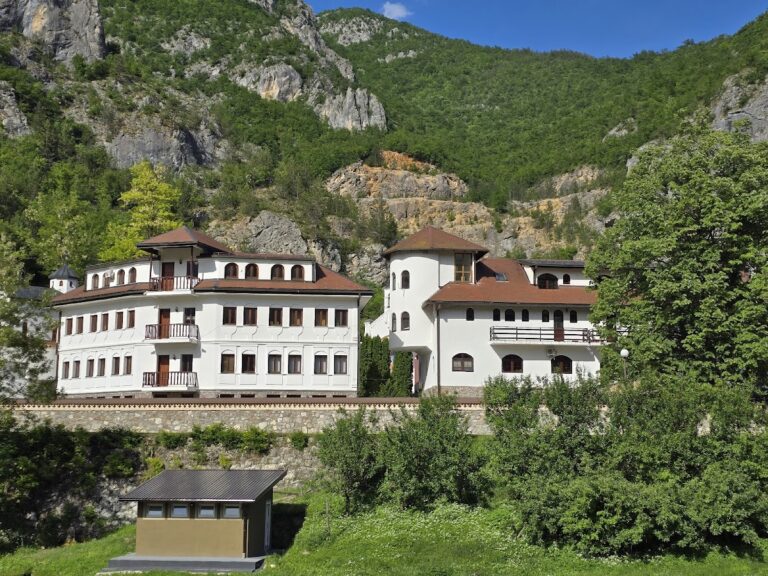
Serafim Džarić served as head of the monastery from 1900 until 1941. On 1 December 1941, during the Battle of Pljevlja, Communist forces killed him after an order from the Partisan headquarters called for a struggle against spies and “fifth column.” The monastery’s renovated residential buildings were consecrated during a hierarchical liturgy on 16 May 2004, celebrated by Serbian Patriarch Pavle and numerous Serbian Orthodox bishops. Montenegro’s president, Filip Vujanović, attended with regional political and cultural officials. Vladislav Veljković led the monastery from 2016 to 2020, and its abbot is Zosim.
Traditional costumes were also preserved at Holy Trinity for a period before being displayed in the ethnological department of the Heritage Museum in Pljevlja. The monastery remains inhabited and continues to embody the religious, educational, and cultural traditions associated with the complex.
Remains
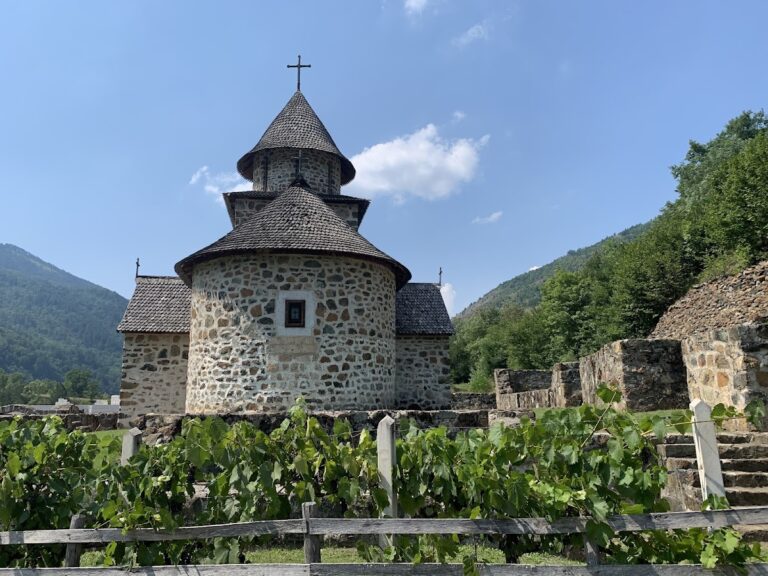
The monastery lies in a wooded area surrounded by hills near Pljevlja. Its church, dedicated to the Holy Trinity, has an unusual plan that is almost square in its oldest part. A large apse projects from this core. The building resembles thirteenth-century Serbian-Byzantine architecture, although its precise style is difficult to define. Four pillars divide the nave into a broad central space and two narrow side aisles, with two pillars on each side. A longitudinal barrel vault covers the central nave, while the aisles have semicircular transverse vaults set at right angles to the central space.
Church paintings and sacred objects
The nave and sanctuary contain wall paintings dated to 1595. Their iconographic program is notable for its selection of saints and compositions. To the right of the iconostasis, the screen separating the sanctuary from the nave, stands a sarcophagus-shaped reliquary. Since the seventeenth century, it has preserved what is venerated as part of Saint Sava’s relics, specifically a left hand. The identification remains uncertain because the hand may belong instead to an unidentified saint. Saint Sava’s staff and scepter are placed with the reliquary.
The reliquary rests on a passage-like tunnel structure used in a ritual during the feast of the Holy Trinity. The church also preserves another object associated with Saint Sava, described as his crutch or staff. Saint Sava was a medieval Serbian Orthodox archbishop, ecclesiastical organizer, and major saint of the Serbian Orthodox Church.
Treasury and metalwork
The monastery treasury contains a substantial collection of goldsmiths’ work. A reliquary commissioned by Abbot Stefan was made in 1576 and is described as the oldest surviving Serbian reliquary of its type. It takes the form of a single-naved church with a two-pitched roof and three cupolas. A long inscription covers all four sides and also functions as decoration.
Abbot Stefan also commissioned a richly made chalice produced between 1578 and 1579. The liturgical cup resembles contemporary Italian examples and is predominantly Gothic in style, combining different artistic traditions with carefully proportioned workmanship.
Manuscripts and icons
The library contains numerous valuable illuminated manuscripts, meaning handwritten books embellished with painted decoration, ornament, or miniature scenes. Its best-preserved volume is a richly illustrated and hand-coloured copy of the Hexaemeron of Saint John of Damascus, dated 1649. The Hexaemeron is a Christian commentary on the six days of Creation. A travel account of India was added at the end of the liturgical book.
Holy Trinity also preserves numerous icons. A Nativity icon from the 1570s and an icon of the Baptism of Christ are attributed to the Serbian painter Longin of Peć. Five icons painted in 1645 and 1646 were made at the monastery and remain in its treasury. Other works are associated with Andrija Raičević, the Cretan School, Russian icon painting, and unidentified artists. Especially noted examples linked with the Cretan School include a Deesis, an Orthodox composition centered on Christ with intercessory figures, and an icon of Saint George and the Dragon.
Nearby sites