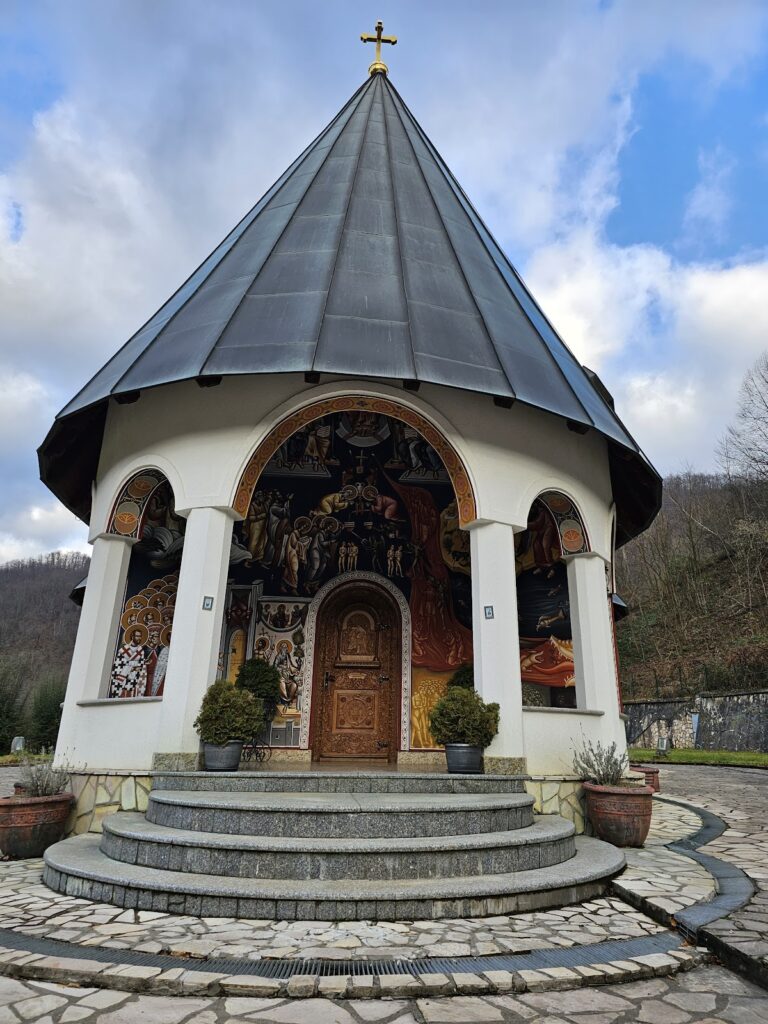
Dobrun Monastery: A Medieval Serbian Orthodox Monastery in Bosnia and Herzegovina


Site at a Glance
- Rating
- 4.9
- Popularity
- Low
- Country
- Bosnia and Herzegovina
- Primary era
- Medieval
- Eras represented
- Medieval, Modern
- Civilizations
- Austria-Hungary, Habsburg, Serbian
- Site type
- Religious
- Remains
- Monastery
On this page12 sections
History
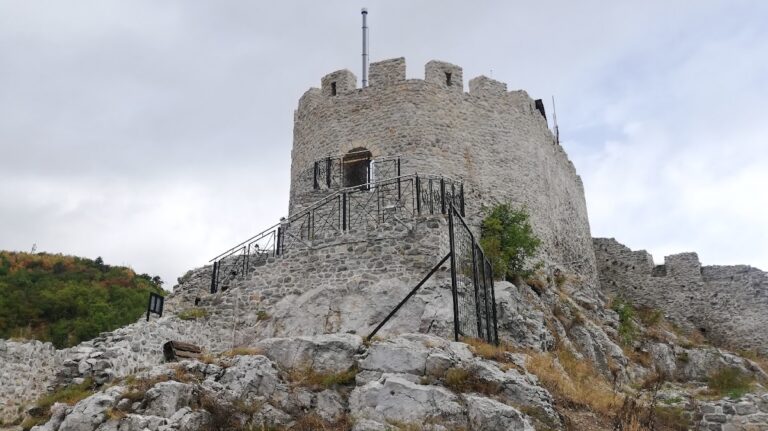
Dobrun Monastery is a medieval Serbian Orthodox monastery in Bosnia and Herzegovina, near Višegrad on the Rzav River. It belongs to the Dabar-Bosna Metropolitanate, the regional ecclesiastical jurisdiction of the Serbian Orthodox Church, and is regarded as one of the oldest monasteries in present-day Bosnia and Herzegovina. The monastery stands beside the remains of a medieval fortified town that shared its name.
Foundation and Fourteenth-Century Patronage
The monastery’s foundation date remains uncertain. One tradition, associated with Metropolitan Sava Kosanović, places it in the ninth century. Other interpretations connect its origins with 1219, when the Serbian Orthodox Church gained independence, or with the reign of Emperor Stefan Dušan. The latter tradition identifies Župan Pribil, a high-ranking territorial lord, as the founder and places the construction between 1340 and 1343, beside his administrative court within the fortress.
Dobrun developed as an aristocratic foundation during the period associated with Stefan Dušan’s rule. Pribil’s sons Stefan and Petar inherited his position after their father entered monastic life under the name Varnava. Petar later became a monk named Jovan. The medieval foundation narrative describes the church as dedicated to the Annunciation, while its formal name and later references identify it with the Dormition of the Most Holy Mother of God.
Petar enlarged the monastery with an outer narthex, an entrance vestibule at the western end of an Orthodox church, and a treasury on the north side. Both spaces were frescoed in 1383. During his tenure, the monastery reportedly housed about 720 monks. The influence of the Bosnian noble families Radinović and Pavlović, based in Višegrad, was connected with Petar’s withdrawal from his administrative position and his entry into monastic life.
Ottoman Rule and Repeated Rebuilding
Dobrun came under Ottoman rule in 1462. A preserved local legend attributes the conquest to a stratagem in which attackers ambushed a wedding party returning from Prijepolje and then entered the town disguised as members of the party. The fortified settlement was destroyed and the monastery was damaged. Younger monks withdrew to remote hermitages, while older monks remained at Dobrun. After their deaths, the church was opened only on major feast days, and the monastery eventually fell into ruin and was abandoned.
The monastery had a scriptorium, where books were copied, and one monk associated with Dobrun was known by the epithet “Dobrunlija.” Monks restored the institution during the sixteenth century after establishing a dependency at Vagan. Ottoman forces destroyed it again at the end of the seventeenth century, prompting another dispersal to the old hermitages.
Local inhabitants rebuilt the monastery at the end of the eighteenth century, although no resident monastic community was established at that time. Religious services were held at Christmas, Easter, and Pentecost. During the 1875 uprising in Bosnia and Herzegovina, Ottoman punitive measures destroyed Dobrun along with many other religious foundations.
Modern Reconstruction and Monastic Renewal
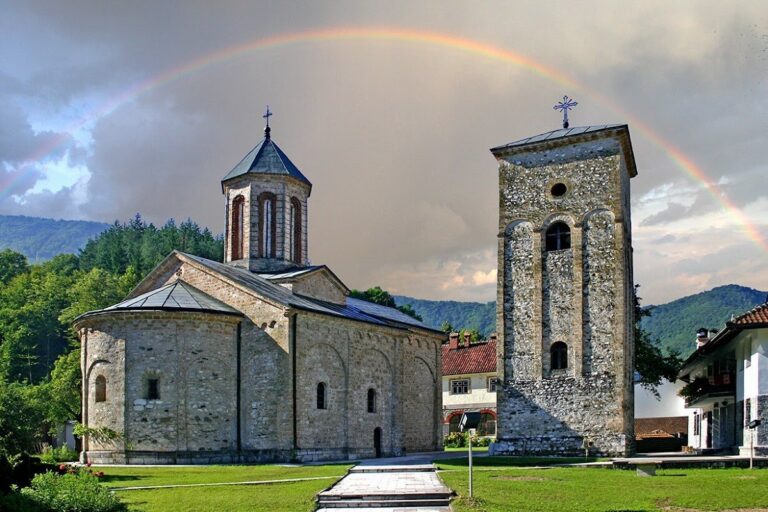
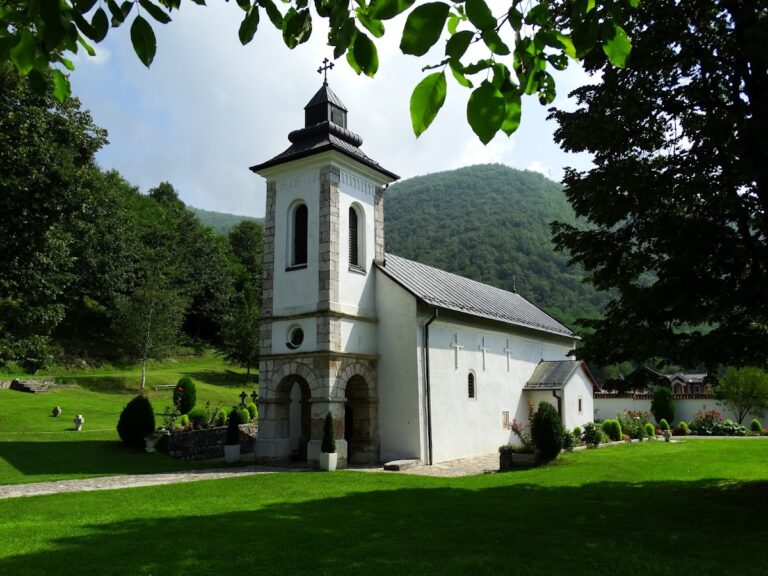
After the Austro-Hungarian occupation of Bosnia and Herzegovina in 1878, Dobrun was rebuilt in 1884 through the efforts of Metropolitan Sava Kosanović, local inhabitants, and Baroness Wilhelmina Nikolić. This intervention substantially changed the historic complex rather than simply restoring its earlier form. The outer narthex was demolished, the masonry iconostasis, the screen separating the sanctuary from the nave, was removed, and a bell tower was added. The façades received shallow vertical strips and rows of small arcades.
The monastery suffered further damage during the First World War, and restoration began in 1921. During this work, the founder’s inscription above the narthex entrance was painted over, while older frescoes in the vaulted porch were covered by a newer painted layer.
During the Second World War, German forces used the church to store mines. Explosions in January 1945 destroyed the monastery almost completely, leaving the narthex and bell tower. Local inhabitants rebuilt the church within a year, and it was consecrated on the Sunday after Mitrovdan in 1946.
Monks returned to Dobrun in 1994 by decision of Metropolitan Nikolaj of Dabar-Bosna, after approximately 250 years without a resident monastic community. The complex was placed on the Provisional List of National Monuments of Bosnia and Herzegovina. In 2004, new buildings and commemorative features were added during events marking the bicentenary of the First Serbian Uprising. Dobrun also houses the Dabar publishing house, which issues a journal dedicated to the Dabar-Bosna Metropolitanate and has published approximately fifty other spiritual titles.
Remains
The Church and Medieval Paintings
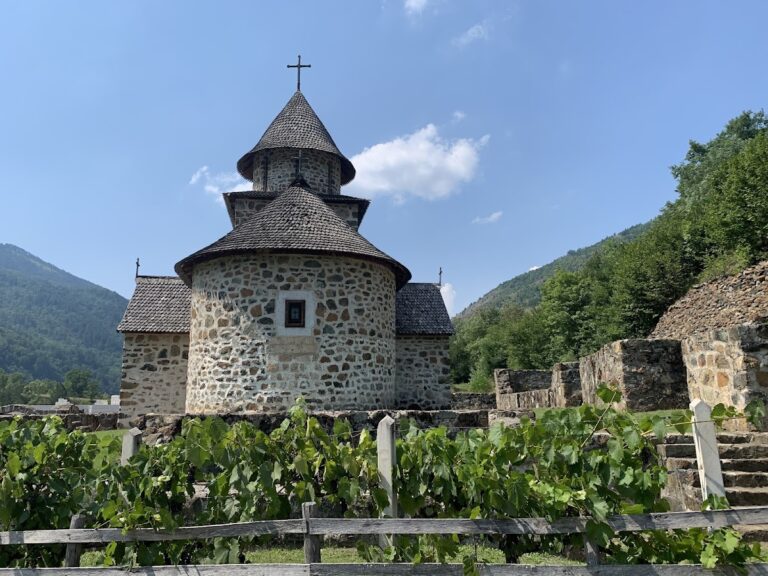
The original church was a modest, single-nave basilica with a vaulted roof and no dome. Built from stone and tufa, it was painted by accomplished fresco painters from southern Serbia. The surviving medieval paintings are concentrated in the narthex, while archaeological work beneath the church has revealed further fragments connected with the earlier decoration.
Frescoes of the Founders and Rulers
The narthex frescoes are arranged in several horizontal zones. The upper zone represents Ecumenical Councils, while the zone below contains medallions with busts of holy hierarchs. Among them is Saint Peter of Koriša, whose image is regarded as his oldest known representation. The lower zone includes founders, members of the ruling family, holy women, monks, and hierarchs.
In the founder’s composition, Župan Pribil holds a model of the church. His sons Stefan and Petar follow him, together with the protovestiarios Stan, a high court official from the aristocratic founding family. Pribil presents his offering to a standing figure of the Mother of God holding Christ. On the opposite side were portraits of Emperor Stefan Dušan, his wife Jelena, and their son Uroš, shown beneath Christ’s blessing. The surviving paintings of Dušan, Jelena, and Uroš, together with those of Pribil and his family, are fragmentary but artistically important examples of fourteenth-century Serbian painting and the mature Palaiologan Renaissance, a late Byzantine style known for refined compositions and expressive religious imagery.
Later Alterations and Archaeological Finds
Petar’s outer narthex and north-side treasury were added to the first church and painted in 1383. The 1884 reconstruction changed this arrangement, and the two medieval additions were not rebuilt. The First World War and the 1921 restoration further altered the surviving painted surfaces. The 1945 explosion then destroyed the church and most of the complex down to its foundations. The present church follows the postwar reconstruction that was consecrated in 1946.
Excavations beneath the church have yielded medieval fresco fragments, ceramics, Austro-Hungarian metal coins, human remains, and a complete grave. More than two square metres of additional painted plaster were found, probably buried by the 1945 explosion. The grave and human remains suggest that church dignitaries and founders may have been buried at the site, although the individual in the complete grave has not been identified.
Hermitage and Twentieth-First-Century Additions
Hermit Cave
A cave in the rock face above the monastery preserves evidence of the hermit tradition associated with Dobrun. Its entrance was formerly enclosed with tufa. Hermits used the cave as a retreat and descended to the monastery only during major religious festivals.
Karađorđe’s Konak
Karađorđe’s Konak is a multi-storey building added to the complex in 2004. A konak is a traditional residence or lodging building associated with an administrative or elite household. The first floor contains the Museum of the First Serbian Uprising, led by Karađorđe against Ottoman rule from 1804 to 1813. The second floor houses the museum of the Dabar-Bosna metropolitans and includes a small chapel dedicated to Saint Andrew the First-Called, identified as the patron saint of the Karađorđević royal family.
Monument and Bridge
A monument to Karađorđe was erected in 2004 on the rock above the monastery, beside a large white cross. The complex also includes a pedestrian bridge crossing the Rzav, built in the same year.
Nearby sites