Uspienski Monastery in Orša: An Orthodox Women’s Monastic Community
Site at a Glance
- Rating
- 4.5
- Popularity
- Medium
- Country
- Belarus
- Primary era
- Modern
- Eras represented
- Modern
- Civilizations
- Russian
- Site type
- Religious
- Remains
- Monastery
On this page12 sections
History
The Uspienski Monastery in Orša, Belarus, was founded in 1631 on the city’s southwestern outskirts as an Orthodox women’s community. It was also called the Kuteino Dormition Monastery, referring to the Dormition, the Eastern Christian feast commemorating Mary’s death and assumption into heaven.
Foundation and early community
Princess Anna Oginskaya and her son Bogdan Statkevich were associated with the monastery’s foundation. Anna endowed the community with part of her estates, including the village of Svistelki. The monastery was sometimes called the Svistelskaya Monastery after that village.
The community belonged to a group of Orthodox monasteries under the Trinity Monastery at Slutsk, and remained under the jurisdiction of the Kiev diocese until 1773. In 1658, nuns from Kuteino were transferred to the newly opened Resurrection Monastery in Smolensk. Some may also have been among the first residents of Moscow’s Novodevichy Monastery, a historic Orthodox convent.
Pilgrimage and formal status
The monastery housed the Kazan icon of the Mother of God, a venerated Orthodox image of Mary named for the city of Kazan. People credited the icon with miraculous healings. On its feast day, July 8 in the Old Style calendar, as many as 8,000 pilgrims came from different provinces. Catholic monks repeatedly tried to steal the icon.
In 1842, the monastery received first-class status, a formal rank in the Orthodox monastic administrative system.
Closure and renewal
The monastery closed in the 1920s. Under Soviet rule, its church served as a warehouse and smokehouse, while the Dormition Cathedral reopened for worship during the Second World War. The old monastic complex was destroyed in the 1950s.
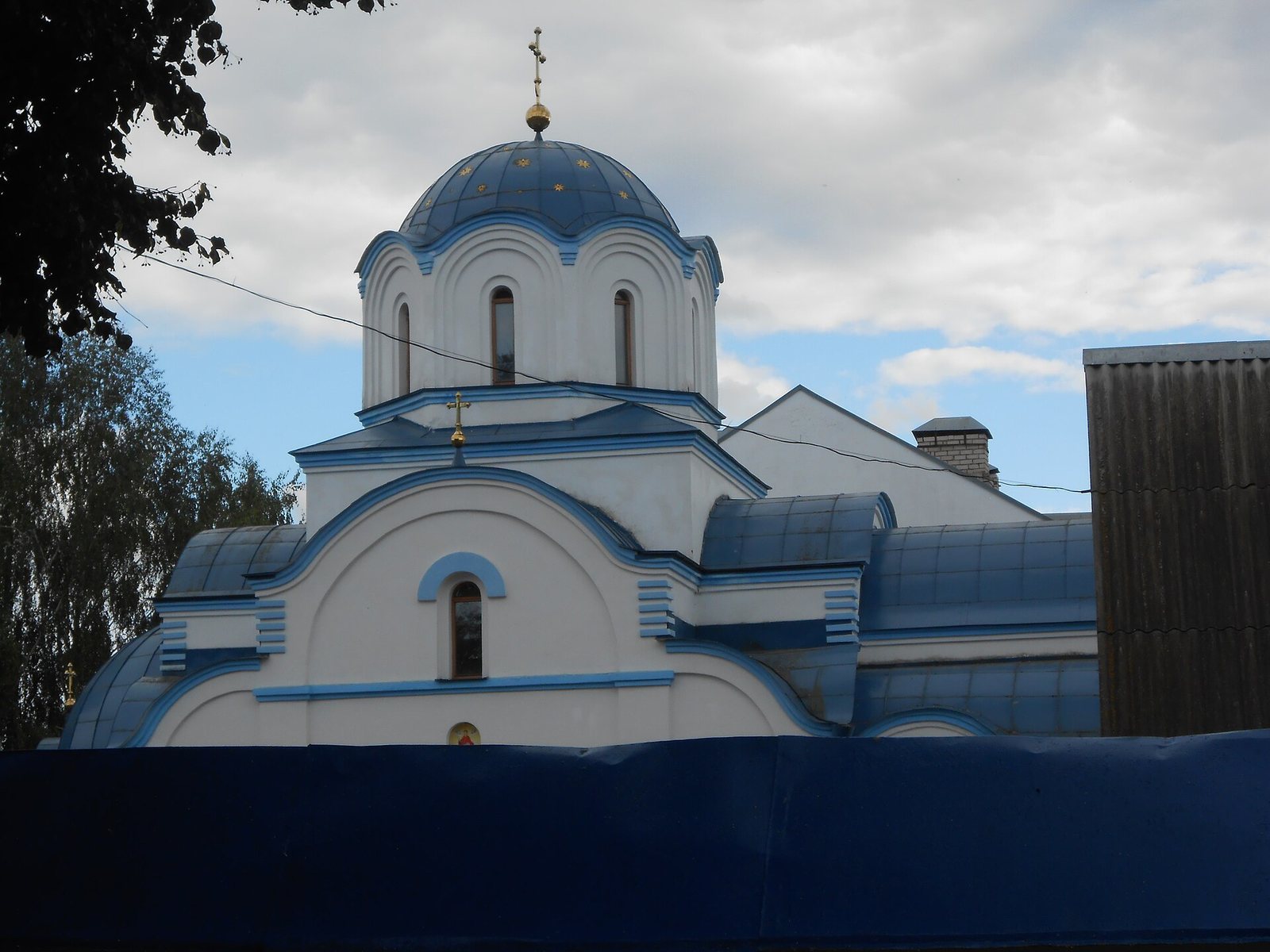
After the closure, the nuns continued their monastic duties at St Elijah’s Church. The community resumed activity in 1996 at a new location beside the church. It is an Orthodox women’s community under the Belarusian Exarchate, a regional church structure within the Russian Orthodox Church, and the Vitebsk and Orsha diocese.
Remains
The historic precinct combined churches with residential and service buildings, using both wood and masonry. The renewed monastery occupies a different site and includes a church and buildings for the sisters.
Historic monastic precinct
Early buildings
The original complex included several wooden churches, residential and service buildings, and a two-tier gate-belfry with a stone lower level. Its principal wooden cathedral burned in 1635.
Stone Dormition Cathedral
Built in 1655 in the Baroque style, the stone Dormition Cathedral had three apses, or semicircular sanctuary ends, and a plan arranged around a central crossing. The main worship space and its crosswise arms had intersecting gabled roofs with triangular end gables. An eight-sided, windowless drum at the crossing supported a large pear-shaped dome topped by a cupola.
Moulded cornices and shallow corner pilasters, or vertical projections from the walls, decorated the exterior. Tall windows ended in semicircular arches. The gables featured cupolas and three flat-arched niches. The cathedral’s design is associated with the Mogilev school, a regional church-building tradition linked to the city of Mogilev in present-day Belarus.
Church of the Nativity of the Mother of God
This brick church was built in 1691 and stood for more than two centuries. The former monastery grounds are now occupied by multi-storey housing and Secondary School No. 20.
Renewed monastery at St Elijah’s Church
St Elijah’s Church
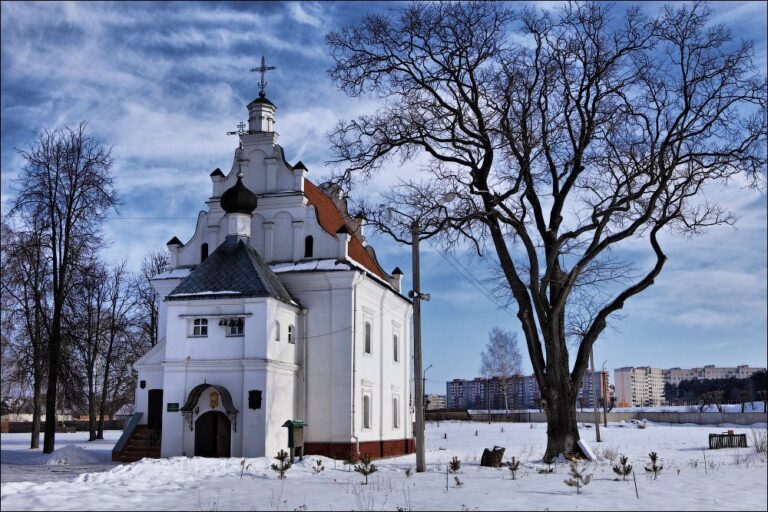
St Elijah’s Church was built in 1880 on the site of a wooden church from the early sixteenth century that had burned down. It is dedicated to Elijah, the biblical prophet revered as a saint in Orthodox Christianity.
New monastic buildings
The renewed monastery includes the repaired St Elijah’s Church, a two-storey residence for the sisters, and a new Dormition Church. The new church was completed and consecrated in 2006.