Kopys Castle: A Military-Administrative Fortress in Belarus


Site at a Glance
- Rating
- 4.7
- Popularity
- Low
- Country
- Belarus
- Primary era
- Medieval
- Eras represented
- Medieval
- Civilizations
- Kievan Rus
- Site type
- Military
- Remains
- Castle
On this page15 sections
History
Kopys Castle is a medieval fortress in Belarus that served as the military-administrative center of the ancient town of Kopys from the fourteenth to the eighteenth century. Its earliest fortification phase dates to the second half of the eleventh or the beginning of the twelfth century, when an earlier unfortified settlement was enclosed by an earthen rampart. Positioned at the meeting point of important land and water routes, the town and castle repeatedly became involved in military operations and were burned or destroyed several times.
Early Fortification and Local Defense
The first rampart was built on an elevated settlement beside the Dnieper. It was later widened and raised, creating the defensive core that continued to shape the site through subsequent centuries. During the castle’s later medieval and early modern existence, defense depended on the organized service of the local population. Townspeople, peasants, nobles, and armed boyars were required to appear when Kopys was threatened. In peacetime, they performed guard duty and helped maintain the fortifications.
Boyars generally held plots of about five dessiatines and had defined military and labor obligations. Each was expected to provide a horseman equipped in the manner of a Cossack, serve a week of guard duty when summoned, and send workers to repair the defenses. The townspeople and inhabitants of nearby districts also contributed to rebuilding. Residents of the recently founded town of Baran were among those required to assist with this work.
Artillery and the Radziwill Administration
The castle’s defenses included a locally organized artillery system. In 1597, Prince Nikolai Radziwill ordered the establishment of a foundry at Baran to manufacture cannonballs and ammunition for cannons and hackbuts. A hackbut was an early firearm usually fired from a support or rest. The following year, fourteen ammunition makers from Baran were required to supply Kopys Castle each year with large iron balls and hackbut ammunition.
A privilege issued in 1599 to the gunner Semyon Ivanovich assigned him six voloks of land in the village of Zaviryukha. A volok was a historical land-measurement unit used in the lands of the former Polish–Lithuanian Commonwealth, with an area that varied by time and place. In return, Ivanovich had to serve as the castle’s gunner, maintain and direct its artillery, provide the iron needed for artillery work, and deliver set annual quantities of lead and gunpowder.
War with Russia and Reconstruction
By the beginning of the war between Russia and the Polish–Lithuanian Commonwealth in 1654, the fortifications had not been restored. The Commonwealth was the political federation that governed much of the region before the late-eighteenth-century partitions. On 13 May 1654, the local population surrendered the poorly fortified town to the army of Voivode Zamyatnya Leontiev after monks and priests of Kuteysky Monastery encouraged them to do so. A monastery was a religious institution and residence for a community of monks.
In September 1661, Baron Augustin von Meyerberg described Kopys as a town defended by a wooden castle on a high hill. Major reconstruction of the fortifications and the mill dam began in 1668, with additional work undertaken in 1670 and 1688. The rebuilt defenses altered the water system around the castle and brought the entrance, drawbridge, and mill into a more integrated defensive arrangement.
Destruction and Decline
An inventory from 1684 described the fortifications as severely damaged, despite the repair campaigns. During the Great Northern War, a major European conflict fought from 1700 to 1721 involving Sweden, Russia, and other states, Russian troops completely burned Kopys, including its castle defenses, in 1707. They also removed the weapons from the castle arsenal. Later repair and military-construction work is recorded, although the extent of rebuilding after the fire remains uncertain.
In 1713, famine and poor-quality bread prevented peasants from the Kopys district from completing the military work required of them. The moat had filled with sand and was difficult to clear. Russian wartime works included a palisade on the earthen rampart, with timber supplied by inhabitants of several surrounding districts. A palisade was a defensive barrier made from upright wooden stakes or logs.
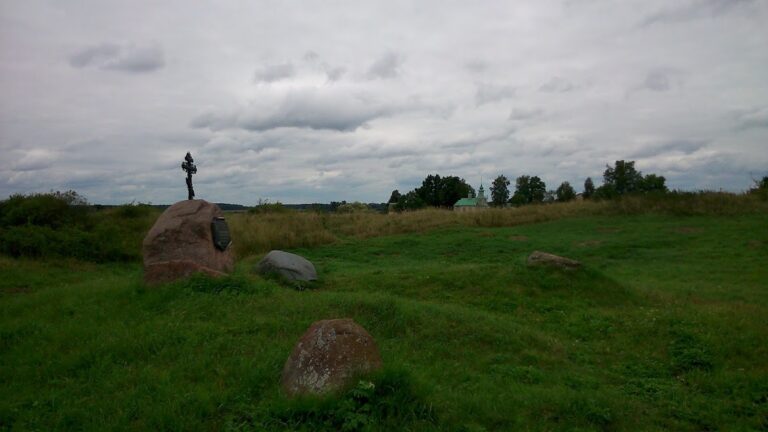
After 1772, the fortifications were no longer rebuilt and gradually disappeared. The site was investigated archaeologically in 1972 by E. Zagorulskii. Kopys Castle is now preserved as a hillfort, an archaeological remnant of the fortified settlement rather than a standing castle.
Remains
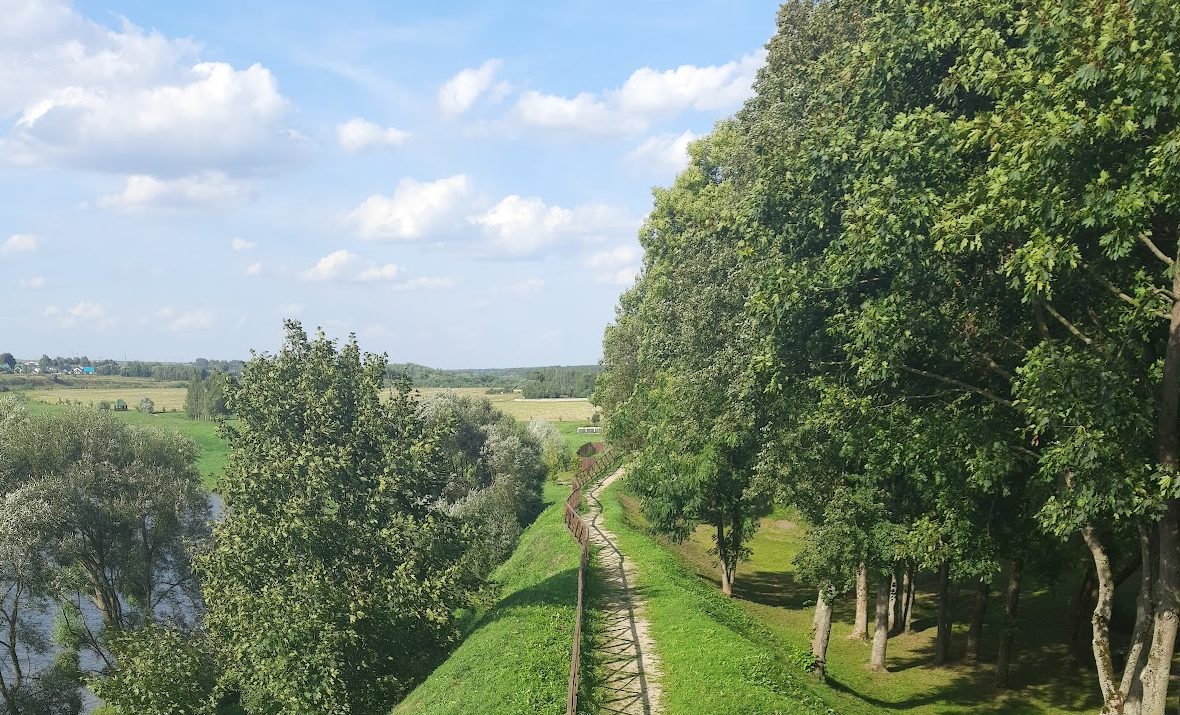
Kopys Castle occupies an elevated position on the left bank of the Dnieper, at the site of the ancient fortified settlement. The roughly circular settlement covered about 0.5 hectares and had its entrance on the eastern side. Its surviving form is an archaeological hillfort, with the castle buildings themselves represented by historical descriptions and archaeological evidence rather than standing structures.
Ramparts and Water Defenses
Earthen Rampart
The earliest defensive earthwork was made from fine sand laid in layers with humus. This construction reflects the earlier settlement beneath the fortification. The initial rampart, built in the second half of the eleventh or the beginning of the twelfth century, stood about 5 metres high. It was later widened and raised by a further 2 metres. The rampart had a perimeter of about 370 metres and enclosed an inner area measuring approximately 80 by 60 metres.
Rivers, Dam, and Moat
In the sixteenth to eighteenth centuries, the small Strashavka and Smorkivka rivers shaped the castle’s defenses as they flowed around two sides of the site before entering the Dnieper. A dam blocked the mouth of the Smorkivka, while the waters of both rivers, supplemented by a mill dam, formed an artificial reservoir. The mill helped protect approaches from the south, east, and northeast.
Access led along the mill dam to a drawbridge in front of the castle gate. In 1668, water was directed around the castle to create a moat. A spring flood, particularly from the Strashavka, damaged the mill’s outlet and caused it to be moved to another location. These changes made the surrounding waterways part of the castle’s defensive arrangement.
Gates and Wooden Fortifications
Early Gates and Defensive Buildings
The 1651 inventory described two gates with large entrance openings. It also recorded steep, leaning, tower-like structures above the Dnieper that required repair. A large two-storey building, decorated with painted designs and surrounded by an upper fighting gallery, played an important part in the castle’s defense. An upper fighting gallery was a covered or elevated passage from which defenders could fire over or along the fortifications. The buildings were enclosed by a palisade.
Gate Tower
After the reconstruction of 1668, the entrance was reduced to one gate preceded by a drawbridge and the water mill. Inventories from 1726 to 1773 recorded four bastions and wooden walls or palisades that were regularly repaired. A bastion is a projecting fortification that allowed defenders to fire along the faces of surrounding walls.
The gate was formed by a wooden tower with double doors and powerful locks. Its second storey contained a four-windowed hall surrounded by a circular upper fighting gallery. The hall served both for storing small firearms and for religious purposes, including the celebration of Mass. The tower had a shingle roof and carried a tin weathervane shaped like an eagle.
Arsenal and Courtyard
Weapons and Ammunition
In the late seventeenth century, the castle held four cannons, twenty-two iron hackbuts, and four muskets. Its stores included gunpowder, lead, cannonballs, bullets, and fuses. The arsenal also contained a crimson-silk banner belonging to Prince Boguslaw Radziwill. The 1684 inventory listed three serviceable field cannons, seventeen long hackbuts, five short hackbuts, cannonballs, gunpowder, lead, fuses, and various cartridges.
Well and Central Courtyard
A well stood in the middle of the castle courtyard. It was fitted with a lifting wheel and an iron bucket, providing a fixed water source within the enclosed defensive area.