Ulugh Beg Astronomical Institute: Uzbekistan’s Center for Astronomical Research
Site at a Glance
- Rating
- 4.4
- Popularity
- Very Low
- Country
- Uzbekistan
- Primary era
- Modern
- External website
- Open
- Eras represented
- Modern
- Civilizations
- Russian
- Site type
- Civic
On this page15 sections
History
The Ulugh Beg Astronomical Institute is an astronomical research institution in Tashkent, Uzbekistan, established in 1873 as the Tashkent Astronomical Observatory. Created at the request of the Military Topographic Department of the Turkestan Military District, it was initially subordinate to that department and supported the mapping of Central Asia.
Surveying and early astronomy
The observatory’s first task was to conduct field astronomical observations for geographical and military surveys. Military surveyors and astronomers, including Illiodor Pomerantsev, Pyotr Zalessky, and Dmitry Gedeonov, determined the high-precision coordinates of many hundreds of points. Numerous expeditions connected these points to the observatory’s coordinate system, giving the institution an important role in the systematic surveying of the region.
The observatory was equipped in 1874 with a six-inch refracting telescope, an instrument that uses lenses to collect and focus light, together with a Hohwu clock. Its work gradually expanded beyond applied surveying. In 1895, the astrophysicist Vsevolod Stratonov came from the Pulkovo Observatory and became the institution’s first civilian astronomer. That year, a 13-inch telescope was installed for photographic observations of nebulae in the Milky Way and of minor planets.
Expansion into astrophysics and geodesy
During 1898 and 1899, the observatory broadened its astrophysical program to include solar activity, stellar astronomy, comets, and meteors. An astrophysical laboratory building was constructed on the observatory property during the same period. The institution also pursued geodesy, the measurement and representation of the Earth. Between 1901 and 1911, its staff determined 145 gravimetric points, surveyed locations used to measure the Earth’s gravitational field, and published a study of the geoid in the Fergana Valley. The geoid is a mathematical model of mean sea level extended beneath the continents. This work became a foundation for gravimetry in the Soviet Union.
In 1928, the observatory began regularly transmitting data for regional geodetic and topographic research. The Kitab International Latitude Station, an astronomical facility that repeatedly observes stellar positions to monitor changes in the Earth’s latitude and orientation, began regular observations under the observatory’s administration in 1930. A solar-research laboratory followed in 1932.
Institute status and affiliated observatories
In 1966, the observatory received the status of an academic research institute and became the Astronomical Institute of the Academy of Sciences of the Uzbek Soviet Socialist Republic. The Maydanak High-Altitude Observatory was established under its administration in 1970. Located 40 kilometers south of Kitab at an elevation of 2,800 meters, Maydanak extended the institute’s observing work into a high-altitude environment.
During the 1980s, as part of SoProG, a Soviet program for coordinated observations of Halley’s Comet, Uzbek astronomers obtained 540 precise positions of the comet. This was the largest number recorded among the 104 observatories participating worldwide. The institute later developed further solar research. In 1989, an instrument from the IRIS network was installed on Mount Kumbel, about 70 kilometers northeast of Tashkent and 2,300 meters above sea level, beginning full-disk observations of global solar oscillations.
Modern solar research and institutional identity
In 1996, a TON ground-based helioseismology instrument was installed in Tashkent. Helioseismology examines the Sun’s internal structure through oscillations observed at its surface. Measurements of local solar oscillations in the K Ca spectral line, a feature associated with calcium in the Sun’s atmosphere, began as part of this work.
The institute is part of the Academy of Sciences of Uzbekistan and bears the name of Ulugh Beg, the fifteenth-century Timurid ruler and astronomer who established an observatory in Samarkand. Its predecessor was the Tashkent Astronomical Observatory. The institute’s departments now include solar physics, galactic astronomy and cosmogony, astrophysical research, and geodynamics, alongside an astroclimate-research group and the Maydanak High-Altitude Observatory.
Its recorded heads included Illiodor Pomerantsev from 1880 to 1890, Dmitry Gedeonov from 1890 to 1900, Stepan Kozlovsky from 1900 to 1904, Mikhail Osipov from 1904 to 1908, Anton Davydov from 1908 to 1911, and Andrei Auzans from 1911 to 1917. Yakov Gultyayev led the observatory from 1918 to 1923, Pyotr Yashnov from 1923 to 1925, and Mikhail Subbotin from 1922 to 1930. Vladimir Shcheglov held leadership from 1941 to 1966 and again from 1966 to 1983. Taimas Yuldashbayev directed the institute from 1983 to 1995, followed by Shukhrat Abdumannapovich Egamberdiev from 1995 onward.
The institution also preserved a substantial scholarly library. In 1958, it contained 30,000 volumes of specialist and reference literature. Its oldest recorded book was T. Hevelii’s Prodromus Astronomiae, published in Gdansk in 1690. An astronomy museum opened at the Tashkent institute in December 2009, continuing the presentation of the observatory’s scientific history.
Remains
The surviving institute complex in Tashkent combines the main institutional building and its grounds with instruments and associated observing facilities. The physical remains include early telescopes, later research equipment, a museum on the first floor, a wall-mounted sundial, and an alley within the institute grounds. Other observing stations connected with the institute occupy separate locations near Kitab and on the mountains around Tashkent.
Tashkent observatory buildings and displays
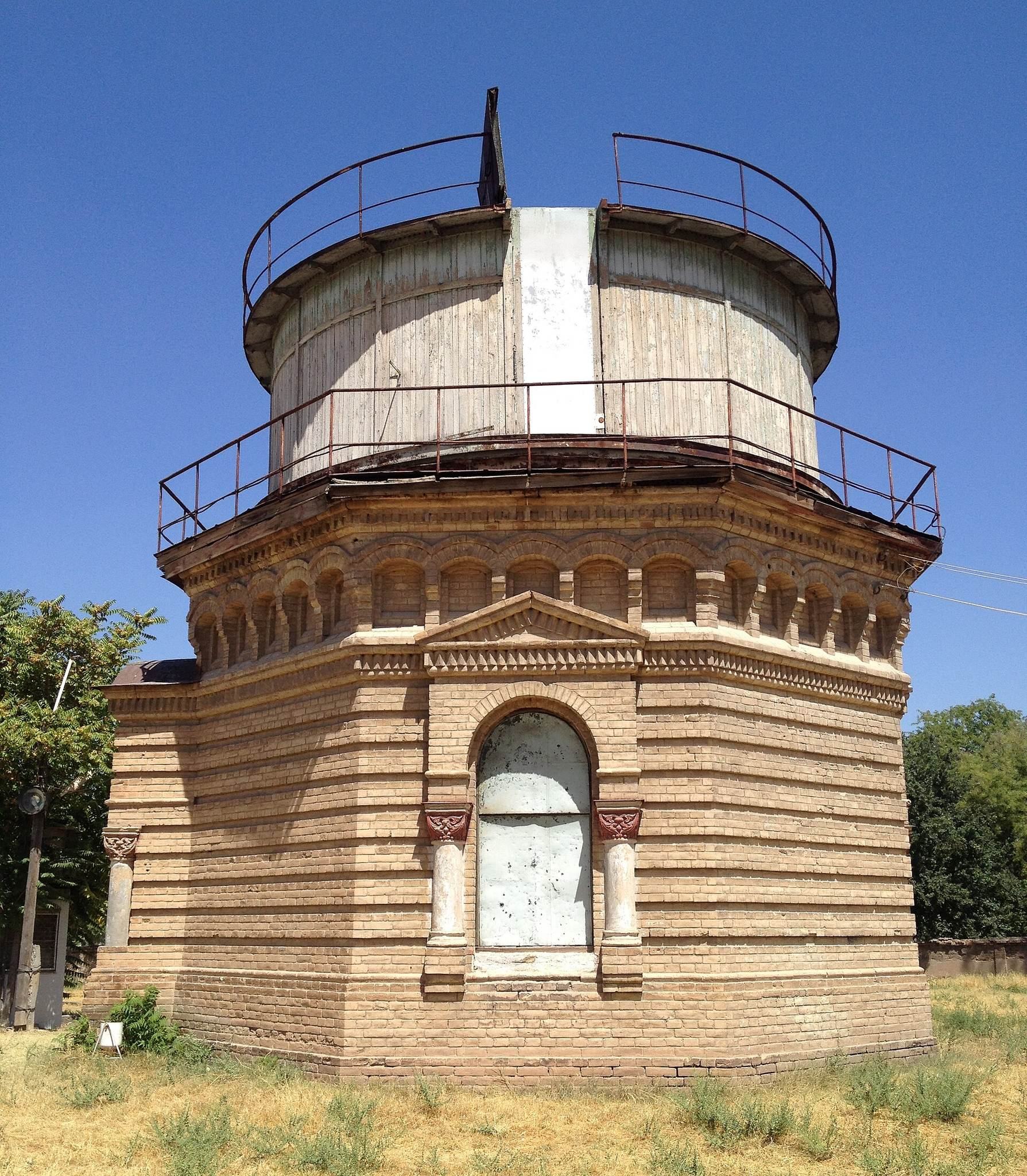
Astrophysical laboratory
The astrophysical laboratory building was constructed on the observatory property during 1898 and 1899, when the institution expanded its work into solar activity, stellar astronomy, comets, and meteors. It forms part of the Tashkent observatory’s surviving architectural and research history.
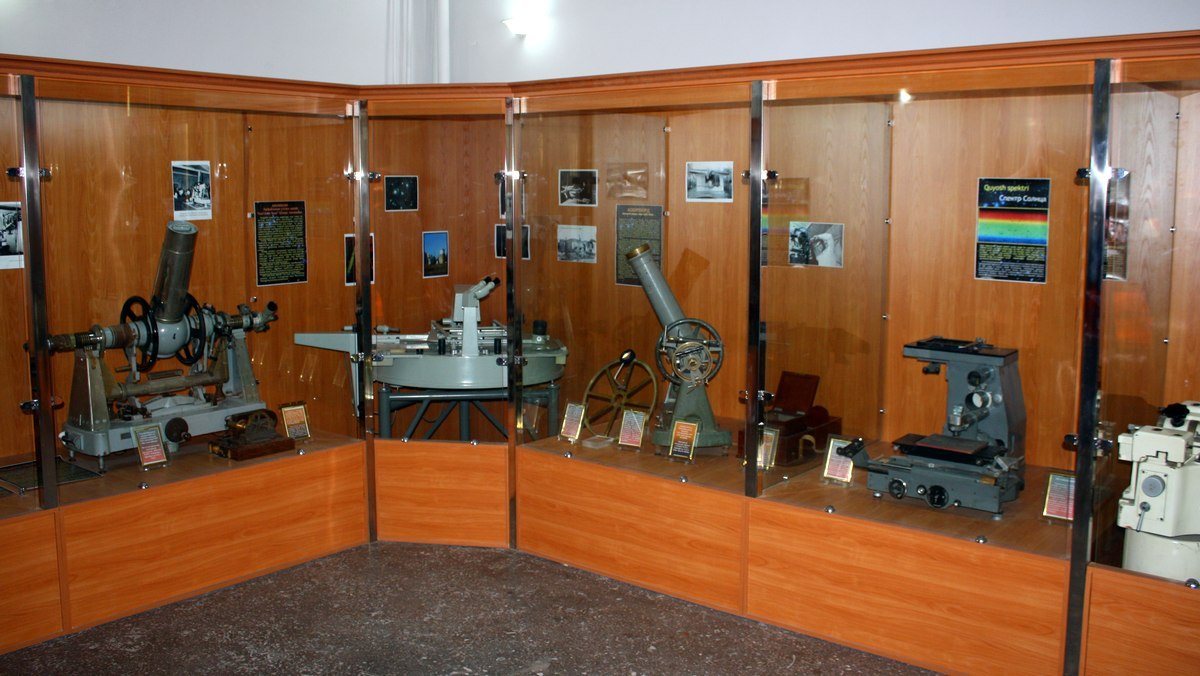
Astronomy museum
The astronomy museum, opened in December 2009, occupies space on the first floor of the institute building. Telescopes formerly used at the Tashkent Observatory are displayed in the museum area, linking the current institute to the equipment used during its earlier observational programs.
Sundial and grounds
A sundial is installed on the wall of the institute building, while an alley occupies part of the grounds. Together, these features form visible elements of the present Tashkent complex.
Associated observing facilities
Kitab International Latitude Station
The Kitab International Latitude Station lies near Kitab and has conducted regular observations under the observatory since 1930. Its repeated observations of stellar positions served measurements of changes in the Earth’s latitude and orientation.
Maydanak High-Altitude Observatory
The Maydanak High-Altitude Observatory stands 40 kilometers south of Kitab at an elevation of 2,800 meters. Established under the institute in 1970, it is one of the institution’s associated observing facilities.
Mount Kumbel solar instrument
An IRIS network instrument was installed on Mount Kumbel, approximately 70 kilometers northeast of Tashkent, at an elevation of 2,300 meters. From 1989, it supported full-disk observations of global solar oscillations.
TON helioseismology instrument
A TON ground-based instrument was installed in Tashkent in 1996 for measurements of local solar oscillations in the K Ca spectral line. These observations formed part of the institute’s work on the internal structure of the Sun.