Uffizi Gallery: A Medici Palace and Public Art Museum in Florence


Site at a Glance
- Rating
- 4.7
- Popularity
- Very High
- Country
- Italy
- Primary era
- Early Modern
- External website
- Open
- Eras represented
- Medieval, Early Modern, Modern
- Civilizations
- Grand Duchy of Tuscany, Italian
- Site type
- Civic
- Remains
- Palace
On this page30 sections
History
The Uffizi Gallery is a museum in Florence, Italy, established in 1560 as a Renaissance administrative palace for the Medici state. Duke Cosimo I de’ Medici ordered one building for thirteen Florentine magistracies previously scattered across the city. The project centralized government and expressed the political and military power Florence had acquired after conquering Siena. Its name comes from the Italian word for offices.
Creation of the Medici offices
Giorgio Vasari designed the building on land between Piazza della Signoria and the Arno. The area was densely inhabited and included Florence’s river port, so the project transformed a busy urban district as well as creating new administrative space. The design incorporated the Romanesque church of San Pier Scheraggio and the old Florentine mint, known as the Zecca Vecchia.
The building was intended to accommodate the magistracies responsible for the Medici government’s many activities. These included territorial administration, commerce, finance, silk manufacture, medicine, manufacturing, trade, public morality, taxation, food supply, guardianship, law, and military bands. The Uffizi therefore began as a working center of government rather than as a museum.
Construction started under Cosimo I and continued after his death under his son, Francesco I de’ Medici. Vasari directed the initial work with the assistance of Dionigi della Neghittosa. After Vasari died in 1574, Bernardo Buontalenti and Alfonso Parigi the Elder completed the complex. The building was finished around 1580, although some parts were already occupied by 1572.
The Medici court and the first gallery
In 1565, to mark the marriage of Francesco de’ Medici and Joanna of Austria, Cosimo I commissioned Vasari to create a private elevated passage between Palazzo Vecchio and Palazzo Pitti. Built in about six months, the passage crossed the Uffizi, Ponte Vecchio, the Arno, and the Oltrarno district before reaching the Boboli Gardens and Palazzo Pitti. A later connection extended toward Forte Belvedere. Reserved originally for the Medici court, it allowed secure movement through Florence without using the streets.
In 1581 Francesco I transformed the upper-floor loggia into a private gallery. It held paintings, ancient and modern sculpture, cameos, medals, precious stones, goldsmiths’ work, bronzes, arms and armor, miniatures, scientific instruments, natural curiosities, and portraits. Visitors could enter by request, and a formal decree in 1591 established public access by request. This transformation made the Uffizi one of Europe’s earliest museums.
Francesco I commissioned Buontalenti to build the Tribuna in 1584. This octagonal room provided a central setting for the Medici’s archaeological and luxury collections. The complex also gained the Medici Theatre in 1586 and a hanging garden in 1583, when a terrace above the Loggia dei Lanzi was converted for that purpose.
Expansion under the later Medici
Under Ferdinando I de’ Medici, the collections expanded further. The Gioviana Series of portraits entered the Uffizi in 1587, and a terrace was enclosed to create the Map Room. In 1588, the grand-ducal workshops moved into the complex. They included the Opificio delle Pietre Dure and workshops for goldsmiths, jewellers, miniaturists, porcelain makers, sculptors, painters, and gardeners.
Seven rooms were devoted to arms and armor. Other rooms held precious stones brought as part of Cristina of Lorraine’s dowry, while the Mathematical Room displayed scientific instruments. The Fonderia, or pharmacy, accumulated natural curiosities such as mummies, stuffed animals, ostrich eggs, and rhinoceros horns. These varied holdings reflected a princely collection in which art, science, craftsmanship, and the natural world occupied neighboring rooms.
During the seventeenth century, the Medici continued to enlarge the collections. Vittoria della Rovere brought the extensive inheritance of Urbino to Florence, including works by Titian, Piero della Francesca, Raphael, and Federico Barocci. Cardinal Leopoldo de’ Medici assembled drawings, miniatures, and self-portraits. Cosimo III acquired Flemish paintings, including works by Rubens, as well as Roman sculpture such as the Medici Venus.
The ceilings and vaults were decorated and redecorated several times. Work carried out between 1658 and 1679 under Ferdinando II was destroyed by the fire of 1762. Giuseppe del Moro, Giuliano Traballesi, and Giuseppe Terreni subsequently replaced those decorations. Between 1696 and 1699, Giuseppe Nicola Nasini and Giuseppe Tonelli painted the vaults of the corridor facing the Arno.
From Medici collection to public museum
When the Medici dynasty ended in 1737, Anna Maria Luisa de’ Medici transferred the family collections to the Lorraine dynasty, also called the Habsburg-Lorraine dynasty. The agreement required that the collections remain in Florence and not be alienated. This provision preserved the holdings in the city and shaped the future of the Uffizi.
On 12 August 1762, a fire destroyed part of the eastern corridor and many works stored there. The damaged section was rebuilt and redecorated promptly. In 1769, Grand Duke Peter Leopold of Lorraine officially opened the Uffizi to the public and commissioned a new entrance by Zanobi del Rosso. Giuseppe Pelli Bencivenni directed the gallery, and Luigi Lanzi reorganized it between 1780 and 1782 according to Enlightenment principles, generally grouping one or two artistic categories in each room.
This reorganization changed the character of the institution. The armory was removed, the maiolica collection was sold, and scientific instruments were transferred to La Specola. Ancient sculpture, minor arts, Renaissance sculpture, and Etruscan works were redistributed among other Florentine institutions. The Uffizi increasingly became a museum centered on painting.
Exchanges with the Imperial Gallery of Vienna in 1793 brought works by Titian, Giovanni Bellini, Giorgione, Dürer, and other artists to Florence in exchange for Florentine paintings, including works by Fra Bartolomeo. In 1779, Gaspare Maria Paoletti created the Sala della Niobe for an ancient sculptural group transferred from the Villa Medici in Rome.
During the Napoleonic occupation and the Italian campaign of 1796, selected works were taken to Paris. They included the Medici Venus, Parmigianino’s Madonna of the Long Neck, and Raphael’s Portrait of Pope Leo X. After the Restoration, the works were returned with the assistance of Antonio Canova and the Congress of Vienna.
Nineteenth-century changes
Between 1842 and 1856, twenty-eight statues of distinguished Tuscans from the Middle Ages to the nineteenth century were installed in the exterior niches. During the years when Florence was the capital of Italy, from 1865 to 1871, the Medici Theatre was adapted for use as the Italian Senate chamber.
From 1866, the western short wing housed the Royal Post Office. In 1889, the Medici Theatre was divided into two floors and dismantled. Its former space later contained galleries for early Italian painting and the Cabinet of Drawings and Prints. Renaissance sculptures were transferred to the Bargello, while Etruscan works went to the Archaeological Museum.
In 1900, the Uffizi acquired the picture gallery of the Arcispedale of Santa Maria Nuova, including Hugo van der Goes’s Portinari Triptych. During the early twentieth century, acquisitions and transfers from churches and religious institutions strengthened the holdings of fourteenth- and early fifteenth-century painting.
War, damage, and modern reorganization
During the Second World War, the galleries were emptied and the works were stored in places considered safe. The objects returned in July 1945, and works requisitioned by German forces and taken to the province of Bolzano were recovered.
In 1956, six rooms occupying part of the former Medici Theatre were redesigned by Giovanni Michelucci, Carlo Scarpa, and Ignazio Gardella. The Contini Bonacossi Collection, assembled during the first half of the twentieth century, was acquired in 1969. It was later incorporated into the regular museum route.
On 27 May 1993, a Mafia car-bomb attack in Via dei Georgofili killed five people and damaged parts of the Uffizi and the Vasari Corridor. Works were moved into storage, and the affected areas, especially the western wing and the Sala della Niobe, were restored and secured.
The long-term Great Uffizi project expanded exhibition space after the Florence State Archive moved out of the first floor in 1989. Antonio Natali and, from 2015, Eike Schmidt continued the reorganization of the galleries, including the integration of the Contini Bonacossi Collection into the Blue Rooms. The collections derive principally from Medici holdings and were enlarged through inheritances, exchanges, donations, and the suppression of monasteries and convents in the eighteenth and nineteenth centuries. Today they cover painting from the twelfth to the eighteenth century, ancient sculpture, applied arts, drawings, and prints.
The Uffizi forms part of the Gallerie degli Uffizi museum complex, together with the Vasari Corridor, the collections of Palazzo Pitti, and the Boboli Gardens. A proposed rear entrance in Piazza Castellani, designed by Arata Isozaki and Andrea Maffei, won an international competition in 1998 and received ministerial approval in 2009, but it has not been realized.
Remains
The palace and its exterior
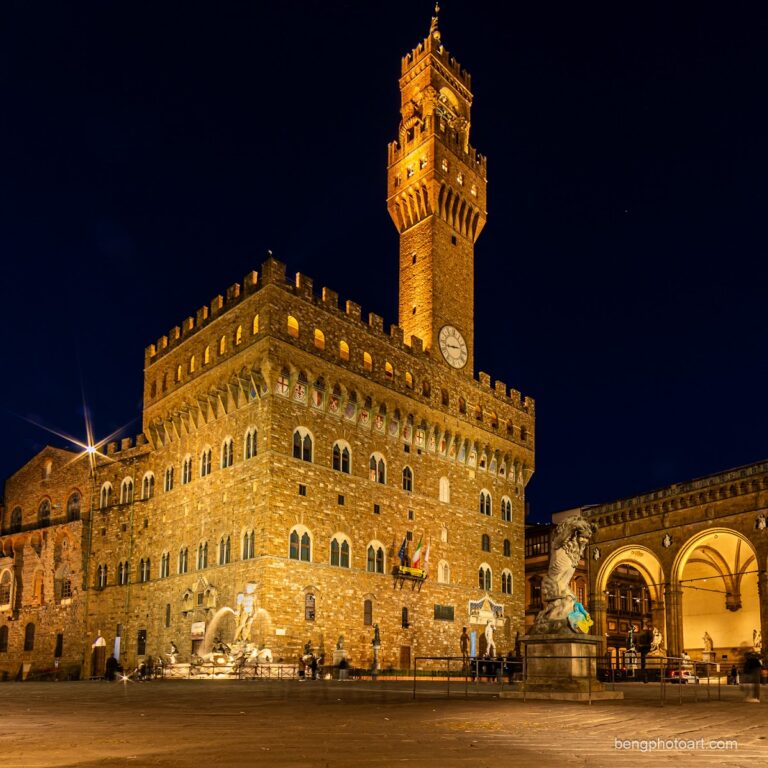
The Uffizi is a three-storey palace between the Arno to the south and Piazza della Signoria to the north. Palazzo Vecchio adjoins its eastern side, while the western side reaches the Loggia dei Lanzi. Two long parallel wings are joined at the southern end by a shorter cross-wing, creating a U-shaped complex around an internal piazza. The open end frames Palazzo Vecchio and its tower toward Piazza della Signoria. The internal street formed by the wings measures about 142 metres in length and about 18 metres in width.
Vasari’s design uses the Doric order and a repeated three-part module. The ground floor has an architraved loggia with barrel vaults, piers containing statue niches, and columns. The upper floors use three-part window arrangements, projecting balconies, alternating triangular and curved pediments, pilasters, and a further upper loggia. The continuous ground-floor portico rises on a low podium and extends along the western and southern sides, as well as the eastern side as far as Via Lambertesca.
The barrel vaults of the portico are decorated with raised rectangular frames joined by geometric bands. The architraved form was an architectural innovation because it relies on an entablature supported by columns and piers rather than the arcaded porticoes more commonly used in medieval and Renaissance buildings. Grey pietra serena, a Florentine sandstone, contrasts with white plaster on the façades, continuing a local architectural tradition associated with Brunelleschi.
The southern cross-wing contains a large Serlian arch, an opening with a broad central arch and two narrower side openings, framing the view toward the Arno. Above it, a loggia opens toward both the internal piazza and the river, creating a theatrical architectural backdrop. The southern front includes Temistocle Guerrazzi’s statue of Giovanni dalle Bande Nere. Above the central first-floor window stand Giambologna’s statue of Cosimo I, dated 1585, and Vincenzo Danti’s reclining personifications of Equity and Rigor, dated 1566.
On Via Lambertesca, Bernardo Buontalenti designed the Porta delle Suppliche. Its broken pediment has two reversed halves that form a distinctive wing-like shape. The former Zecca Vecchia, or Florentine mint, is incorporated into the western wing. Its lower level differs from the rest of the palace because it is enclosed rather than arranged as an open loggia.
Integrated medieval and early modern spaces
San Pier Scheraggio
The former church of San Pier Scheraggio survives as several arches visible from Via della Ninna and as a largely intact nave incorporated into the Uffizi. The room is used for conferences and temporary exhibitions. It has previously held detached frescoes by Andrea del Castagno, Botticelli’s 1481 Annunciation, and other works.
Entrance complex
The late eighteenth-century entrance complex consists of three vestibules created when the monumental staircase was completed. The first contains marble and porphyry busts of the Medici. The rectangular vestibule has a vault decorated with mythological caprices by Giovanni da San Giovanni. The elliptical vestibule contains Roman statues, sarcophagi, and ancient reliefs.
A bust of Peter Leopold surmounts the gallery entrance, which is flanked by two Roman copies of Molossian dogs. The main staircase has 126 grey-stone steps and leads toward the former Medici Theatre and the second floor.
Medici Theatre and former post office
Buontalenti designed the Medici Theatre in 1586 as a large double-height rectangular room, with seating on three sides and a princely box at the center. Its conversion for the Italian Senate and later division into two floors left only the vestibule and parts of the entrance. The former theatre space now contains galleries and the Cabinet of Drawings and Prints.
The section between Via Lambertesca and the Loggia dei Lanzi contains the former Royal Post Office. In 1865 and 1866, Mariano Falcini adapted a carriage courtyard into a large hall with white-and-red marble paving, a pavilion skylight supported by four cast-iron columns, and stucco decoration. It remained a post office until 1917, later served as an experimental restoration laboratory, and was restored to its earlier configuration in 1988.
The corridors and ancient sculpture
The three internal corridors correspond to the three bodies of the palace and extend along their full length. Their ceilings contain frescoes and grotesques, Renaissance decorations combining foliage, animals, human figures, mythological imagery, and fantastic forms. Large windows reveal their original function as covered, open loggias.
Eastern corridor
The eastern corridor has grotesque decorations dating from 1581 by Antonio Tempesta, Alessandro Allori, and their collaborators. It contains the Gioviana Series of portraits of notable people and the Aulic Series of Medici portraits. Together, these series form one of the world’s largest historical portrait collections.
The corridor also contains ancient sculpture, mainly Roman works and Roman copies of Greek originals. Examples include Hercules and the Centaur, integrated by Giovanni Battista Caccini in 1589, the Barbarian King assembled in 1712 from an ancient bust, Pan and Daphnis, the Dancing Satyr, Proserpina, Pothos, a Hercules derived from Lysippos, a bust of Hadrian, two Venuses, and a Hellenistic Apollo.
Arno corridor
The south-facing corridor has frescoes painted between 1696 and 1699 by Giuseppe Nicola Nasini and Giuseppe Tonelli. Its works include a Roman copy of Amor and Psyche, the Hellenistic Dying Alexander, statues derived from Phidias’s seated Venus type, a second-century BC seated girl prepared to dance, a black-marble Mars, a porphyry fragment of a she-wolf, and a Dionysus and satyr with later additions by Caccini.
Western corridor
The western corridor was formerly used for workshops and became a gallery during the second half of the seventeenth century. It contains Roman and Hellenistic sculpture, including two Roman copies of Marsyas, a copy of Myron’s Discobolus, a Mercury derived from Praxiteles, a bust of Caracalla, a Muse, an Apollo with a lyre, the Celestial Venus, a Nereid on a hippocamp, and the realistic Child’s Bust known as the Child Nero.
At the end of the western corridor is a copy of the Laocoön group made by Baccio Bandinelli for Cosimo I at the request of Cardinal Giulio de’ Medici. It is the only entirely modern statue in the corridors and was designed to allow comparison between ancient and modern sculpture.
Specialized Medici rooms
The Tribuna
The Tribuna is an octagonal display room commissioned by Francesco I in 1584 for rare and precious archaeological and artistic objects. Its dome is encrusted with shells and mother-of-pearl, crossed by gilded ribs, and topped by a lantern once fitted with a wind rose. Scarlet velvet covered the walls, the floor had marble inlay, and an octagonal cabinet once stood at the center.
The decoration represents the four elements. The wind rose represents air, the shells water, the red walls fire, and the precious marble floor earth. The furnishings and objects also conveyed the glory of the Medici. The room contains, or historically contained, a pietre dure table dated 1633 to 1649 and ancient sculptures including the Dancing Faun, the Wrestlers, the Knife Grinder, the Scythian, the Apollino, and the Medici Venus, an ancient Greek marble statue dated to the first century BC.
Map Room and Mathematical Room
The Map Room was formed by closing a terrace near the Tribuna. Ludovico Buti and Stefano Bonsignori painted its walls with maps of the old Florentine dominion, the state of Siena, and Elba. Jacopo Zucchi painted mythological scenes on the ceiling. A globe and an armillary sphere once stood in the room, while the sphere is now in the Galileo Museum.
Ferdinando I created the Mathematical Room to house scientific instruments. Its ceiling contains an allegory of Mathematics and scenes celebrating ancient scientific culture. The room now displays modern bronzes and some ancient sculpture.
Sala della Niobe
Gaspare Maria Paoletti built the Sala della Niobe in 1779 for the Niobid Group, Roman copies of Hellenistic originals discovered in Rome in 1583 and transferred from the Villa Medici to Florence in 1781. The room also contains large paintings, including works by Rubens.
Painting galleries and works on paper
The exhibition route is arranged mainly by period and artistic school across two principal floors. It includes an archaeological room, medieval and early Renaissance galleries, the Botticelli rooms, Leonardo’s room, Renaissance rooms, the Blue Rooms for foreign seventeenth- and eighteenth-century painting, the Red Rooms for Florentine Mannerism, the Caravaggio rooms, and rooms for Guido Reni.
Archaeological and medieval galleries
Created in 1921, the archaeological room contains Roman and Greek-related sculpture and reliefs. Its holdings include a relief of a chariot, the Athena Nike frieze, two first-century AD workshop scenes, fragments of Augustan pilasters, reliefs of divine attributes, parts of the Hadrianic frieze, and a sarcophagus showing the Labors of Heracles.
The medieval rooms contain Tuscan paintings from the twelfth to the early fourteenth century. They include Cimabue’s Santa Trinita Maestà, Duccio’s Rucellai Madonna, Giotto’s Ognissanti Maestà and Badia Polyptych, and works by Simone Martini, Lippo Memmi, Ambrogio and Pietro Lorenzetti, Lorenzo Monaco, and Gentile da Fabriano. The rooms were redesigned in 1956 with a timber-truss ceiling modeled on medieval churches.
Botticelli and Leonardo rooms
Rooms 10 to 14 contain the Uffizi’s major group of Botticelli paintings. The works include the Primavera, Birth of Venus, Madonna of the Magnificat, Madonna of the Pomegranate, Pallas and the Centaur, Calumny, and the San Barnaba Altarpiece. Hugo van der Goes’s Portinari Triptych and Rogier van der Weyden’s Entombment are also displayed there.
Leonardo’s room contains the Baptism of Christ, made with Verrocchio and including contributions attributed to the young Leonardo, as well as Leonardo’s Annunciation and unfinished Adoration of the Magi. The surrounding rooms include works by Perugino, Luca Signorelli, and Piero di Cosimo.
Sixteenth-century and Mannerist rooms
The sixteenth-century rooms contain Michelangelo’s Doni Tondo, Raphael’s Madonna of the Goldfinch and portraits, Titian’s Venus of Urbino and Flora, Parmigianino’s Madonna of the Long Neck, works by Veronese and Tintoretto, and paintings by Lombard artists including Lorenzo Lotto, Savoldo, and Moroni.
The Red Rooms contain Florentine Mannerist works and ancient sculpture, including a Hellenistic Niobid, the Gaddi Torso, and a crouching Venus. Paintings by Andrea del Sarto, Rosso Fiorentino, Pontormo, Agnolo Bronzino, and Raphael are also displayed there. Bronzino’s portrait of Eleonora of Toledo with her son Giovanni is among the Medici portraits in the rooms.
Blue Rooms and Cabinet of Drawings and Prints
The Blue Rooms, opened in December 2011, contain seventeenth- and eighteenth-century Spanish, French, Dutch, and Flemish painting. They are organized by regional school, including Spain, Leiden, Amsterdam, The Hague, Delft, Rotterdam, Haarlem, Utrecht, and the southern Netherlands.
The Cabinet of Drawings and Prints occupies rooms formed from the former Medici Theatre. Cardinal Leopoldo de’ Medici began the collection, which was transferred to the Uffizi around 1700. It contains about 150,000 works dating from the late fourteenth century to the twentieth century, including preparatory drawings and old copies that preserve evidence of lost works such as Leonardo’s Battle of Anghiari and Michelangelo’s Battle of Cascina.
Collections and connected features
Contini Bonacossi Collection
The Contini Bonacossi Collection was assembled during the first half of the twentieth century and donated to the Uffizi in the 1970s. It was later incorporated into the normal exhibition route. The collection includes furniture, ancient maiolica, Robbian terracottas, Tuscan painting and sculpture, Cimabue’s Maestà with Saints Francis and Dominic, Sassetta’s Madonna of the Snow, Andrea del Castagno’s Madonna of the Pazzi House, Giovanni Bellini’s Saint Jerome, Bernini’s Martyrdom of Saint Lawrence, Bramantino’s Madonna with the Child and Eight Saints, and Goya’s Bullfighter.
Vasari Corridor
The Vasari Corridor contains paintings and a major collection of self-portraits. More than 1,700 self-portraits have historically been held within the Uffizi complex. The passage follows the Uffizi, crosses Ponte Vecchio, and continues through the urban fabric toward the Boboli Gardens and Palazzo Pitti.
Exterior sculpture and Loggia dei Lanzi terrace
The terrace above the Loggia dei Lanzi contains a copy of Giambologna’s Dwarf Morgante riding a snail. The original was made for the Uffizi and is now in the Bargello. The terrace has a direct architectural relationship with Piazza della Signoria, Palazzo Vecchio, and the dome of Santa Maria del Fiore.
The exterior niches contain twenty-eight statues of distinguished Tuscans installed between 1842 and 1856. The series includes figures such as Giotto, Machiavelli, Saint Antoninus, Michelangelo, and Galileo.
Nearby sites