Uffington White Horse: A Prehistoric Chalk Hill Figure in England
Site at a Glance
- Popularity
- Very High
- Country
- United Kingdom
- Primary era
- Bronze Age
- Eras represented
- Bronze Age, Iron Age
- Civilizations
- Unclassified
- Site type
- Civic
- Remains
- Rock Art
On this page4 sections
History
The Uffington White Horse is a prehistoric chalk hill figure on Whitehorse Hill in Oxfordshire, United Kingdom. Its creation is dated to about 1380–550 BC, placing it in the Late Bronze Age or Early Iron Age and making it the oldest known chalk hill figure in Britain. An excavation in 1990 by Simon Palmer and David Miles of the Oxford Archaeological Unit used optically stimulated luminescence dating, a method estimating how long buried mineral grains were shielded from sunlight, on deposits associated with the figure. Its date is broadly contemporary with nearby Uffington Castle, an Iron Age hillfort.
Early references and interpretations
The figure has been associated with a horse for many centuries. An Abingdon Abbey cartulary, a collection of documents concerning an institution’s rights and property, compiled between 1072 and 1084, names White Horse Hill at Uffington. The Welsh Red Book of Hergest, compiled between 1375 and 1425, describes a white stallion figure on a mountain near Abingdon.
Ideas about the figure’s date and purpose have varied. In the seventeenth century, John Aubrey connected it with Hengist and Horsa, legendary figures of early Anglo-Saxon tradition, and also proposed a British Celtic origin. Francis Wise later suggested it commemorated Alfred the Great, the ninth-century king of Wessex, and his victory at the Battle of Edington. Comparisons with Celtic coin designs led prehistorian Stuart Piggott to propose a date around 100 BC. Ann Ross also examined comparisons, while Morris Marple argued for a Bronze Age date in 1949. The later luminescence dating placed the figure earlier than Piggott’s proposed date.
There has also been debate about whether the image represents a horse or another animal, including a dog or a sabre-toothed cat. One interpretation sees it as a tribal emblem, perhaps associated with the people who built Uffington Castle. Comparisons have been drawn with horses on Celtic coins and on the Iron Age Marlborough Bucket, a burial bucket found in Wiltshire. Archaeologist Joshua Pollard has suggested that the figure’s alignment with the sun, especially at midwinter, may relate to an idea of a solar horse carrying the sun across the sky. Other interpretations connect it with Epona, a Celtic goddess associated with horses, or Rhiannon, a figure in the medieval Welsh prose tales called the Mabinogi.
Local legend identifies the image with the dragon slain by St George at nearby Dragon Hill. In one version, twins carried the dragon to the hill, where its imprint kept grass from growing. Another tradition associated with Epona held that a woman who spent a night lying on the figure’s eye would conceive a child.
Cleaning, conflict and modern care
Keeping vegetation from obscuring the chalk has long required periodic cleaning. Traditionally, this took place about every seven years and formed part of a local fair. Francis Wise described the custom in 1736, when the lord of the manor sponsored a rural festival after the cleaning. A series of festivals ran from 1755 to 1857. About 30,000 people attended the last gathering, in 1857, which was described as excessively rowdy.
During the Second World War, the figure was covered with turf and hedge trimmings so German air force pilots could not use it as a landmark during bombing raids. Welsh archaeologist William Francis Grimes uncovered it after the war. The National Trust, a British conservation organization that owns and manages the site, revived the cleaning tradition in 2009. Volunteers spread freshly quarried chalk, and periodic cleaning continues because vegetation can quickly conceal the figure.
A settlement nearly 3,000 years old was discovered near Letcombe Bassett in 2019. Archaeologists believe it belonged to the community involved in making the horse. Finds included tools and animal bones, alongside the remains of 26 people, whose skeletons were interpreted as possible evidence of human sacrifice.
A project to measure and address the figure’s gradual shrinking since the 1980s was planned in 2023. Work began in summer 2024 with the National Trust, Oxford Archaeology, English Heritage, a charity caring for historic sites in England, and volunteers. The project aimed to return the figure to its original position and shape. The site has been a scheduled monument since 1929, a status protecting it under United Kingdom heritage law. Whitehorse Hill is also a Site of Special Scientific Interest for its Pleistocene sediments and remaining areas of unploughed chalk grassland.
The Uffington figure has influenced later hill figures. These include the Kilburn White Horse, made in 1858, the Folkestone White Horse of 2003, and a figure at Mossley that existed from 1981 until the mid-1990s. It is also thought to have inspired the first Westbury White Horse. Further works inspired by it include a hill figure in Ciudad Juárez, replicas at Cockington Green Gardens and Hogansville, and sculptures by Julie Livsey in 1987 and Charlotte Moreton in 2010.
Remains
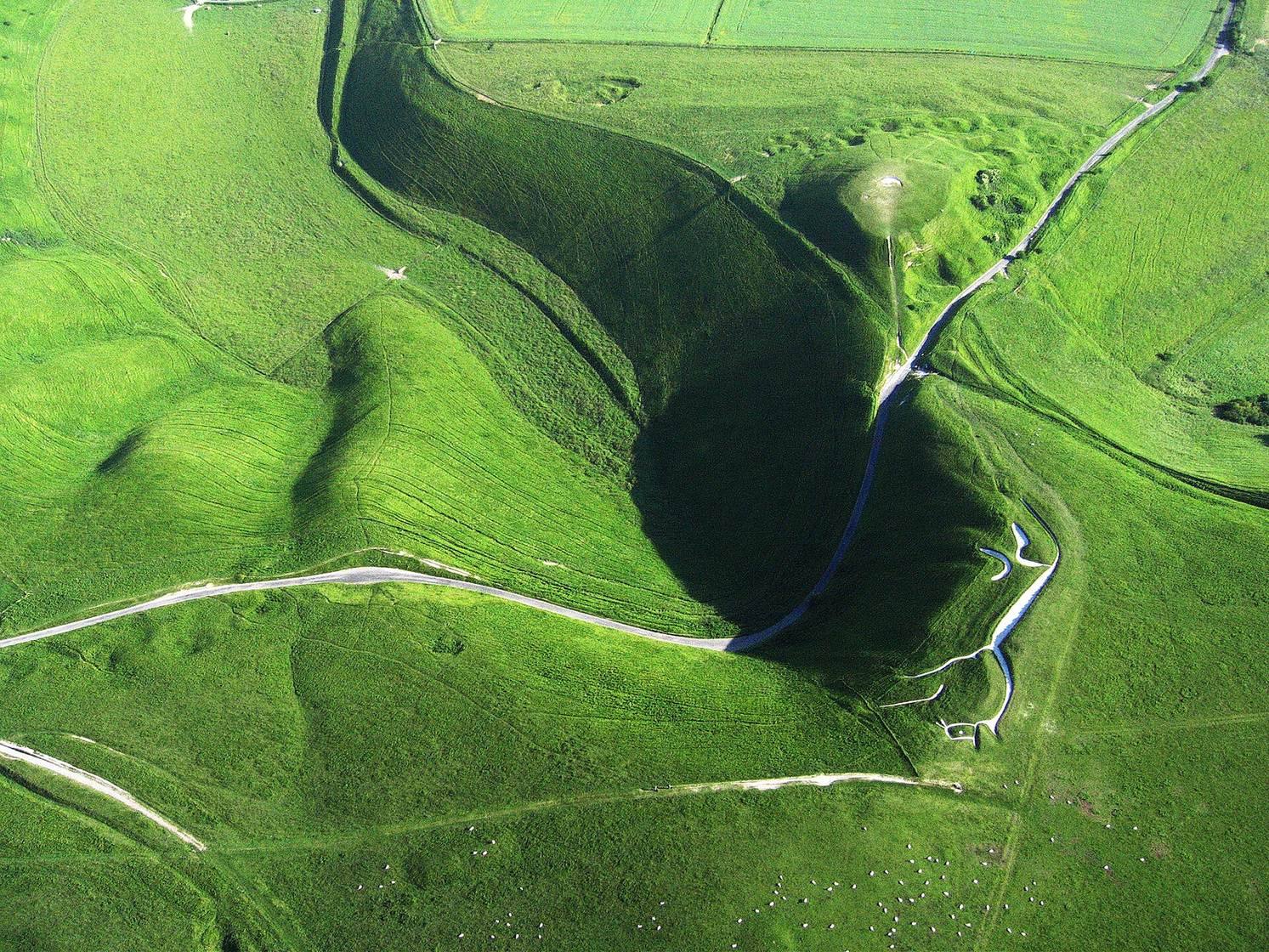
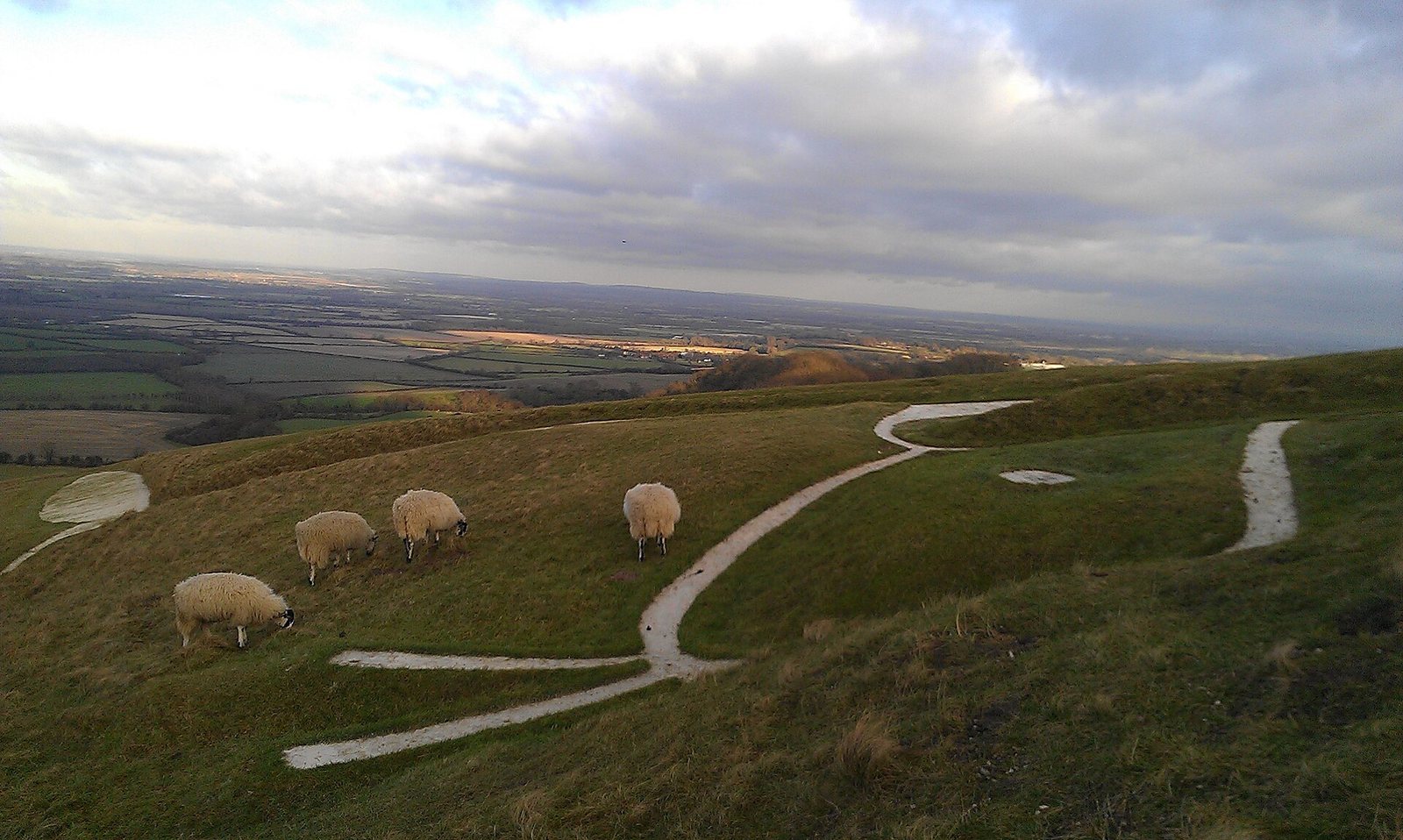
The highly stylized figure is about 110 metres long and lies on the upper slopes of Whitehorse Hill. Its outline is made from deep trenches cut through the turf into the underlying chalk. The trenches are about one metre deep and between two and four metres wide, and are filled with compacted white chalk.
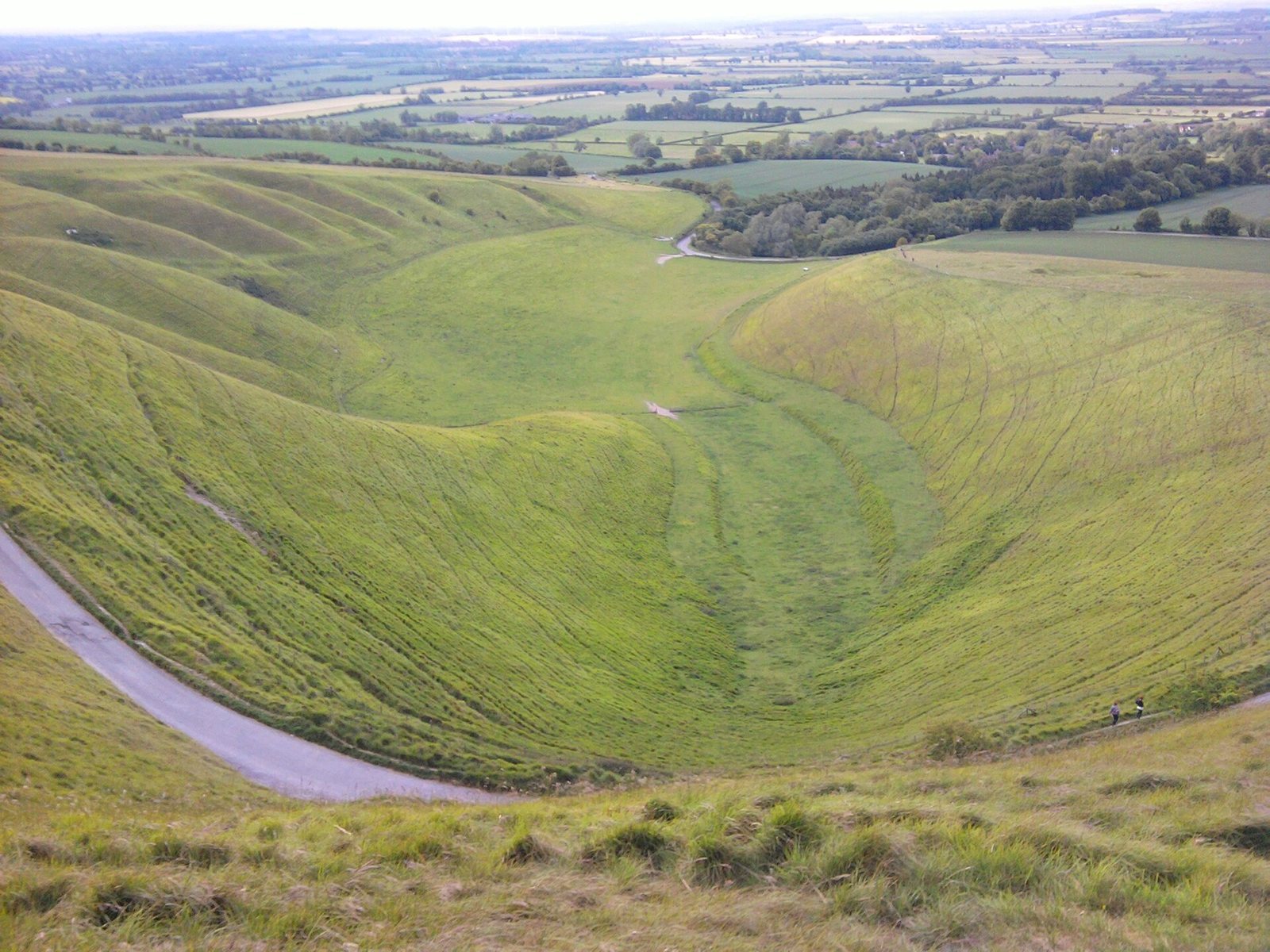
Whitehorse Hill rises to about 261 metres on the steep edge of the Berkshire Downs, overlooking the Vale of White Horse to the north. West of the figure are ice-cut terraces known as the Giant’s Stair; below it lies the steep-sided dry valley called the Manger. Nearby Dragon Hill is a natural chalk hill with an artificially flattened top.