Uda Mikumari Shrine: A National Treasure Shinto Sanctuary in Japan


Site at a Glance
- Rating
- 4.3
- Popularity
- Low
- Country
- Japan
- Primary era
- Medieval
- External website
- Open
- Eras represented
- Medieval
- Civilizations
- Ashikaga shogunate, Kamakura shogunate
- Site type
- Religious
- Remains
- Sanctuary
On this page11 sections
History
Uda Mikumari Shrine is a Shinto shrine in Japan, traditionally said to have been founded during the reign of Emperor Sujin, in the seventh year of his reign. Emperor Sujin is traditionally regarded as Japan’s tenth emperor, but his reign belongs to the early legendary imperial chronology, so this is a foundation tradition rather than a securely established archaeological date. The shrine is associated with Mikumari-no-Kami, a Shinto kami connected with the distribution of water and, in tradition, with childbirth.
Regional and early court connections
Uda Mikumari Shrine is regarded as the eastern member of four Mikumari shrines associated with the eastern, western, northern, and southern parts of Yamato. In the Uda region, it is also known as the Middle Shrine, distinguishing it from the Upper Shrine at Utano Kamihono and the Lower Shrine at Haibara-Shimoida.
The shrine appears in the Engishiki, a tenth-century compilation of governmental regulations and court ritual procedures, where it was listed among the major shrines. It was entitled to receive imperial offerings for the monthly festivals and the Niiname festival, a court ceremony connected with the first offering of newly harvested grain. The shrine was also included among the eighty-five kami honored in the temporary Rainmaking Kami Festival.
In 840, the shrine’s deity was recorded as Mikumari-no-Kami and received the rank of Junior Fifth Rank, Lower Grade. In 859, the deity was recorded as Uda Mikumari-no-Kami and received the rank of Senior Fifth Rank, Lower Grade. These records reflect the shrine’s place within the formal religious order of the early Heian period.
Protection and conservation
The three main buildings were designated as specially protected structures under the former Ancient Shrines and Temples Preservation Law in 1911. Under the 1950 Law for the Protection of Cultural Properties, they became Important Cultural Properties and were designated National Treasures in 1954. The auxiliary Kasuga and Munakata sanctuaries were also designated nationally important cultural properties in 1954.
Repainting work in 2003 revealed small surviving areas of the shrine’s original coloration. These traces were used to restore the colors of the buildings.
Remains
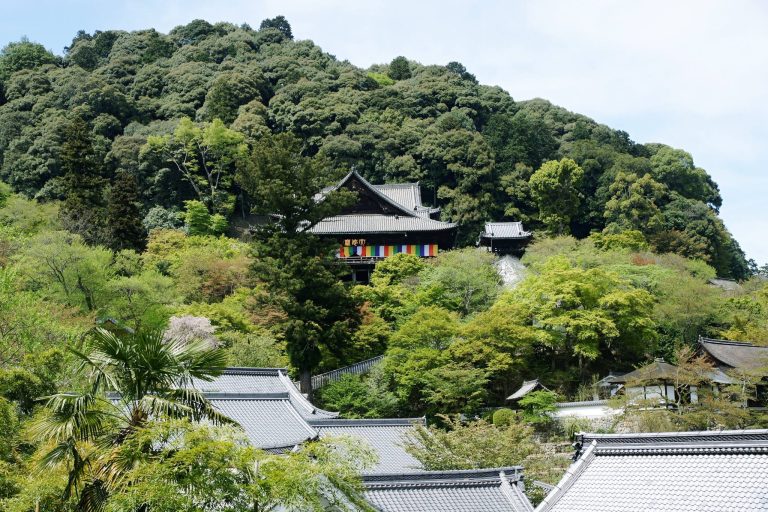
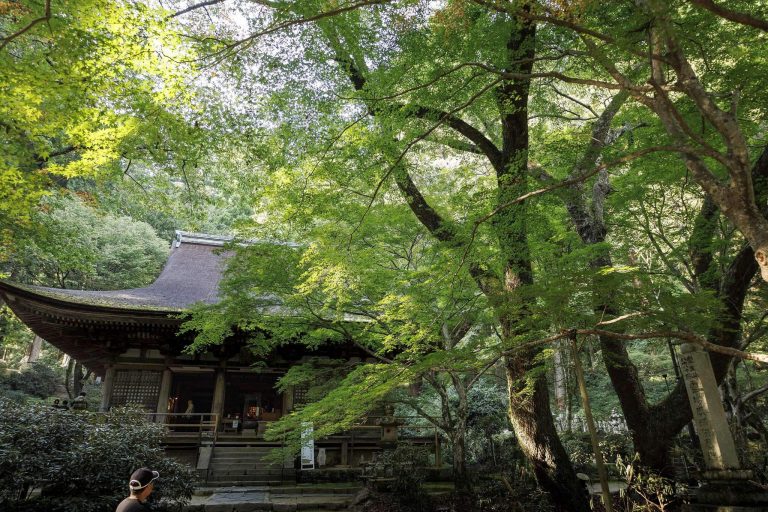
The shrine’s principal architectural group consists of three closely adjoining main sanctuaries standing side by side. Viewed from the front, the First Sanctuary is on the right, followed by the Second and Third Sanctuaries. Each is a compact, one-bay building in Kasuga-zukuri, a shrine style with a projecting front porch and a gabled roof whose ridge runs across the building. The roofs are covered with cypress bark, and each sanctuary has corner rafters.
Main sanctuaries
First Sanctuary
The First Sanctuary enshrines Ame-no-mikumari-no-kami, the heavenly water-distribution kami. An ink inscription on its ridge timber is dated 1320. Together with the Third Sanctuary, it is considered one of the oldest securely dated examples of Kasuga-zukuri with corner rafters.
Second Sanctuary
The Second Sanctuary enshrines Hayaakitsuhiko, a separate Shinto kami. Its ridge timber bears an ink inscription dated 1558. The building is considered to have undergone rebuilding so extensive that the work was nearly a new construction.
Third Sanctuary
The Third Sanctuary enshrines Kuni-no-mikumari-no-kami, the earthly water-distribution kami. It is considered to have been built at approximately the same time as the First Sanctuary and shares its status as one of the oldest securely dated examples of Kasuga-zukuri with corner rafters.
The three adjoining sanctuaries have an unusual structural arrangement. Between the main posts and the posts of each projecting worship porch, there is no connecting rainbow beam. Instead, hand-support members are used. This arrangement is thought to have preserved a clear side view through the row of sanctuaries.
Auxiliary sanctuaries
Kasuga Shrine
The honden, or main sanctuary, of the auxiliary Kasuga Shrine was built during the middle Muromachi period, the era of warrior government conventionally dated from 1336 to 1573.
Munakata Shrine
The honden of the auxiliary Munakata Shrine was built during the late Muromachi period. Both auxiliary sanctuaries form part of the shrine’s nationally protected architectural heritage.