Turjak Castle: An Auersperg Stronghold in Slovenia


Site at a Glance
- Rating
- 4.4
- Popularity
- Low
- Country
- Slovenia
- Primary era
- Early Modern
- Eras represented
- Medieval, Early Modern
- Civilizations
- Habsburg, Holy Roman Empire
- Site type
- Military
- Remains
- Castle
On this page16 sections
History
Turjak Castle is a 13th-century castle in Slovenia, standing above the settlement of Turjak in the municipality of Velike Lašče, in the Lower Carniola region southeast of Ljubljana. Built and held by the noble Auersperg family, it became a fortified family seat, a refuge for Slovene Protestant leaders, and a military stronghold on a route exposed to Ottoman attacks.
Early castles and the move uphill
The first Auersperg castle stood lower on the slope and was probably built in the late 11th century. Konrad von Auersperg is first recorded in 1062, while an inscription at the present castle gives 1067 as the beginning of the site. The name Turjak has an uncertain origin. Local tradition connects it with the extinct aurochs, while another explanation derives it from the Ursberg family, later known as Auersperg. A proposed connection with Turriaco in Italy is generally considered coincidental.
In 1140, the earlier castle was burned and destroyed during a succession dispute between Pilgram IV von Auersperg, the son of Pilgram II, and Otto von Ortenburg, Pilgram II’s son-in-law. Pilgram IV held the castle but was defeated. Count Adolf II von Auersperg rebuilt it in 1190, but another war, involving his son Otto, the noble houses of Gortz and Ortenburg, and the Patriarchate of Aquileia, led to its demolition. The first two castles were then abandoned in favor of the higher location occupied by the present complex.
The current castle was first mentioned in 1220. Peter and Wolfgang von Auersperg sold it to another branch of the family in 1270. Balthazar von Auersperg, chancellor of the Holy Roman Empire, later bought it back. Fourteenth-century owners included Gerhard, recorded in 1317, and the brothers Friederich, Volkard, and Herward.
Fortress in the age of Ottoman warfare
Ottoman forces attacked Turjak in 1491 and again in 1528, but the castle resisted both assaults. A major earthquake completely destroyed it in 1511. It was rebuilt in time to withstand the peasant revolt of 1515, an uprising that devastated several other castles in the region. The rebuilding shaped the defensive complex represented in later views of the castle.
The Auerspergs were prominent military leaders during the continuing conflicts with the Ottoman Empire, whose armies were expanding into southeastern and central Europe. Ivan of Turjak died at the Battle of Vienna in 1529. Herbard VIII von Auersperg was killed at Budačko in 1575. Andreas von Auersperg, known as the “Carniolan Achilles,” commanded Carinthian and Carniolan forces at the Battle of Sisak on 22 June 1593, contributing to a decisive victory over the Ottomans.
Reformation and family rule
During the 16th century, the Auerspergs strongly supported the Protestant Reformation, the movement that challenged established Catholic authority and encouraged new Protestant churches and religious translations. They sheltered Primož Trubar, a leading Slovene Protestant reformer, and Jurij Dalmatin, a Protestant pastor and Bible translator. At Turjak, the two men worked on the first Slovene translation of the Bible. The counts also provided financial support for the printing of some of the earliest Slovene books.
Seventeenth-century lords of Turjak included Johan Andreas von Auersperg and Wolf Engelbert von Auersperg. The Carniolan historian and polymath Janez Vajkard Valvasor recorded the castle’s importance in his 1689 Glory of the Duchy of Carniola. His work included two etchings of Turjak, one of them extending across two pages.
In 1739, Adam Anton Siegfried von Auersperg established a fideicommiss, an inheritance arrangement intended to keep specified family properties together. It included the Turjak lordship, the holding of Nadlischegg in Mokronog, and the Turjak or Auersperg Palace in Ljubljana. Adam Anton died that year and was succeeded by his eldest son, Adolf Engelbert Ignaz, who died in 1768. On 20 May 1769, the allodial land ownership passed to Adolf’s widow, Elisabeth, née Lichtenberg, while the fideicommiss went to her brother-in-law Josef Maria. After Josef Maria’s death on 24 December 1805, it passed to Johann Paul Alois, then to Count Josef von Auersperg, who held it until his death on 12 October 1883. His son, Count Leo von Auersperg, succeeded him, followed by Leo’s son Herward between 1916 and 1931 and then by Herward’s son, also named Herward.
War, restoration, and later associations
On 19 September 1943, during the Second World War, Slovene Partisans captured Turjak after a lengthy battle with its garrison of Slovene Blue Guard detachments of the Yugoslav Army in the Homeland. About five hundred prisoners were taken and became targets of reprisals that included notable war crimes. The fighting severely damaged the castle, which remained in ruins for several years.
After the war, the castle was nationalized and restoration began gradually. Slovenia designated it a monument of national importance, with that designation recorded in 1999. In 2006, Slovenian president Janez Drnovšek founded the Movement for Justice and Development, a civil-society organization, at a large rally held at the castle.
Turjak remains associated with the Slovene Reformation and with France Prešeren’s ballad “Rosamund of Turjak.” Prešeren, Slovenia’s leading 19th-century Romantic poet, portrayed in the poem the courtship of a Turjak heiress in the late Middle Ages.
Remains
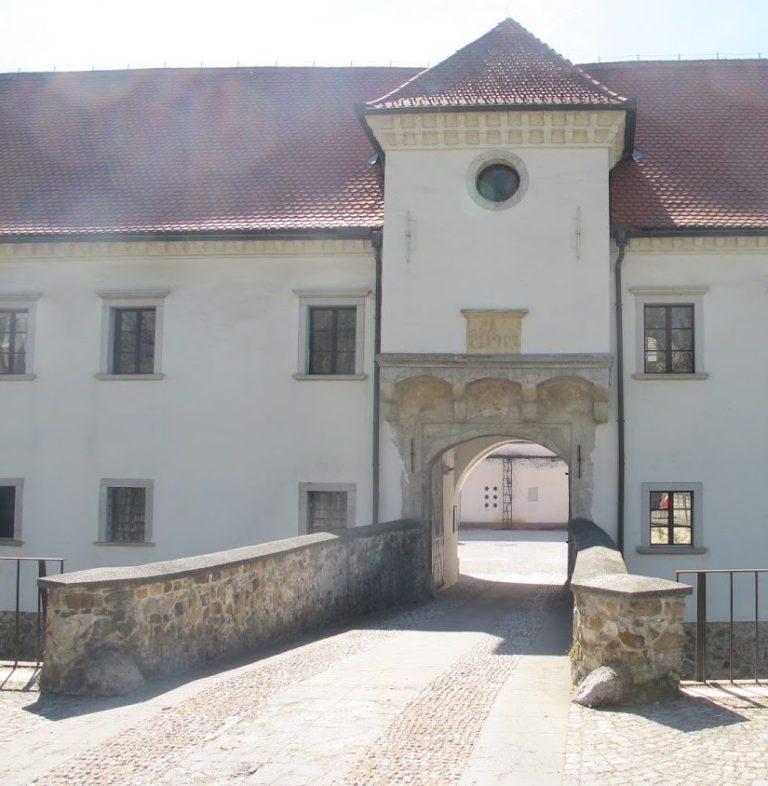
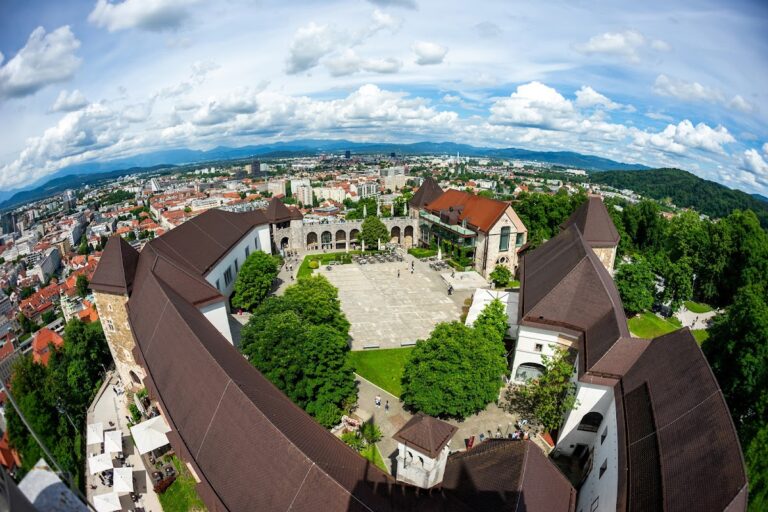
Turjak Castle occupies a terraced hill and has a triangular plan. Large Renaissance defensive towers, known as bastilles, stand at the three points of the triangle and are linked by residential wings. The complex combines defensive walls, towers, residential structures, and two chapels, while elements predating the 16th century survive in the north wing and parts of the fortifications.
Defensive and residential complex
Renaissance towers and walls
The large towers at the corners form the principal defensive framework of the castle. The western tower contains a group of dungeons with differing conditions. The north wing and portions of the defensive walls preserve elements from before the 16th century, while the overall arrangement reflects the major rebuilding that followed the earthquake of 1511.
Central residential building
The tall central palacium, the principal residential or ceremonial building of a medieval castle complex, dates from the Romantic period. It rises within the fortified plan and is connected to the defensive towers by the residential wings.
Earlier slope remains
Lower down the slope, minor ruins mark the location of the original 10th- or 11th-century castle. This lower site belongs to the earlier stages of the Auersperg presence before the castle was moved to its higher position.
Chapels and commemorative features
Catholic chapel
The Catholic chapel stands on the west side of the castle. It has functioned as a church since 1789. After renovation in 1990, Sunday Mass continued to be celebrated there. A chapel in the Turjak graveyard contains a glass jar with the preserved heart of the young Count Hanno von Auersperg, who lived from 1838 to 1861. Tradition holds that he committed suicide after being exiled to Naples for refusing to abandon a socially unsuitable relationship.
Dalmatin Chapel
The second chapel is a Romanesque Protestant chapel known as the Dalmatin Chapel. It contains the tombs of Protestant counts and Gothic frescoes, linking the building’s physical remains with the Reformation history associated with Turjak and Jurij Dalmatin.
Ox Tower inscription
On the eastern side, a stone slab is built into the structure known as the Ox Tower. It bears an inscription beside an engraved coat of arms and bison; the lettering was formerly gilded. The text attributes the castle’s beginning to Konrad von Auersperg in 1067, records its destruction in 1511, and states that Trojan von Auersperg began rebuilding it anew in 1520.
Former armory memorial
The former armory displayed the heads of Herbard von Auersperg and Friedrich von Weichselburg, who were killed fighting Ottoman forces in 1575. Their heads were skinned, tanned, and sent as mementos to the Sultan in Constantinople. Their relatives later ransomed them.
Changing appearance
Valvasor’s views from the 1680s show a rectangular complex with small towers at only two corners and a large bastille at the eastern end. This appearance resulted from the substantial rebuilding after the 1511 earthquake and differs from the triangular arrangement formed by the large corner towers described for the castle today.
Nearby sites