Tumulus de Poulguen: A Prehistoric Burial Mound and Megalithic Tomb
Site at a Glance
- Popularity
- Low
- Country
- France
- Primary era
- Stone Age
- Eras represented
- Stone Age, Modern
- Civilizations
- French
- Site type
- Burial
- Remains
- Burial Mound
On this page11 sections
History
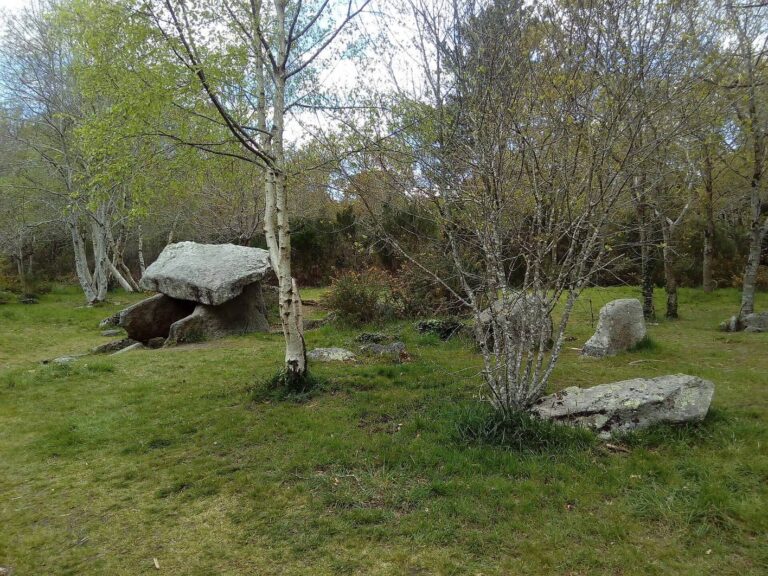
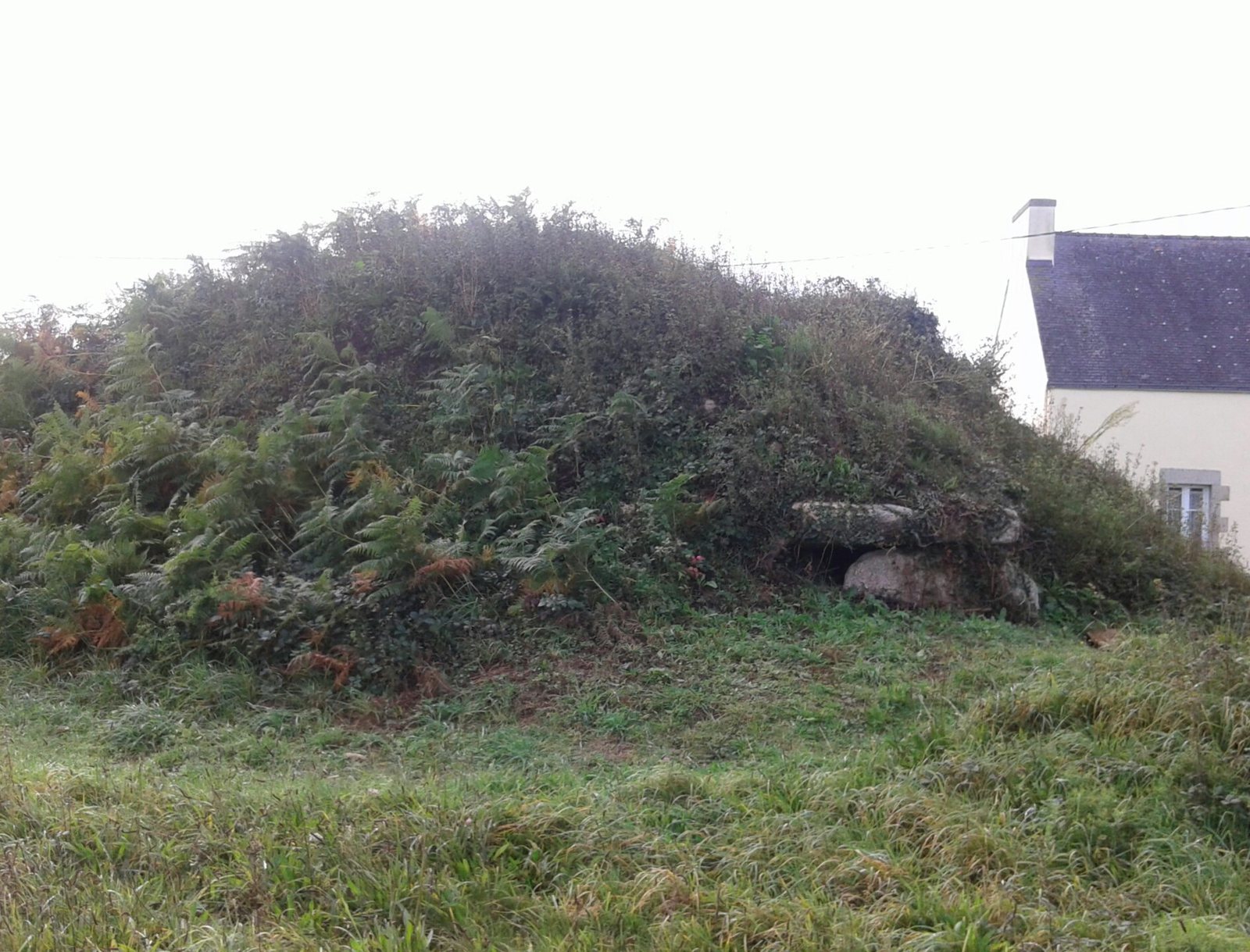
The Tumulus de Poulguen is a prehistoric burial mound containing a megalithic tomb at Penmarch, France. It is broadly dated to around 4000 BCE and associated with the Neolithic and Early Bronze Age, with cultural links to the Seine-Oise-Marne culture, a prehistoric culture associated with northern France.
Prehistoric use and later reuse
Radiocarbon results place a piece of wood collected by Armand René du Châtellier at about 1600 BCE and charcoal gathered by A. Martin at about 500 BCE. L’Helgouach associated the finds with the Seine-Oise-Marne culture and interpreted the earlier date as evidence that a megalithic group persisted into the Early Bronze Age. Later artifacts and alterations from the Gallo-Roman period, when Gaul was under Roman rule, indicate that the monument was reused.
Later history and investigation
In the nineteenth century, a monumental religious cross stood on the mound’s summit. Its position near the coast also made the mound a navigational landmark. Excavations took place in 1807, September 1861, 1902, and 1927. Du Châtellier led the 1861 work, Martin excavated in 1902, and a team from the Finistère Prehistoric Museum worked at the site in 1927. Pierre-Roland Giot’s investigation in 1948 had to stop because of the risk of collapse. France classified the monument as a protected historic property by decree on 10 November 1921.
Remains
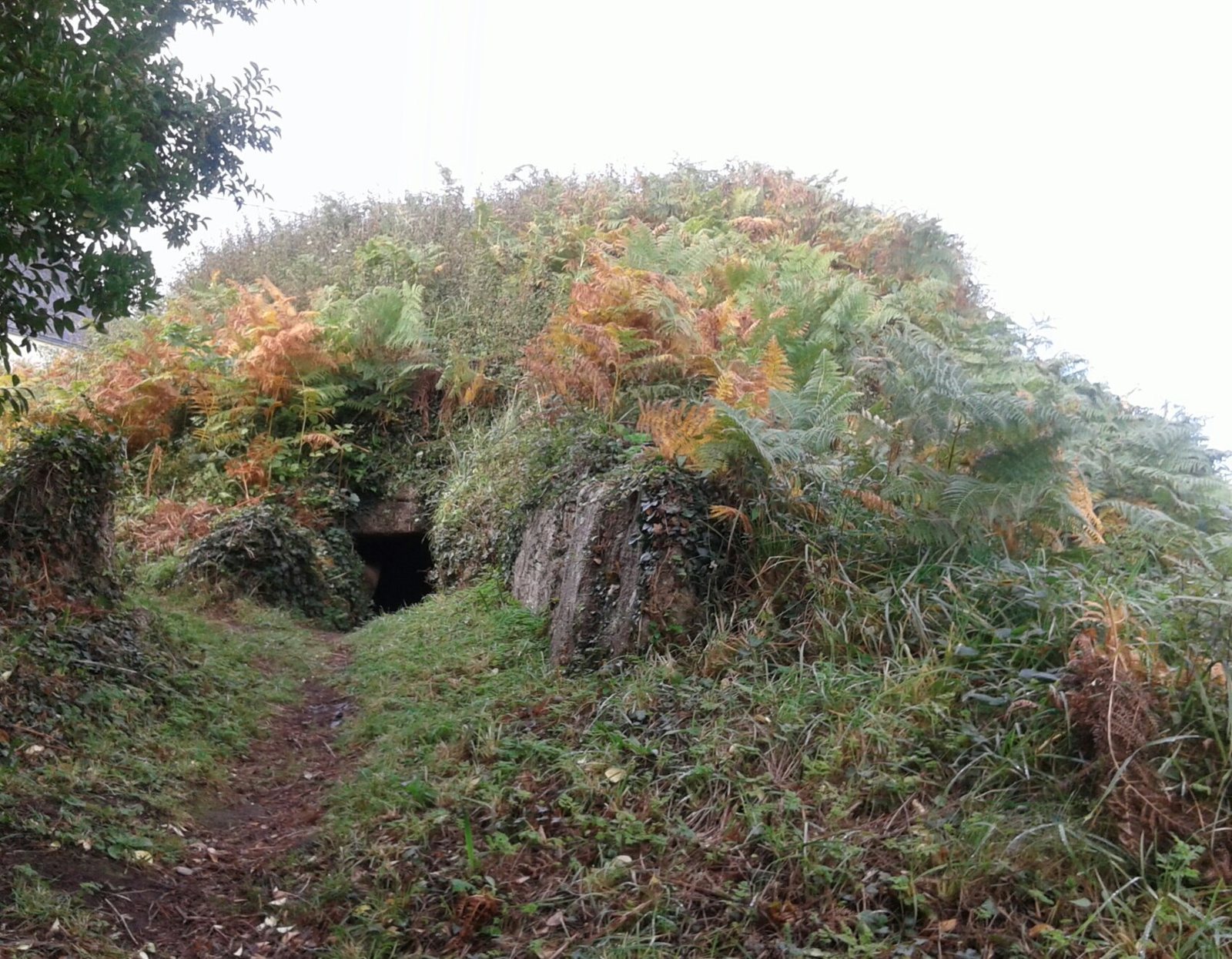
The monument consists of a stone-and-clay mound containing a T-shaped tomb. Its separate entrance passage and chamber combine features of passage dolmens, megalithic graves with a corridor leading to a burial chamber, and covered-gallery tombs, long roofed burial chambers. L’Helgouach identified the long chamber and its proportions as features of the latter type.
Mound and tomb
Burial mound
The mound originally measured about 40 metres across and rose several metres. Repeated removal of earth and stones has damaged roughly three-quarters of its circumference.
Passage
The passage opens toward the east-northeast and narrows from about 2.30 metres wide at its outer end to about 1.30 metres near the chamber. Its surviving sides include four upright stone slabs on one side and five on the other, alternating with low walls built without mortar. Three slabs cover the passage; they measure 2 metres, 2.90 metres, and 2.15 metres long. The passage ceiling is about 1.40 metres high. A support stone dividing the chamber bears seven cup-marks, or small hollows cut into the stone, and five other support stones are engraved. The last pillar on the left before the chamber has five unequal vertical cuts joined by a curved line, along with a cup-shaped hollow.
Chamber
The rectangular chamber has walls of upright slabs alternating with small walls built without mortar. Its western part is 9 metres long and 1.50 to 1.60 metres wide. Martin’s plan showed an eastern section about 2 metres long, apparently closed by a slab. Quarrying later severely damaged this part and caused its roof to collapse. A detached stone structure east of the mound, once described by Martin as a stone chest, is understood as a continuation of the chamber’s eastern end. The entrance is framed by two stones and measures 0.90 metres wide.
Burial deposits and finds
Excavated deposits
Du Châtellier found a layer of fine black earth, about 1.10 to 1.30 metres thick, in the intact part of the passage and in the chamber. In the chamber, it contained wood fragments, bones, and ashes. He proposed that cremated remains and grave goods had rested on split planks laid over a bed of stones. In the eastern chamber section, Martin found abundant ash and bone fragments, which he interpreted as the cremated remains of several people.
Associated objects
Du Châtellier collected about fifteen sherds of coarse, thin-walled pottery with dark paste, a terracotta spindle whorl, a stone mortar, and a fragment of Roman roof tile. Martin’s finds included a roughly made, broken vessel shaped like a flowerpot, a finely retouched flint blade 13 centimetres long of the type associated with the Grand-Pressigny region, and grinding stones. Other stone finds attributed to the monument, though their recovery circumstances are unclear, include three polished axes, two made of dolerite, as well as scrapers, flint blades, and flakes.