Tumba Madžari: A Neolithic Settlement in North Macedonia
Site at a Glance
- Popularity
- Medium
- Country
- North Macedonia
- Primary era
- Stone Age
- Eras represented
- Stone Age, Modern
- Civilizations
- Unclassified
- Site type
- Settlement
- Remains
- Village
On this page18 sections
History
Tumba Madžari is a Neolithic settlement in Skopje, North Macedonia, occupied from about 6000 to 4300 BC. The Neolithic was the later part of the Stone Age, when settled communities practised farming. The settlement belonged to the Anzabegovo-Vršnik II–IV cultural group, a regional Neolithic tradition, and reached its peak around 5800–5200 BC. It is regarded as the most important Neolithic settlement in the Skopje Valley and as a nucleus of present-day Skopje.
Neolithic occupation
The settlement’s occupation extended across several centuries, with its most active period falling between about 5800 and 5200 BC. Its remains provide evidence of a substantial community whose houses, sanctuary, tools, and other finds are described below.
Discovery, investigation, and modern change
The mound was found in 1961–1962 during trial excavations undertaken in connection with construction of a nearby motorway. The Museum of Macedonia carried out the first archaeological excavations in 1978, led by Voislav Sanev, as building activity threatened the site. Systematic excavation began in 1981 and continued through small campaigns until 1990, concentrating on the latest occupation layer. Further work took place in 2002 under Dragisha Zdravkovski, and Elena Stojanova Kanzurova led investigations from 2007.
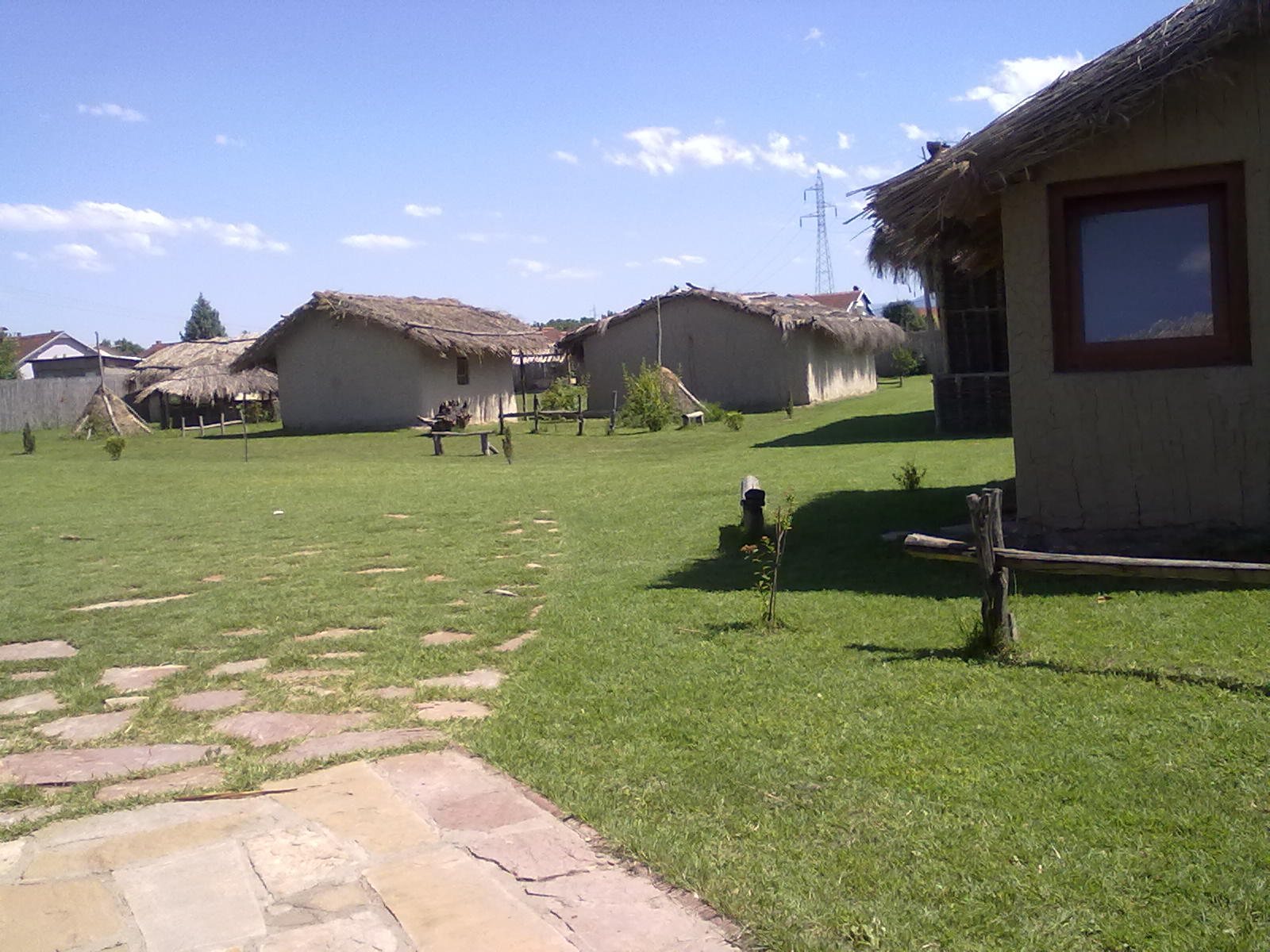
Agriculture did not conceal the mound in its flat surroundings before the 1963 earthquake. Later neighborhood development, especially uncontrolled construction on and around the mound, changed its setting and damaged the archaeological deposits. House construction has made more than three quarters of the area unavailable for scientific study. Plans to recreate a Neolithic village began in 2007, and the open-air museum project was implemented from 2008. By 2018, several houses in Neolithic style had been built and furnished with figures depicting activities and with original or replica objects. Selected finds have appeared in exhibitions in North Macedonia and abroad. A figurine identified as the Great Mother was unearthed in July 2024 and assigned a date of 8000 BC, earlier than the settlement’s stated occupation.
Remains
The settlement lies on an artificial mound at the foot of a low ridge, beside a marsh, between the Skopje neighborhoods of Madžari and Čento. The mound has an irregularly circular base about 200 metres across and rises roughly 3 metres. The ridge offered protection if the marsh water level rose. Excavated remains include closely spaced houses, a sanctuary, and other structures, built with posts, branches, and mud-based coatings.
Mound and occupation deposits
The archaeological deposit is about 3 metres thick. Six layers have been identified: the first, third, and fifth represent periods of occupation, while the other layers were laid down to level the ground. Excavation also distinguished three successive Middle Neolithic occupation horizons.
Buildings and settlement layout
Excavation in the mound’s northwestern sector covered about 1,400 square metres and revealed foundations and remains of seven above-ground buildings, six houses and one sanctuary. Later work uncovered eight more dwellings and parts of other structures. The houses stood close together, with narrow lanes and small courtyards between them.
Houses
Houses had square or rectangular plans and floor areas of about 60 to 80 square metres. Builders set posts into the ground, sometimes bracing them with stones, and wove branches between the posts. They coated this framework with mud mixed with chaff. Planks lined the inner walls beneath a thick layer of the same mud-and-chaff mixture; traces of white pigment remain on some fragments.
Roof frames were wooden and covered with rye straw, reed, or bulrush. Larger houses included a small loft for sleeping and storing produce. Hearths and ovens were found in almost every building. A plastered clay installation discovered in 2002, with salt crystals on its floor, has been described as a bath.
Large building and sanctuary
A rectangular building measuring 8 by 8 metres was initially interpreted as a sanctuary. Three installations inside it were first thought to be ritual altars, but comparison with similar features at other Neolithic settlements led to their identification as ovens. The sanctuary assemblage included 45 intact vessels and many fragments.
Possible service structure
Excavations in 2007–2008 uncovered connected square and circular features that may have belonged to a building used for household or other practical activities.
Ceramics and figurative objects
Pottery
Pottery was abundant and varied in shape and decoration. Some vessels were decorated with added clay that raised the surface, while others carried patterns pressed into the clay. Painted designs used two colors, including brown on red and dark brown or brown on pale ochre. Motifs on many vessels have been interpreted as references to rain, ears of grain, and water. Vessels were often found near hearths.
Sanctuary vessels
The sanctuary’s vessels included two-handled containers with stylized plant designs, large storage jars, bowls, plates, and a small box with raised decoration on its base. Other forms included curved vessels shaped like waterbirds, bell-shaped goblets, and rounded pots.
Figurines and sculpted animals
A 39-centimetre terracotta figure of the Great Mother is shown in a watchful pose over a house and its hearth. The Great Mother was a goddess associated with fertility and protection. Such figurines have been interpreted as evidence of a cult, although that interpretation is uncertain. Other finds include female and male human figures, small tables, and animal-shaped altars.
A life-size terracotta ram’s head measures 32 by 33 by 27 centimetres and has openings for natural horns. Its smooth back suggests it may have been fixed to a house front. The sculpture has been linked to the urial, regarded as an early domesticated sheep in western Asia and thought to have been brought to Ovče Pole. Its proposed early Neolithic date is based on its larger size compared with examples known from Middle Neolithic Skopje. Other animal representations include a goat and a centaur.
A terracotta female head was accidentally uncovered in 1984 during basement construction on Finland Street. It was formed around a thick stake of unrefined earth and smoothed with layers of pale ochre clay. The flattened face has incised eyes and shaped brows and nose, but no mouth. Deep grooves show hair arranged in braids gathered to the left.
Tools, personal objects, and daily life
Tools and craft activities
Finds associated with craft and work include loom weights, biconical weights for fishing nets, and bone needles, spatulas, and hooks. Stone objects include mortars, knives, adzes, chisels, hoes, clubs, and millstones. Hoes and axes were mounted on horn pieces that could be pierced for a handle. Flint knives and choppers were also found, along with deer antlers and patterned ceramic stamps.
Stone tools were made from volcanic rocks, chalcedony, and opalite. Red jasper became especially prominent in the final occupation phase. These stone materials have been considered locally sourced from the hills around Ovče Pole.
Ornaments
Personal ornaments included flat, disk-shaped river stones pierced with two conical holes for a leather neck cord, bone bracelets, and cylindrical bone beads for necklaces.
Food and animal remains
Wild olive seeds, freshwater shells, and animal and bird bones were recovered. An analysis of 2,847 bones found that 5.5 percent came from wild animals, while 22 were fish bones and 14 were human bones. The remaining bones belonged to domestic animals. Sheep and goats accounted for 48 percent of the domestic animal remains, and cattle for 41 percent. The bones indicate that animals and birds were used for food; some were deliberately worked.
Burial
One infant burial, dated to the Middle Neolithic, was found at the settlement.