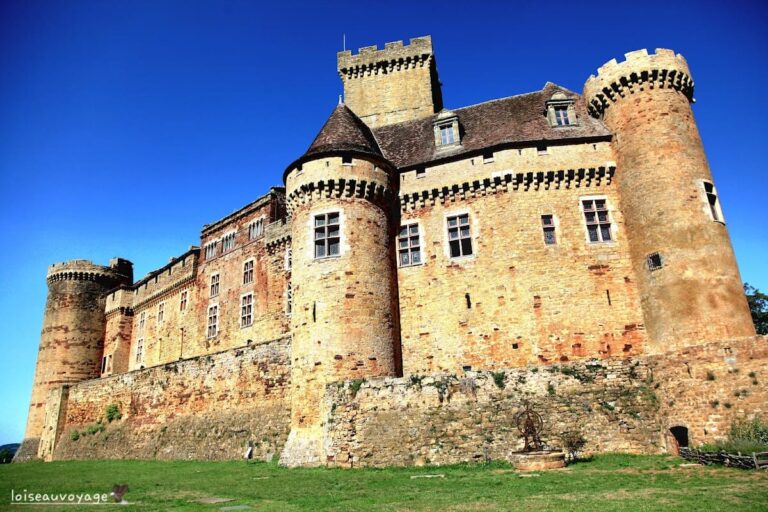
Château de Turenne: A Medieval Fortified Castle in France


Site at a Glance
- Rating
- 4.3
- Popularity
- Medium
- Country
- France
- Primary era
- Medieval
- Eras represented
- Medieval, Early Modern
- Civilizations
- Duchy of Aquitaine, French
- Site type
- Military
- Remains
- Castle
On this page10 sections
History
Château de Turenne is a medieval fortified castle in Turenne, France, whose origins lie in the early fortified settlement known as the castrum of Turenne. A place called vicaria Torinensis is mentioned in the seventh century, while the castrum first appears in written records in 767, when Pepin the Short seized it during his war against Waïfre, son of Hunald I, duke of Aquitaine, who was resisting Frankish rule. The castle is generally described as having been built from the thirteenth century and completed in the fifteenth, although the dates and purposes of every part cannot be established precisely.
Carolingian stronghold and early lords
An act issued by Emperor Louis the Pious in 823 recalled that Pepin had taken the castrum and entrusted it to Immon, the first count of Quercy. The same document described the long hostage-taking of Lambert Agan. His father Aganus and Count Ermenric had given him to Louis the Pious to preserve peace in Aquitaine, and Lambert remained in captivity for fifty years before his release at the assembly of Compiègne in 823.
The stronghold changed hands again in 839, when Louis the Pious captured it from Pepin II, king of Aquitaine. Relics of Saint Martial, normally kept at Limoges, were placed there for safekeeping around 842 and again between 885 and 895, probably in response to the danger posed by Viking incursions. A charter of Saint-Pierre Abbey at Beaulieu-sur-Dordogne also records Count Raoul of Quercy and his wife Aiga granting property to their children Rodulfus and Immena, who had entered religious life. Raoul is often associated with the early counts of Turenne, although he has also been identified as a count of Quercy and relative of Wicfred, count of Bourges.
Bernard I of Turenne, son of Adhémar of Turenne, is the first person explicitly called viscount of Turenne, in a text written after Bernard’s death in 984. A viscount was a high-ranking territorial lord who governed a viscounty. Bernard’s daughter Sépulcie married Archambaud of Comborn. During a struggle with his brother-in-law, the Viscount of Aubusson, Archambaud fought to take Turenne Castle around 957 to 962 and injured his leg, earning the nickname “Rotten Leg.” He brought the viscounties of Comborn and Turenne together. Their grandson Guillaume received Turenne, while Guillaume’s brother Archambaud II inherited Comborn.
The castle and the viscounts of Turenne
The original location of the castle remains uncertain. A charter from 1074 refers to “Old Turenne,” about 1.5 kilometres northeast of the present town above Gondres. Historical interpretation places a Carolingian castle there, although excavation has not confirmed such a structure. The castle may have been moved to its present site by Archambaud “Rotten Leg” at the end of the tenth century or by his grandson Guillaume I during the first half of the eleventh century. Another possibility is that the earlier site was a smaller watch-post contemporary with the main stronghold.
Before leaving for the First Crusade in 1096, Raymond I of Turenne, son of Boson I, probably strengthened the castle’s defenses. He was probably also the first viscount of Turenne to mint coins. These lightweight silver pieces circulated in the dioceses of Limoges, Cahors, and Périgueux, and this local coinage continued until 1317.
At the beginning of the twelfth century, the viscounts entered the political sphere of the dukes of Aquitaine, a relationship formally attested from 1120. They nevertheless retained considerable independence, including the right to mint money. Rivalry between the Plantagenets and Capetians enabled them to secure or confirm privileges. The Plantagenets were the English royal dynasty whose rulers held major French territories, including Aquitaine, while the Capetians were the French royal dynasty represented in this period by Philip Augustus, Louis VIII, and Louis IX. Richard the Lionheart may have captured the castle in 1188.
In 1214, during the struggle between the Capetians and Plantagenets, Raymond IV transferred his allegiance from the duke of Aquitaine to King Philip Augustus. Raymond assisted Louis VIII in 1224 as the French king brought the duchy of Aquitaine under French control. In 1242, however, Raymond moved closer to the count of Toulouse and joined a revolt against the young Louis IX and his brother Alphonse of Poitiers. The French crown seized Turenne Castle and retained it under royal administration until 1253. For part of that time, it served as the seat of a seneschalry, a royal administrative district governed by an official responsible for justice and royal administration.
Division, reunification, and royal purchase
The Viscounty of Turenne was divided in 1251 between Raymond VI and Hélie II of Rudel, lord of Aillac. Through his marriage to Hélix, daughter of Raymond IV, Hélie received the western possessions, including Larche, Ribérac, Salignac, Creysse, Carlux, and Monfort. This division created the Pons of Bergerac branch, whose members called themselves “part-viscounts of Turenne.” Raymond VI, Raymond IV’s nephew, received the eastern half, including Turenne, Montvalent, Saint-Céré, and Curemonte.
The two portions were reunited in 1494 through the marriage of Antoine de La Tour d’Olliergues, son of Anne Roger de Beaufort, viscountess of Turenne, and Annet IV de La Tour, lord of Olliergues, to Antoinette de Pons, daughter of Guy de Pons and lady of Montfort.
On 6 May 1738, Charles-Godefroy de La Tour d’Auvergne, duke of Bouillon and viscount of Turenne, sold the viscounty to King Louis XV for 4,200,000 livres. He retained the right to use the title of viscount of Turenne. Destruction followed the sale, and further losses took place after the castle was repurchased by the Viscount of Noailles.
The surviving remains were classified as historic monuments in 1840. The Tour de César and the rectangular Tour du Trésor received separate classification in 1890. In 2015, protection was extended to the castle’s land parcels, their archaeological remains, and the buildings supported by them.
Remains
The upper castle
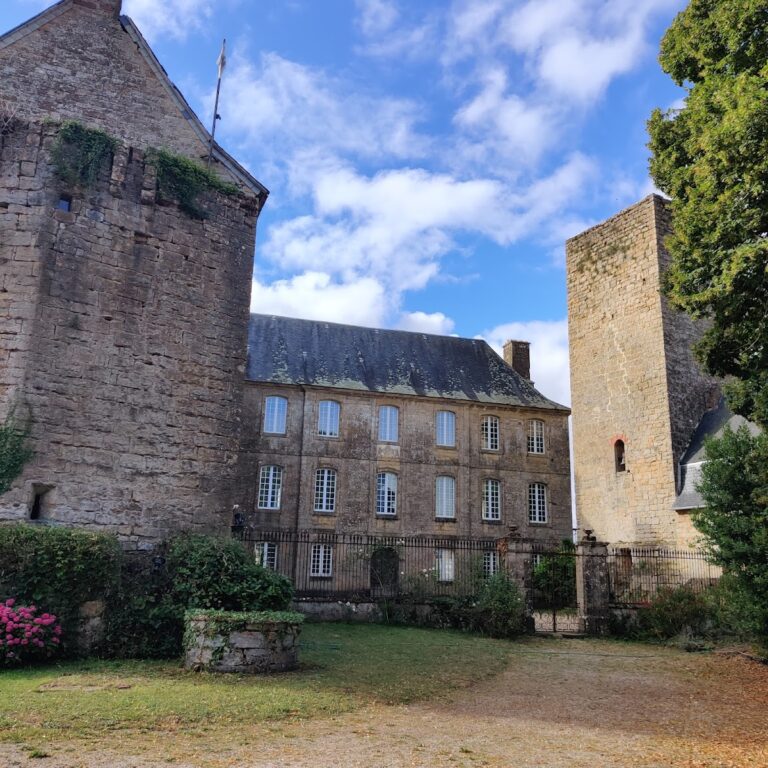
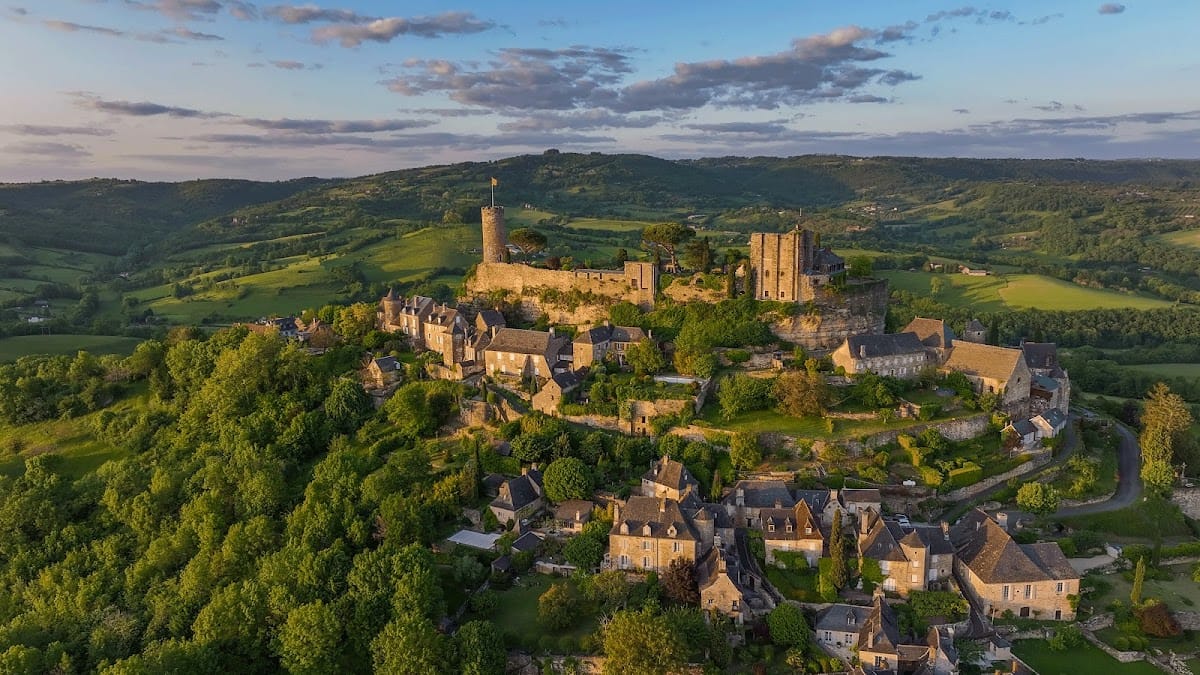
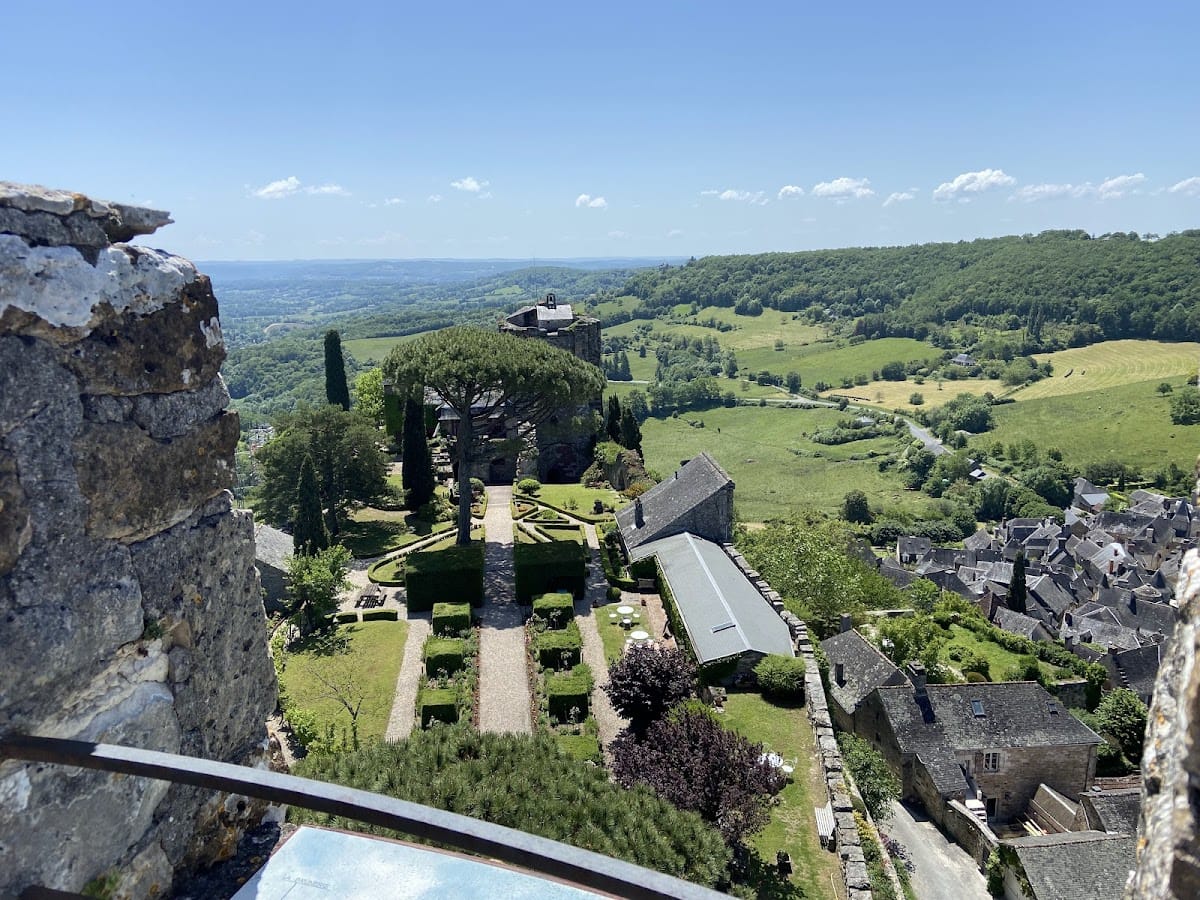
The roca castri, meaning the upper castle, preserves the bases of its enclosing defensive walls and three towers. The surviving complex was organized around the principal fortified structures, with the entrance protected by the Tour de la Poudrière and the two major towers occupying northern and southern positions. A defensive enclosure, or enceinte, is a wall or enclosed defensive circuit around a fortified site. At Turenne, the castle enceinte surrounded the upper castle, while another enclosed the town.
Tour de César
The Tour de César is a circular keep, or principal fortified tower, standing 18 metres high and dating from the thirteenth century. Its round form has been compared with towers in the Capetian royal domain. This comparison has led to proposed construction dates around 1212 to 1214, when Raymond IV aligned himself with Philip Augustus, or between 1242 and 1253, when the French crown controlled the castle. Christian Remy and Gilles Séraphin favor attributing the tower to Raymond IV. A similarly named circular tower was built at Allassac by Archambaud of Comborn between 1240 and 1250.
Tour du Trésor
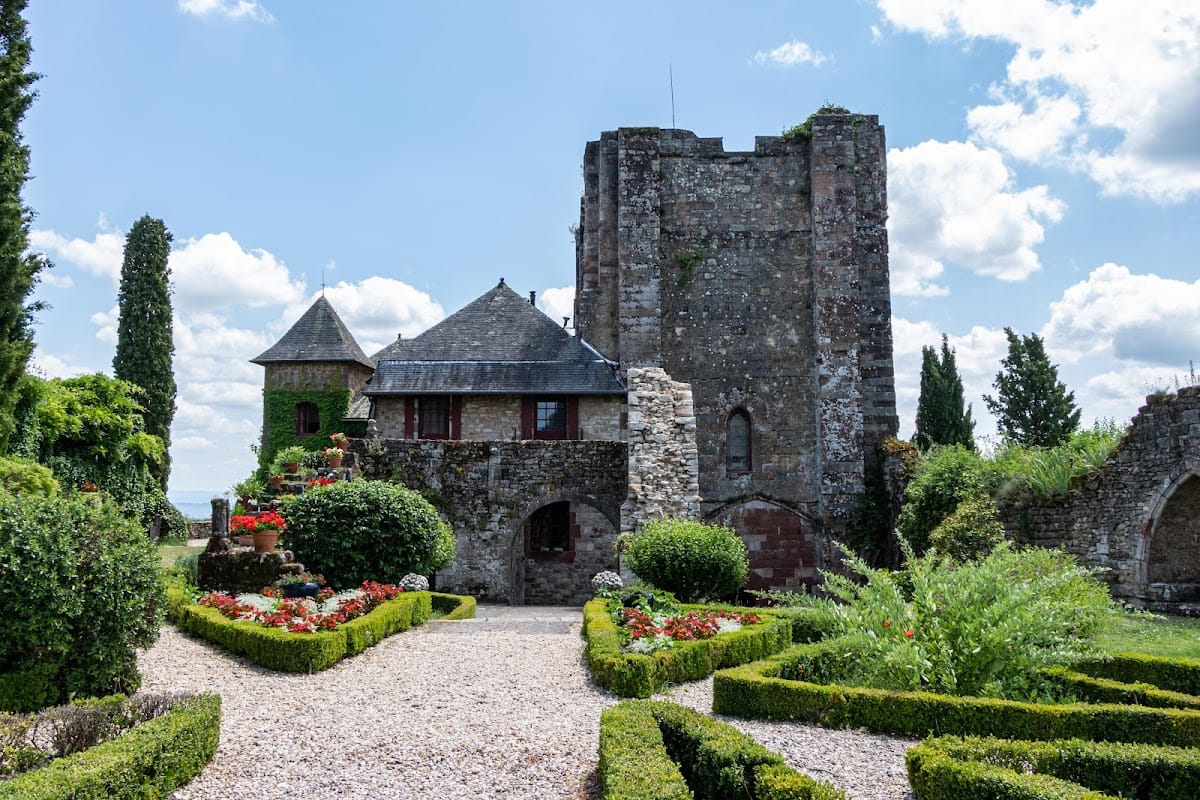
The Tour du Trésor is a rectangular, buttressed keep measuring 9.50 by 12.50 metres. It belongs broadly to the thirteenth century and has the form of a Romanesque keep, a medieval fortified tower built with substantial masonry and rounded-arch traditions. Gilles Séraphin has proposed that its origins may reach back to the twelfth century, followed by changes to its internal arrangement and the addition of later elements.
The tower originally contained three levels. Its ground floor was remodeled as a kitchen in the seventeenth century. The first floor has a rib vault, a vaulted ceiling supported by intersecting stone ribs, rising more than 9 metres. It may have been the medieval aula, or great hall, where the viscounts held receptions. The second floor contained a room formerly called the archive room. This upper level was later shortened and now forms the summit terrace. Buildings once attached to the eastern, southern, and northern sides of the tower have since disappeared.
Tour de la Poudrière and entrance buildings
Only remnants of the Tour de la Poudrière survive. The tower was intended to guard the castle entrance. A building study by Gilles Séraphin proposes that a ceremonial gallery at the entrance connected the Tour du Trésor with a residential building along the western side. Another building, also attached to the keep, stood on the eastern side.
A stained-glass medallion in the collegiate church of Notre-Dame and Saint-Pantaléon preserves evidence for the former arrangement of the complex. Between the Tour du Trésor and the Tour de César stood two large residential and reception buildings, together with smaller structures. The larger buildings probably contained substantial vaulted rooms. The medallion also depicts a religious building, possibly the Chapel of Saint Martial, at the southern end of the complex behind the Tour du Trésor.
Defensive enclosures
Three, and possibly four, defensive circuits have been identified. The first surrounded the upper castle, and the second protected the town. A third was probably added during the Wars of Religion, the sixteenth-century conflicts between Catholics and Protestants in France. It was likely built in the 1570s or 1580s by Henri I de La Tour d’Auvergne, the Reformed, or Protestant, viscount of Turenne, to protect the newly established Protestant stronghold.
Nearby sites