Tughlaqabad Fort: A Tughlaq-Dynasty Fortified City in India
Site at a Glance
- Rating
- 4.2
- Popularity
- High
- Country
- India
- Primary era
- Medieval
- Eras represented
- Medieval
- Civilizations
- Delhi Sultanate
- Site type
- Military
- Remains
- Fortified Town
On this page10 sections
History
Tughlaqabad Fort in India is a ruined fortified city in southern Delhi, founded in 1321 by Ghiyath al-Din Tughluq, founder of the Tughlaq dynasty, as a new capital of the Delhi Sultanate. The Delhi Sultanate was a succession of Muslim-ruled dynasties that governed much of northern India from the thirteenth to the sixteenth century. Tughlaqabad was intended to protect the sultanate from Mongol attacks and became one of Delhi’s historic cities.
Foundation under Ghiyath al-Din Tughluq
Before becoming sultan, Ghazi Malik served as a feudatory under the Khalji rulers, the dynasty that immediately preceded the Tughlaqs. Tradition says that he proposed building a fort on the site to Mubarak Khalji, who mockingly replied that Ghazi Malik should build it himself if he ever became ruler. Ghazi Malik seized power in 1321, took the title Ghiyath al-Din Tughluq, and began constructing the fort and its surrounding city.
The ruler sought to mobilize labor for the new stronghold while workers were also building a baoli, or stepped water reservoir, at the residence of the Sufi saint Nizamuddin Auliya. Nizamuddin Auliya belonged to the Chishti tradition, an influential devotional order in South Asia. Tradition holds that Ghiyath al-Din tried to stop the work by banning the sale of kerosene for nighttime lighting, and that he compelled the inhabitants of Delhi to labor on the fort.
Ghiyath al-Din also established a road linking the new city with the Grand Trunk Road. This route is now known as Mehrauli–Badarpur Road. The new capital was organized as a fortified urban settlement rather than as an isolated military enclosure, combining residential districts with a citadel and a palace area.
Abandonment and later tradition
Tughlaqabad and its city were abandoned in 1327, only a few years after their foundation. Tradition connects the abandonment with the conflict between Ghiyath al-Din Tughluq and Nizamuddin Auliya. Two sayings are attributed to the saint: “Either it remains a ruin or Gujjars may live there,” and “Delhi is still far away.” The second saying was associated with the sultan’s campaign in Bengal and his threat to punish the saint on his return.
Ghiyath al-Din died in 1324 while returning from Bengal. The traditional account says that a temporary pavilion or tent collapsed on him at Kara, allegedly through the actions of his son Muhammad bin Tughluq. Later interpretation connected the fort’s abandonment with the fulfillment of Nizamuddin Auliya’s curses. Muhammad bin Tughluq succeeded his father and later built the Fortress of Adilabad southeast of Tughlaqabad in a similar manner.
Historic landscape and protection
Tughlaqabad is recognized as a monument of national importance. The fortified city’s historic remains extend for approximately 6.4 kilometers. Its wider landscape forms part of the Northern Aravalli leopard wildlife corridor, including the Delhi Ridge, forested hills, and lakes created in abandoned open-pit mines. Asola Bhatti Wildlife Sanctuary and Mangar Bani are among the nearby protected or culturally important areas associated with this setting.
Remains
The fortified city
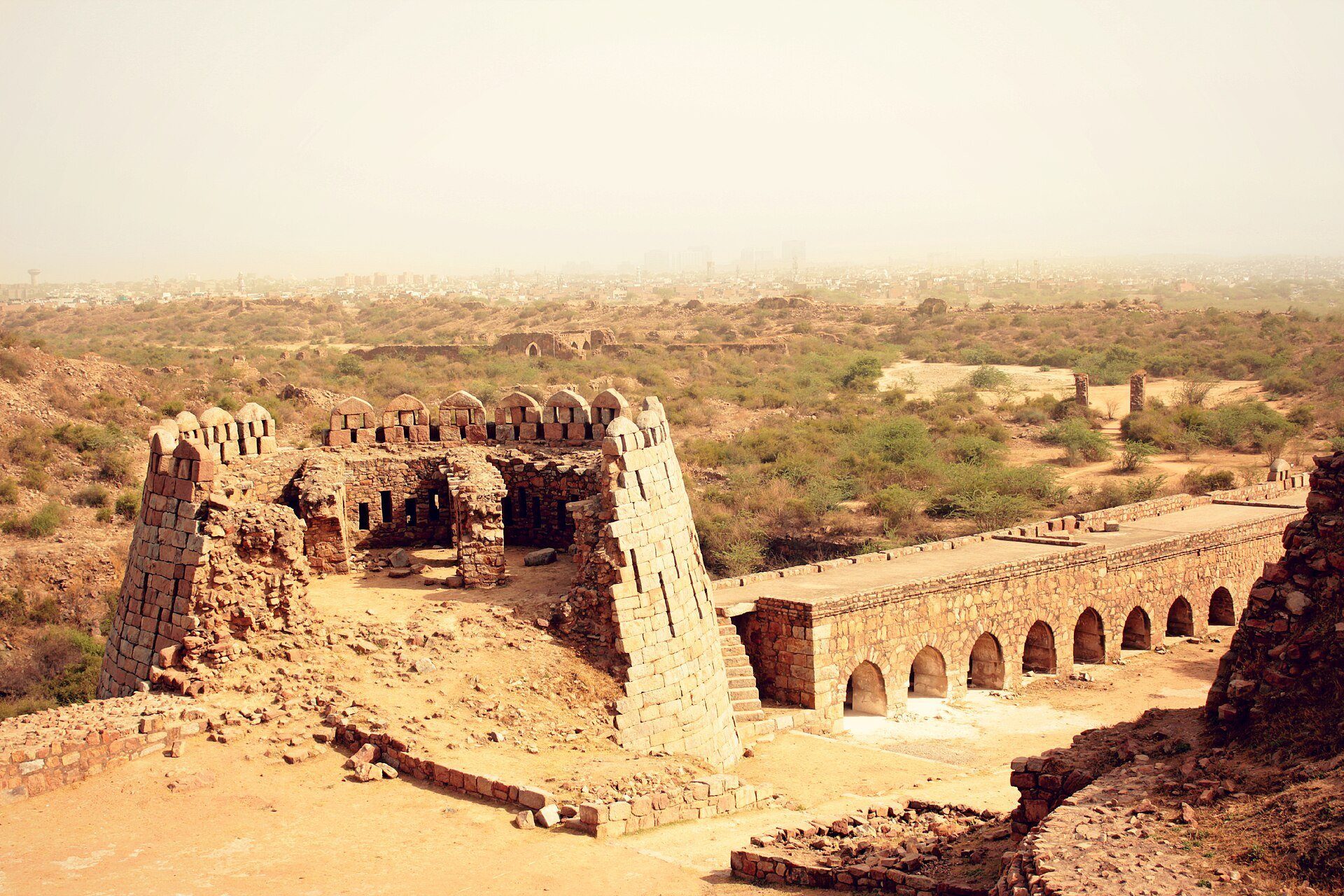
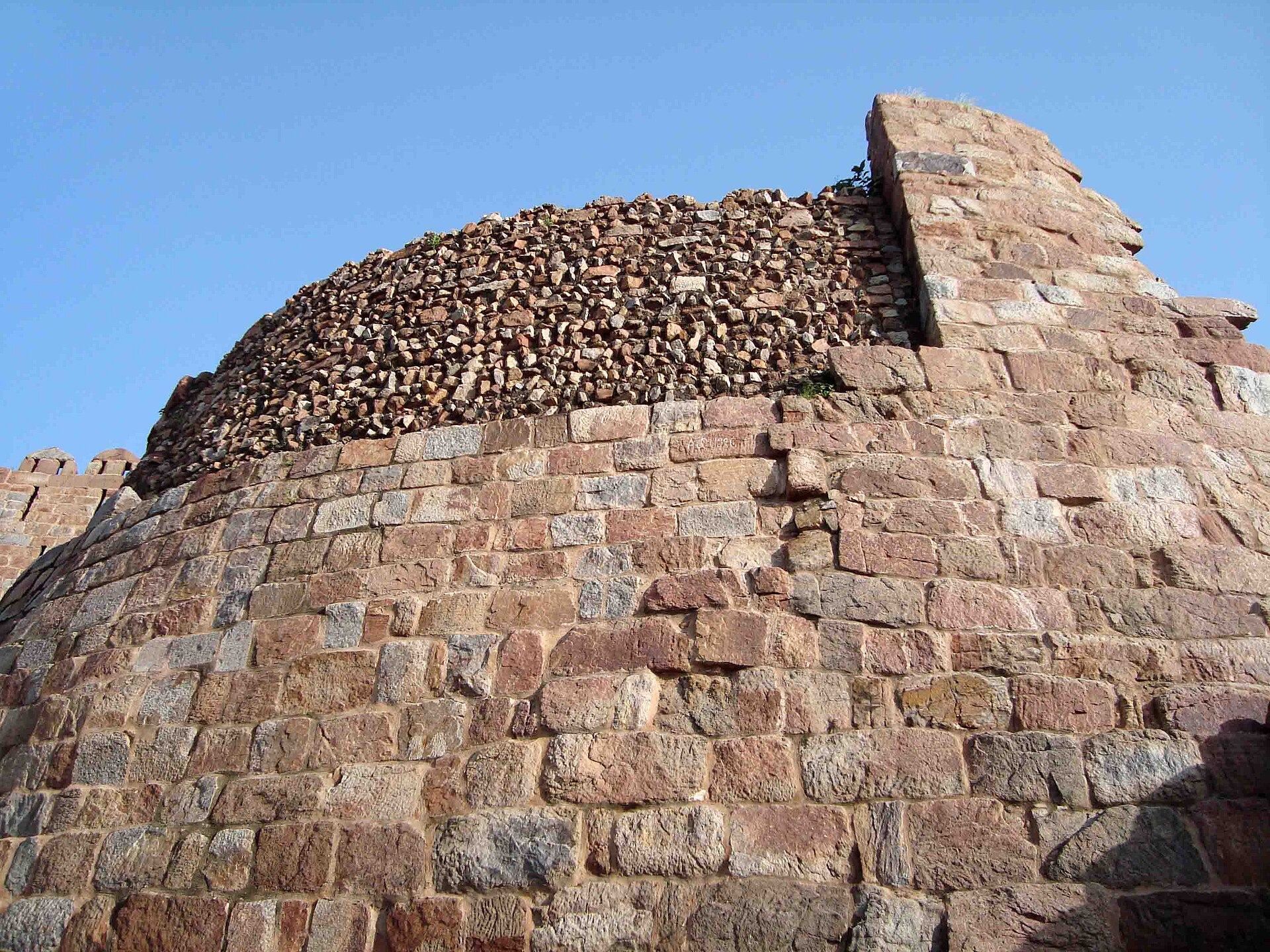
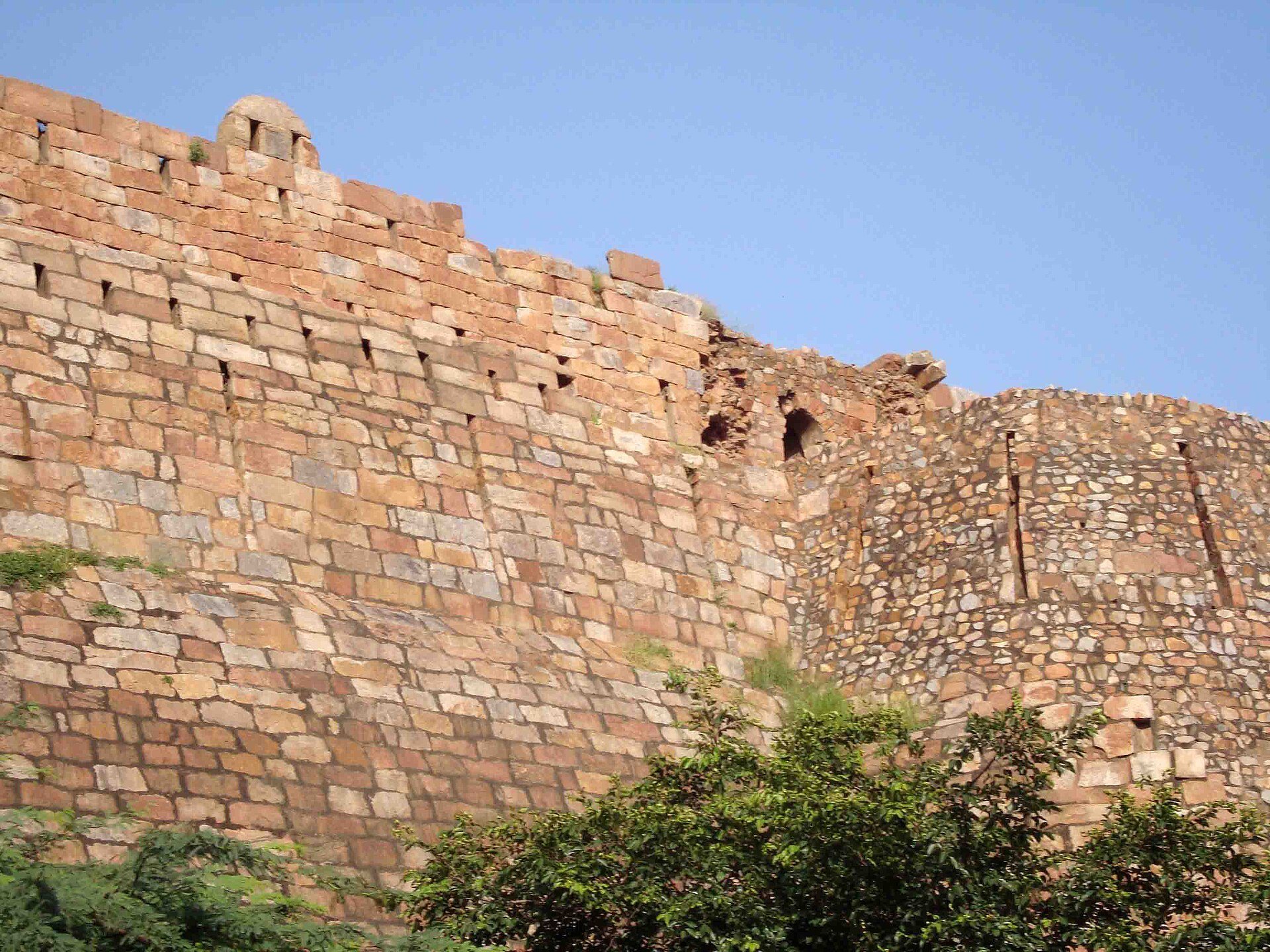
Tughlaqabad is arranged in an irregular, roughly half-hexagonal plan with a base of about 2.4 kilometers and a total circuit of approximately 6.4 kilometers. Its sloping walls are 10 to 15 meters high and were built from granite rubble set in lime mortar. Battlemented parapets crown the walls, while circular bastions, in places rising two stories, strengthen the defensive circuit.
The city originally had as many as 52 gates, of which 13 remain standing. Seven rainwater tanks served the settlement. Within the enclosure, the urban plan was divided into three main parts: a broad residential city with houses arranged along a rectangular grid between the gates, a citadel, and an adjoining palace area containing the royal residences.
Citadel and palace area
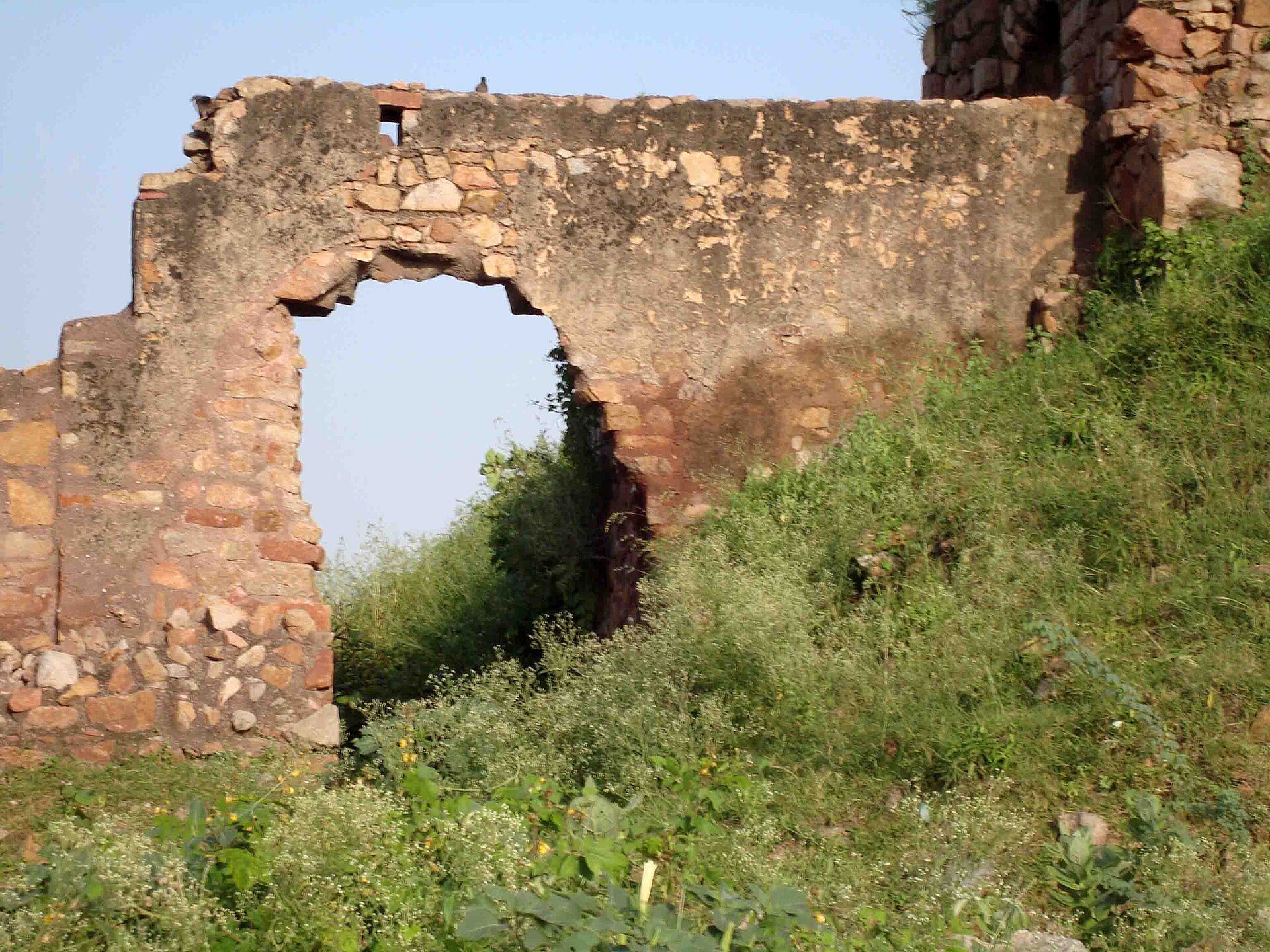
The citadel occupies the highest part of the site. Its remains include Bijai-Mandal, a tower, several halls, and a long underground passage beneath the tower area. The palace area stood beside the citadel and contained the royal residences. Dense thorny vegetation and neglect affect much of the former city, while modern settlement occupies parts of the old urban area, particularly around the lakes.
Ghiyath al-Din Tughluq’s mausoleum
South of the fort stands a fortified outpost containing the mausoleum of Ghiyath al-Din Tughluq. An elevated causeway, a raised passage across wet or low ground, links the outpost to the fort. It extends for about 180 meters, rests on 27 arches, and crosses the site of a former artificial lake. Mehrauli–Badarpur Road partly pierced the causeway around the twentieth century. The outpost’s former water landscape also included a large artificial reservoir south of Tughlaqabad.
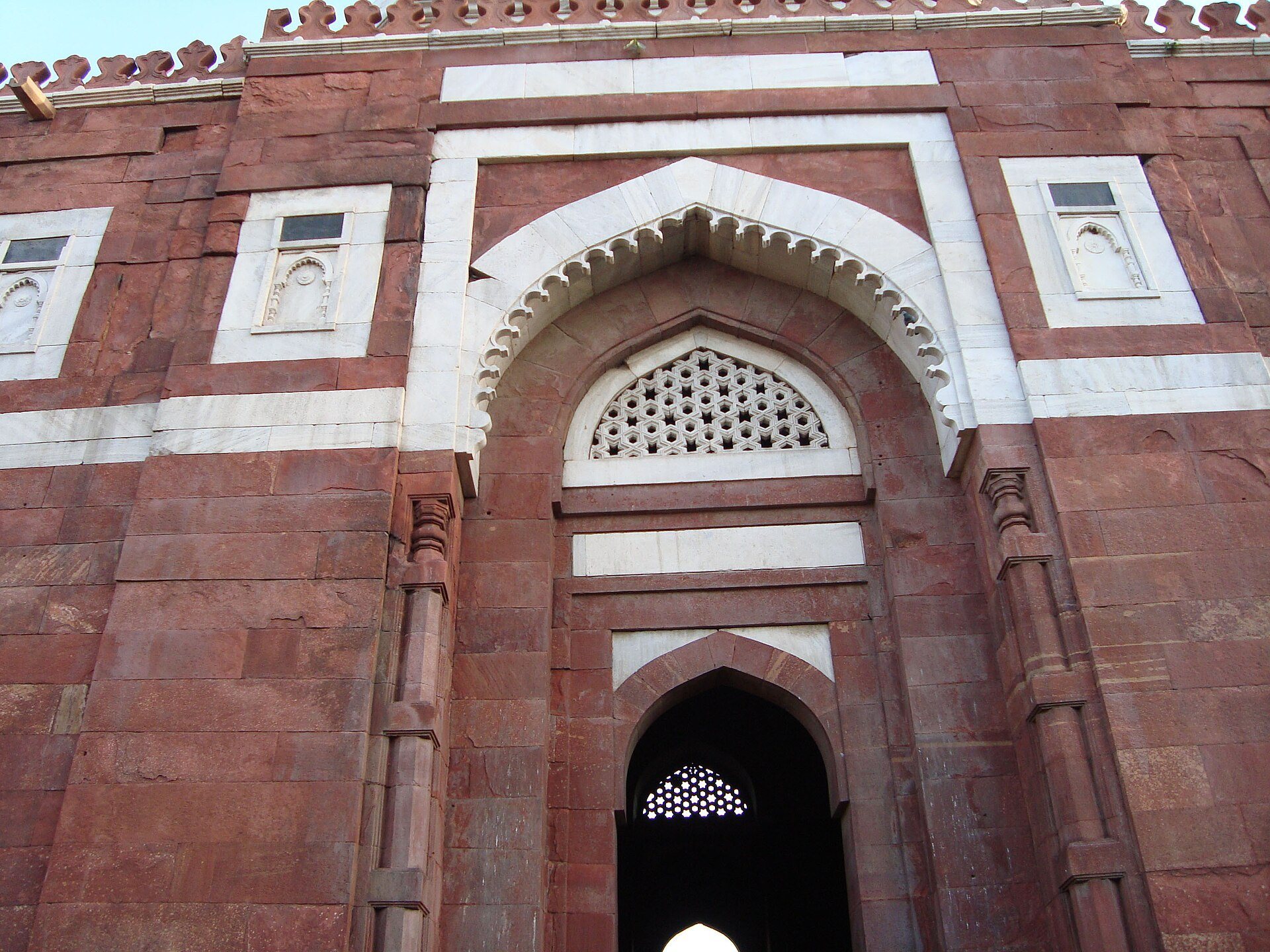
The mausoleum complex is entered through a tall gateway of red sandstone approached by steps, beyond an old pipal tree. The tomb is a square, single-domed structure measuring about 8 by 8 meters. Its walls slope inward and carry parapets. Unlike the granite fortifications, the mausoleum is faced with smooth red sandstone, with marble-inlaid inscribed panels and marble borders around the arches. The dome rests on an octagonal drum covered with white marble slabs and slate.
Three graves lie inside the tomb. The central grave belongs to Ghiyath al-Din Tughluq, while tradition identifies the other two as those of his wife and his son and successor, Muhammad bin Tughluq.
Zafar Khan’s tomb
A second octagonal tomb stands in the northwestern bastion of the mausoleum enclosure, whose walls contain pillared corridors. This smaller structure has a marble dome and inscribed marble and sandstone slabs above its arched doors. An inscription over the southern entrance identifies it as the tomb of Zafar Khan. His grave predated the fortified outpost and was incorporated into the later mausoleum design.
Adilabad Fortress
The remains of Adilabad Fortress are visible southeast of Tughlaqabad. Built later by Muhammad bin Tughluq, the fortress shares the principal construction characteristics of Tughlaqabad Fort and forms part of the surviving remains associated with the Tughlaq capital.