Tsukiyama Kofun: A Keyhole-Shaped Burial Mound in Japan
Site at a Glance
- Rating
- 3.9
- Popularity
- Very Low
- Country
- Japan
- Primary era
- Classical
- External website
- Open
- Eras represented
- Classical
- Civilizations
- Yamato
- Site type
- Burial
- Remains
- Burial Mound
On this page10 sections
History
Tsukiyama Kofun is a keyhole-shaped burial mound in Japan, located in the Kōzaki district of Ōita, and constructed around the middle of the fifth century during the Kofun period, the era of large elite burial mounds that flourished in Japan from approximately the third through sixth centuries. Its elaborate burial equipment and connection with the maritime community of the historical Kaifu District make it important for understanding the society of eastern Kyushu, including communities associated with naval forces.
Construction and burial
The mound was built as a zenpō-kōen-fun, a characteristic keyhole-shaped form with a rectangular front and circular rear. Its two stone coffins contained multiple burials and an extensive assemblage of weapons, tools, ornaments, textiles, and other objects. The quantity and range of these goods, together with the use of vermilion and silk, place the burial among the most lavish of its time in Ōita Prefecture.
The burials had escaped looting, allowing the grave goods to survive. This preservation gave the site particular archaeological value and helped establish its importance in interpreting the local maritime community. The northern coffin contained the remains of one woman, while the southern coffin held the bones of three people, including one woman. The burial of a woman alone in the northern coffin has encouraged the interpretation that she may have been involved in divination or ritual practice, although this remains uncertain.
Discovery and alteration
Tsukiyama Kofun was discovered in 1932 during tree-planting work. By then, its original form had already been damaged. A road had been built across the area between the front and rear sections, and earth was removed from the front section during house construction. The mound therefore no longer retained its complete keyhole shape when its archaeological importance became known.
The first investigation was led by two historical-site investigators from Ōita Prefecture. Sato Torao was later invited from Kyoto University to take part in the work. A further emergency investigation was carried out by the Ōita Prefectural Board of Education in 1966, in connection with new industrial-city construction.
Interpretations and commemoration
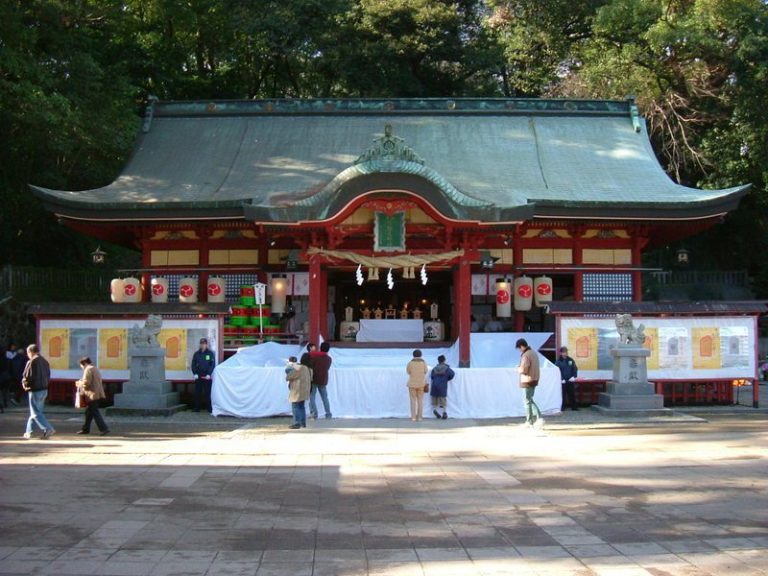
A Hachiman Shrine, a Shinto shrine dedicated to Hachiman, a deity traditionally associated with protection and warfare, was established on the summit of the rear circular section soon after the 1932 discovery. The exposed northern stone coffin was filled with rounded stones as a preservation measure, although this created later conservation problems. Festivals connected with the place were initially active but declined as their organizers grew older.
A festival dedicated to the stone coffin was revived in 1996, and its tenth edition in October 2005 was expanded with assistance from an Ōita City community-development program. Local tradition has identified the mound as the tomb of a female figure worshipped in the area. Another theory connects it with Himiko, the third-century female ruler associated in Chinese historical records with Yamataikoku, whose location and tomb remain debated. Neither identification has been established.
Tsukiyama Kofun became a National Historic Site of Japan on September 3, 1936. Its excavated artifacts were collectively designated archaeological cultural properties by Ōita Prefecture in 1998. Around 19 kofun have been identified in the surrounding area. Kamezuka Kofun was built in parallel with Tsukiyama Kofun, and the two mounds are mutually visible from their summits. Nekozuka Kofun, approximately one kilometer to the southeast, yielded a jasper hoe-shaped object, fragments of an Eastern Han mirror, iron swords, and an iron dagger-axe before development caused the site to disappear.
Remains
Mound and setting
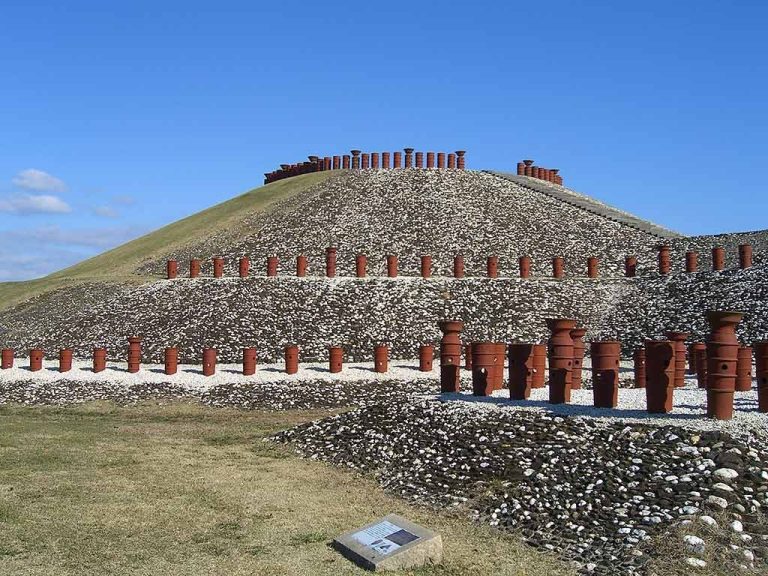
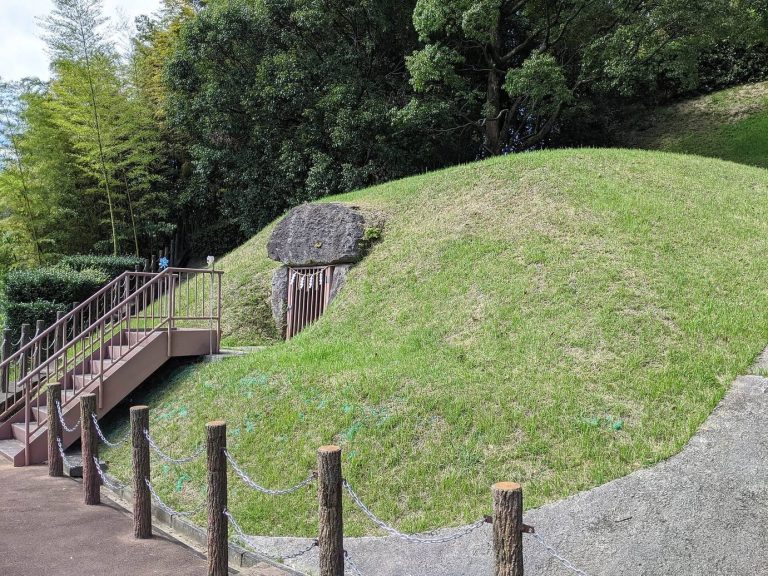
Tsukiyama Kofun stands at the end of a hill projecting from the northwestern coastal area of the Saganoseki Peninsula. The mound is approximately 90 meters long, with a rectangular front section about 50 meters long, 45 meters wide, and 8 meters high. Its circular rear section measures about 40 meters in diameter and rises approximately 10 meters. The mound appears originally to have been covered with fukiishi, stones laid over an earthen mound to help stabilize and protect its surface. The northern part of the rear section extends into the precincts of the local Hachiman Shrine, and the surviving form incorporates the effects of the earlier road cut and house-related earth removal.
Stone coffins
Northern coffin
Two box-shaped stone coffins made from chlorite schist were placed in the rear section. A box-shaped coffin is assembled from stone slabs rather than carved from a single block, while chlorite schist is a fine-grained metamorphic stone that can be shaped into slabs. The northern coffin measures 1.8 meters long, 0.65 meters wide, and 0.73 meters deep. It contained the remains of one woman, with a shell bracelet attached to her right arm. The coffin is thought to have been decorated internally with vermilion, and the body was placed on silk fabric.
Southern coffin
The southern coffin measures 1.95 meters long, 0.75 meters wide, and 0.8 meters deep. It contained the bones of three people, including one woman. Finds included 11 iron blades, among them ring-pommel swords, four iron swords, a spiral-pattern bronze mirror, 180 small glass beads, 90 iron arrowheads, and a hairpin-like implement. The coffin also held five axe heads, 13 hoe blades, two knives, two sickles, three yari-ganna woodworking blades, and six tweezer-shaped iron implements. A yari-ganna was an early Japanese blade used for working timber.
Burial materials
Approximately 34 kilograms of vermilion were used in the burial. The coffins are thought to have been coated with it on their interiors, while the bodies rested on silk. Excavated textile remains include fragments of hemp and silk, as well as silk wadding. Together with the swords, mirror, tubular beads, tools, and other objects, these materials form an unusually extensive burial assemblage and provide evidence for the materially elaborate character of the interments.