Tsudō-Shiroyama Kofun: An Early Keyhole-Shaped Burial Mound in Japan


Site at a Glance
- Rating
- 3.9
- Popularity
- Low
- Country
- Japan
- Primary era
- Classical
- Eras represented
- Classical, Medieval
- Civilizations
- Yamato
- Site type
- Burial
- Remains
- Burial Mound
On this page12 sections
History
Tsudō-Shiroyama Kofun is a keyhole-shaped burial mound in Japan, located in Fujiidera, Osaka. Built around AD 370 during the Kofun period, when large mounds were constructed for elite and ruling individuals, it is among the earliest mounded tombs in the Furuichi Kofun Group, a World Cultural Heritage site. Its early date places it before Konda-yama Kofun and connects it with the development of large-scale burial construction in Kawachi.
Construction and early significance
The mound is generally dated to the latter half of the fourth century. Its two-moat arrangement and outer embankment have been interpreted as an early form of the layout later used for royal burial mounds in the fifth century and after, including Konda Gobyōyama Kofun and Daisen Kofun. This interpretation places Tsudō-Shiroyama within a possible early transfer of major kofun construction from Yamato to Kawachi.
The status of the buried person remains uncertain. Some interpretations identify the mound as an early royal tomb, while others reject that classification. The debate includes comparisons with other large mounds in the Saki and Umami regions, whose dimensions and distribution have been used to question whether size alone establishes royal status.
Burial discovery and proposed occupants
Tsudō-Shiroyama Kofun was not identified as an imperial tomb during the designation process of the early Meiji period. In 1912, stone slabs were removed from the rear mound for use in a shrine monument. Their excavation revealed a vertical stone burial chamber, a large long-chest-shaped stone coffin, mirrors, arrowheads, and other grave goods.
The Imperial Household Agency later designated the site as the Fujiidera Imperial Mausoleum Reference Site, meaning that it is managed as a possible imperial burial place even though the occupant has not been archaeologically established. Emperor Ingyo was proposed as the occupant, but the burial identity remains unknown.
Other proposed identifications draw on early imperial chronicles and later interpretation. Scholars who regard the mound as royal have suggested Emperor Chuai, described in those chronicles as the first sovereign buried in Kawachi. Koichi Mori associated the three waterfowl-shaped clay funerary objects with traditions concerning Yamato Takeru, a legendary imperial prince said to have become a white bird after death, and proposed that the mound might be one of Yamato Takeru’s three traditional tombs. He also suggested Prince Shinobikuma, who was said to have rebelled against Empress Jingu and Prince Homuda Wake, later Emperor Ojin, as a possible builder.
Another interpretation identifies the occupant with King Hondamawake, described as the father of Emperor Ojin’s consort. Under this view, the mound belonged to a powerful local leader who coordinated smaller clans before royal authority moved into Kawachi. Yoshinobu Tsukaguchi interpreted Hondamawake as a genealogical representation of connections among the Kawachi coalition, the later imperial lineage, and powers around Mount Miwa.
Castle use and archaeological protection
During the Muromachi period, a medieval era conventionally dated from the fourteenth through the sixteenth centuries, a small fortress called Shiroyama Castle was built by taking advantage of the mound’s topography. Part of the kofun was cut away during this use, altering the original form.
Archaeological investigations by the Osaka Prefectural Board of Education in 1980 and the Fujiidera Municipal Board of Education in 1983 confirmed projecting platforms, two concentric moats, and a stone-paved outer embankment. They also recovered three waterfowl-shaped haniwa, clay funerary objects placed around or on burial mounds, from altar-like island structures within the moats.
The site became a national historic site under the name “Shiroyama Kofun” on January 21, 1958, and its protected area was enlarged on March 14, 1966. On January 29, 2001, it was incorporated with ten other previously designated mounds, together with Aoyama Kofun and Banshoyama Kofun, into the national historic-site designation of the Furuichi Kofun Group. A further area was added on March 10, 2015.
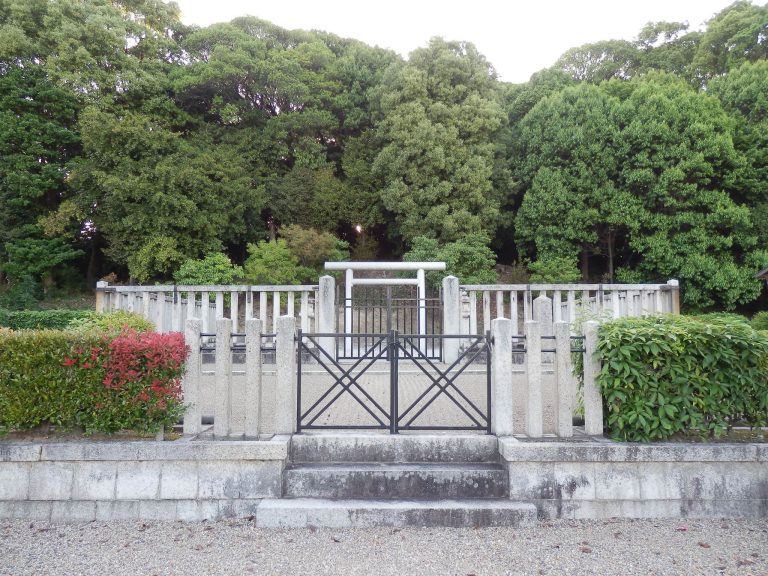
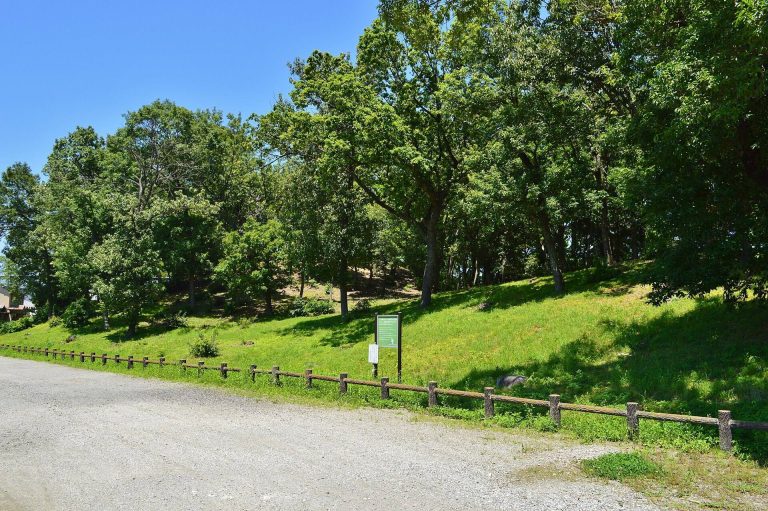
The mound has long been used as a freely accessible recreation area by local residents. The summit of the rear mound is fenced and managed by the Imperial Household Agency as an Imperial Mausoleum Reference Site.
Remains
Mound and surrounding earthworks
Keyhole-shaped mound
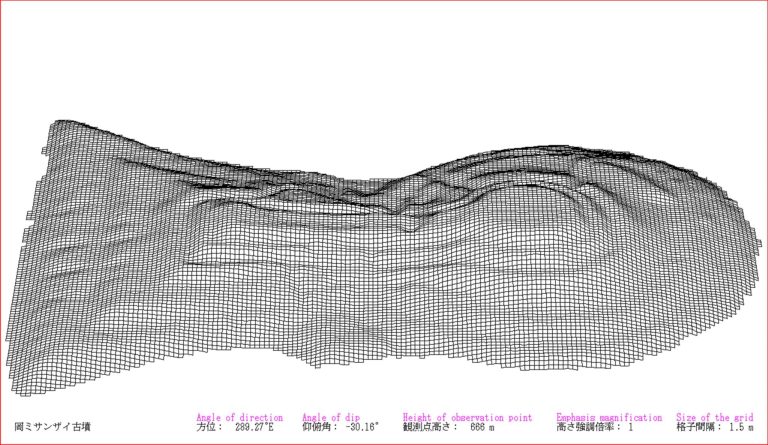
Tsudō-Shiroyama Kofun has a keyhole-shaped plan, combining a rounded rear mound with a rectangular front section. The mound measures 208 meters in total length and reaches 16.9 meters in height. Its front section faces southeast, and projecting platforms extend from the mound. The structure ranks thirty-first in size nationally.
Moats and embankments
Two concentric moats surround the mound. The confirmed boundary arrangement includes a middle embankment about 30 meters wide, an outer moat about 25 meters wide, and an outer embankment about 20 meters wide with a stone-paved surface. Residential land and agricultural fields occupy the outer moat, and the overall extent of the site exceeds 400 meters when that moat is included.
Island-like platforms
Near both sides of the front section, square-mounded island structures were formed within the moats. Their altar-like character is associated with ritual activity, and the three waterfowl-shaped haniwa were recovered from these structures.
Burial chamber and grave goods
Stone burial installation
A vertical stone chamber was placed within the rear mound. It contained a large long-chest-shaped stone coffin, a stone sarcophagus modeled on a traditional Japanese storage chest. A roof stone from the chamber is displayed at the Shiroyama Kofun Historic Site Guidance Building, Mahora Shiroyama, where a replica of the coffin is also displayed.
Haniwa and other objects
The excavated material includes bronze mirrors, beads, iron arrowheads, and other grave goods. The haniwa assemblage includes cylindrical examples as well as forms representing waterfowl, screens, houses, shields, canopies, quivers, ceremonial parasols, and finned cylinders.
The three waterfowl-shaped haniwa date approximately to the fourth century. Fujiidera City holds them, and they are displayed at Aisel Shura Hall. They became nationally designated Important Cultural Properties on June 9, 2006. Fourth-century finned cylindrical and ceremonial parasol-shaped haniwa, along with other excavated examples, are held by the Osaka Prefectural Board of Education and displayed at the Osaka Prefectural Chikatsu-Asuka Museum. A screen-shaped haniwa is displayed at Mahora Shiroyama, while additional figural haniwa are shown at Aisel Shura Hall.