Truvor’s Settlement: An Early Medieval Fortified Site at Izborsk, Russia
Site at a Glance
- Popularity
- High
- Country
- Russia
- Primary era
- Medieval
- Eras represented
- Medieval, Early Modern
- Civilizations
- Kievan Rus, Novgorod Republic, Pskov Republic, Russian
- Site type
- City
On this page16 sections
History
Foundation and early town
Truvor’s Settlement is an early medieval fortified settlement at Izborsk, Russia, founded by the Krivichs, an East Slavic tribal people, probably in the late 7th century or around the turn of the 7th and 8th centuries. It was first recorded in 862. From its beginnings, the settlement supported crafts and trade and drew a varied population, becoming one of the region’s important Krivich centers.
In the 8th and 9th centuries, limestone molds were used to cast ornaments, amid a revival of decorative styles associated with the Prague archaeological culture, which is linked to early Slavic communities. A major fire in the first half of the 10th century preceded Izborsk’s change from a tribal center into an early medieval town with fortified and residential districts. The promontory became a princely and military citadel, while craftspeople lived in the surrounding settlement. Merchants, craftspeople, and miners also lived beyond the fortifications.
Frontier fortress and relocation
By the late 11th century, Izborsk was a strategic town on the frontier of Novgorod territory, the lands governed by the medieval polity centered on Novgorod. Its defenses were strengthened. Livonian and German crusaders attacked the fortress during the 13th century.
In the early 14th century, the fortified center was moved to a new location. The Pskov Chronicle notes that it had been established in a new place by 1303. The old fortress was destroyed in 1330, and a replacement was built about 400 metres to the south on Gerava Hill.
Archaeology and historical memory
The site’s history is conventionally described as extending from the 7th to the 18th century. In a 2007 interpretation, archaeologist V. V. Sedov divided its development into five phases: two pre-urban phases from the 8th to the 10th centuries, a wooden-citadel phase in the 11th and early 12th centuries, and two later phases spanning the late 12th to early 14th centuries.
Excavations began in 1924, when Swedish archaeologist Birger Nerman uncovered medieval pottery and fragments of Scandinavian objects. An expedition of the USSR Academy of Sciences’ Institute of the History of Material Culture began work in 1946. Its researcher S. A. Tarakanova concluded that a Slavic settlement had appeared here no earlier than the 8th or 9th century, making Izborsk younger than Pskov. Grigory Grozdilov led Pskov archaeological expeditions from 1953 to 1962. An expedition led by Sedov began in 1971, and archaeological research continued until 1992.
A popular tradition links the Truvor Cross to the Varangian Truvor, a legendary Scandinavian figure said to have been buried there. The tradition describes him as Rurik’s brother and ruler of Izborsk from 862 until his death in 864; Rurik himself is a semi-legendary ruler associated with early Rus. A series of twelve medals on ancient Russian history, commissioned by the Russian empress Catherine II, included an imagined portrait of Rurik and a reverse showing Truvor’s burial mound with the inscription that he died at Izborsk in 864. The settlement is a cultural heritage property of federal significance in Russia. Its Church of St Nicholas is separately listed as a nationally significant architectural monument under a 1960 decision.
Remains
Setting and layout
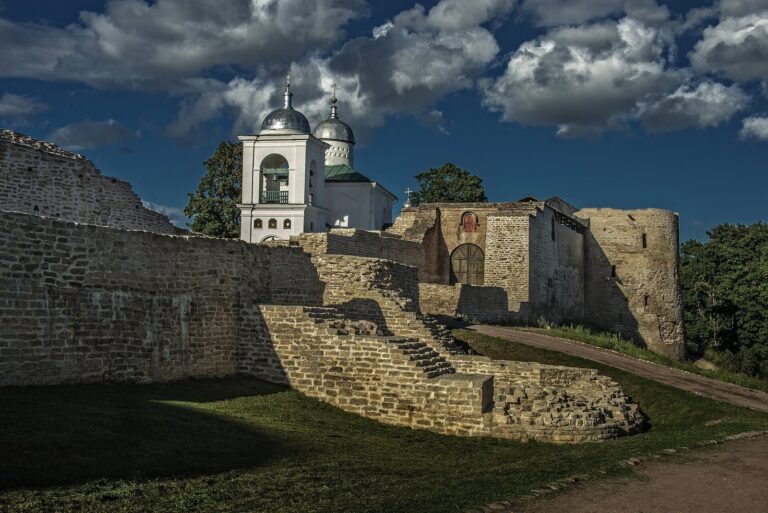
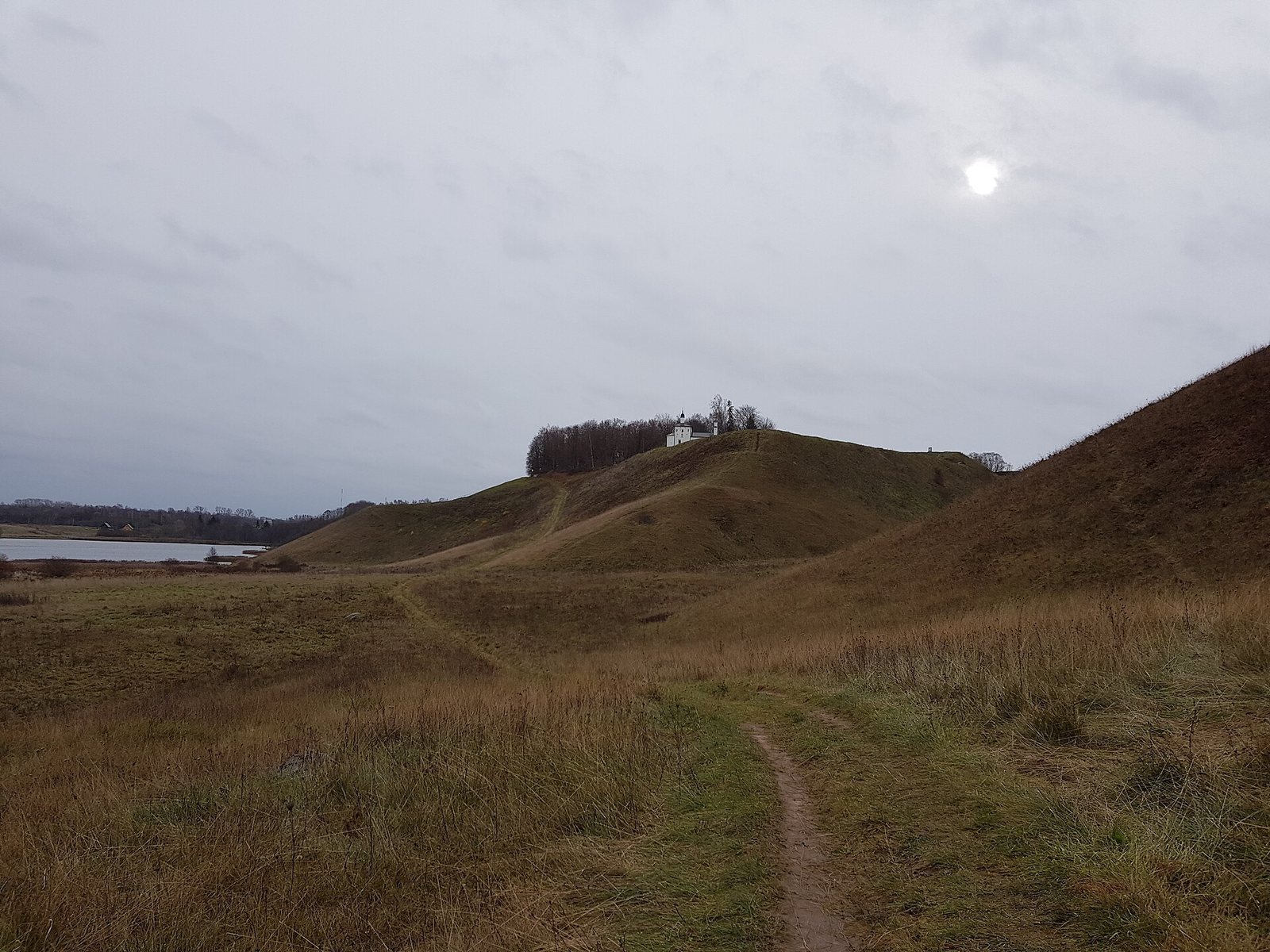
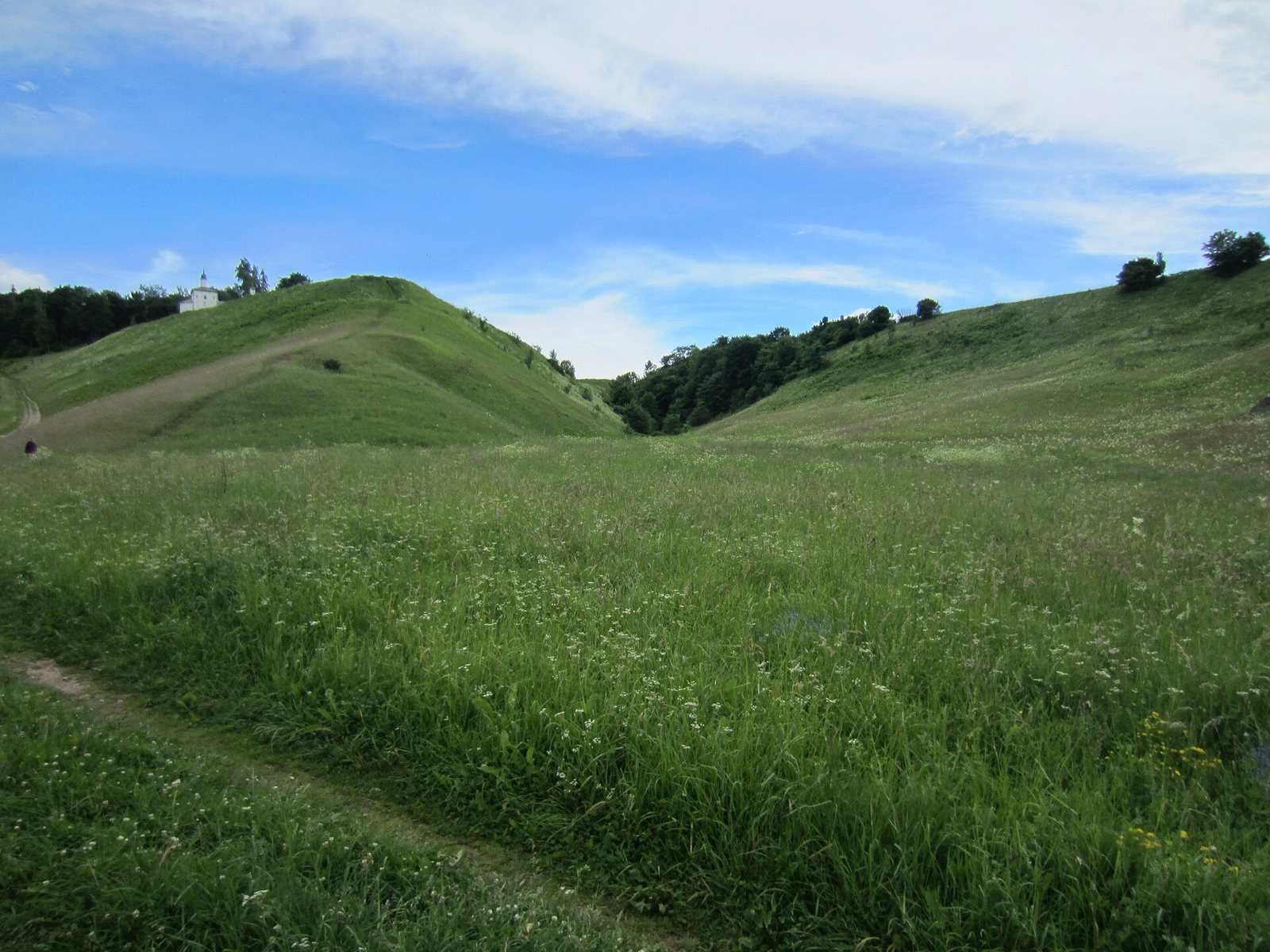
The settlement occupies a pointed, roughly triangular promontory on an elevated plateau above Lake Gorodishchenskoye and the Izborsk-Maly Valley. The plateau rises as much as 48 metres above the lake. The site covers about one hectare, while its inhabited area is measured at roughly 7,000 square metres. On the landward side, an earthwork rampart, up to six metres high, and a ditch about three metres deep formed part of the defenses. Early fortifications also included timber walls up to six metres high.
Buildings and fortifications
Domestic buildings
Slavic residents lived in above-ground log houses with wooden floors and clay ovens. Buildings in one corner of the settlement, associated with a non-Slavic population, had beaten-earth floors and hearths. About one-tenth of the pottery from Izborsk was of the Balto-Finnic Rõuge type.
Citadel and surrounding settlement
After the 10th-century fire, an oak-log wall and gate enclosed the citadel on the promontory. Domestic objects, weapons, and ornaments were recovered within it. The surrounding settlement had a curved earth rampart on its landward side, with a stone wall along the crest and a ditch.
Late fortifications
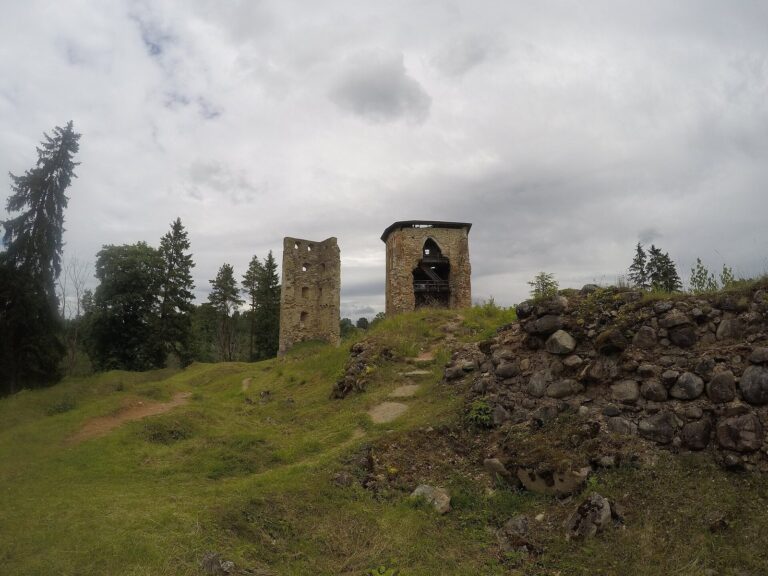
Strengthening in the late 11th century included stone walls and a substantial watchtower. The tower was hexagonal, with six-metre sides and a diameter of ten metres. A concealed passage in the adjoining wall could be used during surprise sieges.
Citadel wall remains
In 1974, excavators found a stone wall and adjoining channels. They were first interpreted as traces of a wooden wall, then identified as remains of the citadel wall.
Markers, cemetery, and later buildings
Boundary stone
A boundary stone found in 1972 measures about 30 by 22 centimetres and is 15 centimetres thick. Its Cyrillic inscription, written in an alphabet used for Slavic languages, has two parts translated as “boundary” and “our part of Vorotkova.”
Cemetery and Truvor Cross
An ancient cemetery lies near the settlement, with stone crosses surviving from the 15th century. The large limestone Truvor Cross was probably erected in the early 15th century. It measures 2.36 metres high, 1.42 metres wide, and 21 centimetres thick, and bears an inscription translated as “King of Glory, Jesus Christ conquers.”
Carved limestone slabs
Several nearby limestone slabs carry geometric carvings and are known in English as “Babylons.”
Church of St Nicholas
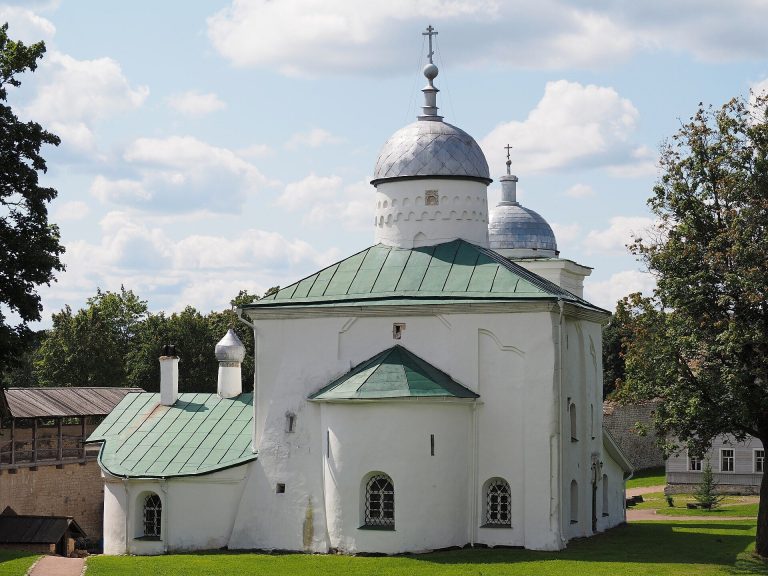
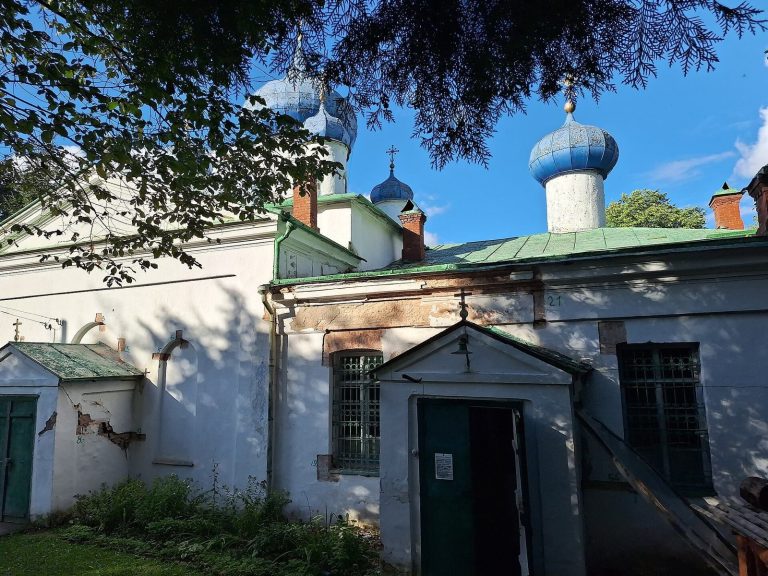
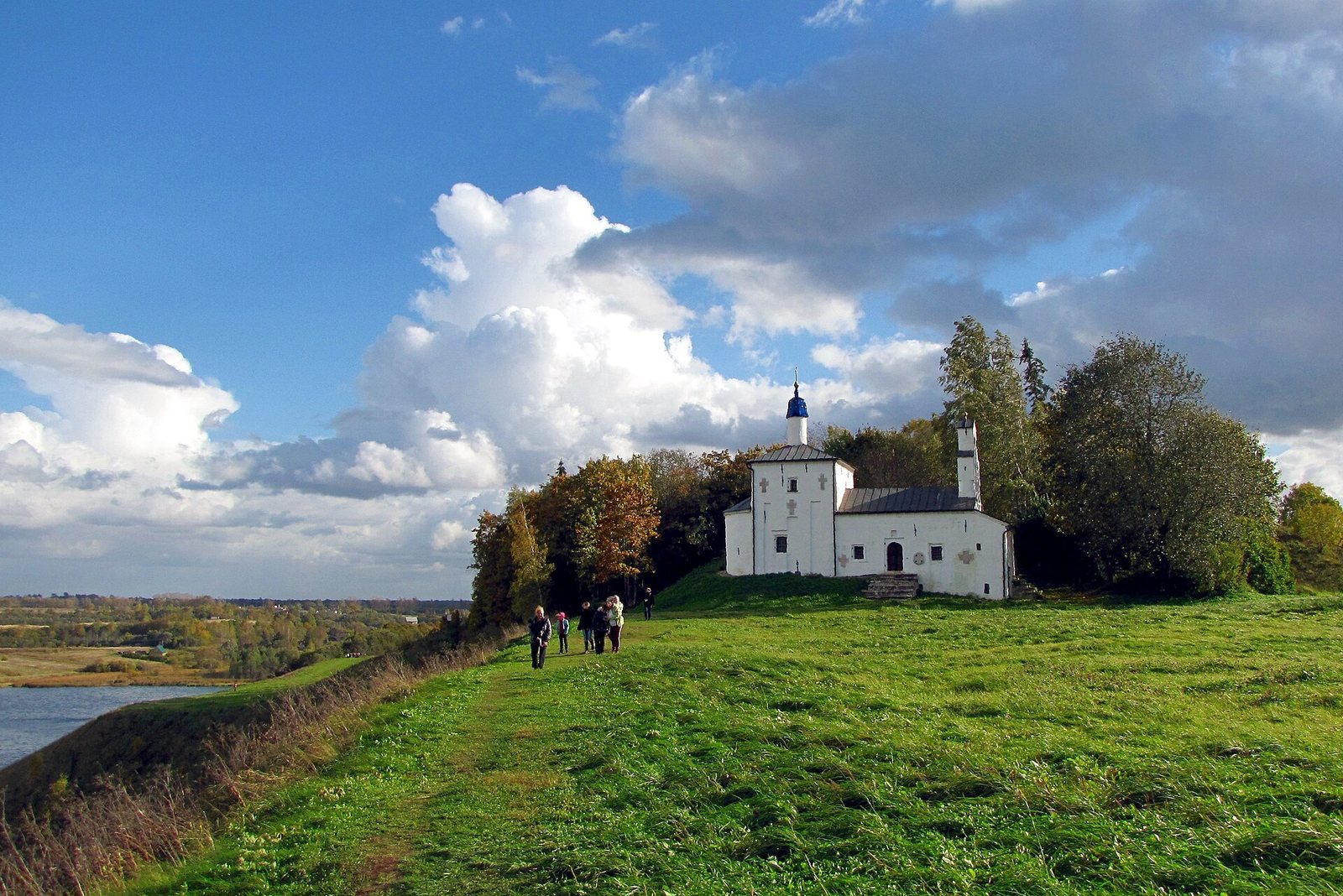
The Church of St Nicholas the Wonderworker was built in the 17th century in the southeastern part of the former fortress, over the remains of an Orthodox men’s monastery. Saint Nicholas was a Christian bishop of Myra, venerated in Eastern Orthodox Christianity.