Truro Cathedral: An Anglican Cathedral in Cornwall
Site at a Glance
- Rating
- 4.7
- Popularity
- Very High
- Country
- United Kingdom
- Primary era
- Modern
- Eras represented
- Early Modern, Modern
- Civilizations
- British, English
- Site type
- Religious
- Remains
- Cathedral
On this page15 sections
History
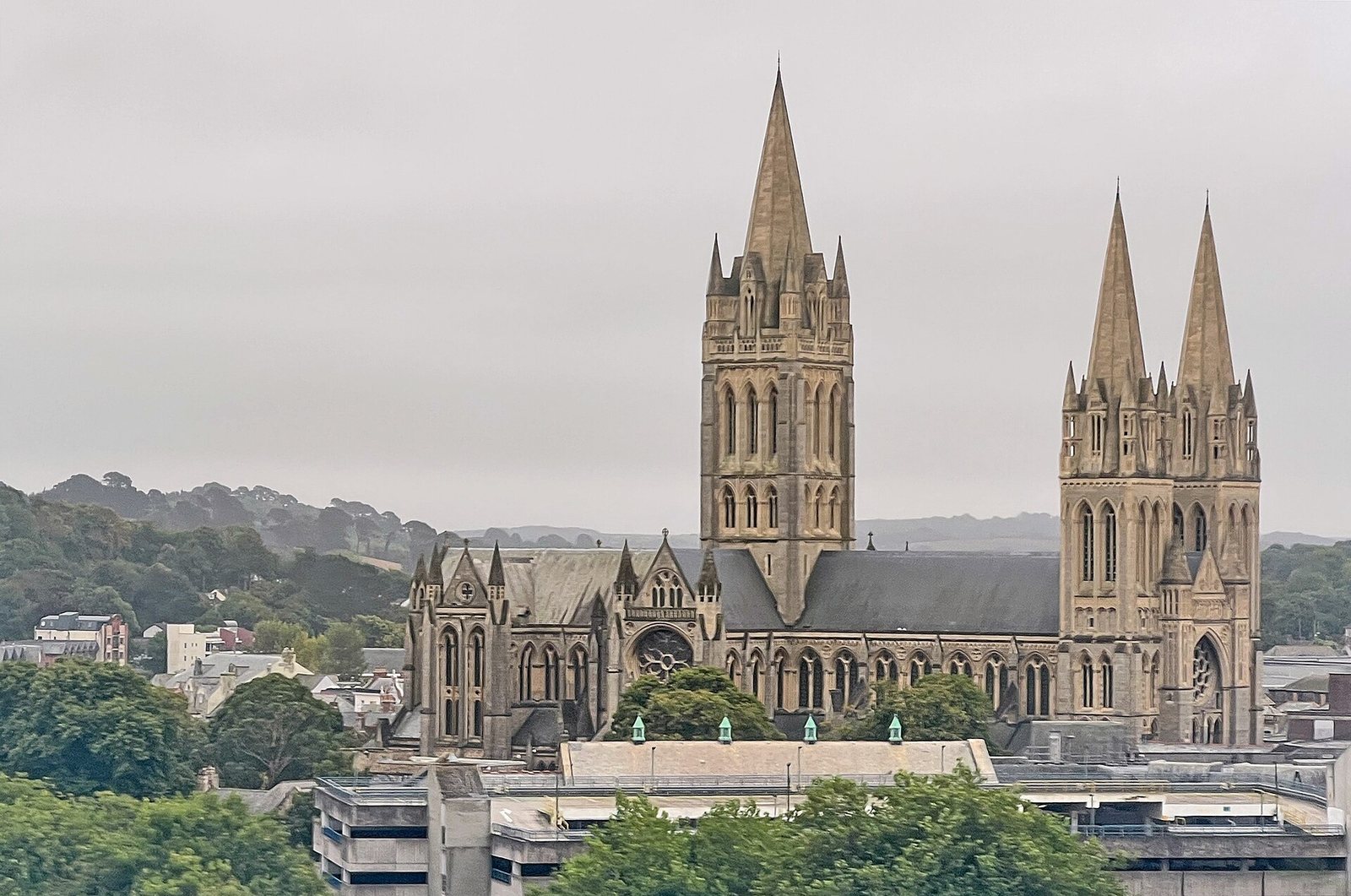
Truro Cathedral is an Anglican cathedral in Truro, Cornwall, United Kingdom. Designed by John Loughborough Pearson in the Gothic Revival style, a movement drawing on medieval architecture, its construction began in 1880. It was the first Anglican cathedral built on a new site in England since Salisbury Cathedral in 1220.
Foundation and consecration
The Diocese of Truro was established in December 1876. Its first bishop, Edward White Benson, was consecrated at St Paul’s Cathedral on 25 April 1877. The new cathedral rose on the site of Truro’s sixteenth-century parish church of St Mary the Virgin, whose final service took place on 3 October 1880. Most of the old building was demolished later that month to clear the site.
From 24 October 1880 until 1887, a temporary wooden building on an adjacent site served as the cathedral. It held fewer than 400 people, with free, unreserved seating. On Christmas Eve 1880, Benson introduced the evening service of Nine Lessons and Carols, a Christian service combining biblical readings and carols, there. The cathedral choir and transepts, the church’s crosswise arms, were complete by October 1887.
The cathedral was consecrated on 3 November 1887 by Benson, who had by then become Archbishop of Canterbury. The service was attended by his successor as Bishop of Truro, George Wilkinson, 20 other bishops, civic representatives, diocesan clergy, and about 2,000 people. Pearson died in 1897, and his son Frank Loughborough Pearson continued the project. The central tower was finished in 1905; the cathedral was completed in 1910 when its western towers opened.
Church life and governance
Truro Cathedral belongs to the Church of England’s Diocese of Truro, a church district overseen by a bishop, within the Province of Canterbury, a group of dioceses under an archbishop. It follows the High Church tradition, which places emphasis on liturgy, sacraments, and historic church forms, and is dedicated to the Blessed Virgin Mary. At the foundation, Benson was authorized to establish 24 honorary canonries, non-residential cathedral appointments. The Truro Chapter Act of 1878 authorized residentiary canonries, posts held by clergy serving at the cathedral. In 1882, a canonry transferred from Exeter provided income for two canonries at Truro. The sub-dean’s office was endowed in 1906. The bishop also held the dean’s office, which leads the cathedral clergy and chapter, while it lacked independent funding; this continued at least until 1925. The 1878 Act was repealed in 1959.
Twentieth century to the present
The cathedral was listed as a Grade I building on 29 December 1950. Its choral tradition has continued without interruption since 1876. After Truro Cathedral School closed in 1982, choristers received bursaries to attend Truro School, and girls joined the choir from 2015. In 1994, the cathedral hosted the Royal Maundy, a Christian ceremony in which the monarch distributes specially issued money; Queen Elizabeth II presented Maundy money to 134 people from Cornwall.
Remains
Plan and architectural design
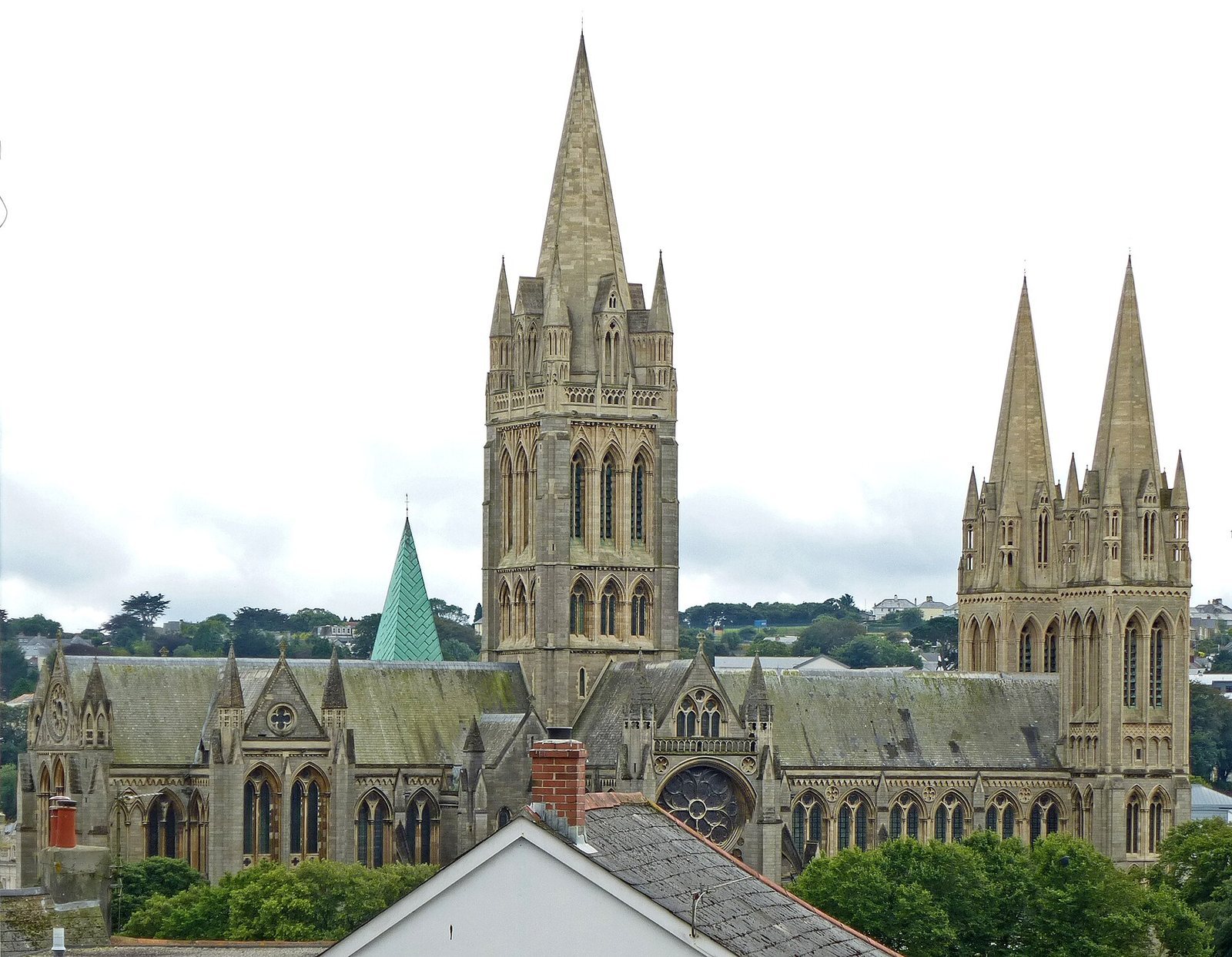
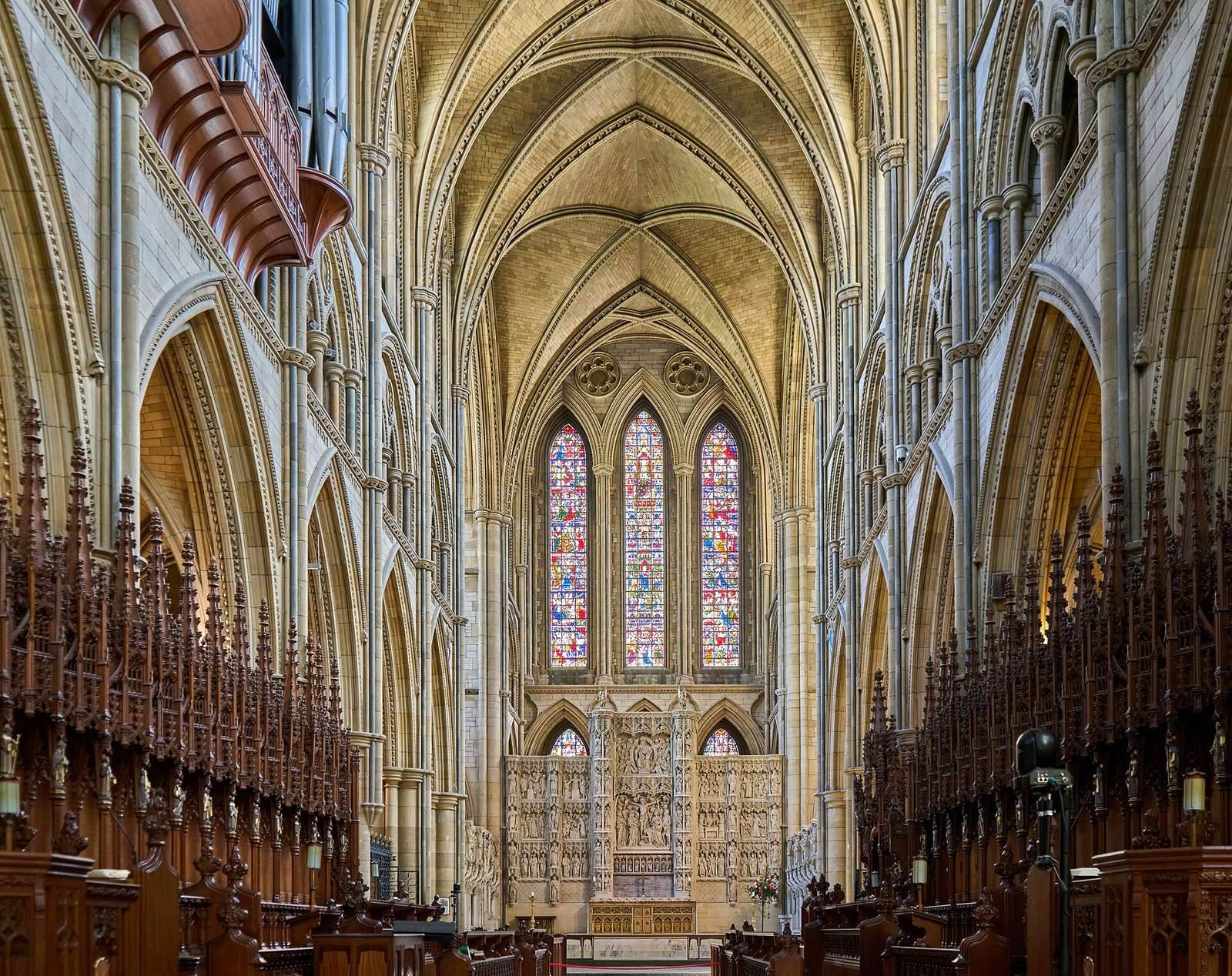
Pearson’s design combines the Early English style of English Gothic architecture with French influences, particularly in its spires and rose windows. The cathedral’s resemblance to Lincoln Cathedral reflects Pearson’s appointment as architect there and Benson’s earlier service there as canon chancellor, a cathedral canon with traditional responsibilities for theological learning and education. The plan bends almost two metres northward to fit the restricted city-centre site, where houses and shops stood close around it.
Exterior and interior fabric
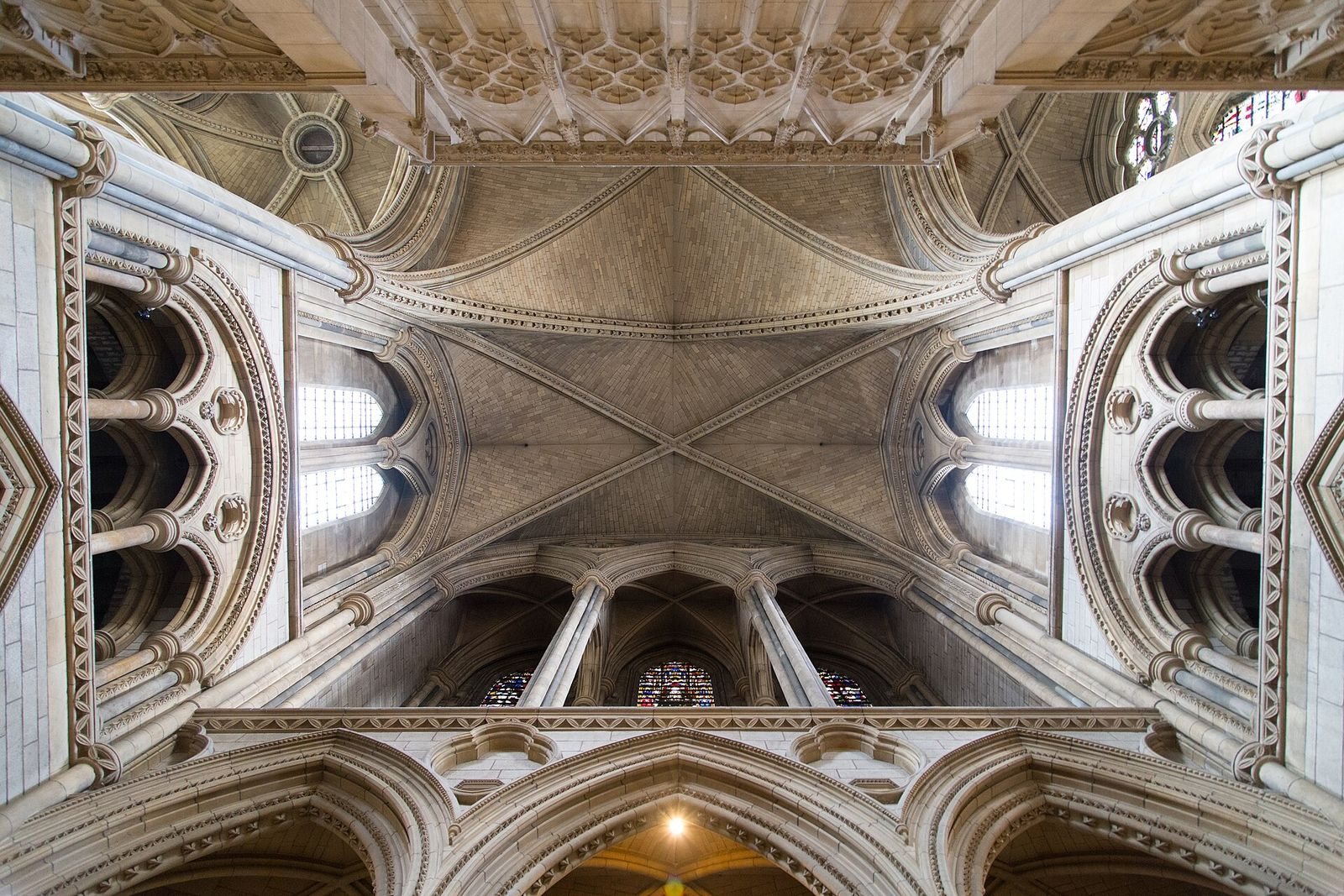
The central tower and spire rise 76 metres, while the western towers reach 61 metres. Mabe granite forms the exterior and St Stephen’s granite the interior, with Bath and Polyphant stone used for decorative trim and column shafts. The spires and turret roofs are stone, apart from the copper spire above the bell tower at the west end of St Mary’s Aisle. Other roofs are slate, and stone vaulting extends throughout the cathedral.
St Mary’s Aisle
The south aisle of the former parish church survives as St Mary’s Aisle, incorporated into the cathedral’s south-east corner and still serving as the city-centre parish church. Three memorial brasses are associated with Cuthbert Sydnam (1630), Thomas Hasell (1567), and George Fitzpen, a parish rector.
Chapels, chapter house, and sculpture
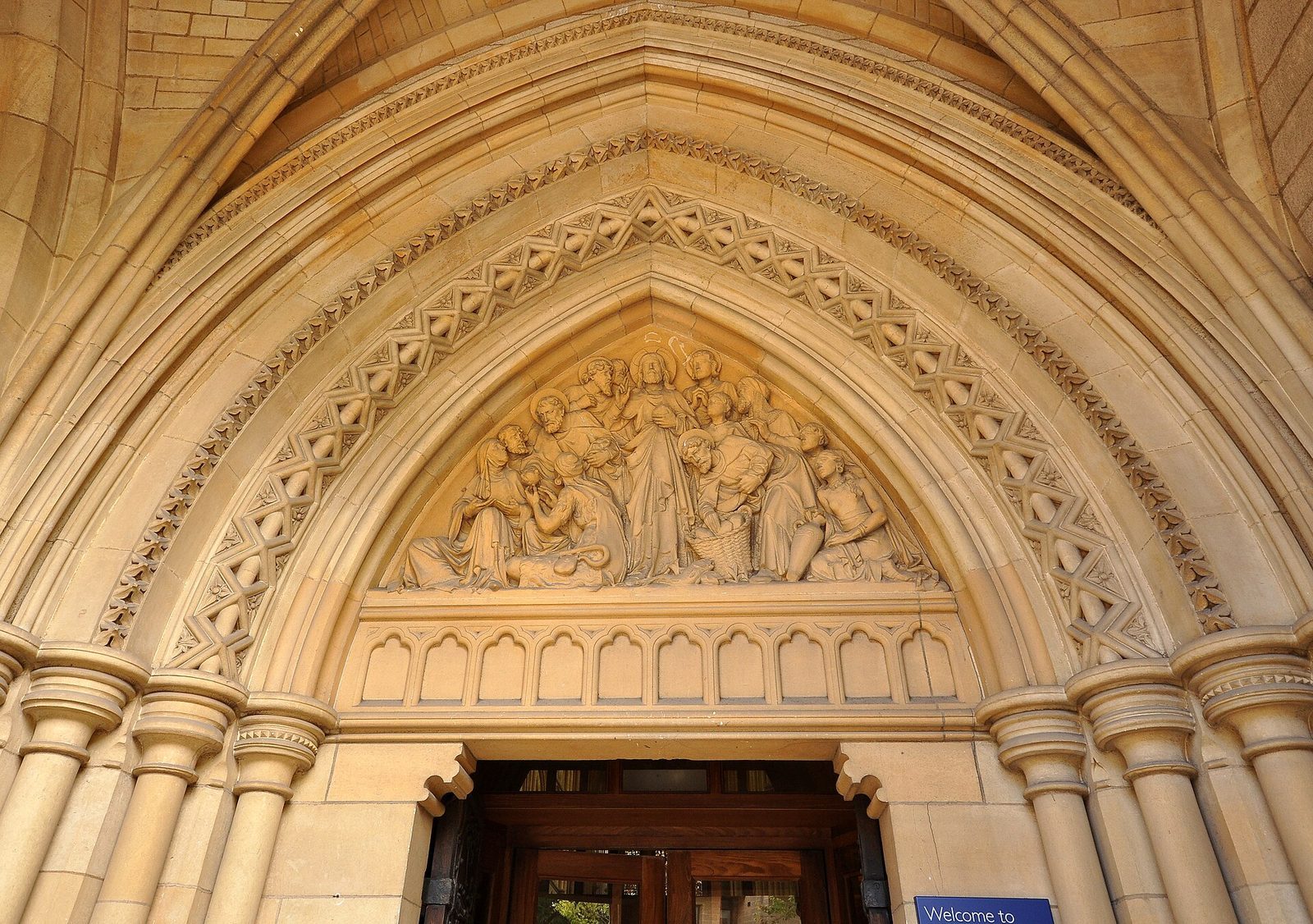
The Jesus Chapel and the Chapel of Unity and Peace provide spaces for quiet and prayer. A chapter house, a meeting place for the cathedral’s chapter, was added on the south-east side in 1967 to a design by John Taylor. Nathaniel Hitch created the cathedral’s decorative sculpture, including the reredos, the structure behind an altar.
Organs
Father Willis organ
Built in London in 1887, the Father Willis organ was brought to Cornwall by boat. Its design is almost identical to an organ Willis built the previous year for St Michael’s, Coventry. The Great and Swell divisions include tierce mixtures, groups of pipes that include a note a third above the principal pitch. The Choir division has covered-pipe stops known as gedackts, and the pedal division, played by foot pedals, is small. An electric blower was added in the 1920s. A conservative restoration in 1963 retained the instrument’s original sound design and voicing. Its console was moved from high within the main case to a gallery south of the choir stalls; previously, access involved climbing a spiral staircase in the north transept. The operating system combines lever assistance, air pressure, and mechanical linkages.
Organ in St Mary’s Aisle
This two-keyboard organ was originally built by Renatus Harris and installed in Truro by John Byfield in 1750. It was moved to the temporary church in 1880, then substantially rebuilt and reduced in size in 1887 for installation in its present position in St Mary’s Aisle.
Continuo organ
The cathedral also has a four-stop continuo organ by Kenneth Tickell, an instrument used to provide musical accompaniment.
Bells
Ten bells cast by John Taylor & Co in 1909 form the principal ring. The largest, the tenor, weighs 1,719 kilograms, or 33 long hundredweight, 3 quarters, and 10 pounds. Four more Taylor bells were installed in 2011: two brought the ring to twelve, while two smaller bells allowed for a lighter sound. The Green Tower holds six bells formerly belonging to St Mary’s Parish Church, five of which are used for chiming.
Stonework and restoration
Bath stone in the more decorative areas weathered in Cornwall’s maritime climate, where salt and sand eroded exposed surfaces into a honeycomb texture. A phased restoration campaign began in 2002, addressing the east end first, followed by the west front and towers in 2004–05, then the central tower and spire from 2009–10. Work repaired stonework at the east end and damage to ironwork on its stained-glass windows. In the east-end and west-front work, Bath stone was replaced with more durable Seyford stone.