Trosa Country Church: A Medieval Church in Vagnhärad, Sweden
Site at a Glance
- Country
- Sweden
- Primary era
- Medieval
- Eras represented
- Medieval, Early Modern, Modern
- Civilizations
- Swedish
- Site type
- Religious
- Remains
- Fortified Church
On this page12 sections
History
Medieval foundation
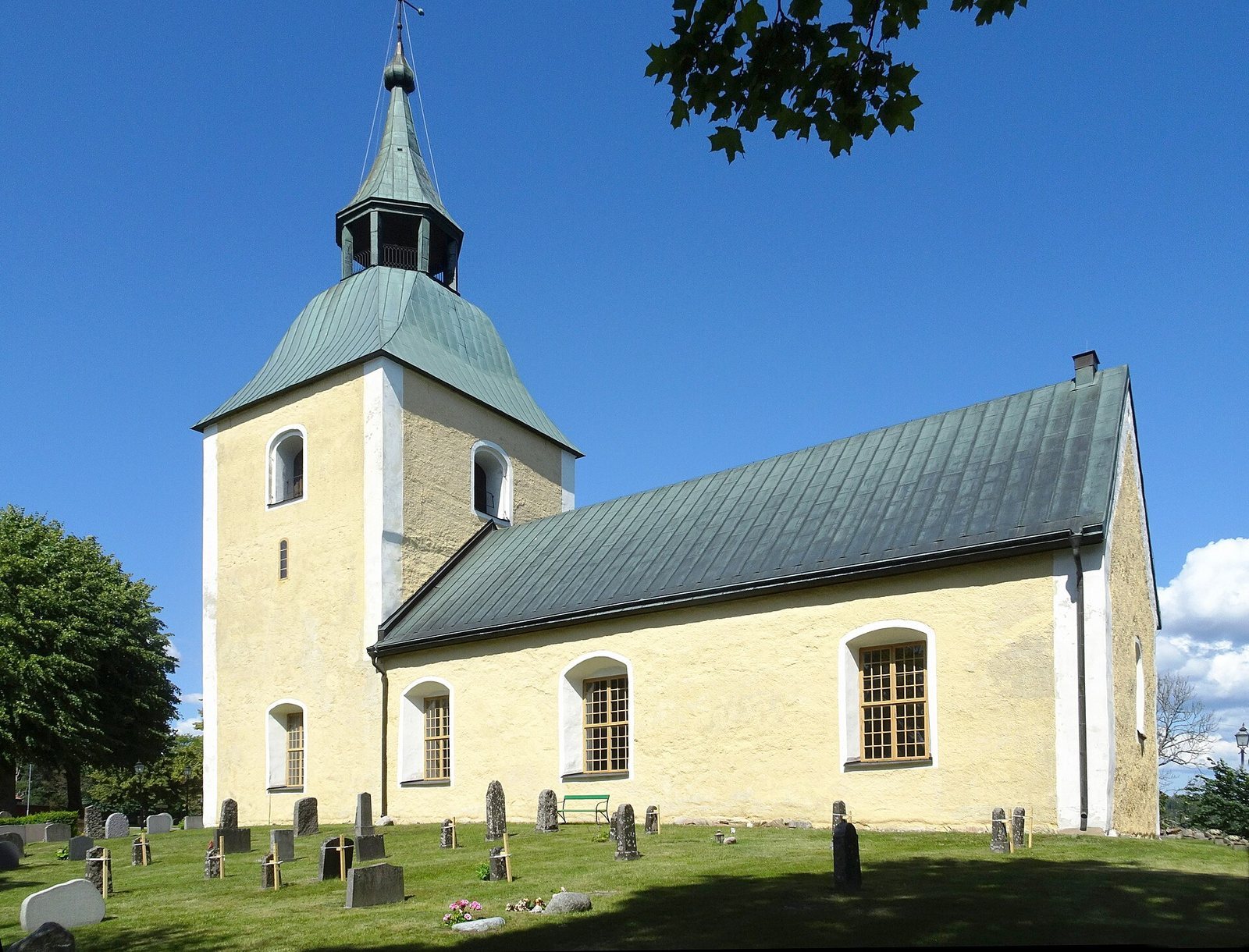
Trosa country church, in Vagnhärad, Sweden, was consecrated in the 13th century, and its oldest parts date from that period. It was built beside the medieval town of Trosa. The church belongs to the Church of Sweden, a Lutheran church, and the Diocese of Strängnäs, an administrative area within the church. It serves Trosa Parish and was formerly associated with Trosa Rural Parish.
Fire and rebuilding
A fire damaged the church in 1773. The vaults and interior furnishings survived, but the burial chapel was destroyed. Kristina Nilsdotter Gyllenstierna, a Swedish noblewoman and political figure, had been buried there. She died in 1559 at Hörningsholm Castle on Mörkö and owned the nearby estates of Gäddeholm, now Tureholm, and Tullgarn. The church was remodeled after the fire.
Restoration
In 1930, restoration work focused on the interior. The church’s successive organs and the surviving historic furnishings reflect further stages in its development.
Remains
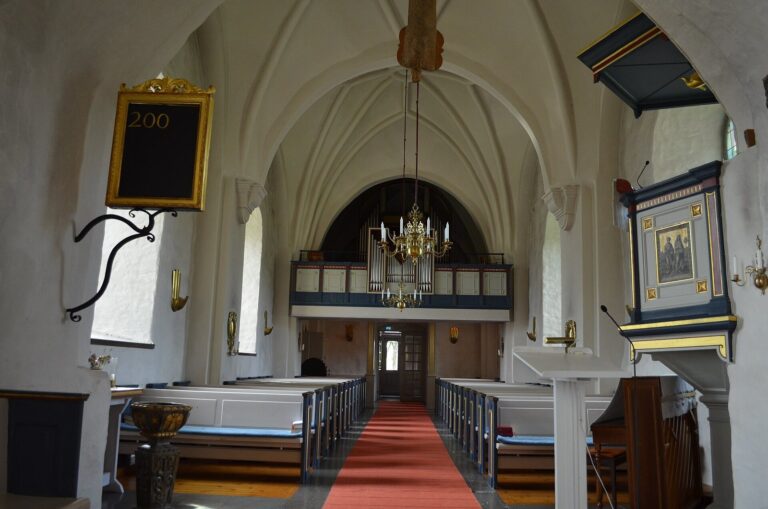
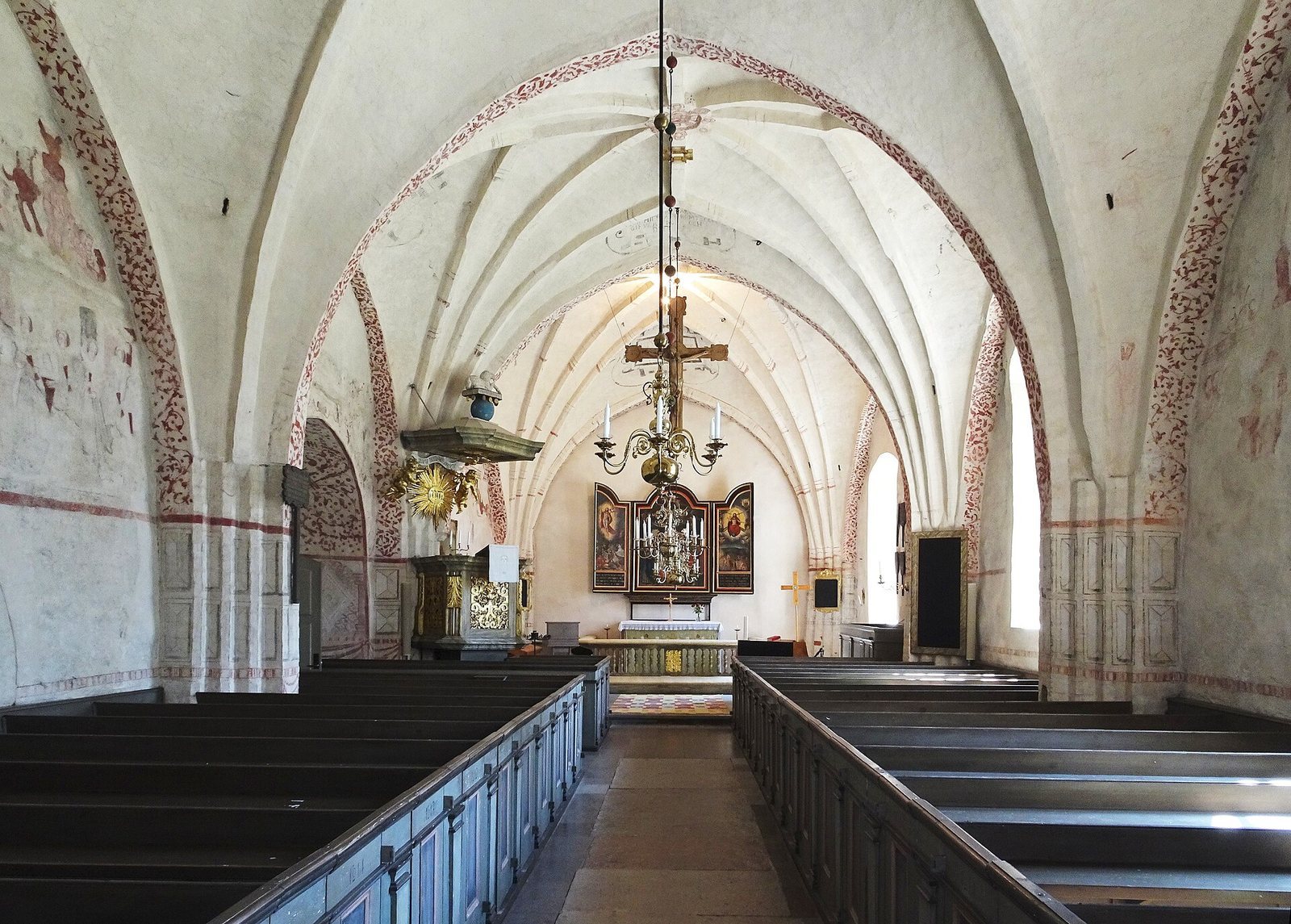
The church brings together medieval fabric and later alterations. Its nave and chancel are linked by an arch, while the sacristy and a substantial tower form part of the building. Interior furnishings include medieval and later works, a funeral banner, and organs from three periods.
Church fabric and alterations
Medieval fabric
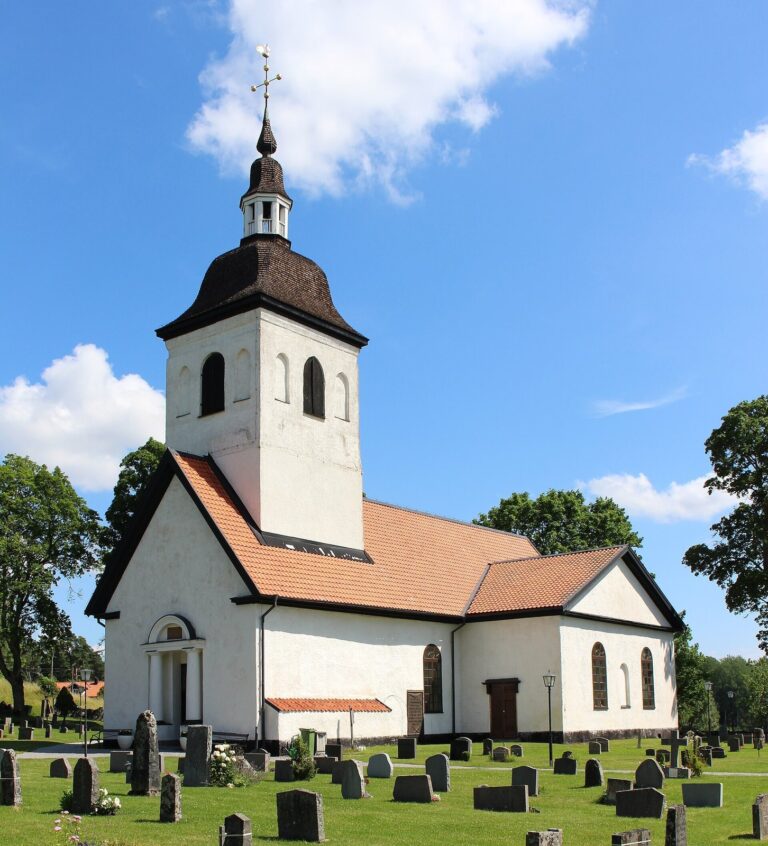
The sacristy was probably added in the 14th century. In the 15th century, brick ribs were arranged in star patterns to form vaulted ceilings, and a substantial tower was built for defensive use. Fieldstone forms its lower section, with brick above. Paintings were added to the vaults in the 17th century.
Later alterations
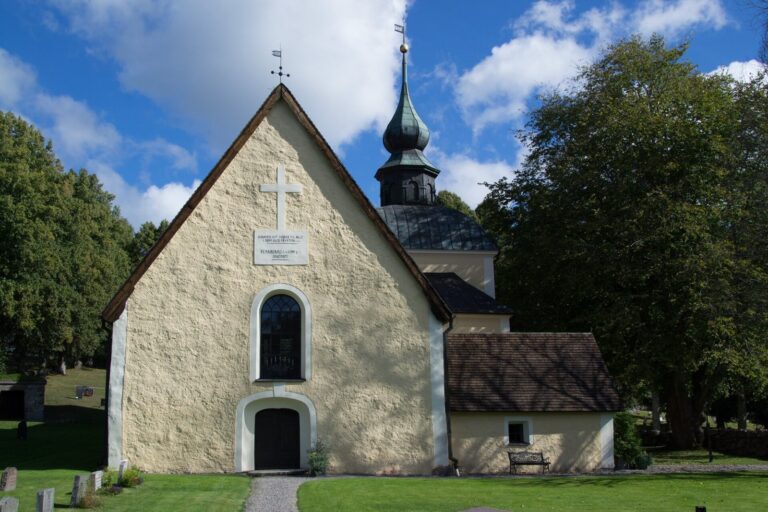
During the remodeling after the fire, the tower was heightened and given a spire. The porch was removed, an entrance was opened in the tower’s west wall, and the windows were enlarged to a uniform size.
Interior furnishings and organs
Medieval and 15th-century works
A crucifix from the later 13th century hangs in the arch between the nave and chancel. The baptismal font, made in Gotland, dates to the period of the oldest stone church. On the north wall hangs a 15th-century North German sculpture of Saint Anne, regarded in Christian tradition as the mother of Mary.
Funeral banner
To the right of the altar is a funeral banner bearing the arms of Ture Pederson Bielke and his ancestors. Bielke was a Swedish nobleman, and the banner was used at his funeral in 1577. It displays one large shield and sixteen smaller ones, with associations to Kråkerum in Kalmar County, Vikhus in Västmanland, and Salsta in Uppland. After the death of Bielke’s father-in-law, Svante Sture, it was also associated with Gäddeholm, now Tureholm. The banner is described as the oldest complete series of its kind known in Sweden.
Organs
A. W. Lindgren of Stockholm built the church’s first organ in 1853. It had eight stops, which control sets of pipes. Gebrüder Rieger of Jägerndorf, then in Czechoslovakia, made a replacement in 1930 with fifteen stops, two hand-played keyboard divisions, and a foot pedal. A. Magnusson Orgelbyggeri AB of Gothenburg built the present mechanical organ in 1969. It has a cymbal star, a rotating ornament with small bells, and a 56/30 compass, indicating the available ranges of its keyboards and pedal. Its front incorporates the façade of the 1853 organ.