Överjärna Church: A Medieval Church in Sweden
Site at a Glance
- Country
- Sweden
- Primary era
- Medieval
- Eras represented
- Medieval, Early Modern, Modern
- Civilizations
- Swedish
- Site type
- Religious
- Remains
- Church
On this page12 sections
History
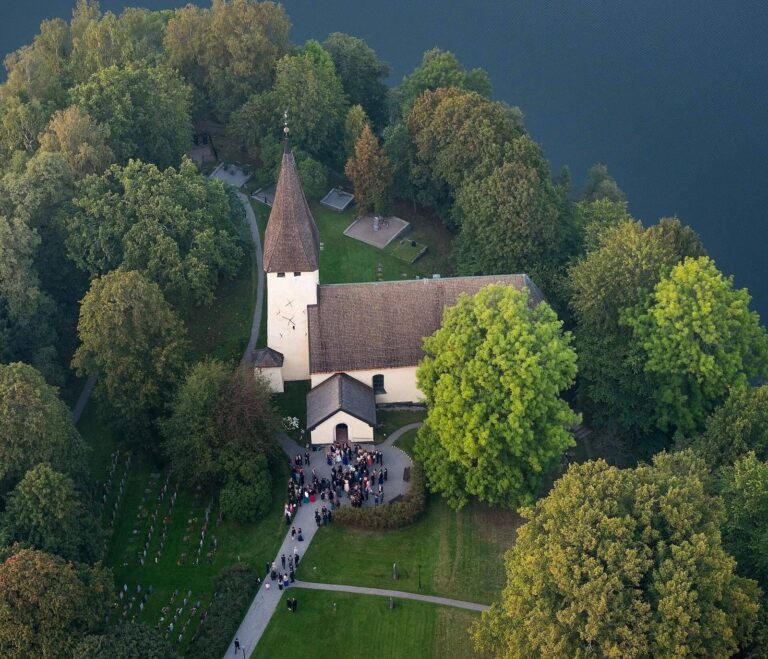
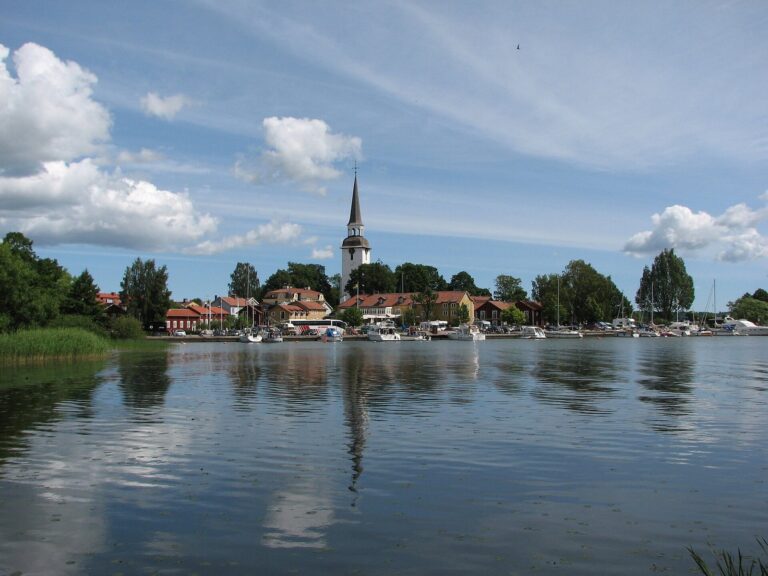
Överjärna Church is a medieval church in Järna, Sweden, built around 1200, with a nave and choir dating to the late 12th century. It stands beside the old road between Södertälje and Nyköping, near a sailing route linking the Baltic Sea with Lake Mälaren. This position placed the church at an important point between two established routes.
Medieval origins and additions
Traces point to an earlier tower at the east end. During an early medieval phase, the nave may have been lengthened and the walls of the nave and choir raised. The upper floor was probably intended for defence. The sacristy was added in the late 13th century or around 1300. A tower at the west end and a porch followed, probably in the 15th century.
Changes from around 1600
Around 1600, the upper part of the eastern tower was taken down. The nave and choir were probably brought beneath a shared roof, and their vaulted ceilings date to about the same period. In 1741, a pyramidal roof with a lantern was built on the west tower. It is attributed to Anders Erson of Floda, though Erik Erson (1703–1759) has also been proposed; the attribution to Anders is uncertain because he was born in 1740. The west entrance was opened in 1776.
Builder P. J. Hallström carried out a major restoration in 1879–1880, when the 15th-century porch was demolished. Architect Martin Westerberg restored the church in 1932–1933. A south chapel was built in 1928 for burials and converted into a prayer and waiting room in 1970. During Ture Jangvik’s restoration in 1983–1984, older painted decoration and a wall niche came to light.
Recent history and church affiliation
In January 2006, a man broke church windows, damaged the sacristy, burned Bibles, and tried to start a fire in the building. Further vandalism in April 2007 included overturned crucifixes, blasphemous writing, and the removal of hymn 666 from hymnbooks.
The church belongs to the Church of Sweden, a Lutheran church, and is part of Överjärna parish, Södertälje deanery, and Strängnäs Diocese. A parish is a local congregation and administrative unit, a deanery groups parishes, and a diocese is a regional church district.
Remains
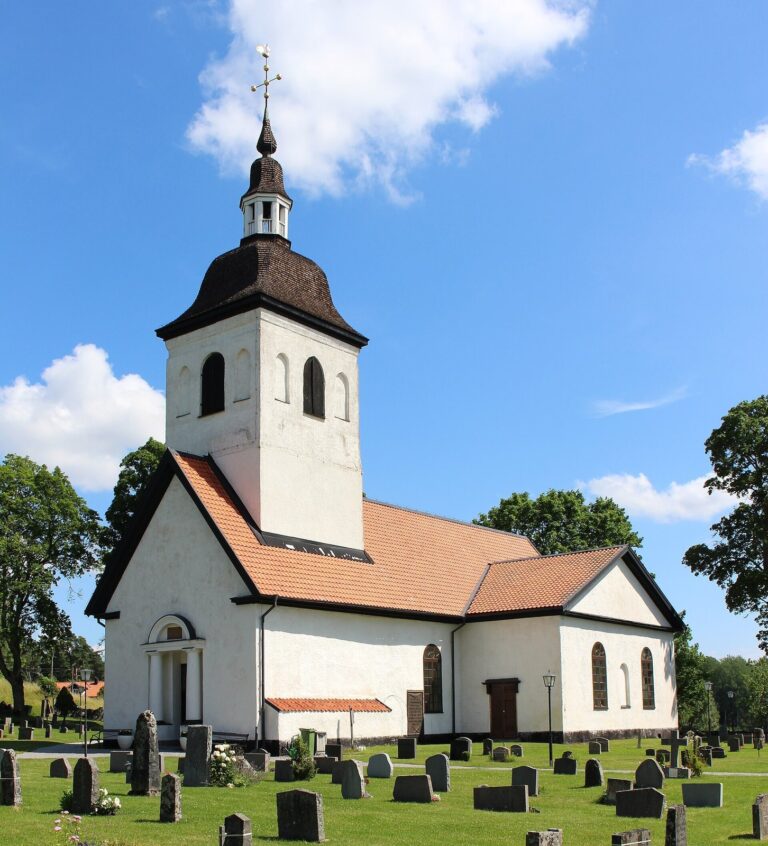
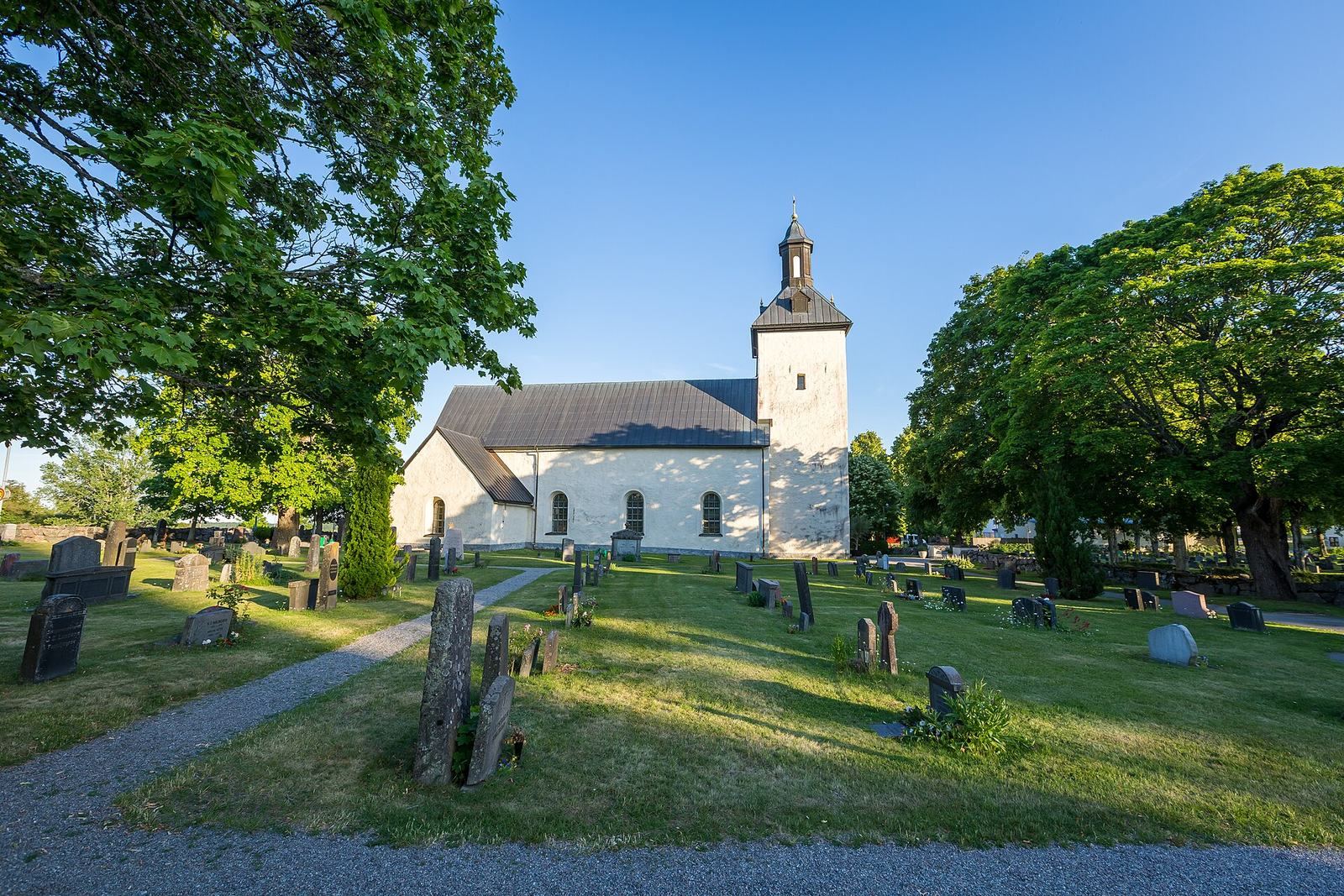
The masonry church has a rectangular nave, a narrower choir at its east end, and a west tower. A sacristy adjoins the north side of the choir, while the south chapel stands on the opposite side. White-rendered exterior walls and a gabled roof define the main building.
Exterior and plan
Side spaces
The sacristy was added in the late 13th century or around 1300. The south chapel, built in 1928 as a burial space, later became a prayer room and waiting room. Traces of the earlier east tower belong to the church’s earlier layout.
West tower and exterior
The west tower carries a pyramidal roof crowned by a lantern, a small structure atop a tower roof. Built in 1741 and altered in 1880, the tower is topped by a gilded cross and four smaller gilded globes, added during the 1879–1880 restoration. The church received a metal roof in that restoration, and its windows took their present round-arched form in 1880. Entry is through the west portal, opened in 1776.
Interior architecture and furnishings
Vaults and choir arch
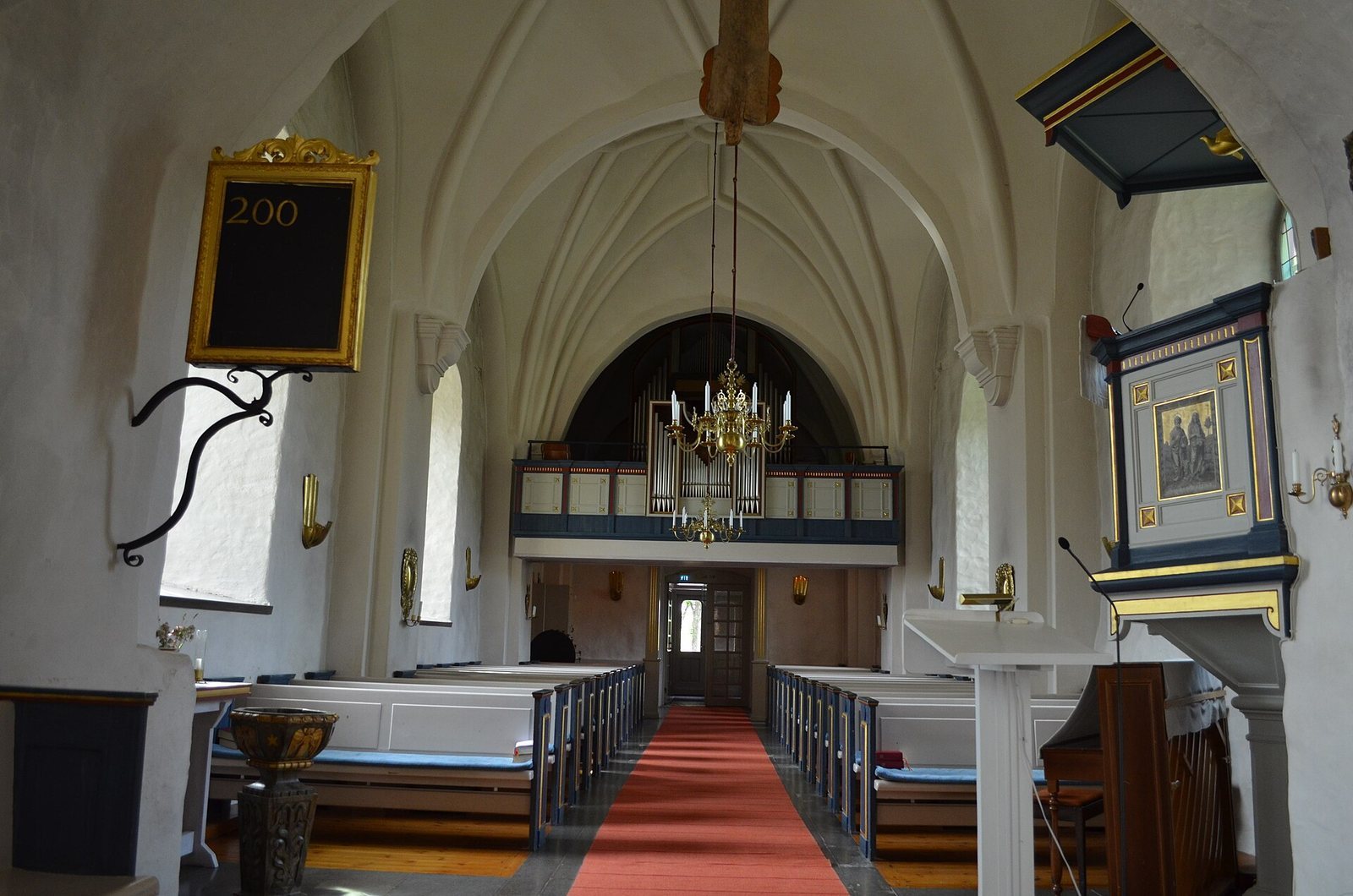
The nave is covered by three star vaults, whose ribs form a star-like pattern, dating to around 1600. The long, narrow choir has two cross vaults from about the same period, formed where two barrel-shaped ceilings intersect. Between the nave and choir, a slightly pointed arch has two stepped layers. Its form dates to the later Middle Ages.
Furnishings and organ
The interior arrangement includes a pulpit, an organ gallery, an altar, open pews, and cast-iron window frames. The pulpit dates to 1880; Axel Hörlin painted it in 1940, and a sounding board was added in 1984. The pews date to 1932–1933.
Jonas Ekengren of Stockholm built a six-stop organ in 1781. In 1898, E. A. Setterquist & Son of Örebro supplied another six-stop instrument, with four couplers linking parts of the organ. A local women’s association initiated the purchase and raised 1,200 kronor at a bazaar selling donated goods and its own handicrafts; the parish paid the rest. The present mechanical organ was built in 1963 by A. Magnussons Organ Works to a design by Harald Thafvelin. It has 21 stops, three keyboards, and a pedalboard.
Paintings and stained glass
Paintings probably dating to around 1600 were uncovered on the choir’s north wall. A niche found there is lined with oak planks, one bearing a painting dated to the late 13th century. A German stained-glass window from the early 20th century is set in the choir.