Tomb of Antipope John XXIII: A Florentine Renaissance Wall Monument
Site at a Glance
- Popularity
- High
- Country
- Italy
- Primary era
- Medieval
- Eras represented
- Medieval
- Civilizations
- Republic of Florence
- Site type
- Religious
- Remains
- Tomb
On this page12 sections
History
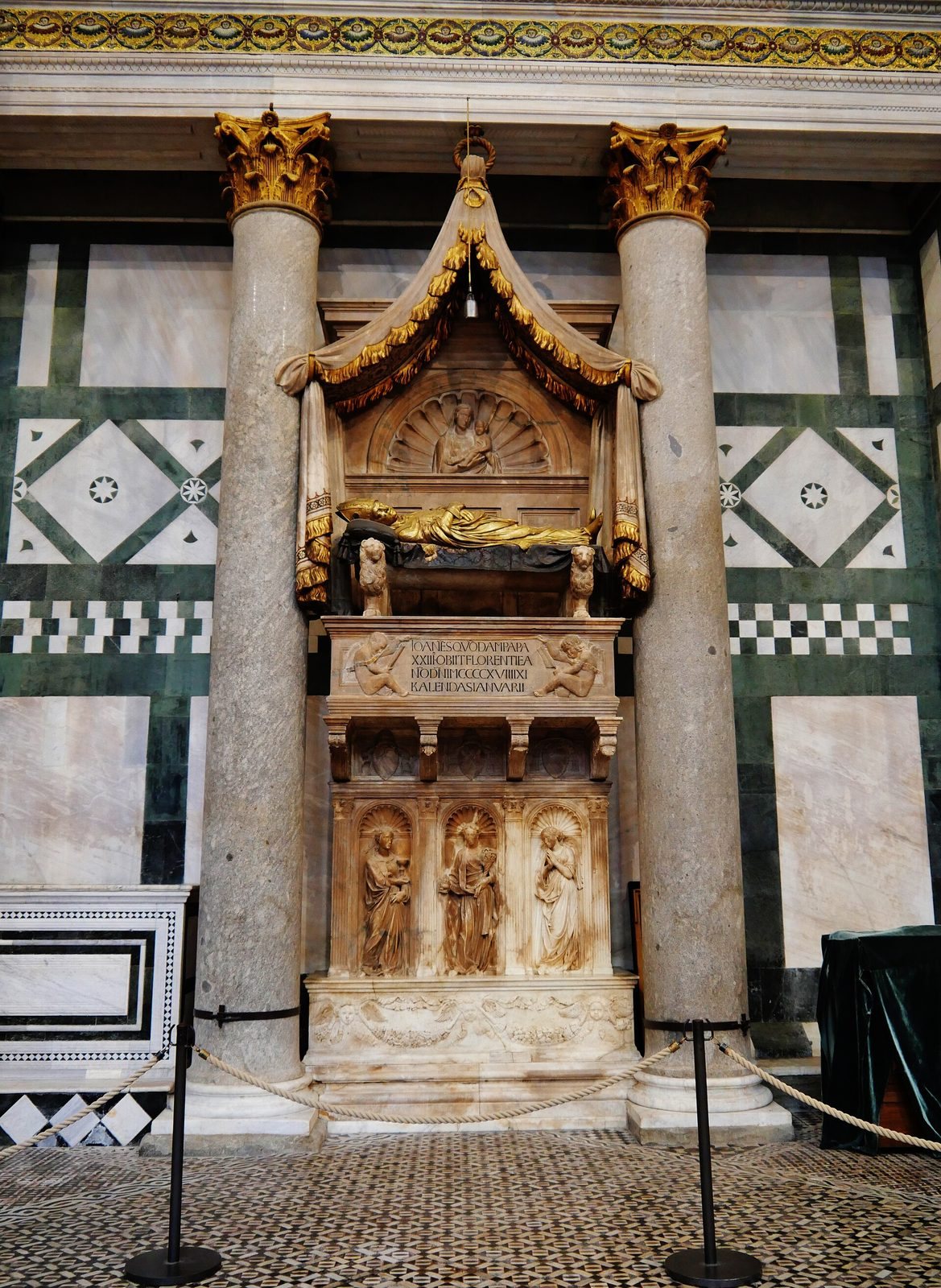
The Tomb of Antipope John XXIII is a marble-and-bronze wall monument in the Baptistry of Santa Maria del Fiore in Florence, Italy, made by Donatello and Michelozzo during the 1420s. An early landmark of the Florentine Renaissance, it commemorates Baldassare Cossa, who claimed the papacy as John XXIII during the Western Schism, a period of competing claims to the papal office. The historian Ferdinand Gregorovius judged it the last papal tomb erected outside Rome.
Cossa and the Western Schism
Cossa was a Neapolitan aristocrat who grew up in Bologna. Pope Boniface IX put him in charge of the Archdiocese of Bologna in 1396 and made him a cardinal in 1406. At the Council of Pisa in 1409, a formal gathering of church leaders, Cossa led opposition to Pope Gregory XII, who would not resign. Cossa lost his cardinal’s rank, but Alexander V, another claimant to the papacy, restored it.
In 1410 Cossa succeeded Alexander as John XXIII, one of several men claiming the papal office. Florence recognized him, while other rulers and territories supported rival claimants. After Ladislaus, King of Naples, took Rome in 1413, John fled to Florence. The Holy Roman Emperor Sigismund compelled him to summon the Council of Constance in 1414. John fled the following year, but Frederick IV, Duke of Austria, handed him over to the council, and Louis III, Elector Palatine, imprisoned him. The council deposed John on 29 May 1415 and elected Martin V on 11 November 1417.
Return to Florence and burial
Florence ransomed Cossa in 1419, with Giovanni di Bicci de’ Medici arranging the transaction. The payment may have repaid Cossa for earlier support of the city, pressured Martin V, or served both ends. As the pope’s envoy in Bologna, Cossa had helped Florence conquer Pisa in 1405. Later, as John XXIII, he designated the Medici bank as the main depository for papal finances.
In Florence, Cossa submitted to Martin V on 14 June 1419 and received a cardinal’s hat on 26 June. Though his formal title was Cardinal Bishop of Tusculum, he referred to himself as the Cardinal of Florence. He died on 22 December that year. His body was taken to the Baptistry for nine days of funeral rites prescribed by the Roman liturgical order, a body of texts setting out church ceremonies. Florentine leaders and members of the papal court attended. The rites took place within the Baptistry and the cathedral. A white mitre was placed on Cossa’s head and a cardinal’s hat at his feet. The first three days successively recalled his service as cardinal and pope, his alliance with Florence, and his private life. He was buried temporarily until the monument was ready.
The commission and its completion
Cossa’s four executors were Bartolommeo di Taldo Valori, Niccolò da Uzzano, Giovanni di Bicci de’ Medici, and Vieri Guadagni. Any two could act on behalf of all four, and Valori and Medici appear to have taken the lead. By Valori’s death on 2 September 1427, Guadagni had also died and Uzzano had withdrawn his interest. Giovanni, or more probably his son Cosimo de’ Medici, was left to oversee the remaining work. Cossa’s estate was disputed by creditors as the tomb was being completed, while his nephews Michele and Giovanni had priority in the inheritance.
The executors said Cossa had wanted burial in the Baptistry but was too modest to state this in his will. Most later scholars accepted their explanation; Horst Janson instead proposed that the executors chose the location against Cossa’s wishes. On 9 January 1421, Palla Strozzi acted for the Arte di Calimala, Florence’s cloth merchants’ guild responsible for maintaining the Baptistry, and approved a small, discreet monument but not a chapel. The restriction has been interpreted as reflecting a view that burial in the Baptistry might be an honor beyond Cossa’s standing.
A traditional explanation for the guild’s consent connects it to a relic of John the Baptist. Cossa was said to have given the Baptistry the saint’s right index finger and 200 florins, a gold coin used in Florence, toward a container for the relic. According to the tradition, Philotheus, Patriarch of Constantinople, gave the finger to Pope Urban V in 1363. It then passed to Gregory XI and Urban VI, who lost it during the siege of Nocera Inferiore. Cossa reportedly purchased the relic for 800 florins, carried it with him, and later concealed it in the monastery of Santa Maria degli Angeli.
Work was under way by about 1425. On 2 February that year Valori and Cosimo asked the Calimala guild to release 400 florins from the money deposited with it, apparently to repay work already done. The deposit protected the guild if the executors failed to finish the monument and the guild had to arrange its completion. By July 1427, about three-quarters of the planned 800-florin budget had been spent, and Michelozzo had worked with Donatello for roughly two years. This is the clearest evidence of Cosimo’s participation, although the claim that he directed the project remains disputed.
The sarcophagus was probably put in place on or shortly before 2 May 1426, when the Calimala arranged for two chaplains to hold a daily mass for Cossa. Valori bought four blocks of white marble on 28 January 1427. The tomb was complete by 1431, when Martin V, who died that year, is known to have visited it, although the work may have finished earlier. A wall tomb made by Jacopo della Quercia in September 1428 repeated the monument’s treatment of the Virtues. The planned cost was 800 florins; Giorgio Vasari later reported a total of 1,000, but the higher sum is uncertain and its payer is unknown.
The monument’s papal imagery and its position in the Baptistry have been read in several ways: as support for Cossa’s claim to the papacy, as a challenge to Martin V, or as indirect promotion of the Medici. The project was Donatello and Michelozzo’s first collaboration. Attribution remains contested. Descriptions from 1475 to 1568 assign almost all the work to Donatello except Faith. Some later assessments give Michelozzo nearly all the monument apart from the portrait, while another credits Donatello only with the childlike figures among its marble sculptures.
Remains
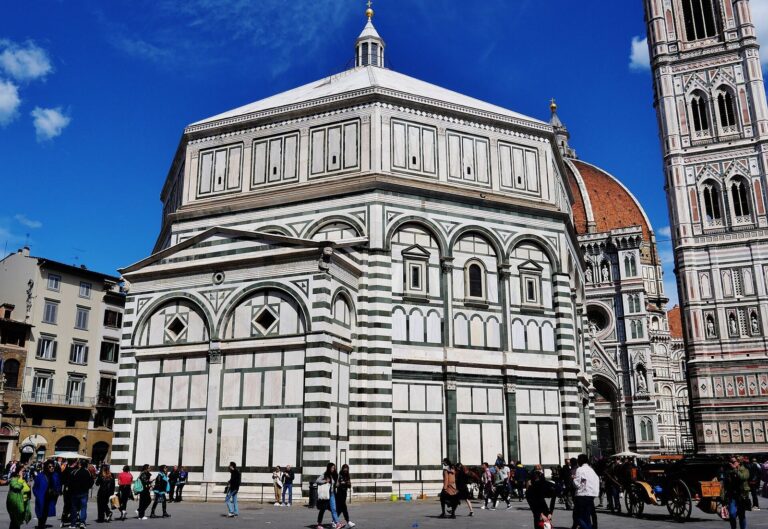
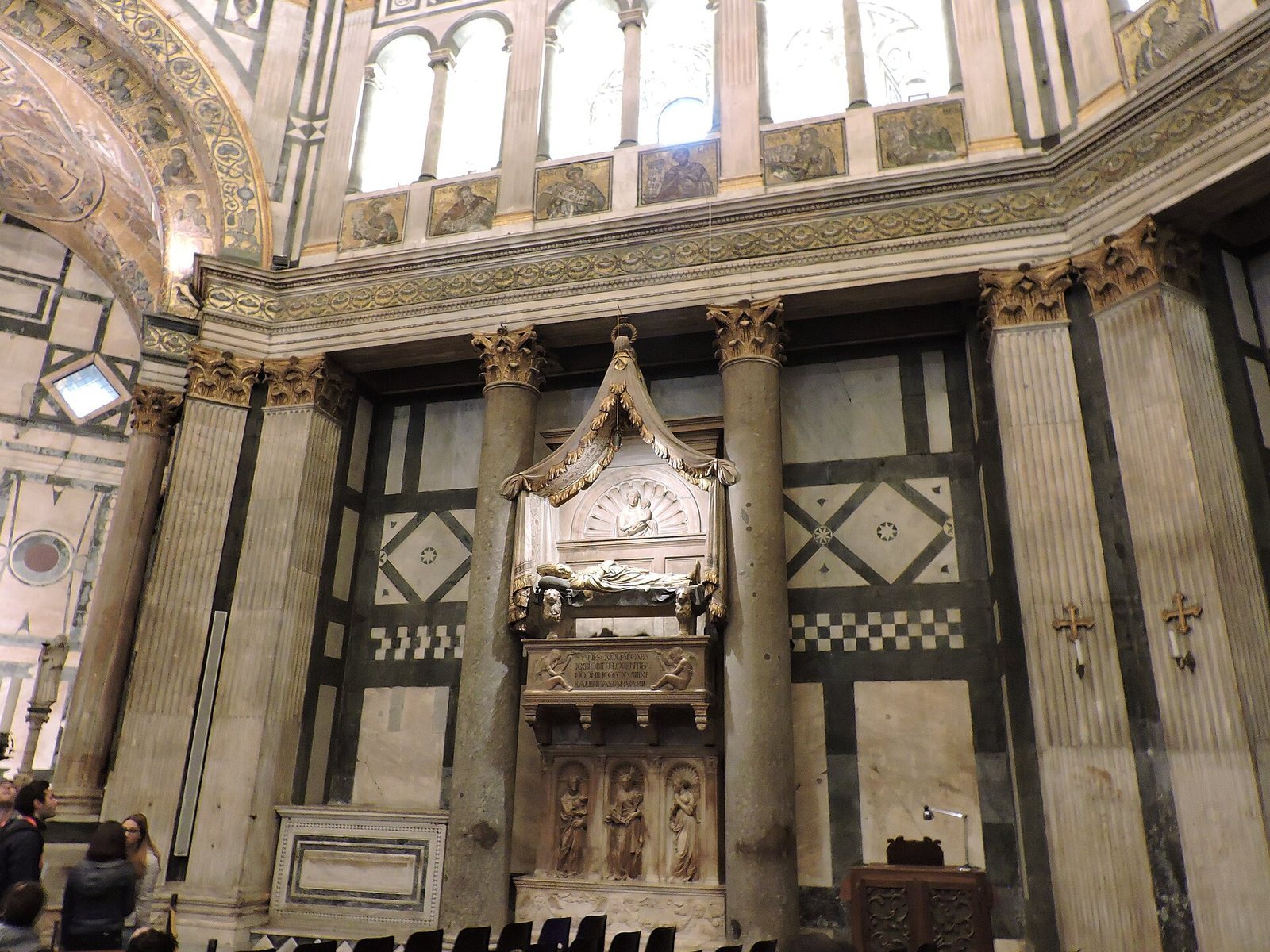
The tomb rises in vertical tiers along about a third of one wall of the Baptistry’s octagonal interior. It combines classical forms with the stacked arrangement common to large medieval Italian wall tombs. At 7.32 metres high, it is the Baptistry’s tallest monument and was Florence’s tallest sculptural work when completed. It stands between two Corinthian columns, a classical type with leafy capitals, between Ghiberti’s North Doors and the western tribune, or raised gallery. Near the altar recess, it faces the East Doors, also called the Gates of Paradise. Its rear projects 48.4 centimetres from the wall. The Baptistry already held the sarcophagus of Bishop Ranieri, who died in 1113, and two ancient Roman sarcophagi reused in the Middle Ages.
The monument’s white and brown marble suits the Baptistry’s white-and-green interior. Its composition has been compared with the 1423 tomb of the Venetian doge Tommaso Mocenigo, whose sculpted figures occupy niches and whose curtains meet above the tomb, though its architectural details are Gothic. Cossa’s monument also drew on the earlier tomb of Cardinal Brancacci by Donatello and Michelozzo, and later influenced Bernardo Rossellino’s tomb of Leonardo Bruni, made about twenty years afterward. A colored drawing by Buonaccorso Ghiberti has been interpreted as evidence that the tomb once had painted color, but the drawing’s accuracy is disputed.
Base and standing figures
Base
The monument rests on a 38-centimetre supporting block, with curved bands and projecting ledges separating it from the section above. Its lowest upright block measures 1.39 metres high and 2.02 metres wide. A carved band across it shows winged angel heads, possibly seraphim, among garlands and ribbons.
Faith, Charity, and Hope
Three figures stand above the base, divided by shallow attached columns. From left to right they represent Faith, Charity, and Hope. Faith, 1.05 metres high, holds a chalice used in the Eucharist. Charity, 1.07 metres high, carries a horn of plenty and a brazier or flaming vase. Hope, 1.06 metres high, clasps her hands in prayer. Their features draw on ancient sculpture; Charity in particular recalls classical images of Abundantia, Ceres, and Juno. The figures have also been understood as placing the viewer at a distance from Cossa’s portrait and presenting him as a general papal figure rather than an individual.
Sarcophagus and upper monument
Sarcophagus and heraldry
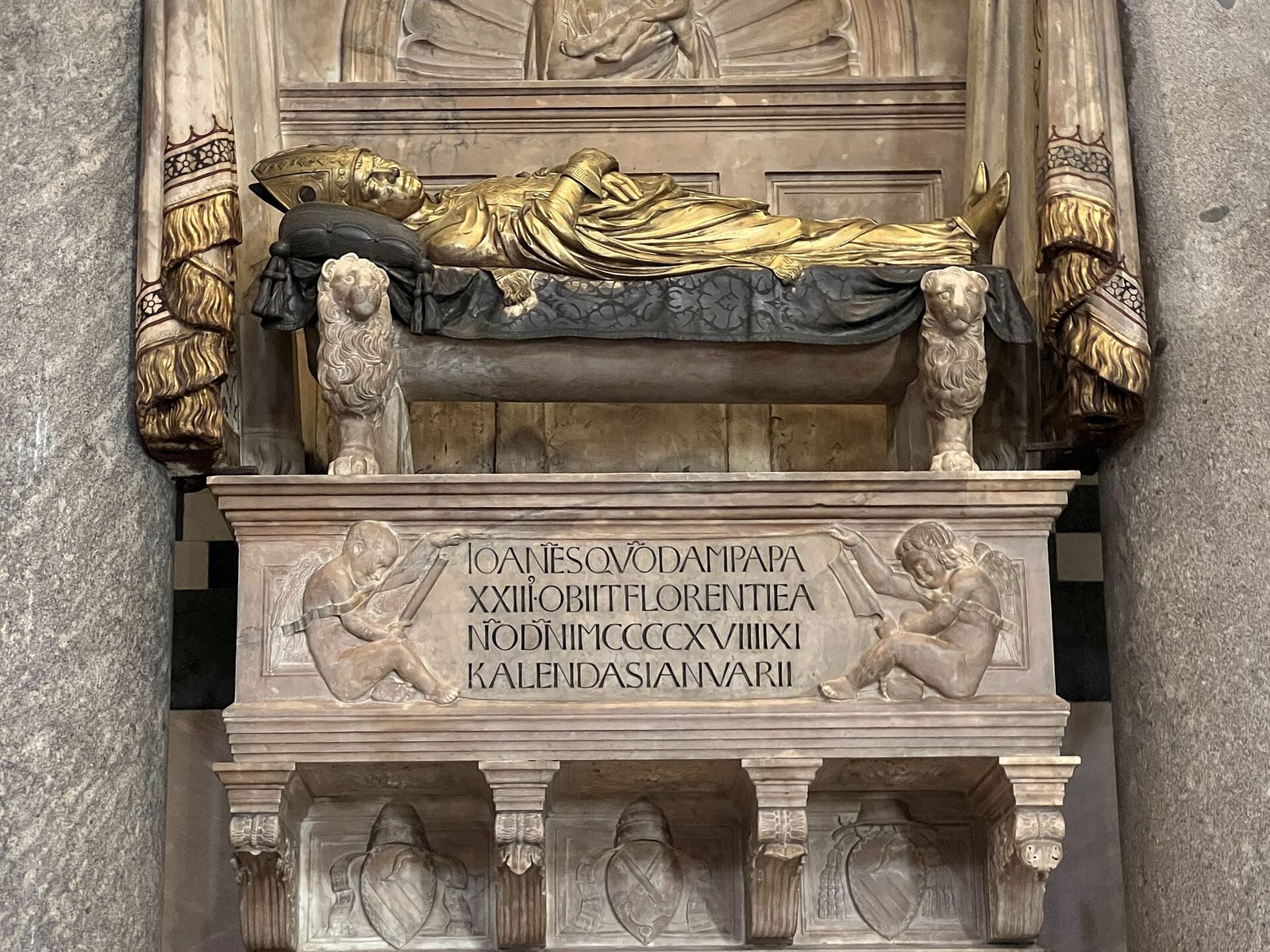
Four projecting brackets decorated with leafy ornament support the stone coffin, or sarcophagus. Between them are three heraldic panels: Cossa’s family arms beneath a papal tiara, the papal arms, and his family arms beneath a cardinal’s hat. The front measures 2.12 metres wide and 70 centimetres high. Its very shallow carving shows two childlike figures holding a sheet shaped like an official papal letter. This unusually compressed relief technique is associated with Donatello. The inscription names John as a former pope and gives his death in Florence in 1419, eleven days before the January Kalends. This is an ancient Roman way of reckoning dates, used on papal tombs but unusual for burials in Florence. A separate relief of Christ’s Ascension and the handing of the keys to Saint Peter may have been intended for the coffin’s front, though this proposed placement is uncertain.
Lions, bier, and portrait
Lions support the stand beneath the coffin. Their shape resembles brackets from fourteenth-century sculpture. They may refer to Florence’s heraldic lion, the Marzocco, although their meaning is uncertain. The stand and the cloth laid over it angle slightly toward the viewer. The lion beneath Cossa’s head is two centimetres shorter than the other, improving the view of the portrait, particularly its head.
The life-size portrait is bronze covered with gold and shows Cossa in cardinal’s clothing; the bronze bedding beneath him is not gilded. When the coffin was opened in the sixteenth century, Cossa’s clothing was found to match the garments shown on the sculpture. A three-dimensional gold-covered bronze portrait of this kind had no precedent on an Italian tomb monument. Some scholars think Donatello used a death mask as a model; others reject that proposal.
Madonna and canopy
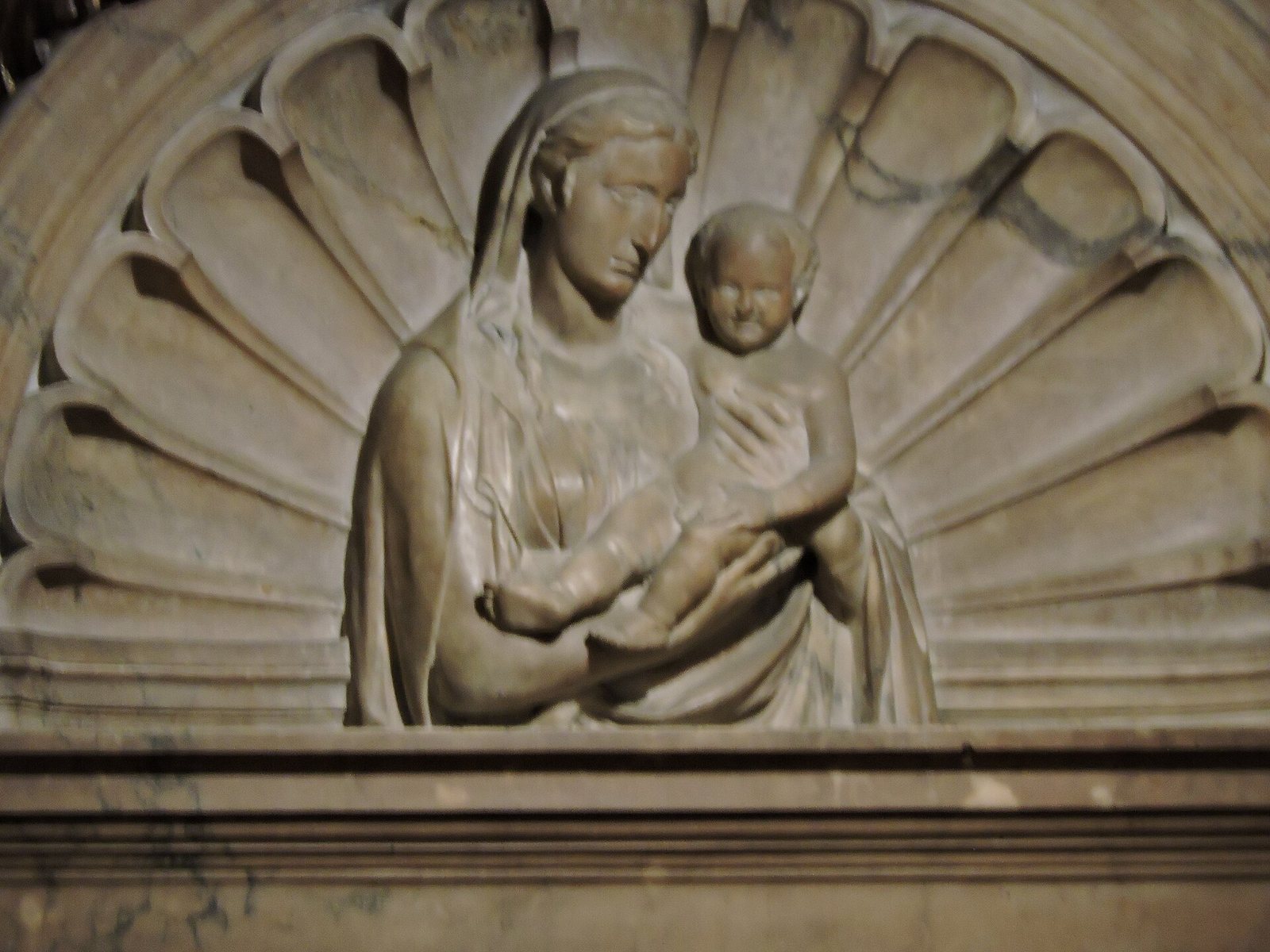
Behind the portrait, a 1.34-metre upright block with recessed borders supports a projecting ledge and is flanked by two shallow attached columns. Above it, a horizontal architectural structure frames a semicircular panel showing the Madonna and Child. The marble canopy higher up has gilded edges and flowers patterned along its stems. A ribbed brass ring appears to hold it up, but the canopy is too heavy for the ring to support. The columns and the Baptistry’s projecting ledge also contribute to the appearance of support. The canopy has been interpreted either as an image of the heavens and a papal enthronement or as a secular bed canopy.