Tikhon of Kaluga’s Hermitage: A Russian Orthodox Monastery
Site at a Glance
- Rating
- 4.9
- Popularity
- Low
- Country
- Russia
- Primary era
- Modern
- External website
- Open
- Eras represented
- Modern
- Civilizations
- Russian
- Site type
- Religious
- Remains
- Monastery
On this page14 sections
History
Tikhon of Kaluga’s Hermitage is a Russian Orthodox men’s monastery in L’va Tolstogo, Russia, founded in the fifteenth century by the monk Tikhon of Kaluga. It developed as a secluded monastic community in the forest and became associated with the 1480 confrontation on the Ugra River, an event traditionally regarded as ending Moscow’s effective subordination to the Great Horde. The monastery remains connected with the veneration of Tikhon and his relics.
Foundation and the Fifteenth Century
According to tradition, Tikhon lived as an ascetic in the hollow of a large oak in a remote forest. He dug a well, and disciples gradually gathered around him, forming the community that became the monastery. Early patronage is linked either to Prince Yaroslav Vladimirovich of Borovsk or, in another version, to his son Prince Vasily Yaroslavich. After Tikhon’s prayers were associated with the prince’s recovery from an affliction, the prince promised financial support for the monastery’s construction. Its first church was dedicated to the Dormition of the Mother of God.
In 1480, Ivan III Vasilyevich, the grand prince of Moscow, confronted Khan Akhmat of the Great Horde on the Ugra River. Tikhon blessed Ivan III before the campaign, while the monks prayed for the Russian army. They also supported the forces by hearing confessions, administering communion, assisting wounded soldiers, burying the dead, and providing material aid.
Tikhon received the great schema, the highest form of monastic commitment in the Orthodox tradition, and died on 29 June 1492. He was succeeded by Nikifor of Kaluga, one of his first disciples. Tradition also associates Nikifor with the foundation of Spaso-Vorotynsky Monastery at the mouth of the Ugra. Tikhon was canonized in 1551, and his feast was established for 29 June. His relics were openly venerated in the Dormition Church.
Patronage, Destruction, and Reconstruction
During the sixteenth century, the monastery received the patronage of several boyar families, including the Romanovs, Lopukhins, Vorotynskys, and Baryatinskys. It became a recognized pilgrimage center. In the late sixteenth century, Tsar Feodor Ioannovich donated a velvet-covered Gospel decorated with silver figures of the Evangelists in memory of his father.
The Time of Troubles, a period of political crisis, dynastic conflict, famine, and foreign intervention in early seventeenth-century Russia, brought severe damage. Polish forces devastated the monastery in 1610, and Tikhon’s ancient life was lost. The monks concealed his relics beneath the floor of the Three Hierarchs’ Church, later known as the Transfiguration Church. They remain beneath the church floor.
Reconstruction began under Abbot Gerasim in 1617 and continued into the 1630s, reaching completion under Schema-Abbot Feodosy. The rebuilt community included a winter Church of Saint Nicholas. Between 1677 and 1686, the Three Hierarchs’ Church and the Dormition Church were replaced or substantially rebuilt as a stone Transfiguration Cathedral, the monastery’s first stone building. In 1684, the monastery became a dependency of Moscow’s Donskoy Monastery, a status that lasted until 1765.
Independence and the Kaluga Diocese
In 1765, the monastery regained its independence and became a non-staffed monastery of the Krutitsy Diocese, responsible for its own maintenance. An aisle dedicated to Saint Tikhon of Amathus was added to the Transfiguration Cathedral late in the eighteenth century.
The Kaluga Diocese was established in 1799. Its first bishop, Theophylact Rusanov, approved a liturgical service for Tikhon of Kaluga in 1805. Abbot Methodius governed the monastery from 1803 to 1812. During his tenure, construction began on a new Transfiguration Cathedral and a stone enclosure wall was built.
In 1812, Tikhon’s intercession was credited with saving Kaluga from a cholera epidemic. In the 1830s, lightning felled the oak associated with Tikhon. A chapel was later erected over its remains. Monks from Optina Hermitage, including Geronty Vasilyev and Ephrem Neklyuev, arrived in 1837 and helped restore the monastery. Geronty died in 1857 and was buried in the monastic necropolis.
Nineteenth-Century Renewal
During the nineteenth century, the monastery became one of the wealthiest in Kaluga Province and again grew in importance as a spiritual center. In 1858, Mikhail Krasilnikov, a disciple of the Optina elders Leo, Macarius, and Moses, became abbot under the monastic name Moses. He introduced the tradition of eldership, in which an experienced spiritual guide offers pastoral and ascetic counsel, and later became an archimandrite.
Under Moses, the modern monastery was developed. The late-nineteenth-century rebuilding included the Transfiguration Cathedral, residential buildings, a hospital with the Church of the Joy of All Who Sorrow, and the refectory Church of Saint Nicholas. The rebuilt cathedral contained a shrine with Tikhon’s relics and a burial vault for benefactors.
Several affiliated hermitages expanded the monastery’s religious network. The Sretensky Hermitage was established eight kilometers away, with churches dedicated to the Presentation of the Lord and the Kaluga Icon of the Mother of God. An unceasing Psalter was read there. Other dependent settlements included the Vladimir, Life-Giving Spring, Ephrem, and Sergius hermitages.
The elder Gerasim Bragin lived at the monastery in the late nineteenth century and served for many years at Tikhon’s shrine. Reports associated him with miraculous healings. He practiced severe asceticism, wore chains, and was regarded as clairvoyant. He spent his final years in seclusion and died in 1898 on Tikhon’s feast day.
In 1906, the Sergius Hermitage was founded in the village of Mstikhino in memory of Grand Duke Sergei Alexandrovich. Its founder and first abbot was Hieromonk Gerasim Gavrilov, and Grand Duchess Elizabeth Feodorovna, Sergei Alexandrovich’s widow, visited the hermitage. Under Archimandrite Lavrenty Barkhatov, the Dormition Cathedral was consecrated in Byzantine style, the Church of Saint Nicholas was built, and a stone Church of the Three Hierarchs replaced an earlier wooden church in Tikhon’s Settlement.
Closure and Wartime Damage
The monastery was closed in 1918, desecrated, and converted into the first Soviet cultural farm named after Lenin. The Transfiguration Cathedral and the Church of the Life-Giving Spring were blown up. The chapel and remaining oak associated with Tikhon were demolished, while the Dormition Church and bell tower were left in a dangerous condition. Much of the stone enclosure and its towers was destroyed.
The last abbot, Archimandrite Platon Bezdetkov, was sentenced to death, although the sentence was later cancelled. The monastery’s spiritual father, Hieromonk Joasaph Nekrasov, died of starvation. In the early 1920s, the complex housed an agricultural technical school for disabled people and later a military unit. The Church of Saint Nicholas was converted into a club.
During the Second World War, Soviet and then German military units occupied the monastery complex. The buildings suffered severe damage. Soviet forces attempted to demolish the bell tower because it served as a landmark for German artillery, but the tower survived the detonation. After the war, Soviet authorities ordered the demolition of the main Transfiguration Cathedral.
Religious life continued despite the closure. In the late 1920s, services in the Three Hierarchs’ Church were maintained by Abbot Iona Bronnikov, Hieromonk Pallady Sukhanov, the riasophore novice Nikolay Dmitriev, and the nun Minodora. Pallady continued to minister to believers despite repeated exile and died in 1949.
Revival After 1991
On 15 April 1991, 15.5 hectares of land and the spring were transferred to the Kaluga Diocese of the Russian Orthodox Church. The monastery was revived that year, and Archimandrite Tikhon Zavyalov has served as its abbot since 1991. It is an active monastery and a regional cultural-heritage property of the Russian Federation.
Restoration continued in the modern period. Excavations at the Transfiguration Cathedral in the 2000s revealed the burial of Archimandrite Moses Krasilnikov. A new Transfiguration Cathedral was built in 2005 to a design by the architect P. Gridasova. The monastery continues Orthodox religious activity through worship, a Sunday school, and publication of Tikhon’s Leaflet.
The outlying hermitages also preserve the monastery’s historical associations. In August 2011, a church was consecrated in the Vladimir Hermitage within Ugra National Park at the traditionally presumed location of the 1480 confrontation on the Ugra. A diorama museum devoted to the confrontation opened there in 2014, and a monument to Ivan III was unveiled on 8 July 2017.
Remains
Monastery Layout and Principal Churches
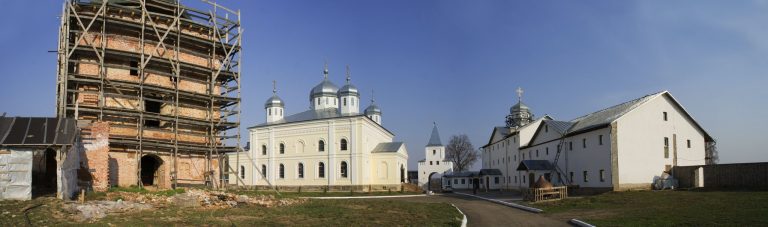
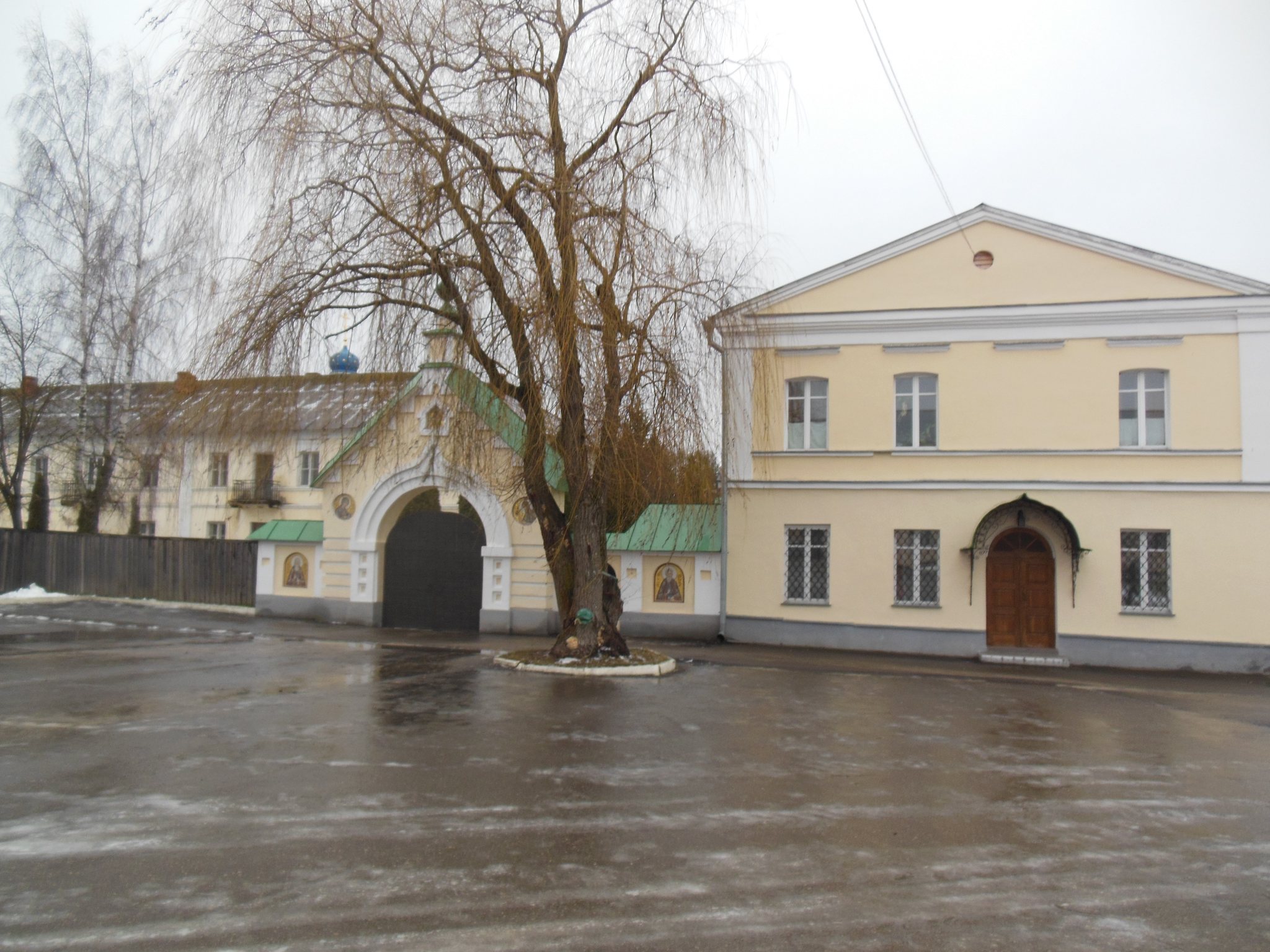
The monastery complex includes the Dormition Cathedral, the Transfiguration Cathedral, a five-storey bell tower, the refectory Church of Saint Nicholas, the Church of the Joy of All Who Sorrow with its hospital building, monastic cells, an abbot’s residence, a history museum, and a Sunday school. The early monastery was built entirely of wood and burned during the Time of Troubles. Later rebuilding introduced stone construction, including the Transfiguration Cathedral and an enclosure wall with a gate church.
Dormition and Transfiguration Cathedrals
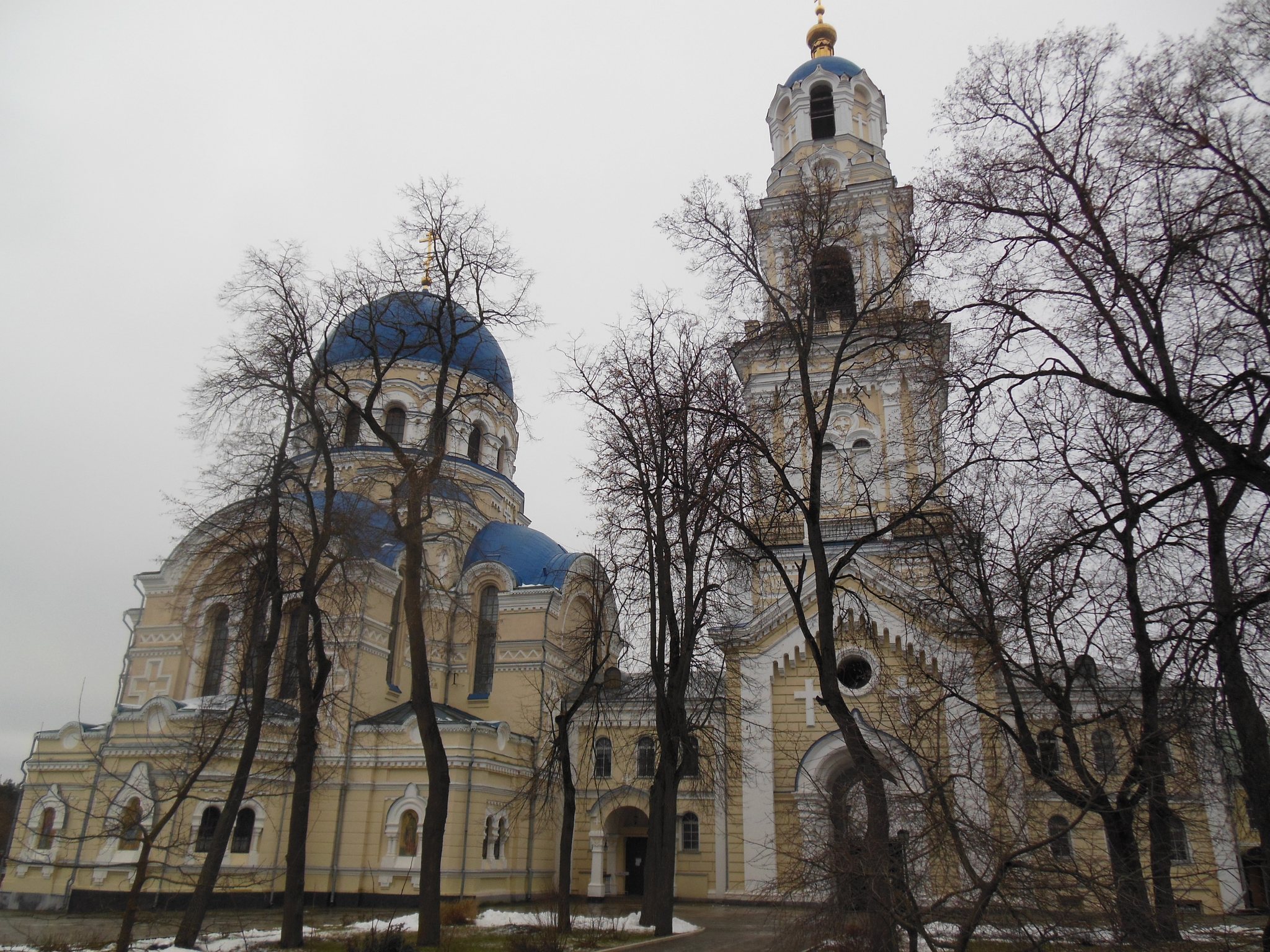
The present Dormition Cathedral dates from 1904. It was restored and consecrated in 2005, and its rebuilding included a main dome approximately 40 metres high. The Transfiguration Cathedral stands over the foundation of the cathedral built in the late seventeenth century and reconstructed in the late nineteenth century. The present building was erected in 2005.
The new Transfiguration Cathedral has a lower church dedicated to Tikhon of Kaluga and an upper church with side chapels dedicated to the Iveron Icon of the Mother of God and the Assembly of the Optina Elders. The lower church contains a carved wooden shrine over Tikhon’s relics, which remain beneath the floor. The earlier cathedral had a precious shrine over the relics and a nineteenth-century burial vault for benefactors, including members of the Shepelev, Zhukov, Lavrov, and Urusov families.
Bell Tower and Refectory Church
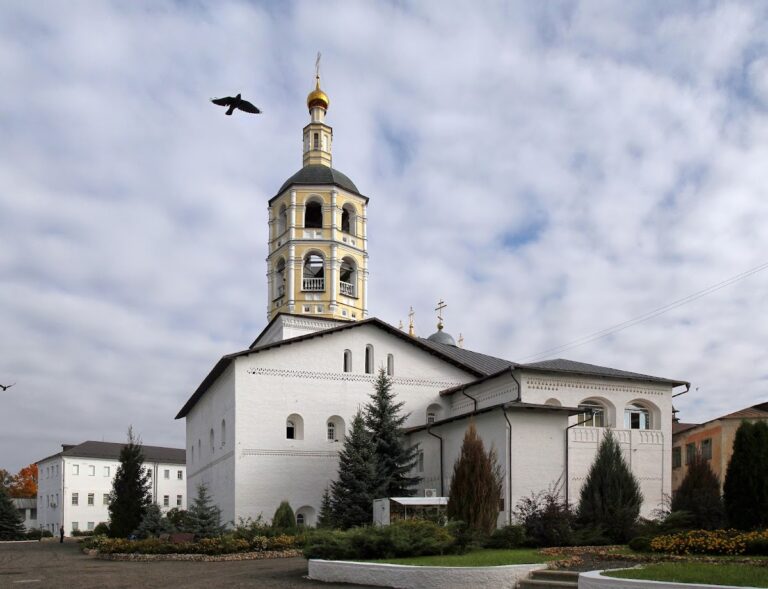
The monastery’s bell tower was built between 1892 and 1894. It has five storeys and rises approximately 70 metres. The tower survived the wartime attempt to demolish it and was visible from about 20 kilometres away. The Church of Saint Nicholas is a refectory church, combining a church with a communal dining building, and dates from 1908.
Outlying Churches and the Oak Chapel
The Church of the Three Hierarchs dates from 1905 and stands outside the main monastery complex. It replaced an earlier wooden church on the site. The Church of the Joy of All Who Sorrow dates from 1907 and is connected with a hospital building. The Church of Saint Ephrem the Syrian stands in the Ephrem Hermitage.
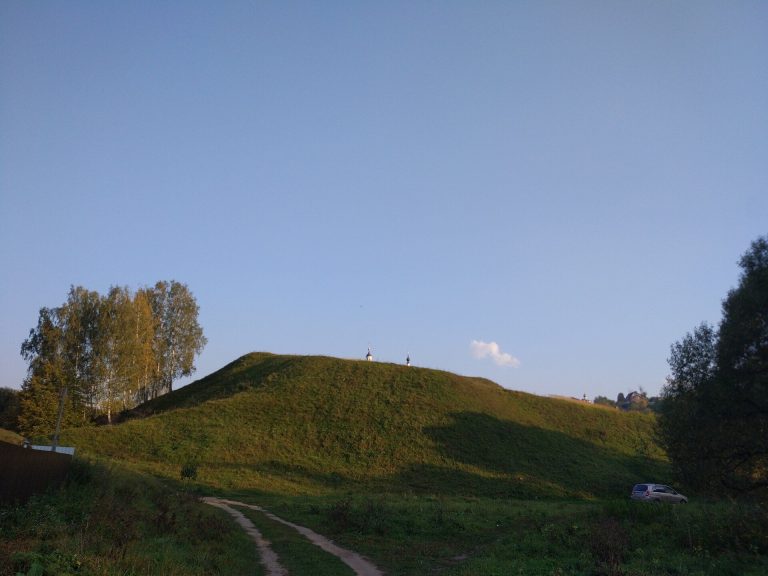
The chapel at the site of Tikhon’s oak was rebuilt in 2006 on the foundation of the former chapel. Lightning destroyed the original oak in the 1830s. A later oak grown from it stands beside the chapel and contains a small hollow.
The Life-Giving Spring Hermitage lies about two kilometres from the monastery. It contains the well traditionally dug by Tikhon and a church dedicated to the Life-Giving Spring Icon of the Mother of God, built in 1994. The Sergius, Sretensky, Ephrem, Vladimir, and Life-Giving Spring hermitages form associated outlying components of the monastery.
Vladimir Hermitage
The Vladimir Hermitage contains a church dating from 2010. Its upper church is dedicated to the Vladimir Icon of the Mother of God, while the lower church is dedicated to Sergius of Radonezh. The complex also contains a diorama museum about the confrontation on the Ugra, with displays of battle-related objects, pages from an illuminated chronicle, and works by Pavel Ryzhenko.
Necropolis and Sacred Objects
The monastery’s necropolis lies near the Transfiguration Cathedral. The cathedral’s basement burial vault was created for benefactors in the nineteenth century. Burials include Prince Ivan Vorotynsky, a boyar and military commander, in 1627, and his wife Maria Buynosova-Rostovskaya in 1628. The necropolis also contains nineteenth-century governors, nobles, officials, Archimandrite Moses Krasilnikov, and members of the Vorotynsky, Naryshkin, Sukhov-Kobylin, Yanovsky, Zhukov, and Shepelev families.
The monastery preserves or venerates Tikhon of Kaluga’s relics, a nineteenth-century icon of Tikhon, and an icon containing relics of the Optina elders. Other revered objects include an icon of Saint Nicholas brought from Bari, an icon of Prince Alexander Nevsky made in memory of Tsar Alexander III’s survival of an assassination attempt, an icon of the Great Martyr and Healer Panteleimon, and the Iveron Icon of the Mother of God.