Thozée Castle: A Historic Estate and Artistic Gathering Place in Belgium


Site at a Glance
- Rating
- 4.4
- Popularity
- Very Low
- Country
- Belgium
- Primary era
- Early Modern
- Eras represented
- Early Modern, Modern
- Civilizations
- Belgian, Holy Roman Empire
- Site type
- Domestic
- Remains
- Manor House
On this page10 sections
History
Thozée Castle is a historic estate in Pontaury, within Mettet, Belgium. Its name is linked to the villa called Toscias, recorded in the twelfth century, while the form Thozée appears in the fifteenth century after several changes in spelling. Like nearby Fosses, Thozée long belonged to the Principality of Liège, an ecclesiastical territory governed by prince-bishops whose courts and administration differed from those of neighboring secular lands.
The Thozée Fief and Its Early Owners
In 1478, Collin Henry, who died in 1527, is traditionally identified as the holder of the Thozée fief. The Henry family is said to have occupied the castle for about five centuries. Through Pierre-Louis Henry, who lived from 1666 to 1736, the family later adopted the name Henry de Faveaux.
In the second half of the seventeenth century, letters patent issued by Philip IV of Spain assigned the estate to the Stévenin d’Arc family. Jean-Baptiste Stévenin, then a captain in the Islands and Fortresses of the Rhine, became the first Baron of Thozée. A succession dispute among the Stévenin heirs reached the court of the prince-bishops of Liège in 1724. The resulting division or resale of the estate ended the family’s direct influence over the castle. The continuity of Henry possession from 1478, and the possibility that later owners sought to remove the Stévenin connection, remain uncertain.
The Henry de Faveaux Family
Charles Henry de Faveaux, mayor of Mettet, lived from 1757 to 1818 and was ennobled by Napoleon Bonaparte, the French military leader and emperor. He was the father of Ferdinand Henry de Faveaux, born in 1783, and Charlotte de Faveaux, born in 1797. Charlotte’s only daughter, also named Charlotte, married the artist Félicien Rops on 28 June 1857.
Rops was a Belgian painter and printmaker whose connection with Thozée shaped the estate’s modern cultural history. He lived there continuously or intermittently from 1852 to 1874. Before settling at the castle, he and his wife, Charlotte Polet, lived in the Rops family home in Namur and later on Avenue Louise in Brussels, while making frequent stays at Thozée, where Charlotte’s uncle Ferdinand de Faveaux resided.
Félicien Rops at Thozée
For Rops, Thozée combined leisure, artistic work and sociability. He hunted and skated there, painted the park and its surroundings, considered teaching printmaking, and composed pedagogical works. The castle also became a meeting place for artists and writers. Among those invited were Charles de Coster, the poet Charles Baudelaire and his publisher Auguste Poulet-Malassis, the photographer Armand Dandoy, painters Louis Dubois, Louis Artan and Edmond Lambrichs, the poet Albert Glatigny, and the writer Alfred Delvau. Baudelaire’s presence, in particular, reflects the estate’s role within a nineteenth-century artistic and literary circle.
After Rops left for Paris in 1874 and the couple separated their property, Charlotte retired permanently to Thozée and raised their son Paul there. She died at the castle on 22 March 1929, aged 94. Their granddaughter Élisabeth Rops died in June 1996. Her heirs, Danièle Rops and her two sons, were disinherited for an unstated reason. The castle then passed to the Félicien Rops Foundation, which undertook the restoration of the castle and farm, their adaptation for cultural use, and the protection and accessibility of the family archives.
Thozée Castle was listed as protected heritage in 1996. The protection includes the castle and specified interior spaces, preserving the buildings associated with the estate’s long ownership history and its connection with Rops.
Remains
Park and Estate Grounds
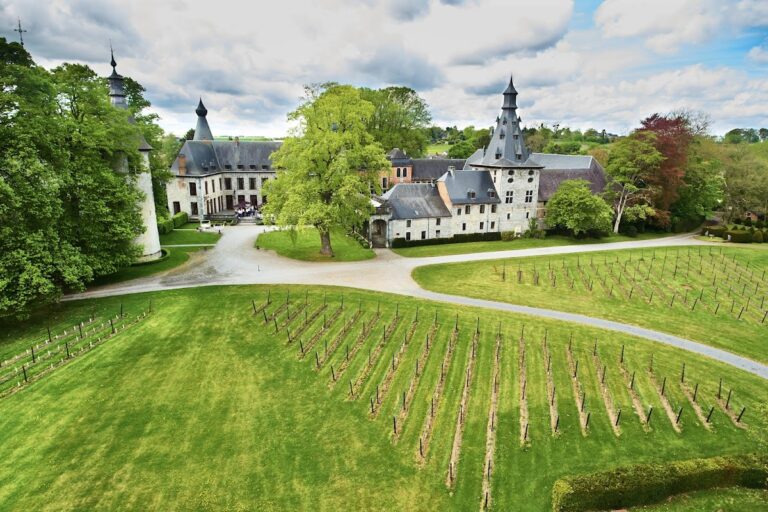
The estate covers 19 hectares and includes the castle, a nineteenth-century farm, and an extensive park with notable trees. The park forms a prominent element of the Pontaury landscape and is described as characteristic of the Thiérache region. Three tree-lined avenues approach the castle, with horse chestnuts, lime trees and beeches lining their routes. Much of the park consists of former orchards and pastures.
Near the castle, a French garden was arranged in strict alignment with the facade before being transformed into an English garden. The formal layout gave way to a more naturalistic arrangement of lawns, trees and winding compositions. Basins, balustrades and benches remain associated with the garden, together with sculpted yew trees. A large pond lies below the gardens and was positioned to reflect the south facade of the castle.
Castle and Farm Buildings
The Castle
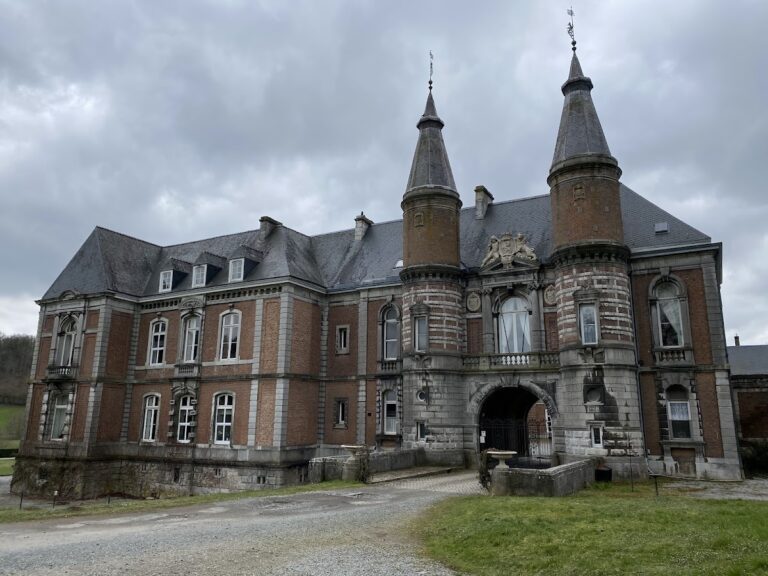
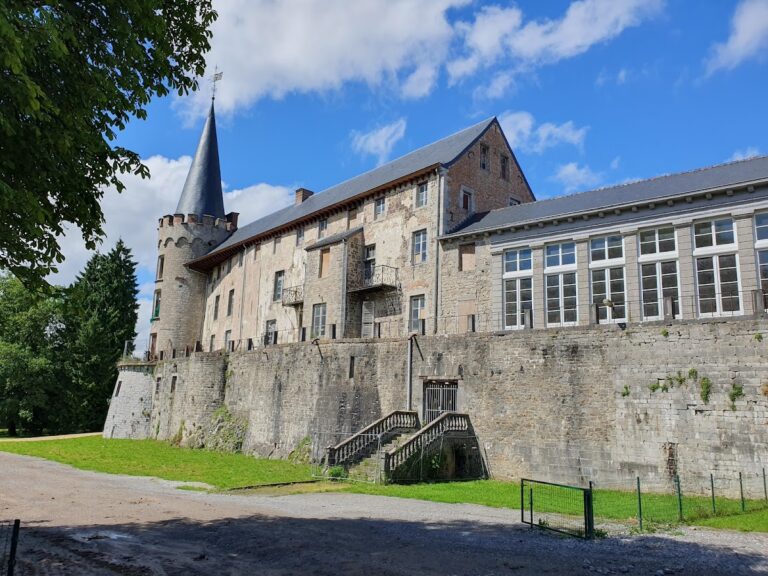
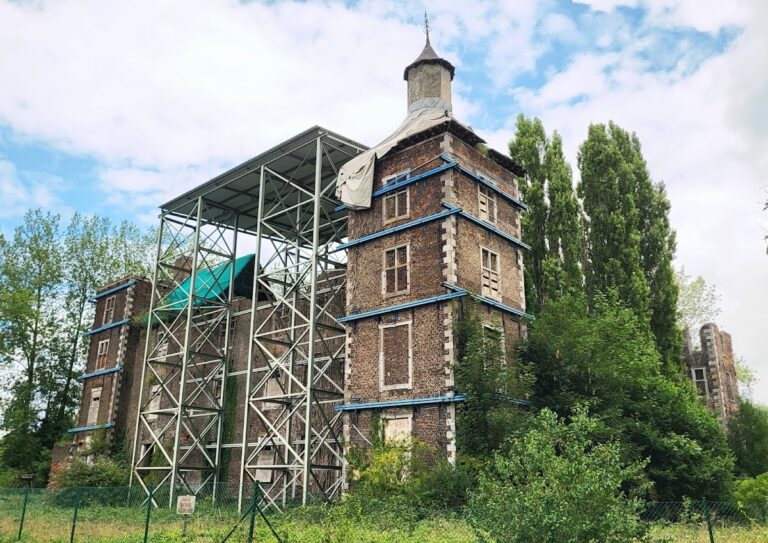
The castle rests on fifteenth-century foundations, while construction of the building associated with the present estate began in 1708. The appearance of the earlier structure is unknown. The surviving house is a neoclassical country residence set between a courtyard and a garden, and it retains the U-shaped plan of the 1708 farm. Its main body rises above high basement cellars and includes a projecting central section, a northeast tower and two lateral wings.
Ferdinand Henry de Faveaux gave the building its final major transformations in a troubadour neo-Gothic style. This nineteenth-century revival combined medieval-inspired Gothic forms with a picturesque, historically romantic character. The work added the southeast tower, regularized the roofs of both towers, created a southern projecting section and a northern chapel, raised part of the south wing, inserted neo-Gothic dormer windows, and altered the upper-storey window of the courtyard-facing projecting section.
The Farm
The nineteenth-century farm is arranged around an irregular courtyard planted with trees. After the passage of Dumouriez’s sans-culottes, radical supporters of the French Revolution, Charles Henry de Faveaux rebuilt the farm in the early nineteenth century. His coat of arms was placed above the entrance gateway to recall his ennoblement by Napoleon Bonaparte.
Protected Interior Spaces
The interiors have a general nineteenth-century character. The central drawing room contains numerous paintings by Rops and his contemporaries on its walls. Other identified rooms are the music room, the blue bedroom, which served as a guest room including for Baudelaire, the dining room and the green drawing room, together with a corridor. These five rooms and the corridor are protected for their interior appearance, retaining the domestic and artistic character associated with the castle’s nineteenth-century use.
Nearby sites