Thorberg Castle with Outbuildings: A Fortress, Monastery, and Prison in Switzerland
Site at a Glance
- Popularity
- Medium
- Country
- Switzerland
- Primary era
- Modern
- Eras represented
- Classical, Medieval, Early Modern, Modern
- Civilizations
- Holy Roman Empire, Roman, Swiss
- Site type
- Civic
- Remains
- Prison
On this page17 sections
History
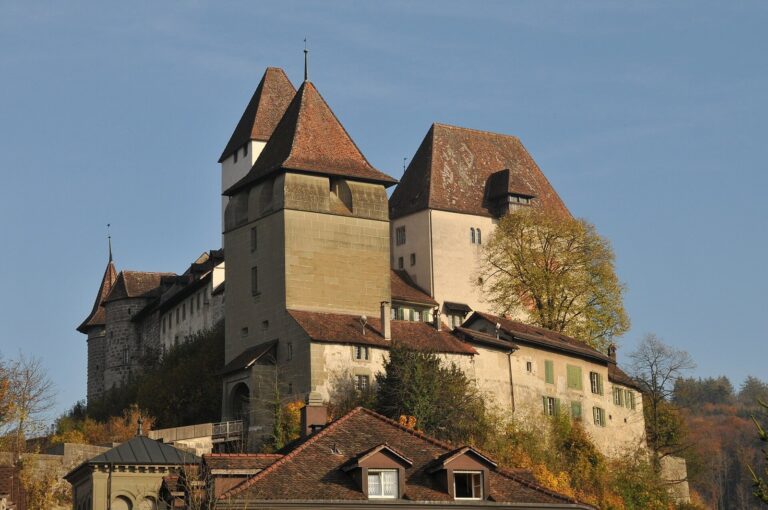
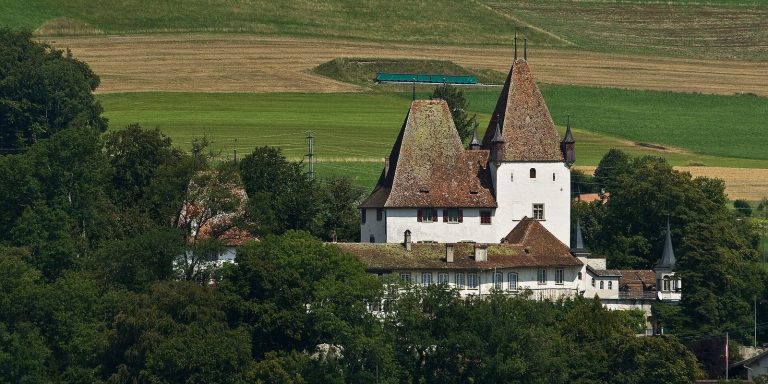
Thorberg Castle with outbuildings is a historic complex on a rocky promontory above Krauchthal in Switzerland, where Roman-period settlement preceded a medieval castle first recorded in 1175. The site later became a monastery and, after secularization, served successive Bernese administrative, care, and penal institutions.
Roman occupation and the Thorberg family
Settlement remains indicate that people occupied the site in the Roman period. The castle belonging to the Thorberg family appears in written records in 1175, though it may previously have been held by the lords of Krauchthal. From the late 12th century, it was a fief of the Thorberg family. Members served as dependent knights to the rival Zähringen or Kyburg ruling houses, and their holdings extended to property at Krauchthal and Koppigen and around other local churches and lordships.
Siege and monastery foundation
During the Sempach War, a late-medieval conflict involving Swiss and Habsburg interests, Bernese forces besieged the fortress. It surrendered in 1386, and the Bernese destroyed its military fortifications. They returned the site to Peter von Thorberg in 1389.
After regaining the promontory, Peter began building a church and monastery there. In 1397, the last knight of the Thorberg family established the Charterhouse of Saint Paula of the Mountain Gate, a Carthusian monastery whose monks lived largely secluded, contemplative lives, supported by lay brothers who were not ordained priests. The monastery belonged to the Diocese of Lausanne, a church jurisdiction headed by a bishop, and housed monks and lay brothers until 1528. Alliances and expanding estates at places including Krauchthal, Erfingen, and Koppigen helped it prosper.
Reformation and Bernese administration
The Reformation, a 16th-century movement that divided Western Christianity and changed religious institutions and property, brought the Carthusian community to an end in 1528. After the priors sided with the Reformation, Bern took over the monastery’s property and converted it to secular use. Most of the 17 choir monks went to the Carthusian monastery at Ittingen. Father Melchior Mörlin was among them, carrying books with him.
Bern first created an administration to manage the former monastery’s estates. From 1570, it operated as a bailiwick, an estate administered by a bailiff, whose income was managed by a member of Bern’s patriciate, its governing elite. The buildings served as a hospice for elderly or sick people and also housed care institutions, a prison, and a hospital. The bailiwick ended in 1798, when the French invasion toppled the Republic of Bern and established the short-lived, French-backed Helvetic Republic.
Care and penal institutions
After the Act of Mediation, an 1803 settlement that reorganized Switzerland following French intervention, Bernese authorities adapted the complex for confinement and correction. In 1805, the former almshouse became a reformatory, model school, and auxiliary asylum for people with mental illness. A facility for enforced abstinence opened in 1807 for people considered not to warrant a penitentiary sentence. On 1 November 1849, a forced-labour institution replaced the care institutions. The auxiliary asylum closed in 1855, after the psychiatric clinic at Waldau opened.
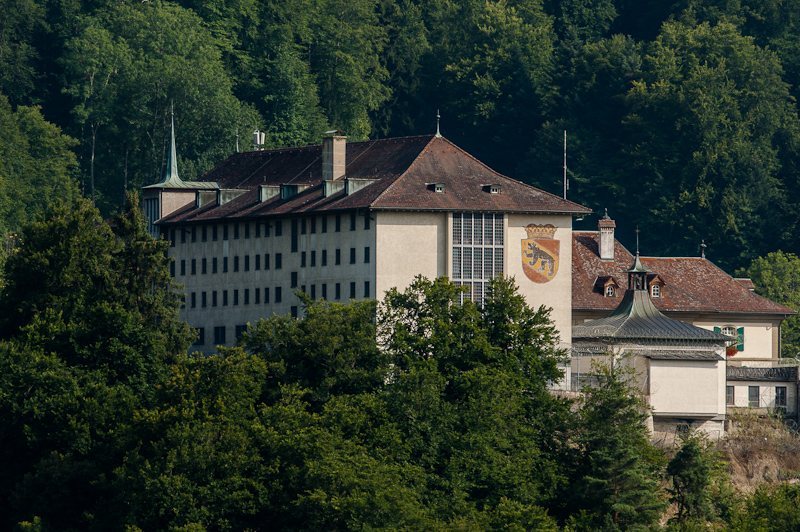
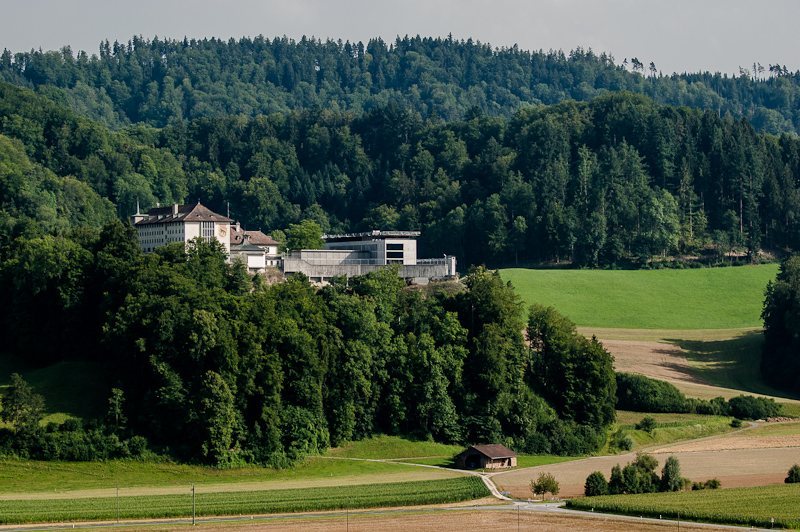
A new cell block opened as a prison in 1893, and the site has remained in penal use. Further building changes followed after 1942, and sanitary facilities in the cell and detention wings had been renewed by 1978. In July 1991, a prisoner deliberately started a fire that damaged the cell building so severely that it had to be demolished. A replacement was completed on the same site in 1998. The present prison holds men serving long sentences or living with serious mental disorders.
Remains
The complex occupies an elevated, rocky promontory above Krauchthal, overlooking the Lindental valley, and access to the site is difficult. Its surviving features range from fragments of medieval tower foundations to monastic buildings, a later Baroque castle, and prison installations. A sandstone quarry lies nearby.
Medieval castle and monastic buildings
Tower foundations
Only fragments of the medieval castle’s tower foundations remain on the promontory.
Women’s guesthouse
The former monastery’s surviving buildings include a women’s guesthouse.
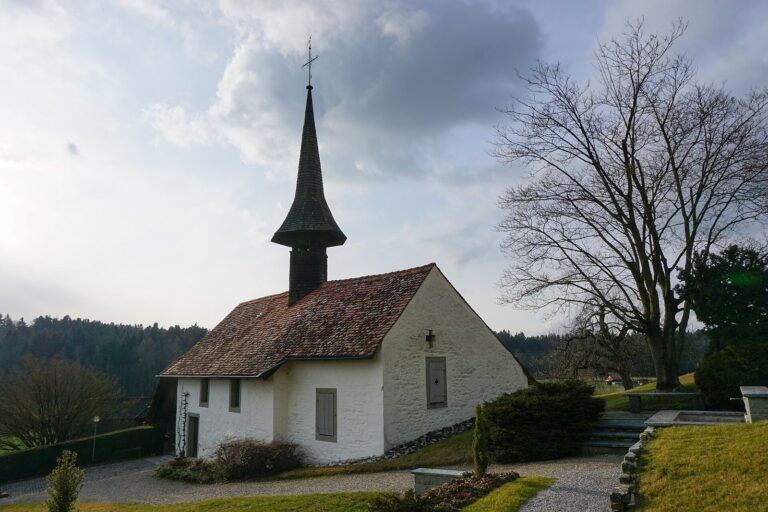
Chapel
The monastery chapel dates to 1510–1515. Its frescoes, paintings made on wet plaster, depict the Adoration of the Magi and the Adoration of the Shepherds.
Later structures and quarry
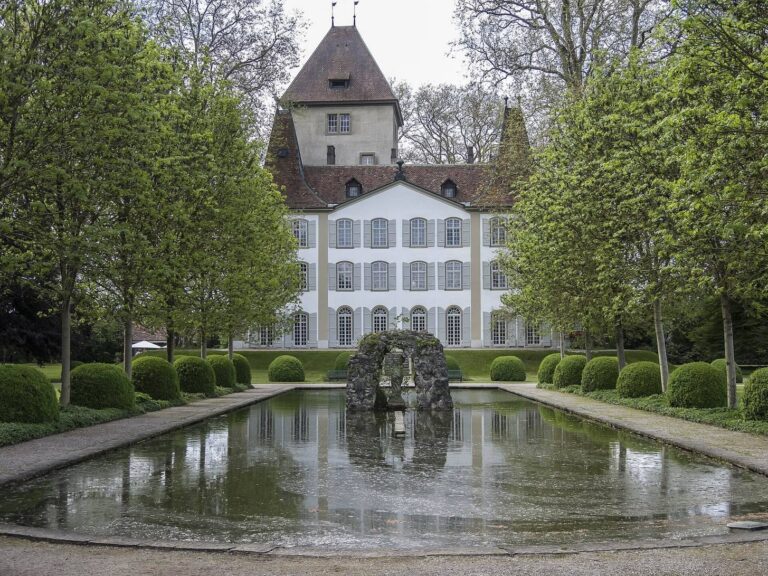
Baroque castle
A Baroque castle, in an elaborate European architectural style, was built on the site during the second half of the 18th century, when Thorberg was a bailiwick. It represented the authority of the bailiwick.
Prison buildings
Most of the present prison installations date from the 1950s. The current complex includes a secure-detention building constructed in 1952.
Sandstone quarry
The old sandstone quarry near the complex retains visible traces of hand-working and tool use.
Movable remains
Sculpture
A sculpture of the Man of Sorrows, a devotional image of Christ showing the wounds of his Passion, once belonged to the monastery. It is now held at the Bern Historical Museum. The work is by Erhart Küng, a sculptor and senior building official at Bern Minster.
Books and manuscripts
A surviving list names 33 books that Father Melchior Mörlin took to Ittingen in 1528. Six can now be traced at the Thurgau Cantonal Library. Four other manuscripts from Thorberg are held at the Bern Burgerbibliothek, with one each in the municipal libraries of Grenoble and Vesoul. The Central Library of Solothurn holds seven books printed before 1501 and ten early printed books from after that period. Most have leather covers decorated by pressing tools into the surface without color or gold.