The Name of Mary Church: A Roman Catholic Parish Church in Novi Sad
Site at a Glance
- Rating
- 4.8
- Popularity
- Very High
- Country
- Serbia
- Primary era
- Modern
- Eras represented
- Modern
- Civilizations
- Austria-Hungary, Habsburg, Hungarian
- Site type
- Religious
- Remains
- Church
On this page16 sections
History
Medieval churches and cemetery
The Name of Mary Church is a Roman Catholic parish church in Novi Sad, Serbia. Its present building was designed in 1892 and consecrated in 1896. A church and cemetery stood on the site around 1100, but both the church and settlement were destroyed in a 13th-century incursion by Tatars, a broad historical label for several Eurasian peoples. After the settlement was rebuilt, another church served fairs and was associated with the name Vašaroš Varad. Ottoman forces destroyed it in 1526.
The Catholic parish and its early churches
The Treaty of Karlowitz in 1699 followed the Great Turkish War, a conflict between the Ottoman Empire and a European coalition that included the Habsburg monarchy. The treaty marked a major shift in territorial control in southeastern Europe, and Habsburg influence in the region strengthened. Novi Sad’s Catholic parish was established in 1702. In 1719, parishioners built a modest church with a cemetery at the site.
After Ottoman forces captured Belgrade in 1739, wealthy Catholics moved to Novi Sad. Their growing commercial prosperity helped make a replacement church possible. The 1719 building was replaced in 1742, when Gábor Patachich, the Catholic archbishop of Kalocsa, consecrated the new church.
Damage and rebuilding
Bombardment on 12 June 1849 badly damaged the church during the Hungarian Revolution of 1848–1849, an uprising against Habsburg rule. The building caught fire and lost its bell tower. It was later rebuilt without the original tower. Dissatisfied with the result, local Catholics proposed a basilica suited to Novi Sad’s status as a royal free city, a municipality with special privileges under the Hungarian crown.
The present church
In 1891, the city council approved replacing the old church. Hungarian architect György Molnár prepared the design in 1892 without charge, and the old building was demolished that year. Stefan Gusek and Karl Lerer carried out construction under Molnár’s supervision. The main structural work was complete by November 1893; the tower and its gilded cross were finished in October 1894. Exterior work continued in 1895, while work on the interior and stained glass carried on into 1896. The church was consecrated on 21 April that year, during the same period that Novi Sad’s City Hall was built. Most of the builders came from Novi Sad, with other craftsmen and artists arriving from Budapest, Timișoara, Subotica and Tyrol. Contributors included carpenter Matthias Drach, sculptor Gustav Freichtner and roofer Jozef Kleinček.
The church was first dedicated to Mary Help of Christians, a devotional title for the Virgin Mary, in commemoration of the Christian victory at Vienna. Tradition connects the dedication with defenders invoking Mary during the siege on 12 September 1683. The dedication later became that of the Name of Mary, a Catholic feast observed on 12 September.
Fire, repair and continuing parish use
A fire in November 1904 destroyed the wooden roof structure. The roof was rebuilt in 1904–1905 with glazed Zsolnay tiles, paid for through donations from local worshippers. The church was renovated in 1965, and work in the 2010s cleaned its yellow façade bricks and renewed its lighting. It is recognized as a Serbian national monument.
The church remains an active Roman Catholic parish in the Diocese of Subotica, within the Latin rite, the Western liturgical tradition of the Catholic Church. Although people in Novi Sad commonly call it “the Cathedral,” it is not the diocesan cathedral. The Diocese of Subotica’s cathedral is in Subotica.
Remains
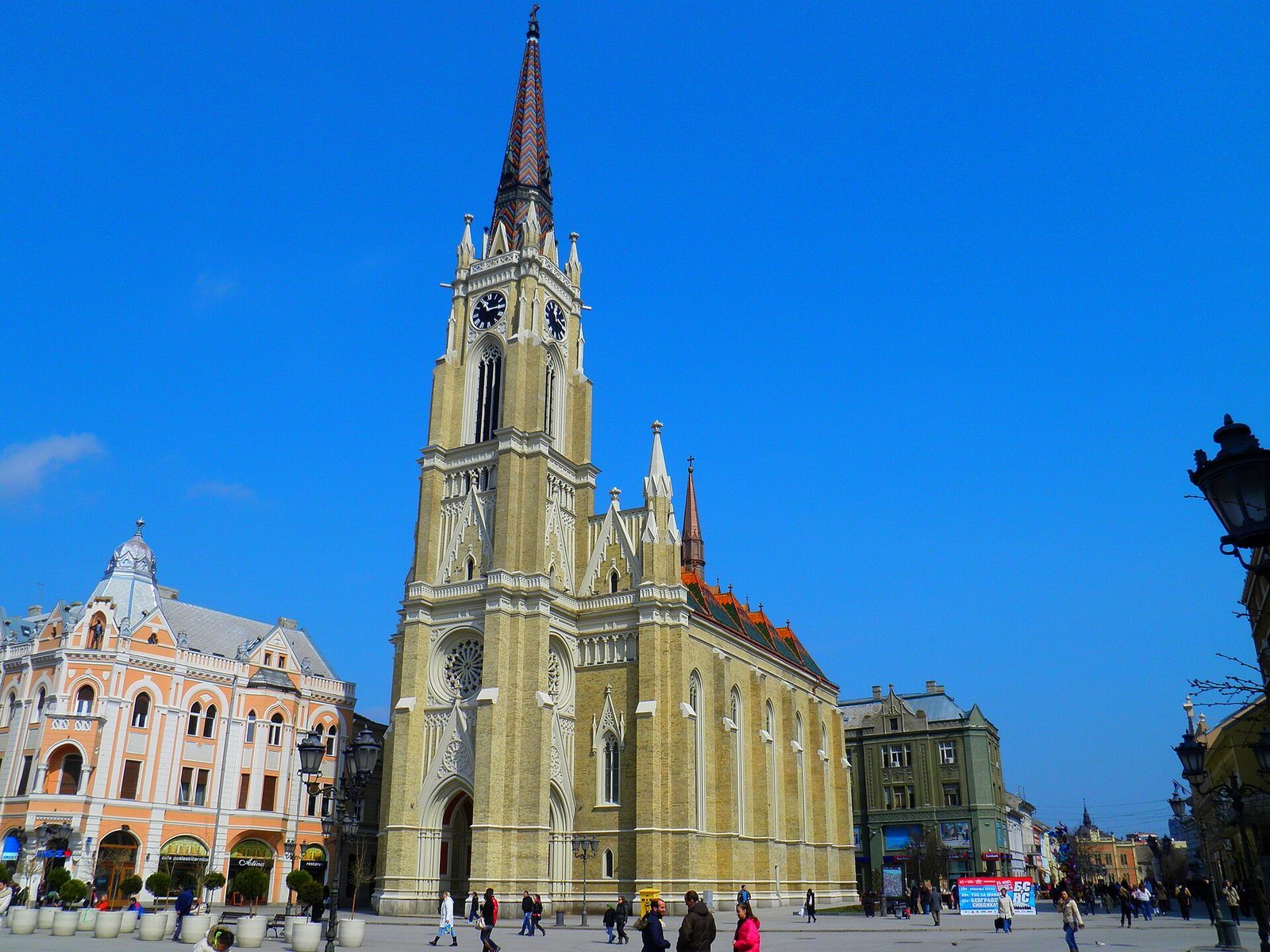
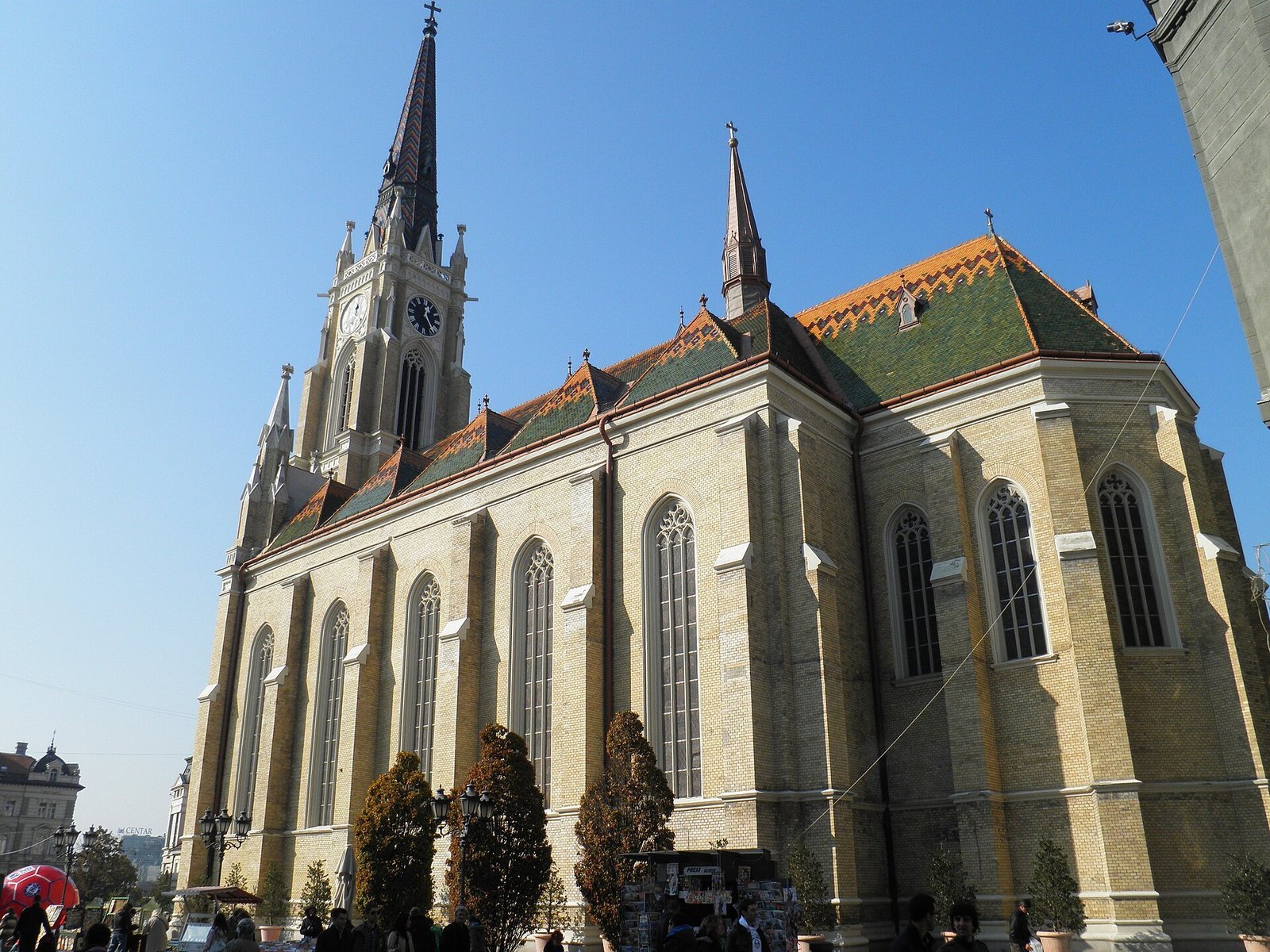
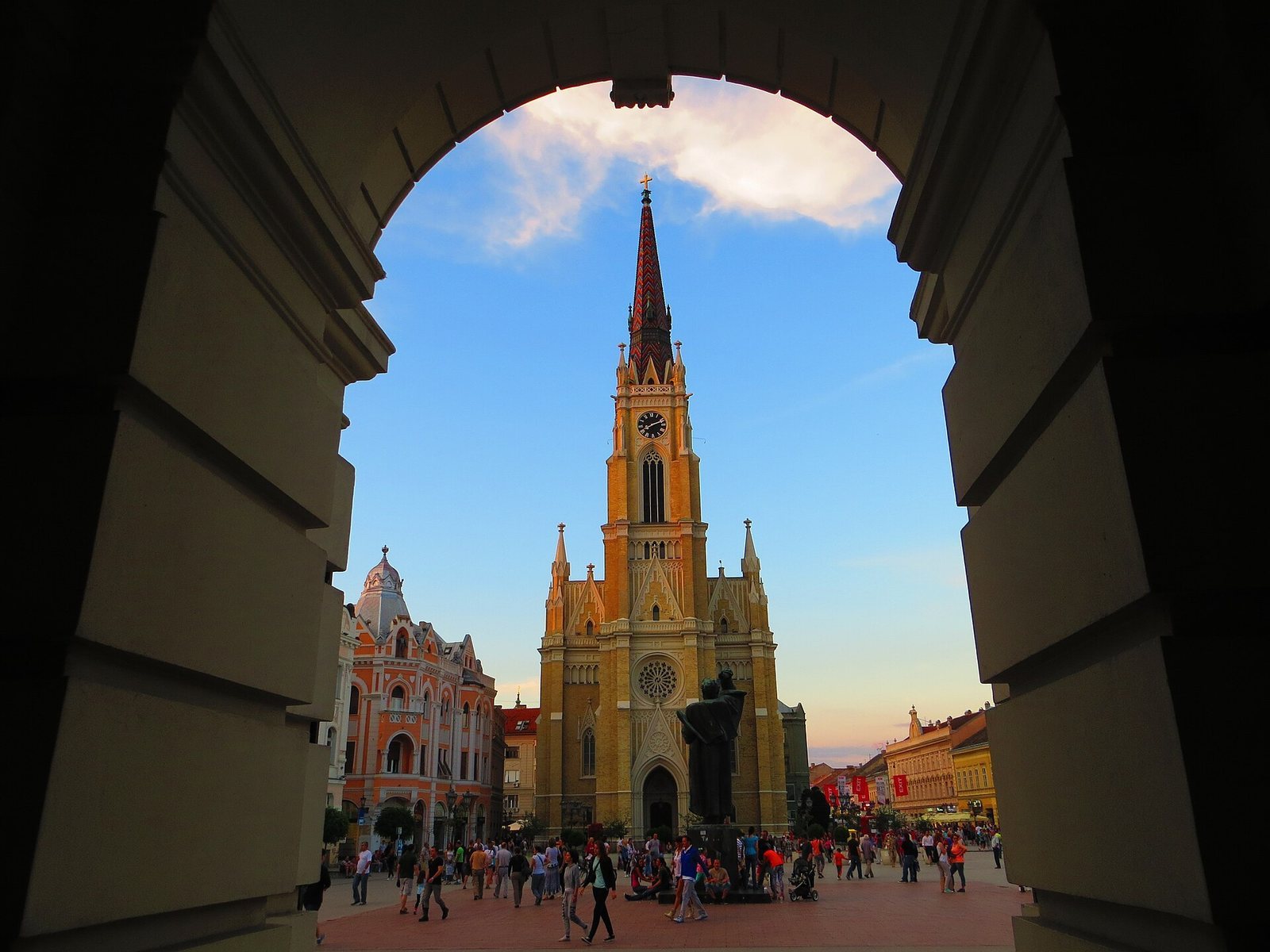
The late-19th-century church has a three-nave basilica plan, with a central main space flanked by side aisles, and Neo-Gothic features. It occupies the northeast corner of Freedom Square as part of the architectural ensemble around the square. The building runs northeast to southwest; its main entrance faces City Hall, while Katolicka Porta Square lies behind it. It is 52.5 metres long and about 24.7 metres wide. The roof is about 22.3 metres high, and the bell tower rises 72 metres. It is the largest and tallest church building in Novi Sad and the third-tallest church in Bačka.
Exterior
Walls and façade
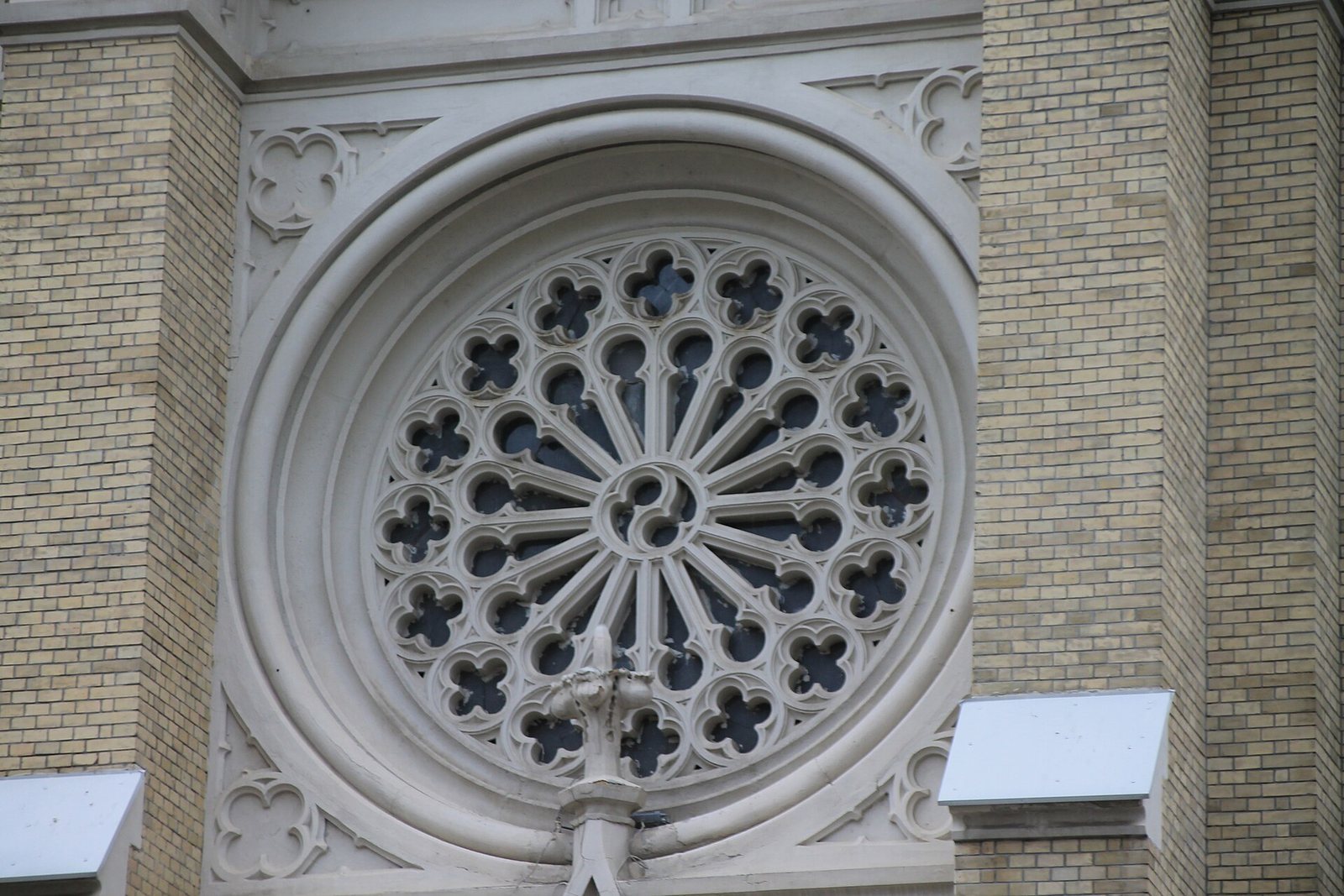
Yellow clinker brick, a dense brick made by firing at high temperatures, faces the exterior. Twenty-two exterior supports reinforce the walls, with high Gothic upper arcades between them. The narrow façade tower rests on four massive pillars and is framed by shallow, column-like projections. Its decoration includes triangular gables, rosettes, upper arcades, paired openings and Gothic columns. Some plaster or decorative fragments fall from the façade, particularly during storms.
Entrance and tower base
The main entrance is a large doorway with two decorated leaves and a raised coat of arms. The stone bears the words Crux Amore, meaning “Cross of Love.” Beneath the tower, small black-and-white square tiles contrast with larger red tiles arranged as a cross. Projecting horizontal moldings run along the side walls above and below the windows, and each side wall also has a door. A triangular gable above the courtyard door contains a relief of an angel in prayer.
Roof and sacristy
Hexagonal decorative ceramic tiles cover the roof and tower. The material includes Zsolnay pyrogranite, a decorative architectural ceramic developed by the Zsolnay manufactory; the tower roof also has small square ceramic tiles. A small tin turret sits on the northeast side of the roof ridge. At the courtyard-side corner between the projecting apse, the end containing the main altar, and the nave is a rectangular sacristy, a room for storing vessels and vestments. Its shallow, roofed porch is reached by five pink-stone steps.
Interior
Naves and interior fittings
Six columns with eight-lobed cross sections and four half-columns divide the three lengthwise spaces into four structural bays. The church ends in a deep, five-sided apse. Intersecting barrel vaults form the ceilings, and high Neo-Gothic arches rise over the central nave. Red, black and white square tiles cover the floor. Sixteen rows of pews in the central nave are arranged in two blocks. Fourteen Stations of the Cross, devotional images of episodes in Christ’s Passion, hang along the walls.
Windows and choir
The church has 61 stained-glass windows, including 20 figurative windows set among the nave’s upper arcades, the large circular rose window above the choir, smaller upper openings in the apse, and the sacristy windows. They depict saints and church dignitaries. Their makers included Eduard Kratoman of Budapest and Tirke and Richard Schleim of Grottau. An iron railing encloses the choir, which contains a mechanical organ delivered from Budapest in 1895. It has 24 registers, sets of pipes controlled together by stops. A niche beneath the choir, on the left, holds a bust of Molnár.
Altars
Tyrolean sculptor Ferdinand Stuffleser made and installed the four altars. The main altar stands in the apse and is carved from wood brought from Tyrol. It holds the church’s oldest and most valued painting, showing the Virgin Mary with the Hungarian kings Stephen and Ladislaus, and includes figures of the four Gospel writers. To its left, the Resurrection altar has figures of the apostles Peter and Paul. The altar of Saint Florian, patron of firefighters, includes figures of Saints Emeric and Elizabeth and an image of the Holy Family, Jesus, Mary and Joseph. Beneath the choir, the fourth altar is dedicated to Christ’s tomb and has figures of four angels. The altar sculptures are painted to resemble stone or treated to imitate marble.
Other furnishings
The church also contains four confessionals and a marble baptismal fitting. It may have four bells; the largest weighs 1,268 kilograms and the smallest 191 kilograms. A Silesian organ builder installed the organ.