Volkersberg Monastery: A Franciscan Pilgrimage Site in Germany
Site at a Glance
- Rating
- 5
- Popularity
- Very Low
- Country
- Germany
- Primary era
- Early Modern
- Eras represented
- Early Modern
- Civilizations
- Holy Roman Empire
- Site type
- Religious
- Remains
- Monastery
On this page8 sections
History
Volkersberg Monastery in Germany was founded in 1658 by Joachim, Count von Gravenegg, Prince-Abbot of Fulda, an abbot who also held princely authority. He established it for the Franciscan Observants, a branch of the Franciscan order committed to strict observance of its rule, and dedicated it to the Finding of the Cross, the Christian commemoration of the discovery of the Cross on which Jesus was crucified.
Early records and pilgrimage
The earliest known reference to Volkersberg dates to 1160, when the place appeared in a property register belonging to the Benedictine monastery of Frauenberg near Fulda. Benedictines are monks who follow the Rule of Saint Benedict. This mention refers to Volkersberg, not to the foundation of the later monastery. A chapel on the mountain is noted from 1378.
A Confraternity of the Cross, a religious association devoted to the Cross, was established at Volkersberg in 1450. Hermits lived on the mountain until 1499, helping serve a growing number of pilgrims. Pilgrimage declined during the Reformation, the sixteenth-century movement that led to Protestant churches, and the Thirty Years’ War, a major European conflict fought from 1618 to 1648. By the middle of the seventeenth century, Volkersberg had again become a popular destination for pilgrims.
Franciscan pilgrimage
In 1659, Joachim gave the Franciscans at Volkersberg a fragment of the Cross. People associated about 25 miracles with the site between 1658 and 1672. Among them was the claimed healing of Elisabeth Hillenbrand of Riedenberg in 1665, when she was said to have recovered from lameness.
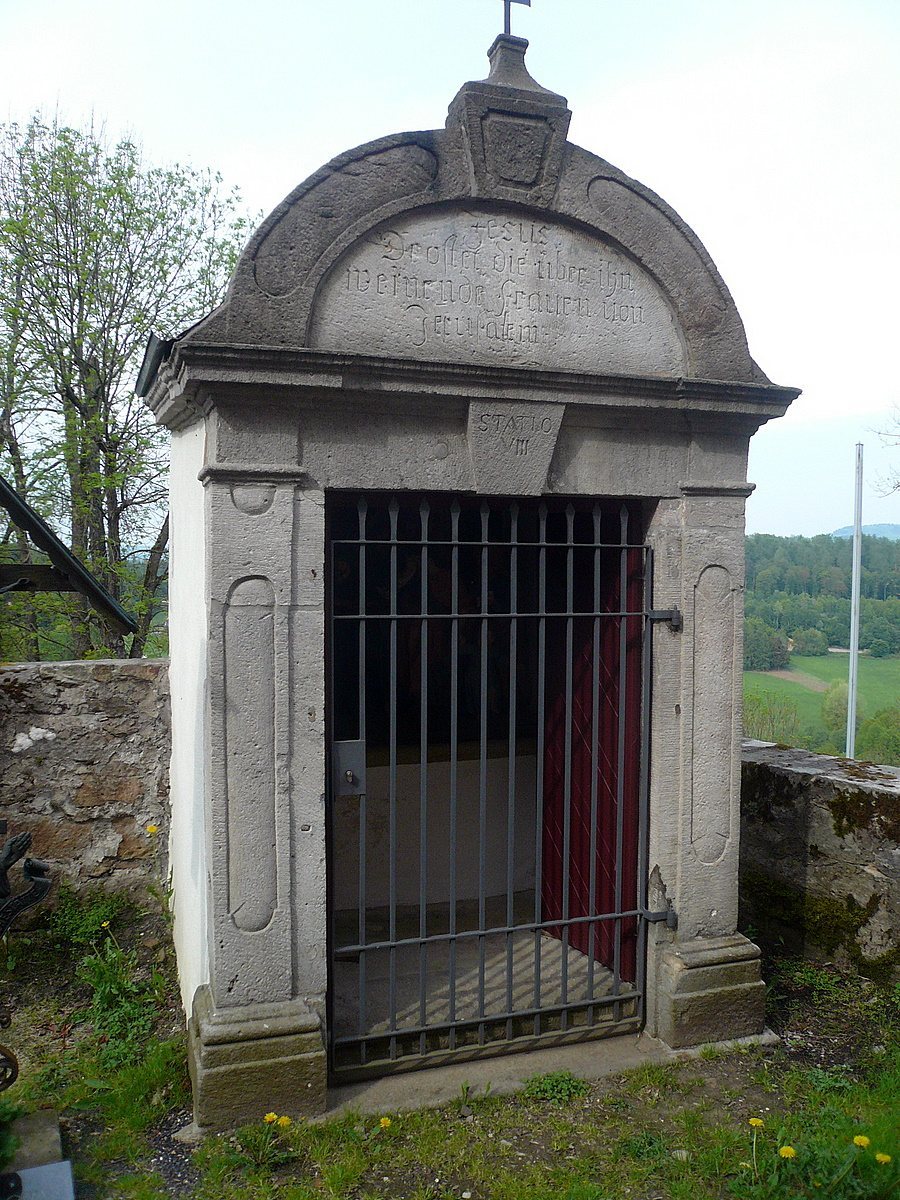
About 60 Franciscan friars lived at the monastery in the early eighteenth century. In 1755, a Way of the Cross was blessed. This Christian devotion recalls Jesus’ final journey to crucifixion through a series of stations.
Diocesan rule and nineteenth-century change
In 1803, secularization, the transfer of church authority and property to secular rule, affected the Prince-Bishopric of Fulda, a territory governed by a bishop who also held secular power. The monastery was left untouched because it was judged too poor. Volkersberg became part of Bavaria in 1816 and came under the Diocese of Würzburg in 1821.
As pilgrim numbers continued to fall, the School Sisters of Notre Dame, a Catholic teaching congregation, opened a girls’ rescue home in the old inn in 1859.
Twentieth-century religious and educational uses
Missionary Dominican Sisters from Neustadt am Main, part of a Catholic religious tradition associated with preaching and teaching, took over the monastery in 1921. They maintained their postulate, a preparatory period before full entry into a religious community, there until 1955. After the old inn was sold to the Diocese of Würzburg, the diocese opened a youth house and the Catholic Rural Adult Education Centre in the premises in 1956. The Dominican sisters returned the following year.
The Franciscan monks left in 1966, when a shortage of vocations led to the monastery’s dissolution. The diocese bought the buildings and expanded the adult education centre, while the church became the parish church of Volkers. From 2002, the youth education centre and the Catholic Rural Adult Education Centre operated under the shared name Haus Volkersberg. Two sisters of the Congregation of the Dominican Sisters of Saint Catherine of Siena continued the monastic tradition there until 2013.
Remains
Monastery and church
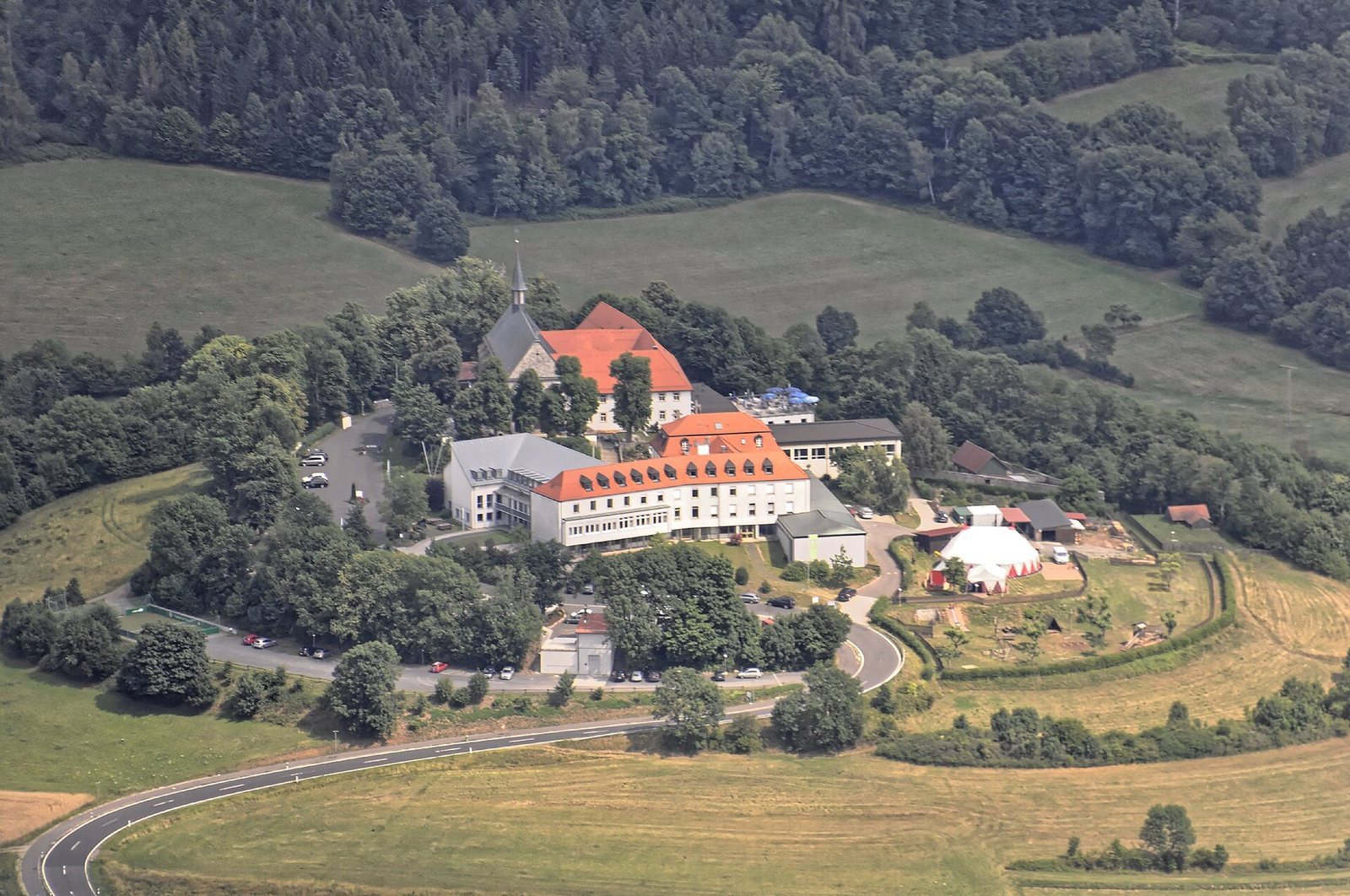
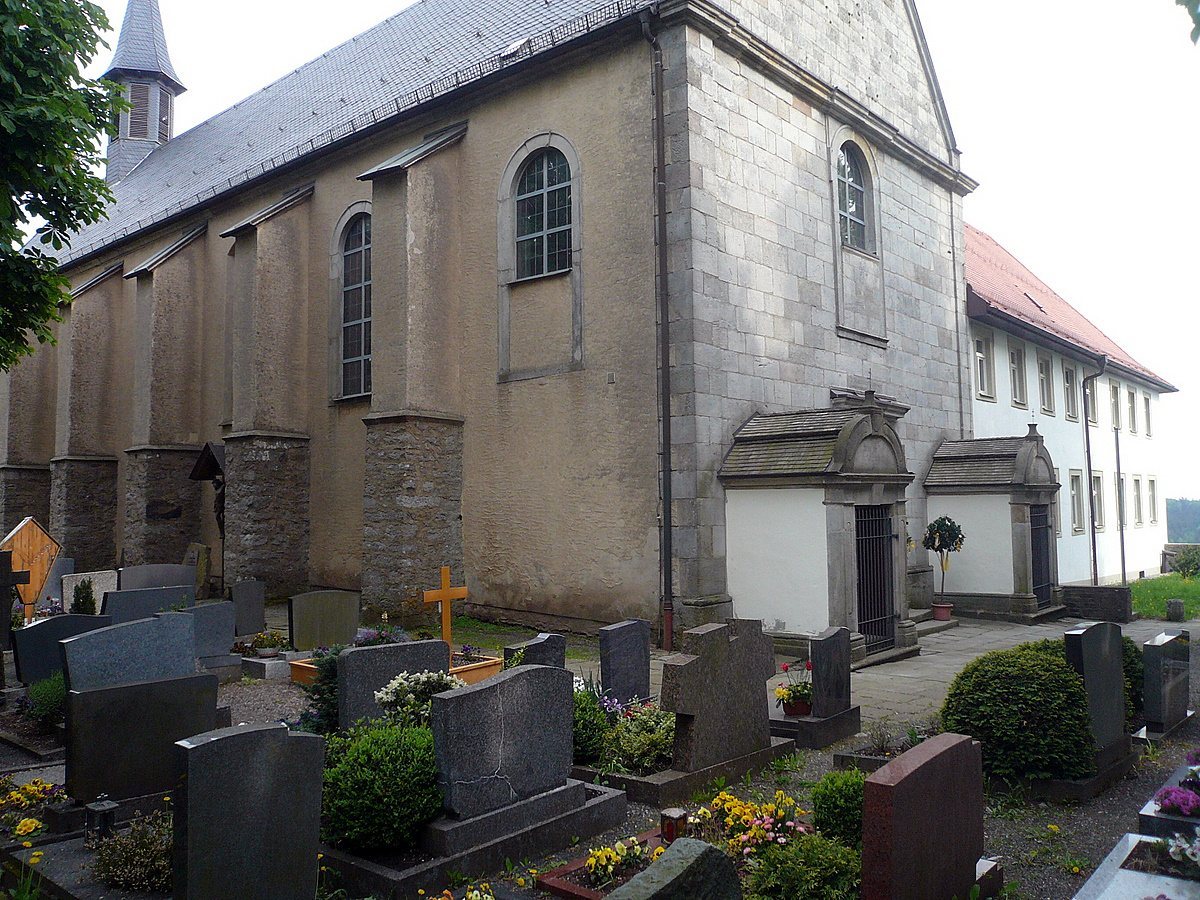
The former complex comprises a church and convent buildings, constructed in several stages. The foundation stone was laid in 1661, and work on the church began in 1664. The monastery was consecrated in 1678. Dedicated to the Holy Cross, the church was enlarged in 1707, and the monastery buildings were expanded in 1710.
Pilgrim buildings and routes
An inn was built around 1690 to serve pilgrims, and a new inn in Baroque style was constructed in 1752. Volkersberg also has a Way of the Cross with 14 stations. The Franconian Marian Way, a regional pilgrimage route dedicated to Mary, passes through the grounds.