Tennenbach Abbey: A Cistercian Monastery in Germany


Site at a Glance
- Rating
- 4.7
- Popularity
- Very Low
- Country
- Germany
- Primary era
- Medieval
- External website
- Open
- Eras represented
- Medieval, Early Modern
- Civilizations
- Holy Roman Empire
- Site type
- Religious
- Remains
- Monastery
On this page14 sections
History
Tennenbach Abbey was a Cistercian monastery in Freiamt, Germany, founded around 1158 during the Romanesque period. Dedicated to Saint Mary, it was originally called Porta Coeli, meaning “Heaven’s Gate,” and developed into one of the largest and most important Cistercian monasteries in southwestern Germany.
Foundation and monastic expansion
Twelve monks moved from Frienisberg Abbey near Bern to establish Tennenbach under Abbot Hesso, probably between 1158 and 1161. Frienisberg was a daughter house of Lucelle Abbey in Alsace and belonged to the Cistercian filiation of Morimond, a network of monasteries linked through their foundation relationships. Tennenbach came under Salem Abbey in 1182, or generally by the end of the twelfth century.
The precise role of Berthold IV, Duke of Zähringen, in arranging the foundation remains uncertain. The families of Emmendingen, Hornberg, Keppenbach, and Üsenberg were among the abbey’s founding families. A foundation notice said to have been written at Hochburg in 1161 is a mid-thirteenth-century forgery, but a papal privilege issued by Alexander III on 5 August 1178 already listed Tennenbach’s rights and properties.
The abbey’s possessions eventually included more than 200 estates, concentrated mainly in the Upper Rhine Plain and the western Black Forest. Its granges, farms and estates operated directly by the monastery, formed the economic basis of this landholding. Properties in the Baar were more isolated from the main concentration. Tennenbach also possessed 672 relics and fragments of saints, more than the 374 held at Salem, its mother house.
Medieval authority and religious life
From the thirteenth into the fourteenth century, the Margraves of Hachberg held Tennenbach’s protective jurisdiction and made the monastery their burial place. The Habsburgs, a major European ruling dynasty with territories in the Upper Rhine region, claimed this jurisdiction from 1373.
Tennenbach was also associated with Hugo of Tennenbach, a monk and priest who entered the monastery after an unexpected recovery from a serious illness in 1215. He became known for exemplary monastic and priestly conduct. After his death on 20 August 1270, he was venerated locally and was later beatified. His life was preserved in a codex of Salem Abbey now held in Heidelberg. The probable author was Gottfried of Freiburg, a thirteenth-century scribe and charter writer in the Breisgau who entered Tennenbach and wrote the biography at the commission of Abbot Heinrich of Falkenstein.
War, fire, and rebuilding
An alleged destruction of Tennenbach by the Armagnacs in 1444 remains unconfirmed. The Armagnacs were troops associated with the French crown who fought in the later stages of the Hundred Years’ War. During the German Peasants’ War, a widespread uprising of 1525 against social and religious grievances, parts of the complex were burned, although the church and chapel survived.
On 15 July 1590, Margrave Jakob III converted to Catholicism at Tennenbach. During the Thirty Years’ War, the major European conflict of 1618 to 1648 involving religious and dynastic struggles, the monks left the convent. They first transferred the archives and sacred treasures to Freiburg and later to Breisach. When Duke Bernhard of Weimar conquered Breisach, parts of the treasures fell into his possession. The abbey archive and land register were saved at Wettingen, while Friedenweiler Abbey also provided refuge.
A fire destroyed many of the monastery buildings in 1723. Between 1726 and 1741, Abbot Leopold Münzer of Freiburg directed the rebuilding of Tennenbach as a Baroque monastery, a complex in the ornate style of the seventeenth and eighteenth centuries. Construction was carried out by the Vorarlberg architect Peter Thumb.
Dissolution and later history
The Grand Duchy of Baden dissolved the prosperous abbey during the secularization of 1806, when a secular government transferred or suppressed church institutions and their property. The assets taken over were valued at 550,000 gulden, and the last monks received compensation.
During the Napoleonic Wars, the former monastery housed a hospital for Austrian and Bavarian soldiers in 1813 and 1814. More than 1,500 soldiers died from wounds and widespread hospital fever. They were first buried in the former monastery cemetery, and about 1,000 were later transferred to a mass grave in the forest roughly 800 meters from the abbey. Monuments now mark both burial sites.
Demolition of the monastery buildings and the auction of their stone began in 1829. The Romanesque abbey church was dismantled in 1829 and 1830 and reconstructed in Freiburg as the first Protestant church there, the old Ludwigskirche. Bombing completely destroyed that church in 1944. Surviving architectural stones were incorporated into the new Ludwigskirche in 1952 to 1954, and further rediscovered stones were displayed beside it from 2007.
A geophysical and archaeological investigation in May 2012 examined the approximately five-hectare site through about 3,000 measurement points and ground-penetrating radar. This method detects buried walls, voids, and other features by sending radar pulses into the ground. The survey clarified the former building arrangement and indicated a second, smaller cloister south of the chapel and infirmary, as well as a stream running beneath the hospital.
Remains
Monastic layout
The former monastery was organized around a compact inner area reserved for the monks. The cloister stood south of the abbey church, and an enclosing wall ring separated this core from a publicly accessible outer area. Beyond it lay a distinct economic quarter with numerous subsidiary buildings. Most of the Baroque buildings directed by Peter Thumb were demolished, although remains of an economic building survive on the site.
Buried structures
The 2012 survey revealed the positions of buildings, wells, pillars, additions, enclosure walls, and other structural elements beneath the ground. The former ground plan becomes visible in the meadows on both sides of the road after prolonged dry weather. A road gradually developed from the late nineteenth century out of an agricultural track that crossed the monastery foundations. After 1945, it apparently carried traffic formerly concentrated for many centuries on the route known as the Old Road.
Hospital quarter
The hospital and chapel were associated with a second, smaller cloister to their south. The infirmary, the monastery’s hospital or sickhouse, was connected with a stream passing beneath it. This arrangement formed a separate part of the wider monastic plan, alongside the main cloister and the economic quarter.
Hospital chapel
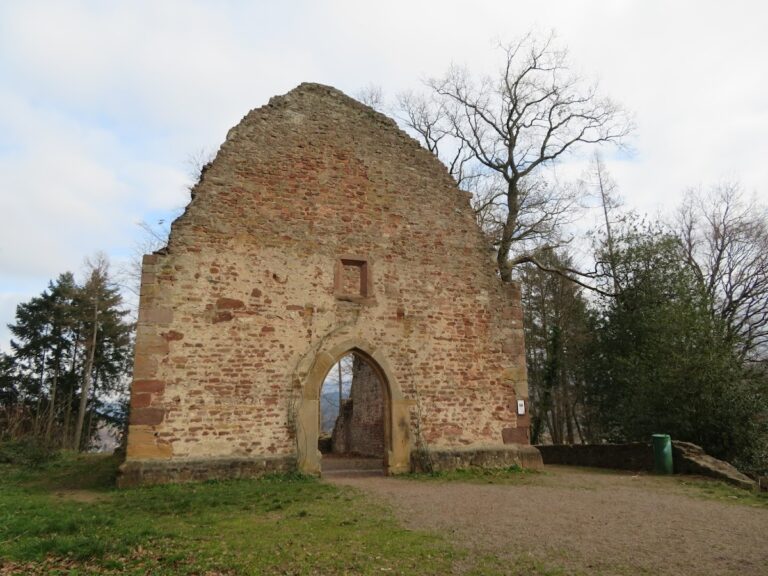
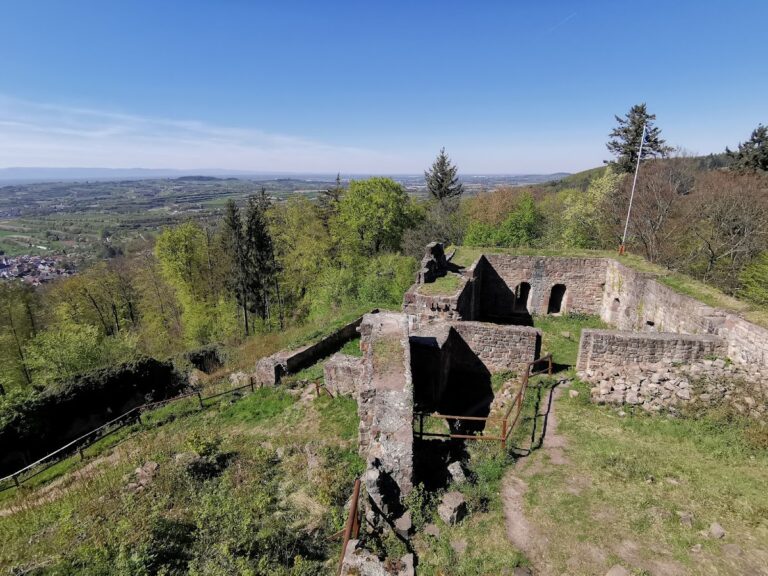
The principal surviving building is the Gothic hospital chapel, constructed during the second half of the thirteenth century and dated to 1280. It was donated by Bruno of Hornberg, a minnesinger, meaning a medieval German-speaking poet and musician who performed courtly songs. The chapel was attached to the infirmary rather than standing independently, and its west facade clearly expresses that relationship.
The chapel contains an unusually large number and distinctive arrangement of masons’ marks. Its west facade bears a Latin inscription recording restoration by Antonius Merz, Abbot of Tennenbach, in honor of the Most Blessed Virgin Mary. Eighteenth-century tomb slabs are set into the west wall.
After the Reformation was introduced in the Margraviate of Baden-Durlach in 1556, the chapel served as the parish church until 1836 for approximately 25 craftworker families employed by the monastery. Its Mannerist altar, an altar in a late Renaissance style, is now in the Augustinian church in Freiburg. The other principal on-site remains include the cemetery cross and the cellar of the present Gasthaus Engel.
Dispersed church fabric and artworks
The Romanesque abbey church was dismantled after the dissolution and rebuilt in Freiburg as the old Ludwigskirche. Some of its architectural stones were reused in the present Ludwigskirche after the earlier church was destroyed in 1944. Further recovered stones were installed beside the church from 2007, and a capital from the former abbey church remains near the new building.
Altarpiece panels
A probably Tennenbach-origin altarpiece is divided between two museum collections. The Augustinermuseum in Freiburg holds eight panels by an Upper Rhine master showing scenes from the life of the Virgin, dated around 1420 to 1430. It also preserves panels depicting the Agony in the Garden, Christ before Pilate, the Crowning with Thorns, and the Flagellation. These Passion scenes were painted by a different hand and may date slightly later, around 1430 to 1435.
Painted fragments
The Staatliche Kunsthalle Karlsruhe preserves three painted fragments probably associated with the same altarpiece: the Crucifixion, the Arrest of Christ with the Kiss of Judas, and the Entombment. Their division between collections reflects the dispersal of the former artwork.
Landscape and building materials
The valley around Tennenbach contained approximately 25 sandstone quarries. Sandstone from the area was used in the church at St. Peter and in parts of Freiburg Minster, while extraction has also resumed at the Lange Au quarry. Together with the chapel, cemetery cross, cellar, buried foundations, relocated church stones, and surviving artworks, these remains preserve physical evidence of the monastery after the institution itself disappeared.