Tecklenburg: A Ruined Hill Castle and County Seat in Germany
Site at a Glance
- Rating
- 4.7
- Popularity
- Low
- Country
- Germany
- Primary era
- Medieval
- External website
- Open
- Eras represented
- Medieval, Early Modern, Modern
- Civilizations
- Holy Roman Empire
- Site type
- Military
- Remains
- Castle
On this page14 sections
History
Tecklenburg is a ruined hill castle in Germany, located in the town of Tecklenburg in North Rhine-Westphalia. Probably built around 1100 by the Dutch Count of Zutphen, it occupied an elevated position on the Teutoburg Forest and controlled an important trade route linking Lübeck, Bremen, Münster, and Cologne. The castle became the seat and political centre of the County of Tecklenburg.
Foundation and the County of Tecklenburg
The castle was placed at a narrow point that could be easily watched, allowing its occupants to control movement and collect tolls from passing merchants. Several noble estates and holdings later served as fiefs, lands granted in return for allegiance and service, to secure the approaches. These included House Marck and the estates of Kieseling, Horne, Meeseburg, Kronenburg, Hülshoff, and Wondahl.
Tecklenburg first appears in a document from 1184, which described it as the largest and most powerful hill-castle complex in northern Germany. Between 1168 and 1190, Archbishop Philip of Cologne acquired the County of Tecklenburg from Count Henry of Guelders and Count Symon of Tecklenburg for 3,300 marks. Symon received the castle as a fief and transferred his allodial possessions, hereditary property held in his own right, to the Archbishopric of Cologne for 50 marks. The associated bailiwicks, administrative and judicial jurisdictions, over the prince-bishoprics of Münster and Osnabrück strengthened Cologne’s claim to ducal authority in Westphalia.
The castle became involved in a major ecclesiastical and political conflict during the thirteenth century. In 1225, Frederick of Isenberg, accused of murdering Archbishop Engelbert of Cologne, found shelter at Tecklenburg. In 1226, the papal legate Conrad of Urach placed the castle and town under an ecclesiastical ban, a church sanction that restricted religious participation and services. In 1227, the Cologne church confiscated the castle, arguing that the count had forfeited it through involvement in the conspiracy against Engelbert. In 1282, the castle entered the pledged possession of Bishop Conrad II of Osnabrück.
Changes of lordship and strategic decline
After the Counts of Tecklenburg died out in 1262, the county passed to the Counts of Bentheim. It belonged to the Counts of Schwerin from 1328 to 1562, and in 1365 the Schwerin family acquired the Barony of Rheda. Territorial losses followed. In 1400, the northern parts of the county, including Cloppenburg, Friesoythe, and Bevergern, went to the Prince-Bishopric of Münster. Tecklenburg also lost its remaining northern territory during Count Nicholas II’s conflict with the Bishopric of Osnabrück.
The castle’s strategic value declined after the Bremen to Cologne trade route was redirected through Osnabrück, where a major road had been improved. Changes in weapon technology further reduced the effectiveness of its older defensive works. Tecklenburg remained an important centre, but its position no longer offered the same military and economic advantages as it had during the medieval period.
Reformation and military transformation
Under Count Conrad, the County of Tecklenburg adopted the Reformation in 1527. It became the first region in Westphalia to do so. In 1538, Conrad joined the Schmalkaldic League, a military alliance of Protestant princes and cities formed in opposition to the Catholic imperial policy of Charles V, the Habsburg emperor of the Holy Roman Empire. Conrad took part in the Battle of Mühlberg in 1547, where the Protestant forces were defeated by Charles V’s Catholic forces.
The possibility of attack during this conflict led to major strengthening of the castle’s defences, including the construction of a northeastern bastion. Buildings along Ibbenbürener Straße were demolished to create a clear field of fire toward the north. The scale of the resulting destruction in the town remains disputed. One interpretation holds that Tecklenburg temporarily ceased to exist because the settlement north of the castle, including the road and market square, made up almost the entire town. Church-historical records from this period also disappeared. The town was rebuilt after the military danger eased and a temporary peace returned in the second half of the sixteenth century.
From palace to ruin
Countess Anna, Count Conrad’s daughter, later reshaped the castle as a more comfortable and prestigious residential palace. Enlarged windows and a new northeastern entrance reduced its defensive character. The embankment built for the new access route, now Schlossstraße, covered much of the northeastern bastion.
In 1557, the county passed to Arnold II, also known as Arnold IV, of Bentheim-Tecklenburg, bypassing the inheritance claims of the House of Solms-Braunfels. Arnold’s son Adolphus established a separate Tecklenburg line in 1606. The counts introduced the Reformed confession in 1588. After a judgment of the Imperial Chamber Court, a supreme judicial institution of the Holy Roman Empire, the county passed to the House of Solms in 1696. Count William Moritz of Solms-Braunfels sold it to Prussia in 1707, and in the Berlin settlement of 1729 the House of Bentheim-Tecklenburg abandoned its remaining claims.
The sale to Prussia ended Tecklenburg’s independence and sovereignty. By then, the castle was already in extremely poor structural condition. Prussia repeatedly considered converting it into a fortified fortress, but these plans were abandoned. The castle was subsequently demolished, and from 1744 it was released for use as a quarry. It gradually became a ruin as its stones were reused throughout Tecklenburg.
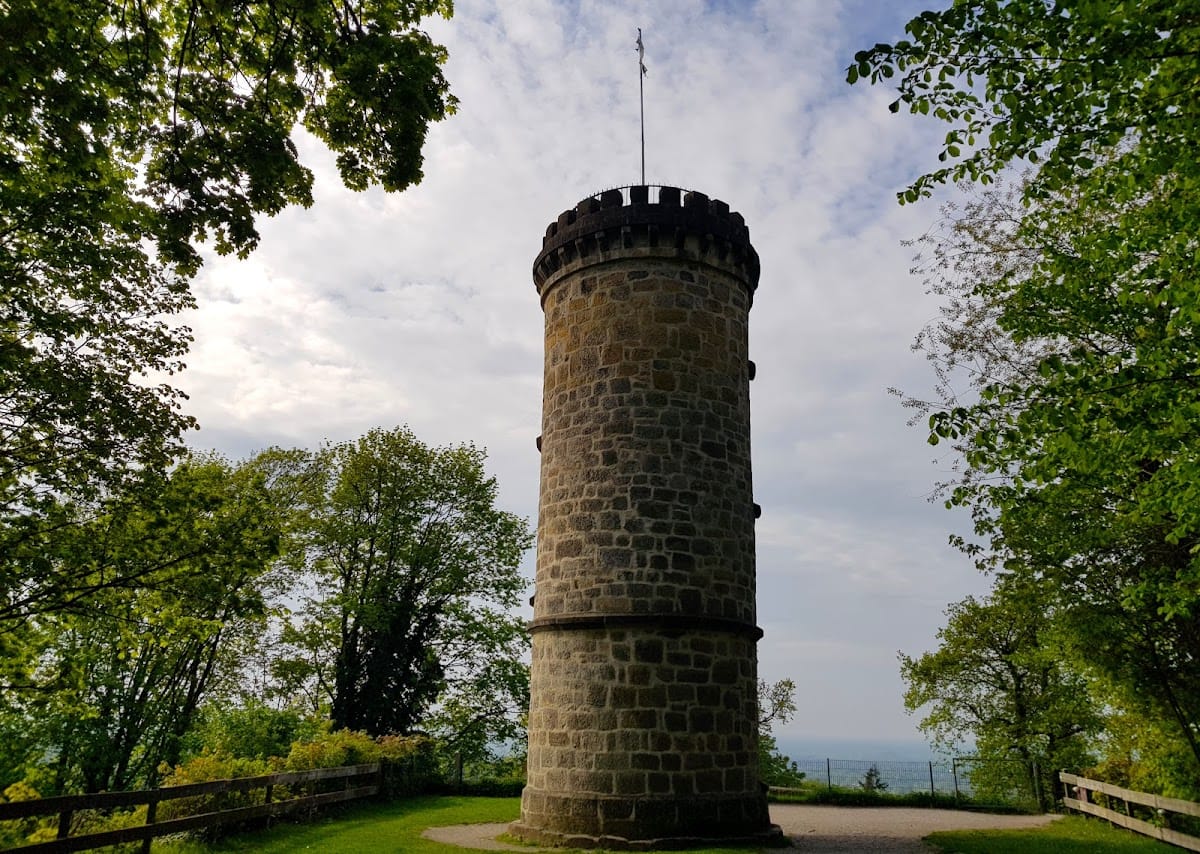
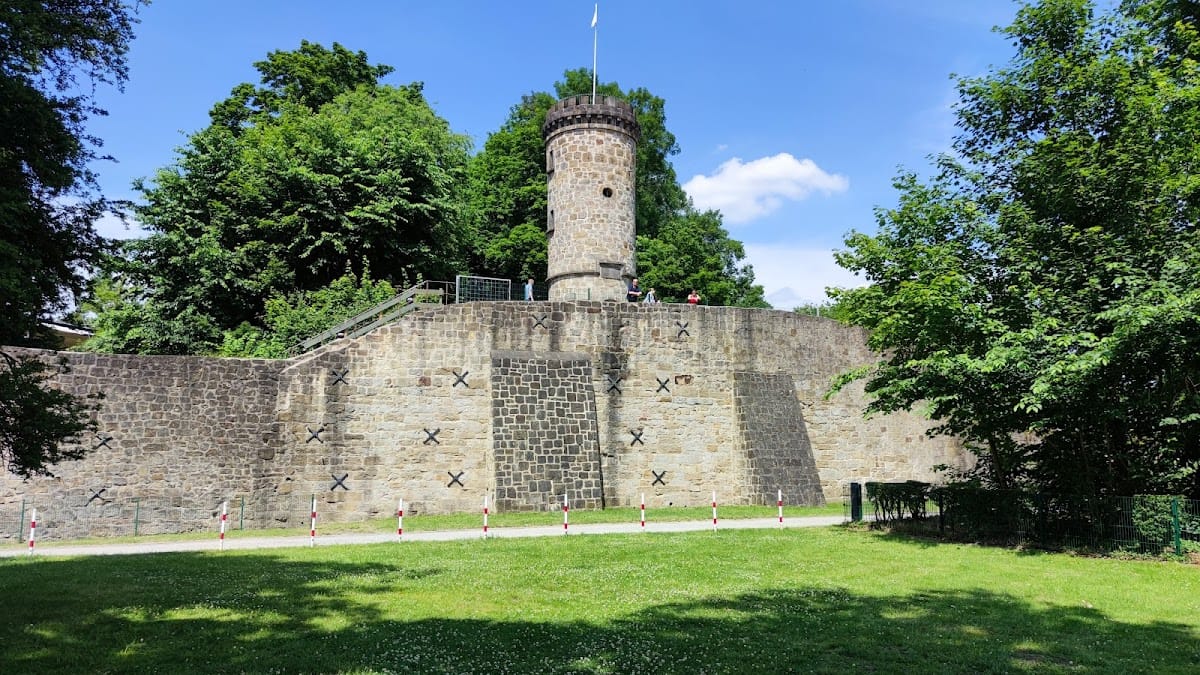
A conservation movement that began in the second half of the nineteenth century halted the continuing demolition and sought to preserve the remaining fabric. In 1884, the Wierturm was erected on the rampart in memory of the court physician Johann Weyer. Weyer and Countess Anna had opposed the burning of witches. Plans for a large climatic spa hotel on the castle grounds were abandoned. On 7 August 1907, a ceremony marking Tecklenburg’s 200 years of association with Prussia took place in the second courtyard in the presence of Kaiser Wilhelm II.
Performances began in the first courtyard in 1927. Since 1949, the castle has hosted the Tecklenburg Open-Air Theatre. The courtyard now contains 2,300 seats and stage equipment for professional musical productions. The northeastern bastion was rediscovered by chance in 1944, when excavation for an air-raid shelter encountered a large cavity identified as its vaulted interior.
Remains
Castle layout and surviving earthworks
Tecklenburg occupies Burgberg at approximately 170 metres above sea level in the Teutoburg Forest. The hill castle consists of an outer ward and a main castle arranged around two courtyards. A moat and an embankment separated these areas, and parts of both earthworks survive. The complex is now fragmentary, with surviving foundations, sections of gates, defensive works, and later structures preserving elements of its former arrangement.
Hakenturm and the dividing rampart
The embankment once carried the pentagonal Hakenturm, also called the Schiffsturm. It was the highest tower in the castle. Only its foundation survives, rising to the level of the embankment crest. The circular Wierturm stands on the rampart separating the outer ward from the main castle. Built of masonry as an observation tower, it provides views toward Tecklenburg and the Münsterland.
Entrances and defensive works
Mauritz Gate
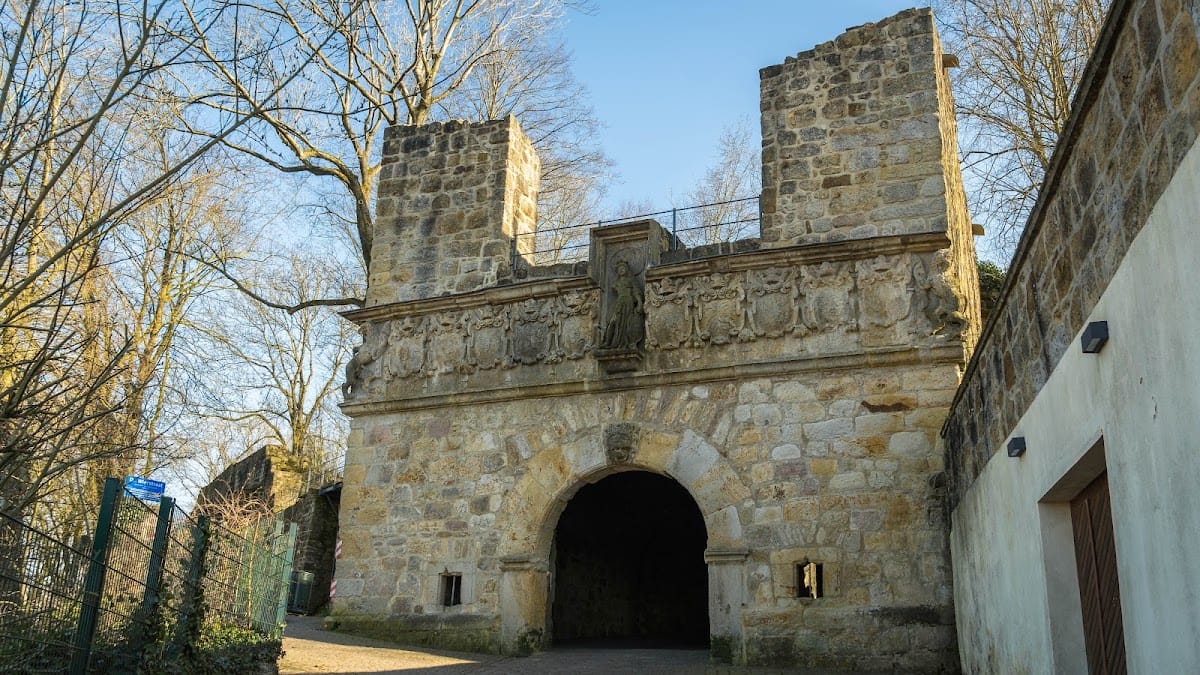
The Mauritz Gate leads into the first courtyard. It was built at the new entrance in the seventeenth century under Count Mauritz. The ground floor and parts of the first floor remain, including a richly designed coat-of-arms frieze. Minerva, the Roman goddess associated with wisdom, strategic warfare, and the arts and crafts, appears at the centre of the arms as the tutelary goddess of the Counts of Tecklenburg.
Northeastern bastion
The northeastern bastion was a projecting fortification from which defenders could fire along adjoining walls and across approaches. Its position allowed fire toward the southeastern moat, the market square, the northern valley, and the northwestern side of the castle. Much of the surviving structure lies beneath the embankment of Schlossstraße. Its vaulted interior was rediscovered in 1944 during excavation for an air-raid shelter. A second bastion has been suspected, but its existence has not been substantiated.
Courtyards and palace remains
Second courtyard and the Krönchen
Buildings once enclosed the second courtyard on three sides, but only fragments of their foundation walls remain. The larger surviving room known as the Krönchen, or “Little Crown,” has traditionally been identified as the former castle chapel. That identification cannot be proven, and the existence of a chapel at the castle remains uncertain, although it is considered plausible given the size and importance of the complex.
Reused castle material
Stone and architectural elements from the demolished castle were reused in Tecklenburg. A Renaissance fireplace survives in the Tecklenburger Hotel Drei Kronen. Decoration from the castle appears on the bridge piers of Haus Marck, while castle stone was incorporated into the Tecklenburg prison and the neighbouring administrative and regional court buildings constructed by 1819.
The exact construction history and original appearance of Tecklenburg remain incompletely understood. The best-known representation of the intact castle is the seventeenth-century Solms Engraving. The outer courtyard, where parts of the historic arrangement survive, is now used by the Tecklenburg Open-Air Theatre and accommodates 2,300 seats with professional stage technology for musical productions.