Taplow Burial: A Richly Furnished Seventh-Century Anglo-Saxon Grave
Site at a Glance
- Popularity
- Medium
- Country
- United Kingdom
- Primary era
- Medieval
- Eras represented
- Medieval
- Civilizations
- Anglo-Saxon
- Site type
- Burial
- Remains
- Burial Mound
On this page14 sections
History
Burial and social identity
The Taplow burial is a seventh-century Anglo-Saxon grave beneath a mound at Taplow Court in Buckinghamshire, United Kingdom. It belongs to the Final Phase, an archaeological category for richly furnished burials from the period when Christianity spread through the Anglo-Saxon kingdoms. Lavish graves of this kind were generally separate from churchyards, but Taplow may have stood beside an early church. The relationship between the mound, the church, and other nearby burials remains uncertain.
Before the Sutton Hoo ship burial was discovered in the 1930s, Taplow was regarded as the most lavish Anglo-Saxon burial then known. It has also been ranked second to Sutton Hoo for wealth and display. Its rich grave goods have been interpreted as expressing the deceased’s high status and an aristocratic way of life in both this world and the next.
The identity of the person buried at Taplow is unknown. The surviving human remains are too slight to establish age or sex, although the grave goods have led archaeologists to infer that the deceased was male. Interpretations include a local chief or ruler, a person of distinction in Mercia, one of the Anglo-Saxon kingdoms, or a ruler in the Thames valley with ties to Kent, another Anglo-Saxon kingdom, and perhaps subject to Kentish overlordship. Some objects are thought to have come from Kent, but they do not establish the deceased’s identity or origin.
Religion, church, and place-name
The burial has also shaped discussion of religious change. Archaeologist Martin Carver interpreted richly furnished graves of the late sixth and seventh centuries as expressions of Anglo-Saxon pagan identity during the spread of Christianity. Historian John Blair argued that such burials need not indicate firm adherence to pagan practice; they might instead express social rank and a connection to an imagined past. Taplow’s possible proximity to a church has prompted questions about how religious conversion related to local authority and status.
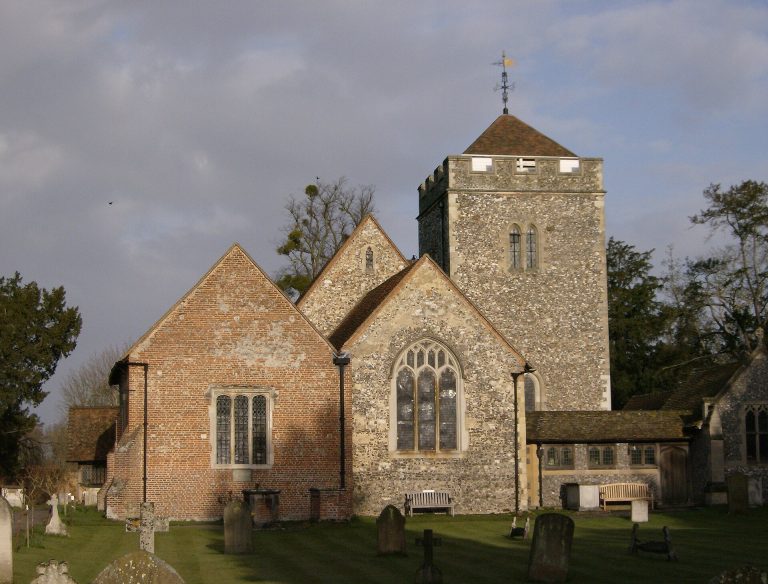
The old parish church associated with the churchyard was destroyed in the 1830s. Blair suggested that churches beside elite burial mounds might have been established in the tenth or early eleventh century to Christianise tombs associated with local ancestors or notable people. Whether this explanation applies to Taplow remains unresolved.
The place-name Taplow comes from the Old English Tæppas hláw, meaning “Tæppa’s mound.” This has prompted speculation that the buried person may have been called Tæppa, though the name does not identify them. Excavator Joseph Stevens proposed another explanation, linking the name to a mound on a hill crest.
Excavation in 1883
Local antiquarians excavated the mound over about three weeks in October 1883. Mr Rutland, Honorary Secretary of the Berkshire Archaeological and Architectural Society, worked with Major Cooper King, Joseph Stevens, and Walter Money. During the work, the central yew and part of the mound collapsed into the burial chamber, damaging its contents and injuring Rutland. The excavation was temporarily halted, and the positions of the grave goods were not recorded precisely.
Stevens noted Gothic elements in the objects and considered a Viking origin, but judged that an Anglo-Saxon origin was more likely. After the excavation, the objects were shown temporarily at Rutland’s home. The Reverend Charles Whately, who cared for the churchyard, offered them to the British Museum, whose trustees accepted them.
Remains
Mound and grave
Hilltop and mound
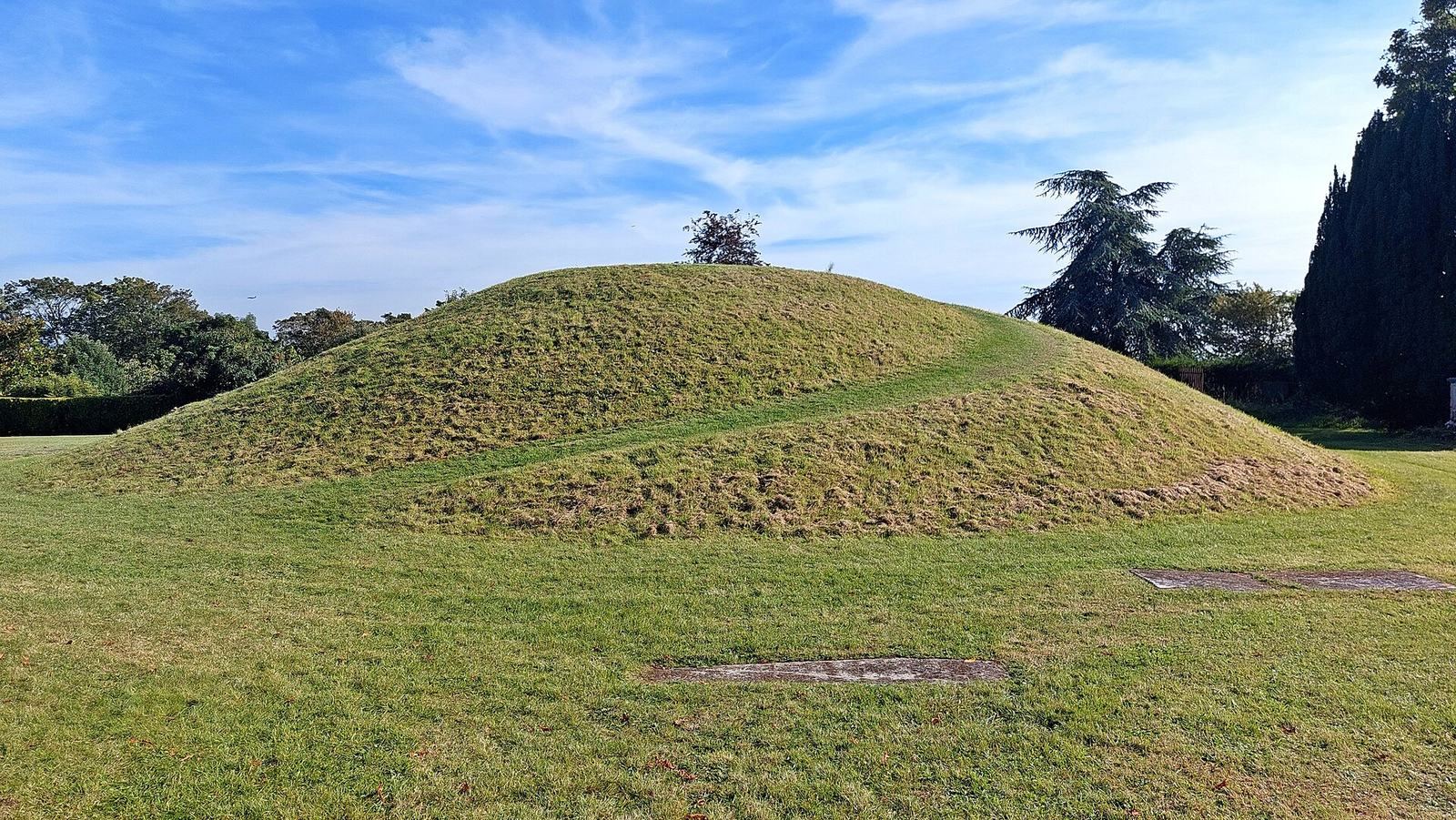
The mound lies within the estate of Taplow Court, on a hill that offered long-distance views in most directions and stood within an earlier Iron Age hillfort, a fortified settlement on elevated ground. Archaeologist Howard Williams has suggested that the prominent position may have asserted claims to land and expressed a new identity for the deceased and their family.
Stevens measured the mound at 240 feet around and described its shape as somewhat bell-like. Later burials around its eastern edge may have contributed to that form. A yew, probably several centuries old, grew at the centre and crowned the mound until it was felled during the 1883 excavation. The mound was then restored to its former dimensions.
Burial chamber
The grave lay below the mound’s base and beneath the ground surface as it existed at the time of burial. It measured twelve feet by eight feet and ran east to west, with the deceased’s head facing east. Planks formed the chamber walls, and fine gravel lay beneath the body. Decayed wood led the excavators to suggest that a plank had covered the body as well. The deceased was described as resting on a feather mattress.
Human remains and mound soil
The surviving human bone consists of a thigh bone and fragments of vertebrae. Fabric shreds were thought to be woollen. The mound soil also held worked flints, including scrapers and cores, worked animal bones, and Romano-British pottery, among it a sherd of Samian ware, a type of Roman pottery. These materials were regarded as older objects mixed into the earth used to build the mound, rather than as deliberate grave offerings.
Grave goods
Weapons
The assemblage included at least three sets of weapons. An iron sword, 30 inches long and 2.5 inches wide, was found to the body’s left, with what were thought to be traces of its scabbard. Two iron shield bosses, the raised metal fittings at the centre of shields, lay near the head on the body’s right. Three iron spearheads were found on the right, including a 26-inch angon, a type of spear, and two smaller examples. The grave also contained an iron link and ring, and a small iron seax, a single-edged knife or short sword.
Feasting and drinking vessels
The burial included 19 vessels for feasting and drinking. A crushed iron cauldron or tub, lined with bronze and two feet across, lay beside one bucket near the thighs. Both buckets were made from wooden staves with bronze fittings. One was crushed beside the tub, while the other lay to the body’s left near the head. A crushed, twelve-sided bronze bowl with two handles was also found on the body’s left.
Four green glass drinking cups had been broken: three were inside the tub and one lay at the foot of the grave. The British Museum identifies four glass claw beakers, drinking vessels with claw-like decoration, among the finds. Two large drinking horns with gilded silver rim mounts had been crushed inside the tub. Four smaller mounted horns or cups were also fragmentary; one lay on the body’s left and another at the foot of the grave.
Textiles and personal ornaments
Shreds of gold, thought to have come from fabric, were spread across an area of about two yards. Several gold braids may have signified royal status. A four-inch gold buckle decorated with garnets was thought to have lain about three feet east of the thigh bone. Two pairs of metal clasps, possibly gold and perhaps attached to a girdle, were believed to have been placed to the body’s left. The buckle and the large drinking horns were apparently already old when buried.
Lyre and gaming pieces
A crescent-shaped metal ornament about six inches long was found at the foot of the grave. In 1970, archaeologist Rupert Bruce-Mitford identified it as a pair of bird-headed plaques from an Anglo-Saxon lyre. Several bone gaming pieces were also found at the foot of the grave, and the assemblage included a gaming board. Many of the grave goods are held by the British Museum.