Tahara Castle: A Japanese Castle and Domain Center in Tahara
Site at a Glance
- Rating
- 3.8
- Popularity
- Very Low
- Country
- Japan
- Primary era
- Early Modern
- External website
- Open
- Eras represented
- Early Modern
- Civilizations
- Unclassified
- Site type
- Military
- Remains
- Castle
On this page13 sections
History
Tahara Castle is a Japanese castle in Tahara, Japan, built around 1480 by Toda Munemitsu, a powerful warlord of the Atsumi Peninsula. A flatland-style castle of the Sengoku period, an era of political fragmentation and military competition, it served as the Toda family’s base for controlling Atsumi and shipping across Mikawa Bay. Its alternative name, Tomoe Castle, refers to the distinctive arrangement of its water moats.
The Toda and Imagawa phases
During the sixteenth century, the Toda first aligned themselves with the Matsudaira and later with the Imagawa, regional warrior houses competing for control in central Japan. A traditional account says that Toda Yasumitsu was ordered to escort Takechiyo, the future Tokugawa Ieyasu, to the Imagawa capital as a hostage. Instead, the story holds, Yasumitsu delivered him to Oda Nobuhide, prompting an Imagawa attack in which Yasumitsu was killed.
That account has been questioned by later historical interpretation, which proposes that Matsudaira Hirotada, Takechiyo’s father and the lord of Okazaki, sent his son as a hostage himself. The attack traditionally dated to 1547 may not have taken Tahara Castle, and the castle’s fall is now placed around 1550.
Tokugawa and Ikeda control
After the Imagawa were defeated at the Battle of Okehazama, the 1560 conflict that broke their regional power, Tokugawa Ieyasu took Tahara Castle. It became subordinate to Yoshida Castle under Sakai Tadatsugu, a senior Tokugawa commander. Honda Hirotaka became its lord, and Honda Hirotaka and Honda Yasushige are recorded as castle lords from 1565 to 1595.
In 1590, Ieyasu was transferred to the Kanto region, and Tahara Castle passed into the holdings of Ikeda Terumasa, a daimyo who entered eastern Mikawa. Ikeda’s senior retainer, Igi Tadatsugu, occupied the castle. Improvements to the moats, stone walls, and enclosed defensive sections are attributed to this administration.
Tahara Domain and the Meiji transformation
Under the Tokugawa shogunate, the military government established by Tokugawa Ieyasu in the early seventeenth century, Tahara became the administrative center of Tahara Domain in 1601. Toda Katatsugu returned as the castle’s lord with revenues of 10,000 koku, a historical measure of agricultural production used to assess a domain’s income. A branch of the Toda family subsequently held the domain, which was assigned to the Miyake clan in 1664 with revenues of 12,000 koku. The Miyake remained in control until the Meiji Restoration.
After the domain system was abolished, the new Meiji government ordered the castle buildings to be demolished in 1872. The former castle grounds were later used by public and religious institutions. The former main enclosure became the site of Tahara City Museum and Tomoe Shrine, while the former third enclosure received Gokoku Shrine and memorial monuments to local figures including Watanabe Kazan, Murakami Norimune, and Okada Torajiro. The former Seishokan domain school became the site of Tahara Chubu Elementary School, while its name survives at Aichi Prefectural Seisho High School.
Tomoe Shrine preserves a religious connection with the Miyake family. During the Bunka era, a period from 1804 to 1818, the Miyake transferred to the shrine the spirit of a shrine they had established in the second enclosure. It was dedicated to Kojima Takanori, a loyalist of the Southern Court, one of two rival imperial courts during Japan’s fourteenth-century period of divided authority, and an ancestor of the Miyake family. A September festival continues to connect the shrine with the local community.
The Tahara City Museum was built in the 1990s on the site of a former municipal nursery school. Construction of the museum and the reorganization of paths and other facilities destroyed many castle remains, an intervention that has been criticized. More recent redevelopment also removed much of the former outer earthworks. The site nevertheless retains substantial stonework and moat remains, while its reconstructed buildings date from the Showa period or later.
Remains
Layout and defensive setting
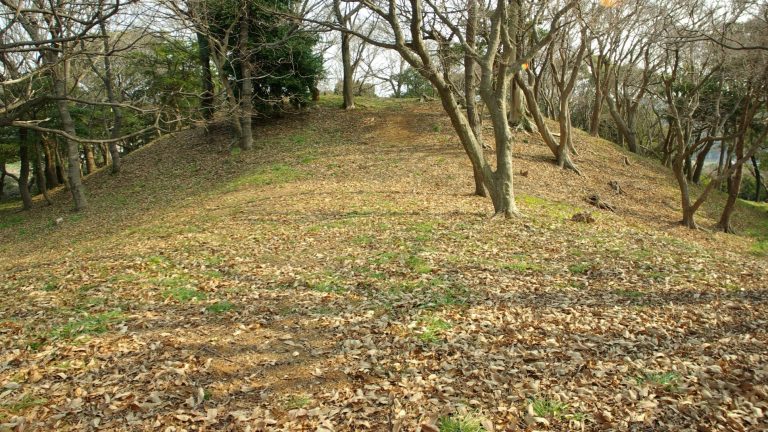
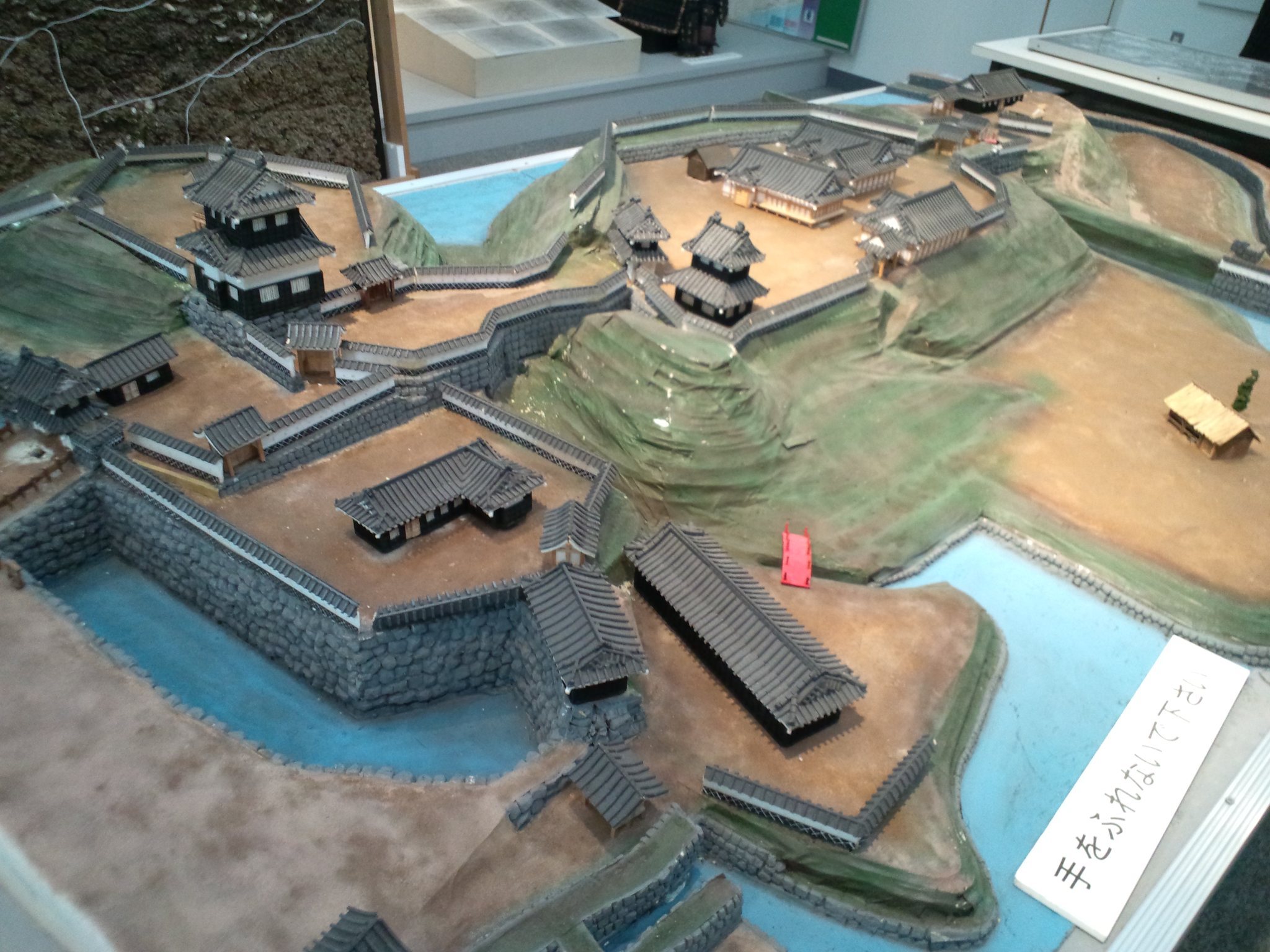
Tahara Castle occupied a small hill near the base of the Atsumi Peninsula, facing Mikawa Bay. Sea inlets once extended from the east around the north to the west, strengthening the position and helping the castle control maritime movement. The castle had a tiered arrangement of enclosed sections and no keep. Water moats followed a tomoe-shaped pattern around the central enclosure, giving the castle its alternative name and protecting the main defensive area.
The present arrangement of the enclosures and much of the surviving stonework is generally associated with the late sixteenth-century administrations of Ikeda and the later Toda family. During the Edo period, a castle town grew south of the castle. An outer enclosure surrounded parts of the samurai residences and the Seishokan domain school. A large inlet east of the castle was reclaimed on a broad scale around the latter half of the seventeenth century, leaving the former main enclosure on land rather than directly beside the shore.
Main enclosure and Tomoe Shrine
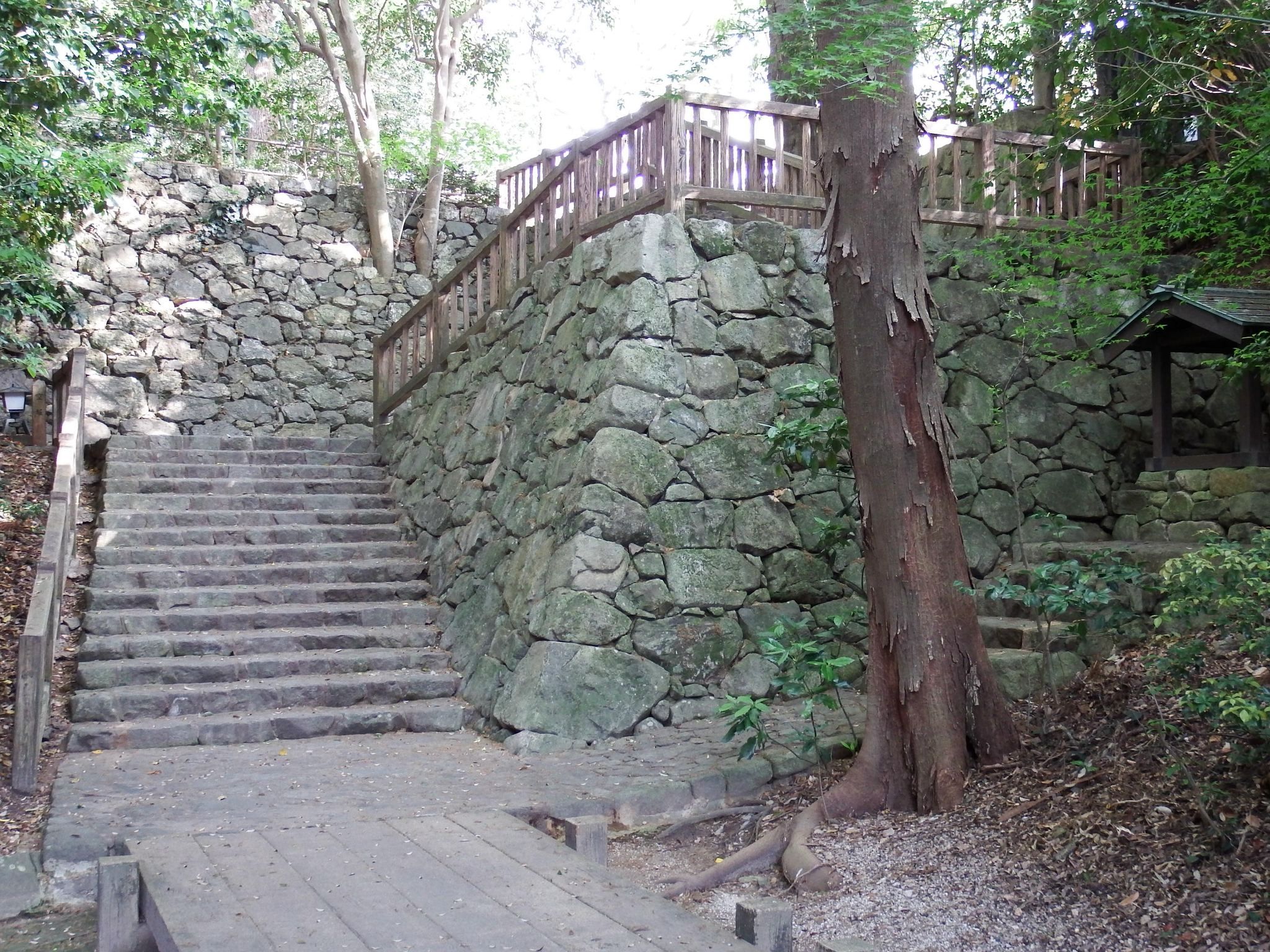
The former main enclosure is occupied by Tomoe Shrine and the Tahara City Museum. A photograph from the early Meiji period shows the enclosure walls finished with namako-style plasterwork, a surface treatment in which raised plaster joints create a grid pattern. Portions of the original stone walls and moats survive. Some of the walls are probably sixteenth-century fieldstone masonry made from irregular natural stones, including limestone quarried in northern Tahara.
Second enclosure and Ninomaru Tower
The former second enclosure contains the reconstructed Ninomaru Tower, a tower associated with the castle’s second principal enclosure. The historical tower shown in the early Meiji photograph was a two-story, layered structure with weatherboard siding. The reconstructed tower has a different appearance and dates from the Showa period or later.
Third enclosure and commemorative sites
The former third enclosure contains Gokoku Shrine and monuments commemorating local figures, including Watanabe Kazan, Murakami Norimune, and Okada Torajiro. These later uses occupy one of the principal sections of the former castle complex and form part of the surviving arrangement of the grounds.
Gates, outer works, and castle town
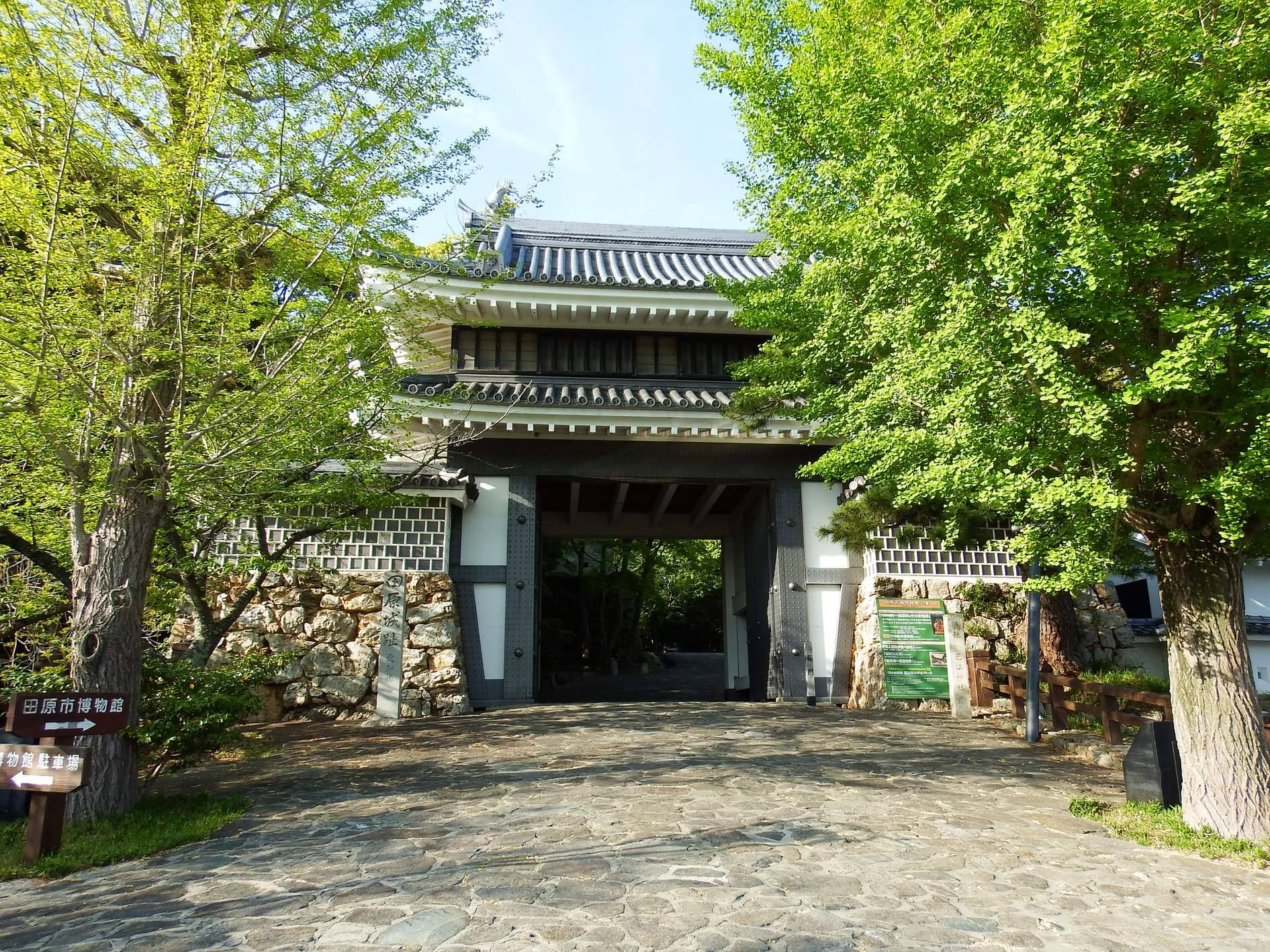
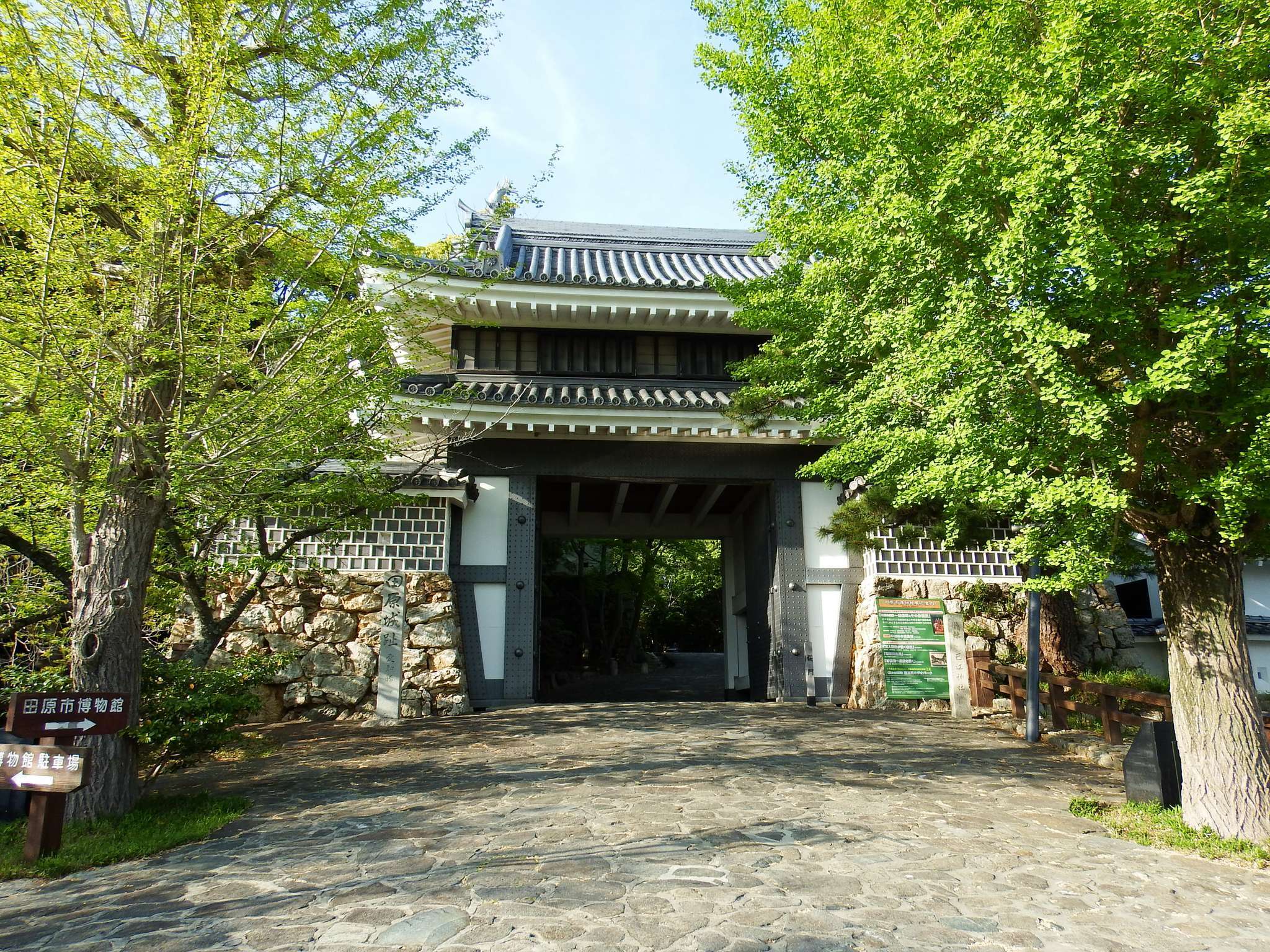
Otemon gate
A reconstructed Otemon gate stands within the castle site. Its decoration is heavier than that of the historical form, so the present gate provides a modern reconstruction rather than a precise survival of the original structure.
Outer enclosure and school grounds
Small portions of the outer enclosure’s stonework and earthworks survive south of Tahara Chubu Elementary School. The school occupies the former Seishokan domain-school site. Watanabe Kazan Shrine stands to its north and is dedicated to Watanabe Kazan, a locally important scholar and artist.
Former castle-town streets
Roads on the south and west sides once passed through areas lined with samurai residences. Redevelopment removed or widened many of these routes, although some sections retain the character of the former castle town. Together with the surviving moats, fragments of stonework, shrines, monuments, school grounds, and reconstructed buildings, these features preserve parts of the castle’s changing physical setting.