Třeboň Castle: A Renaissance Residence and Historic Castle Complex in Czechia



Site at a Glance
- Rating
- 4.7
- Popularity
- Medium
- Country
- Czechia
- Primary era
- Early Modern
- External website
- Open
- Eras represented
- Medieval, Early Modern, Modern
- Civilizations
- Austrian Empire, Habsburg, Holy Roman Empire, Kingdom of Bohemia
- Site type
- Domestic
- Remains
- Castle
On this page17 sections
History
From manorial court to Rožmberk fortress
Třeboň Castle is a historic castle complex in Třeboň, Czechia, developed by successive owners from a manorial court into a fortress, a stone castle, and a Renaissance aristocratic residence. Třeboň was acquired from the Lords of Landštejn by the related Rožmberk family in 1366, while the castle was first mentioned in 1374. The town became a subject town in 1376, and Rožmberk patronage helped shape its development.
The Rožmberks founded an Augustinian monastery immediately beside the castle. In the medieval period, the fortress was attacked twice by Hussite forces. The Hussites followed the religious reform movement associated with Jan Hus, and their unsuccessful assaults became part of the castle’s military history.
The Rožmberk residence
In 1479, Vok II of Rožmberk selected Třeboň as his residence instead of Český Krumlov. He greatly enlarged the buildings in the northwestern corner of the complex. Jindřich VII of Rožmberk later added the east and west wings, further establishing the castle as an important family seat.
A fire that devastated Třeboň in 1562 also damaged the castle. Vilém of Rožmberk then commissioned the builder Antonín Ericer to convert the older buildings into a Renaissance residence. The principal rebuilding took place between 1565 and 1575 and followed contemporary Italian architectural fashion.
The work was completed under Petr Vok of Rožmberk by Dominico Benedetto Cometta of Eckthurn, an architect and master builder active in the Czech lands. Cometta extended the castle towards the outer courtyard and created spacious rooms in the southeastern wing. In 1602, Petr Vok moved his court to Třeboň, making the castle his residence and the centre of the remaining Rožmberk dominion. He died there on 6 November 1611 as the last male member of the Rožmberk family.
Schwarzenberg ownership and state administration
After Petr Vok’s death, the estate passed to the Švamberk family. Emperor Ferdinand II confiscated their property in 1621 after the Bohemian Estates’ revolt and the defeat at the Battle of White Mountain. The Schwarzenberg family acquired Třeboň in 1660 and resumed construction, adding Baroque buildings, particularly around the outer courtyard.
The Schwarzenbergs retained the castle after twentieth-century land reform, although most of their wider estates were expropriated with financial compensation. The family used the castle for Christmas and New Year celebrations during the winter, while it was rented as a hotel in the summer. Their ownership ended in 1940, when the Gestapo, Nazi Germany’s secret state police, seized the castle.
National administration was introduced in 1945, and the castle was nationalized in 1947 under the law known as Lex Schwarzenberg. Třeboň Castle is now state-owned and administered by the National Heritage Institute. It is a national cultural monument of the Czech Republic.
Much of the complex houses the State Regional Archive in Třeboň. Its holdings include the Rožmberk archive, regarded as one of Europe’s most valuable aristocratic archives. Many archival items are themselves recognized as cultural monuments, and the oldest deposited document dates from 1184. The castle also accommodates exhibitions, concerts, theatre and dance performances, wedding ceremonies, conferences, and other cultural events. The Schwarzenberg Hall was renovated in 2005 for such uses and can hold up to 80 people.
The castle garden and park
The castle garden began to take shape under Petr Vok at the end of the sixteenth century, partly because of his interest in exotic plants and trees. He had a road relocated through the Břilická, also called the Budějovická, town gate to create garden space between present-day Sokolská Street and the castle wing extending into the park.
The original garden was destroyed during the Thirty Years’ War and later restored in several phases. A decisive change began in 1804, when a large collection of trees and other woody plants was planted as the foundation of an English landscape park. Under Jan Adolf II of Schwarzenberg, the park received further exotic plants, a flower parterre, and a basin with a fountain.
The park was opened to the general public after 1945. During the First Czechoslovak Republic, it and its pavilion were already used for agricultural exhibitions. Major restorations took place in the 1950s, 1970s, and 1990s. The grounds remain part of the castle’s physical and cultural setting.
Remains
Castle layout and principal wings
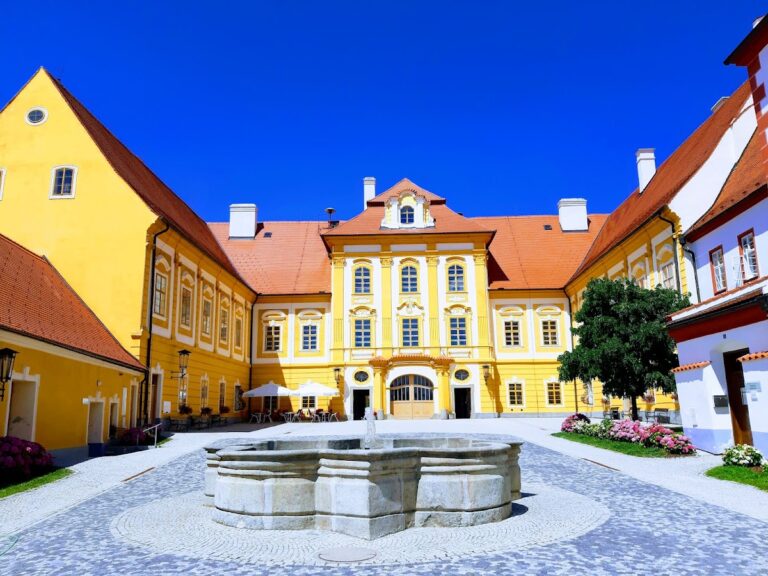
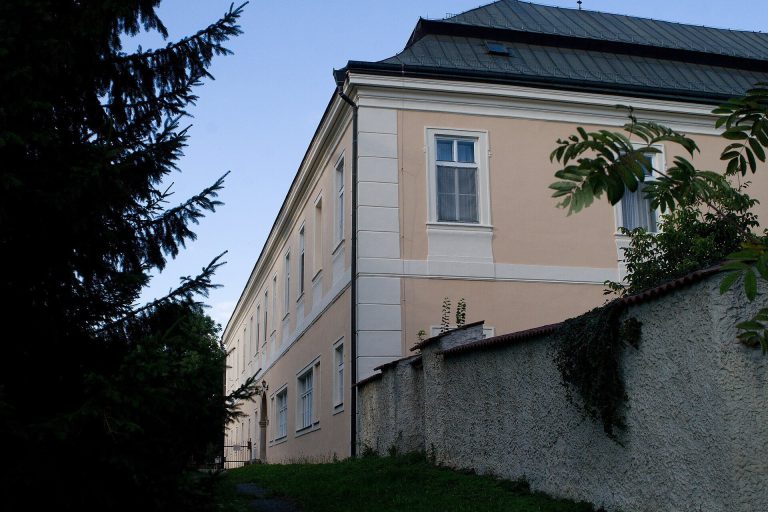
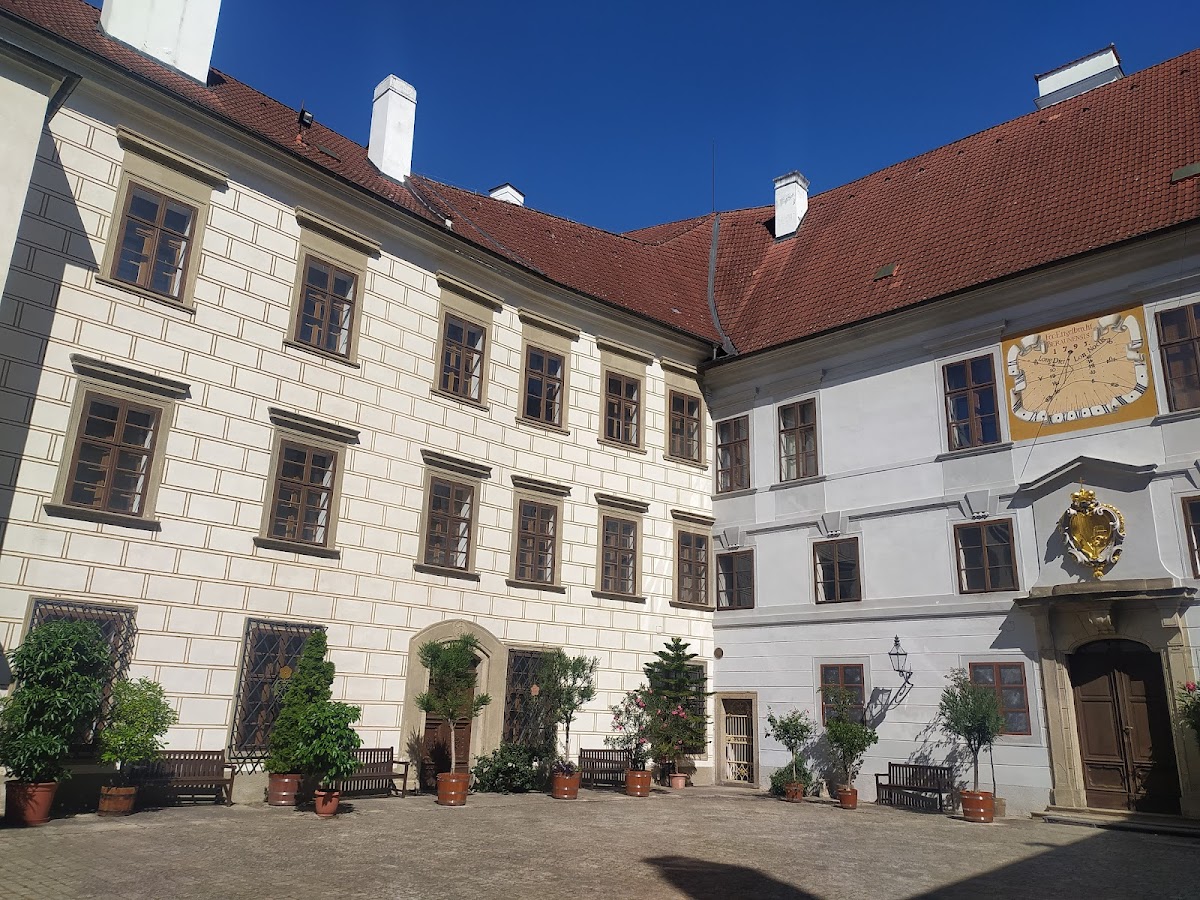
Třeboň Castle stands on the southwestern side of Třeboň’s historic centre and forms the western frontage of Masaryk Square. It adjoins the bourgeois-house complex called Zlatá hvězda and forms an integral part of the urban centre. The complex is among the largest castle complexes in Czechia and southern Bohemia. More than 100 residential rooms occupy four irregular wings arranged around a quadrilateral inner courtyard.
The Renaissance rebuilding extended the entire west wing southward and connected it with a gate and tower, enclosing the inner courtyard. A brewery and malt house were also constructed within the complex during this phase. Under Petr Vok, Cometta added further space towards the outer courtyard and created two large rooms with high mirror vaults, vaulted ceilings whose broad, relatively flat central areas resemble a mirror.
The Noble Room
One of these rooms is the Noble Room. Tomáš Třebechovský decorated it with wall paintings displaying the coats of arms and names of 32 of Petr Vok’s courtiers. The paintings preserve the room’s connection with the household and court assembled at Třeboň during the final Rožmberk period.
Library and picture gallery
In 1604, two houses beside present-day Masaryk Square were rebuilt as a two-chamber library and picture gallery. The older Břilická Gate was demolished during this work, and a new Budějovická Gate was later built in its place. A major interior reconstruction in 1859 and 1860 altered the west wing and its projecting garden section, known as the Imperial Wing.
Outer courtyard and connecting structures
The outer courtyard is enclosed by Renaissance administrative and service buildings. Most of their facades carry sgraffito, a decoration made by scratching through one surface layer to reveal a contrasting layer beneath it. Baroque administrative buildings were later added in the western part of the courtyard, on or near the site of the former castle brewery.
Long Corridor
From 1606 to 1610, an open gallery built on the town wall linked the castle with the neighbouring Augustinian monastery. In the early eighteenth century, it was enclosed as a brick passage known as the Long Corridor. This one-storey structure contains vaulted rooms on the ground floor and has been used to store holdings of the State Regional Archive in Třeboň.
Courtyard fountain
A fountain built in 1712 to a design by Paolo Ignazio Bayer stands in the courtyard. Its sculpture shows a raven pecking at a Turk and commemorates Adolf Schwarzenberg’s victory over the Turks at Raab. The same motif appears in the Schwarzenberg family coat of arms.
Gates, walls, and defensive features
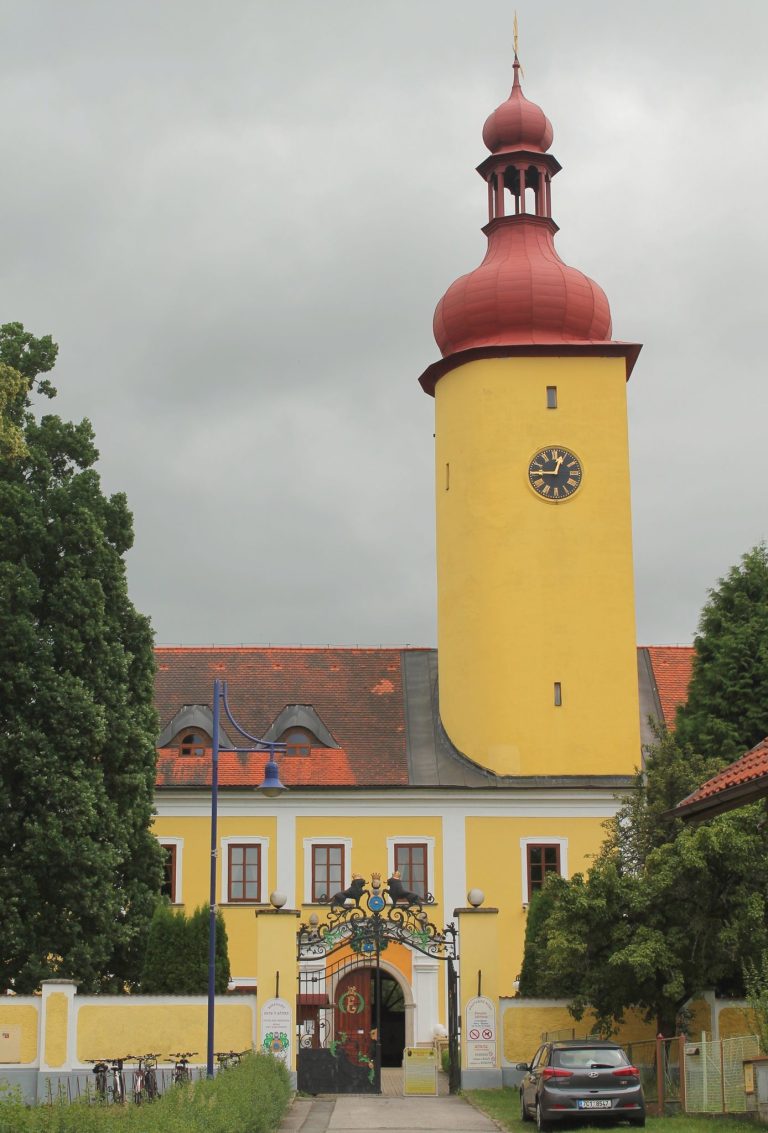
The southern gate forms part of the complex towards the former executioner’s house, the dog kitchen, and the town’s Gothic fortifications. The Renaissance northern gate opens towards Masaryk Square, while the eastern gate near Hamilton Palace leads towards Krčínova Street, the former synagogue, the Jewish school, and the Zámecká restaurant.
Northern and western gates
The northern gate bears the date 1607 and the inscription “Petr Wok Ursin, last ruler of the House of Rožmberk.” Its side facing the outer courtyard retains original sundials. A western barred gate leads from the outer courtyard into the castle park between the western wings, near the pavilion. The park also contains a large barred double gate with a pedestrian wicket towards Sokolská Street, a barred gate towards the former executioner’s house, three additional pedestrian gates, a gate with stairs towards Svět, and a gate with a bridge towards the town library.
Renaissance gate to Masaryk Square
A Renaissance gate dated 1600 on its portal leads by stairs to Masaryk Square near the pastry shop and pharmacy. On the square side, the stairs are covered by a Renaissance barrel vault with sgraffito decoration dated 1569 and two statue niches. One of the statues was apparently irretrievably lost during the period of normalization.
Southern bastions
Three semicircular bastions project into the moat on the southern side of the castle. They originally remained level with the surrounding wall and were open on the side facing the town, preserving the form of an earlier defensive arrangement.
Park and cultural features
The castle is surrounded by an English landscape park containing the pavilion, extensive collections of trees and woody plants, exotic plants, a flower parterre, and a basin with a fountain. A Schwarzenberg funerary monument is also preserved within the grounds.
The complex contains the Třeboň natural-history exhibition, now called the House of Nature of the Třeboň Region. Its permanent displays address the region’s nature and landscape, spa culture, fishpond management, and the historical economic use of the landscape. A theatre is located within the castle complex, adding a continuing cultural function to the historic buildings and park.