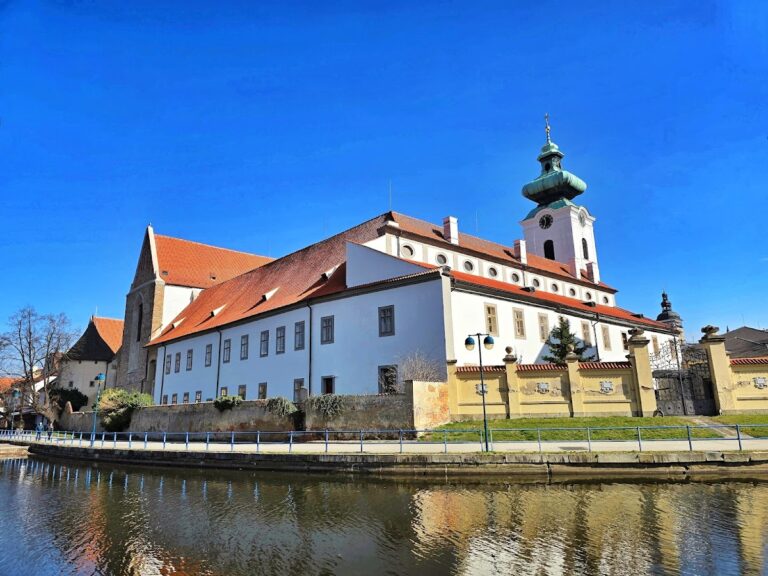
Borovany Monastery: An Augustinian Collegiate Foundation in Czechia


Site at a Glance
- Rating
- 4.7
- Popularity
- Low
- Country
- Czechia
- Primary era
- Medieval
- External website
- Open
- Eras represented
- Medieval, Early Modern
- Civilizations
- Holy Roman Empire, Kingdom of Bohemia
- Site type
- Religious
- Remains
- Monastery
On this page9 sections
History
Borovany Monastery in Czechia, located in the town of Borovany, was an Augustinian canons’ monastery founded in 1455 during the late medieval period. It was the first collegiate foundation established in Bohemia after the Hussite Wars, the fifteenth-century religious and political conflicts associated with the reform movement of Jan Hus. The monastery was then known as Forbes and belonged to the Archdiocese of Prague.
Foundation at Forbes
Forbes had been held by the Lords of Rosenberg since 1359. Peter of Linden, a Budweiser citizen serving the Rosenbergs, acquired the estate in 1435 or 1437. He was ennobled on 21 July 1455 and founded the monastery on 16 October of that year. The former parish church of Saint George became the collegiate church, with the patronage of the Visitation of Mary. Canons came from the Augustinian canons’ monastery at Wittingau. Augustinian canons were priests who lived communally according to the rule attributed to Saint Augustine, while the provost served as head of their collegiate community.
A papal confirmation issued on 10 January 1460 by the papal legate Hieronymus of Crete stated that Peter of Linden had established the monastery for six Augustinian canons and a provost. Johannes Šťávka of Hodenitz, also known as Johannes Boemo, was among the first canons. He made his profession during Peter’s lifetime, became the first canon of Forbes to be ordained a priest, and was later sent to San Pietro in Ciel d’Oro in Pavia, a historic religious complex associated with the Augustinian canons. There he studied the order’s rules and canon law at the University of Pavia.
After Peter of Linden’s death, Johann of Rosenberg undertook on 3 February 1466 to place the monastery and its possessions under his protection. Until the early sixteenth century, the community maintained a good reputation. Its canons combined prayer with pastoral care, charity, and scholarly work, while also enlarging the institution with a cloister and other buildings.
Conflict and dissolution in the sixteenth century
After 1500, disputes between Provost Andreas and the conventual canons led to a visitation. Further problems followed the death of Provost Bartholomew in 1524, when the patron Heinrich of Rosenberg refused to approve the successor proposed by the convent. Provost Simon governed for more than thirty years but could not restore the monastery’s finances.
When Simon died in 1557, a new provost could not be elected because most of the canons had died in a plague epidemic. With the community almost extinguished, the monastery passed under the control of the patron Wilhelm of Rosenberg and his court officials. A temporary administrator was appointed, followed by a priest who attempted to repair the institution’s affairs. Wilhelm then appointed Matthias Kozel of Rynarecz, formerly abbot of the Benedictine monastery at Sázava, as provost. The Prague cathedral chapter opposed the appointment. Matthias was reassigned in 1564, after which the Forbes monastery was dissolved and its possessions were incorporated into the Rosenberg domain.
Seventeenth-century refoundation
On 13 March 1630, Emperor Ferdinand II commissioned Bernhard I, provost of Klosterneuburg, to refound the collegiate monastery at Forbes. Bernhard sent two members of his convent there and later appointed a commission to examine the monastery’s economic foundations and buildings. Books transferred to the Rosenberg library after the first dissolution were intended to be returned.
The Thirty Years’ War, the major European conflict of 1618 to 1648, delayed the project. Ferdinand II nevertheless instructed that the work continue on 24 July 1635. Georg Janda was finally appointed provost on 18 November 1662. He was ordained on behalf of Prague Archbishop Ernst Adalbert of Harrach by Johann Franz Chvalenický, archdeacon of Krumau, and formally installed on 11 June 1663 by Chvalenický and Franz Elias Gattermayer of Gatterburg, representing the landowner Johann Adolf I of Schwarzenberg.
After Georg Janda’s death, disputes arose between the monastery and its patron over the appointment of his successor. The canon Theodor Egerer was eventually elected. He improved the monastery’s finances and renovated its buildings. The recorded succession of provosts ran from Siegmund, who served from 1461 to 1464, through Valentin, Andreas, Jakob, Bartholomew, Simon, Hieronymus, and Matthias Kozel of Rynarecz, to Georg Johann Janda, Conrad Fischer, Christian Preitfelder, Franz Plauck, Augustin Dubenský, and Ernst Stein. Their recorded terms extended to 1785. During Christian Preitfelder’s tenure, the church received a new organ and four bells.
Dissolution and later use
Ernst Stein, the monastery’s last provost, was elected on 21 May 1784. The monastery was dissolved on 14 November 1785 during the Josephinian reforms, the church and monastic measures introduced under Emperor Joseph II that suppressed numerous religious houses and transferred their property to state-controlled religious funds. The collegiate church became the parish church of Forbes, and the former canon Patricius Schwingenschlägel became its first parish priest.
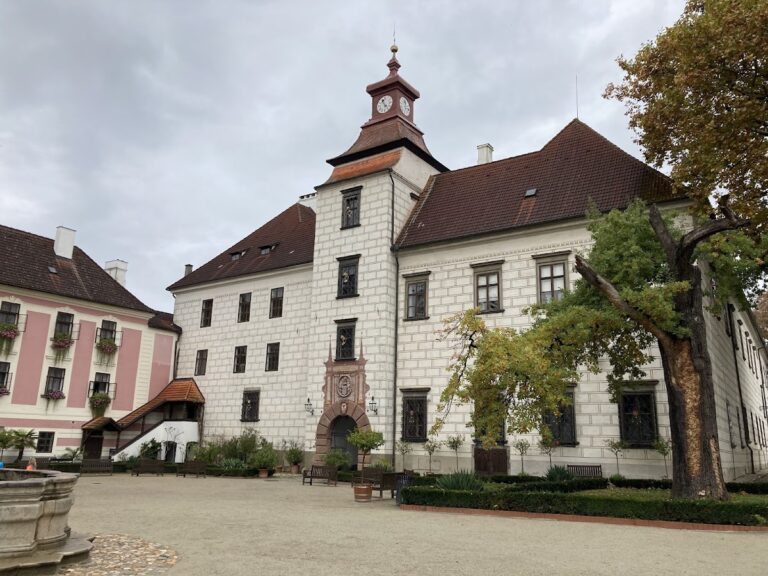
The monastery’s property passed to the Religious Fund, the state institution that received and administered or sold property confiscated from dissolved religious houses. The fund sold the estate to Prince Johann I of Schwarzenberg. The former prelature, the residence and administrative quarter of the provost, was subsequently converted into a castle.
Remains
Collegiate church
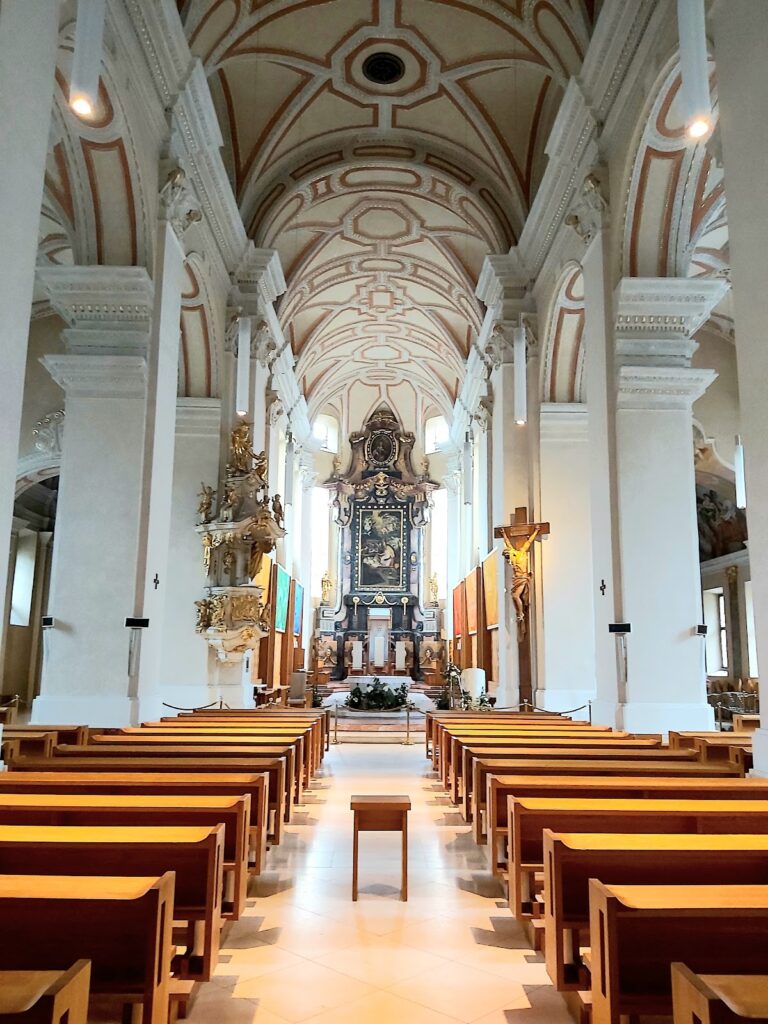
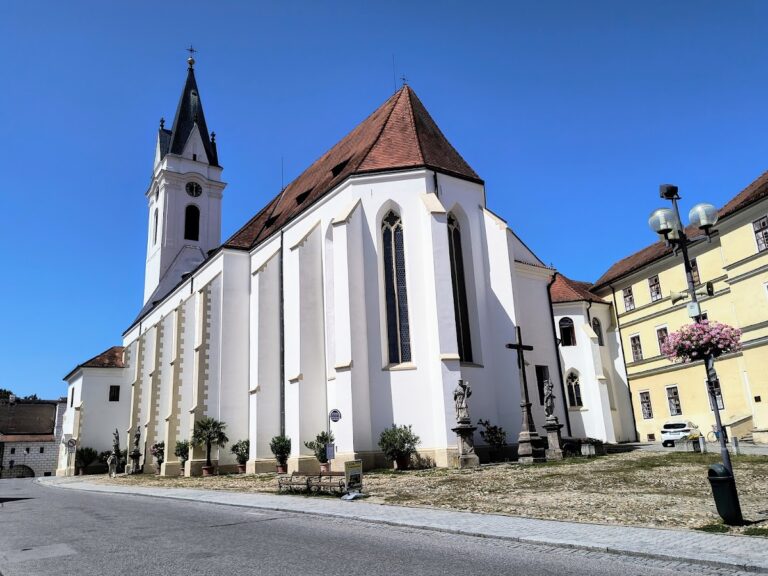
The former parish church of Saint George served as the monastery’s collegiate church after the Augustinian foundation. Its stated patronage was the Visitation of Mary. During Christian Preitfelder’s tenure as provost, the church acquired a new organ and four bells, physical additions associated with the community’s later period of use.
Cloister and monastery buildings
During the monastery’s prosperous period before the sixteenth-century decline, the canons built a cloister and additional monastery buildings around the religious institution. These works expanded the foundation beyond the earlier parish church and provided the architectural setting for the Augustinian community’s communal life.
Former prelature
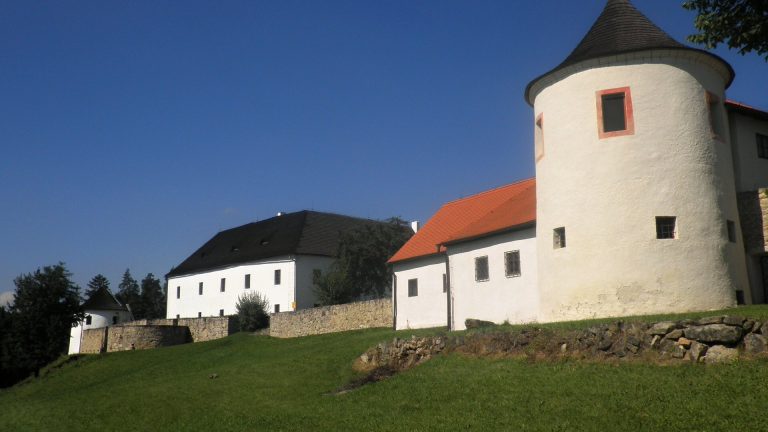
The prelature was built between 1760 and 1770. As the residence and administrative quarter of the provost, it belonged to the monastery’s later architectural phase. After the dissolution in 1785, the building was converted into a castle, giving the former monastic complex a new secular use.