Augustinian Monastery in Třeboň: A Gothic Religious and Cultural Center


Site at a Glance
- Rating
- 4.8
- Popularity
- Very Low
- Country
- Czechia
- Primary era
- Medieval
- External website
- Open
- Eras represented
- Medieval, Early Modern, Modern
- Civilizations
- Habsburg, Holy Roman Empire, Kingdom of Bohemia
- Site type
- Religious
- Remains
- Monastery
On this page10 sections
History
The Augustinian monastery in Třeboň in Czechia was founded in 1367 by the Rosenberg brothers Peter, Jošt, Oldřich, and Jan as a Gothic religious house. Prague Archbishop Johann Očko of Vlašim confirmed the foundation and authorized the conversion of the parish church of St Giles into a church for the Augustinian Canons Regular. The monastery became an important center of religious life, education, writing, and painting in southern Bohemia, and was associated with Devotio moderna, a late-medieval movement that emphasized personal devotion, disciplined religious practice, spiritual reading, and education.
Foundation and growth
The founders undertook to support eight canons. Three of the first members came from the Augustinian monastery at Roudnice under its provost Nicholas, while Beneš became the first provost of Třeboň. The Rosenbergs endowed the institution with the villages of Domanín, Dunajovice, Dvořec, Hrachoviště, Miletín, Spolí, and Šalmanovice. In 1378, its estates comprised 162 peasant holdings covering 70 guf and producing an income of 1,907 groschen.
The community expanded rapidly, reaching 18 canons in 1380 and 21 in 1389. In 1385, Provost Beneš secured royal confirmation of the Rosenberg foundation charters. On 2 February 1389, Pope Urban VI raised the provostship to an abbey, allowing the canons to elect their abbot from among themselves. Beneš resigned in 1390 and died in 1395.
The monastery also developed a library, a scriptorium for copying and producing manuscripts, and a Latin school. In 1493, Benedikt of Waldstein, Bishop of Kammin, donated an extensively illuminated breviary. The community’s intellectual and artistic activity helped make Třeboň a center of written culture in the region.
Expansion and the Hussite Wars
During the fifteenth century, the monastery enlarged its landed wealth through gifts, bequests, purchases, and exchanges. Its possessions extended across Bohemia and beyond, including a vineyard in Austria. It received the Děkaneč pond and revenues from Branná and Slaboshovice as compensation for the flooded village of Opatovice. A Rosenberg pond was subsequently named Opatovický.
The Hussite Wars were fifteenth-century religious and political conflicts in Bohemia associated with the reform movement inspired by Jan Hus. Ulrich II of Rosenberg protected the monastery from plundering and burning, although Hussite forces raided its estates in 1422, 1425, and 1433. For security, the canons left Třeboň in 1421 and took refuge in Austrian Augustinian monasteries. They returned in the early 1430s, or in 1433 according to another chronology.
The monastery’s archives had been concealed in the sacristy of Český Krumlov Castle in 1418. Valuable liturgical vessels were entrusted to Ulrich II of Rosenberg and later pawned to Reinprecht of Walsee. They were returned after Johann of Rosenberg inherited Třeboň in 1457. The Třeboň community had acquired enough prestige by this period to help establish other monasteries in Bohemia and Austria, including the Augustinian monastery at Borovany in 1455. Its estates were again attacked and plundered during the conflict between King George of Poděbrady and the Catholic Green Mountain League in 1467–1468.
Dissolution and restoration
During the sixteenth century, discipline weakened, the community’s moral reputation declined, and poor estate administration created heavy debts. On 24 November 1556, William of Rosenberg ordered the canons to restore discipline, but the measures did not resolve the difficulties. With the consent of King Maximilian I, William closed the monastery in 1566. After the Jesuits declined to provide priests, the parish of Třeboň was subordinated to the Premonstratensian monastery at Milevsko, an institution of canons regular devoted to communal religious and pastoral work. Třeboň and Mladošovice received secular administrators, while the monastery’s property, archives, and library passed to William of Rosenberg.
Ferdinand II refounded the monastery in 1631 and restored its estates and other property. Canons from Klosterneuburg, an Austrian monastery associated with the Augustinian Canons Regular, initially lived in Třeboň Castle while the complex was being prepared. Reconstruction continued into the late 1630s, and recovery of the war-damaged estates continued into the 1660s. Klosterneuburg’s abbots administered the institution until 1663. On 11 March of that year, Norbert Herrmann became its first vice-administrator after the monastery was separated from Klosterneuburg. He imposed strict discipline, increased estate revenues, and wrote a chronicle of the Rosenberg house.
Herrmann became involved in prolonged property disputes with the Schwarzenberg princes, who had become the new owners of the Třeboň estate. He closed the Schwarzenberg family oratory in the monastery church, and Johann Adolf I zu Schwarzenberg considered moving the monastery outside Třeboň. The conflict continued until Herrmann’s death in 1699.
Final eighteenth-century phase
In 1738, Vice-Administrator Vojtěch Prechtl received the title of abbot. By then the restoration was complete, and the community had again become predominantly Czech. The monastery served as a center of the town’s spiritual and cultural life and supported Catholic religious practice, science, art, and education. The monastery mill near Opatovický Pond was reconstructed, while a new abbot’s house, the Chapel of St Barbara, and other buildings were erected. Augustin Marek of Bavorov became the last abbot in 1750.
During Marek’s abbacy, three successive years of crop failure brought famine and plague. Hail destroyed much of the following harvest, surviving crops were eaten by mice, and cattle also died from the plague. A major fire on 2 August 1781, caused by workers repairing the church tower, devastated Třeboň. The monastery complex, 68 houses, the town hall and its tower, the brewery, and the butcher’s shops burned. Třeboň Castle and 21 houses outside it escaped the fire. The monastery church roof burned, and the falling spire pierced the presbytery vault.
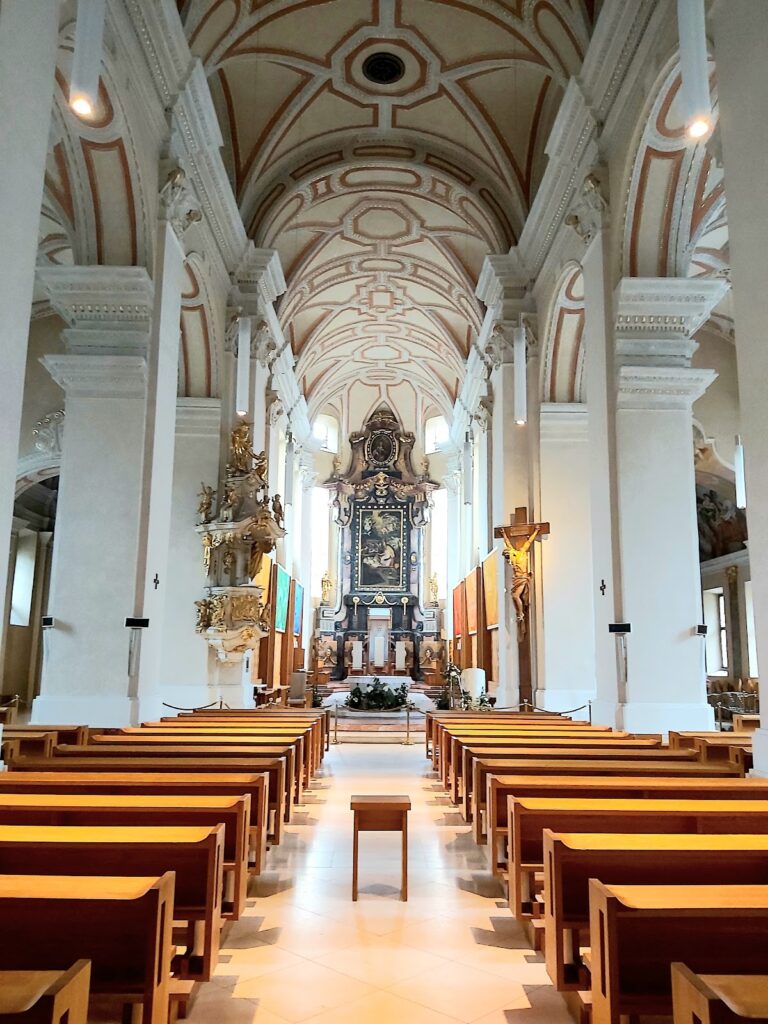
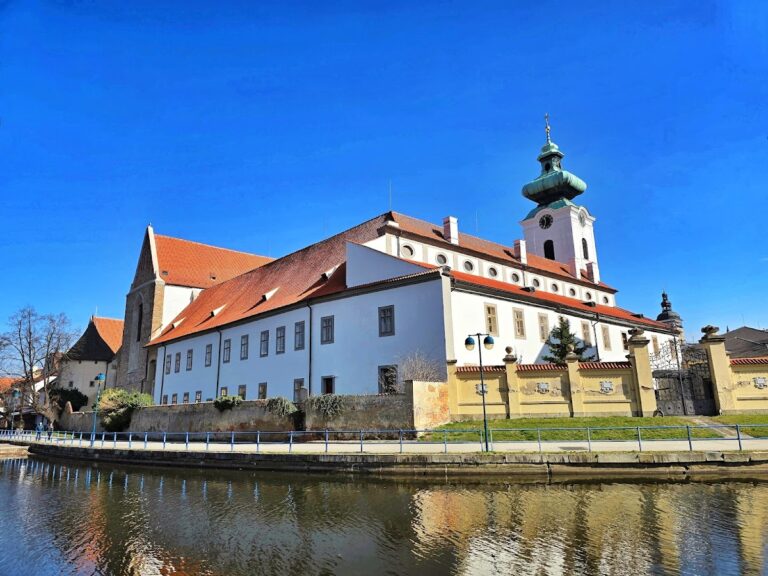
The church was repaired quickly, although its replacement vault acquired a Baroque appearance rather than retaining the character of the earlier Gothic structure. The new roof was lower, and the upper part of the tower received a bulbous form. After the monastery had been substantially restored, Abbot Augustin Marek died on 14 July 1785. The monastery was finally dissolved on 16 November 1785 during the Josephine reforms, the church policies of Emperor Joseph II that closed religious institutions considered insufficiently useful for education, welfare, or pastoral administration.
The canons remained in the monastery until 1786 before being dispersed among parishes. Eight later served as secular priests, while the dean Floridus Brož and two ill canons received pensions. The parishes of Třeboň, Mladošovice, and Borovany were placed under secular pastoral administration. The monastery estates were auctioned and acquired by Johann I Nepomuk, fifth Prince of Schwarzenberg, for 162,876 gulden; they became part of the Schwarzenberg Duchy of Český Krumlov.
After the dissolution, the complex housed the administration of the princely forests and hunting preserves. A wooden relief of St Hubert, the patron of hunters, was placed on the monastery gate. A classical grammar school operated in the northeastern part of the complex during the eighteenth and nineteenth centuries, until a new school building was completed outside the town walls in 1903. The complex is protected as a National Cultural Monument of the Czech Republic.
Remains
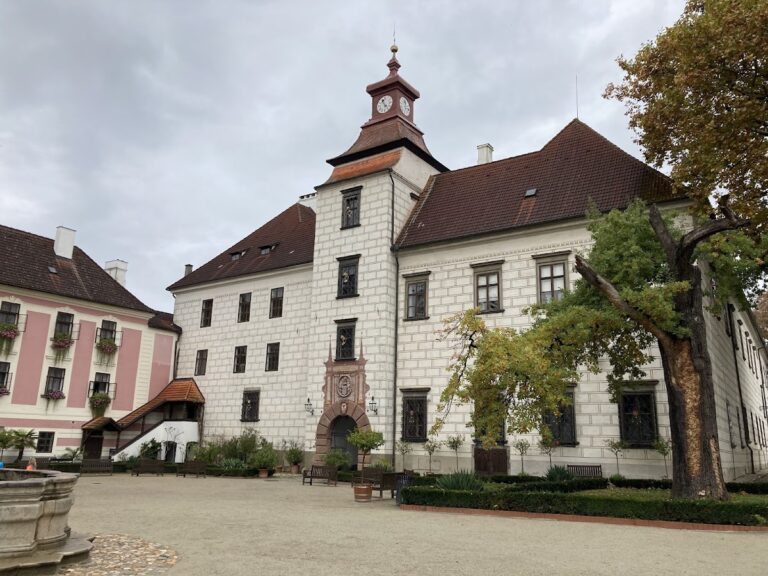
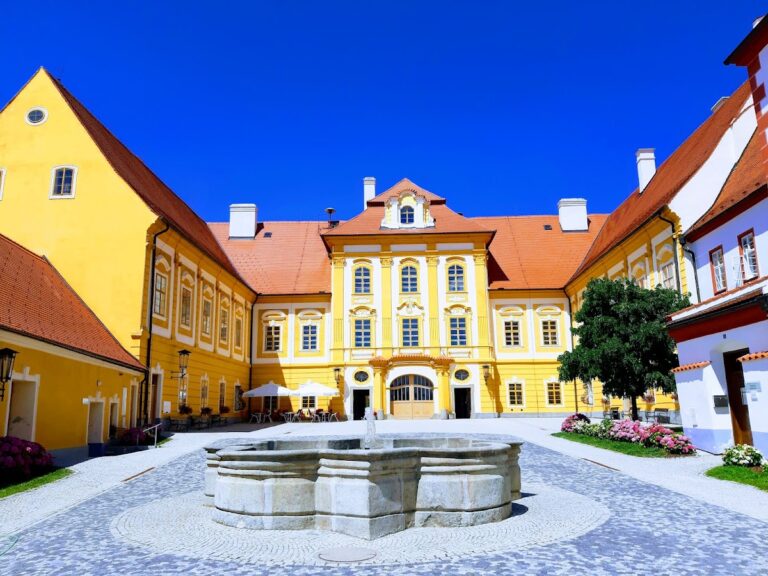
The surviving complex is organized around the Church of St Giles and the Virgin Mary, Queen, a two-nave Gothic hall church, and a two-storey square convent building adjoining its north side. The cloister preserves much of its original late-fourteenth-century form and encloses a square inner garden known as a paradise court. Eighteenth-century Baroque buildings form much of the courtyard, while late-Baroque monastery buildings date from about 1750.
Church of St Giles
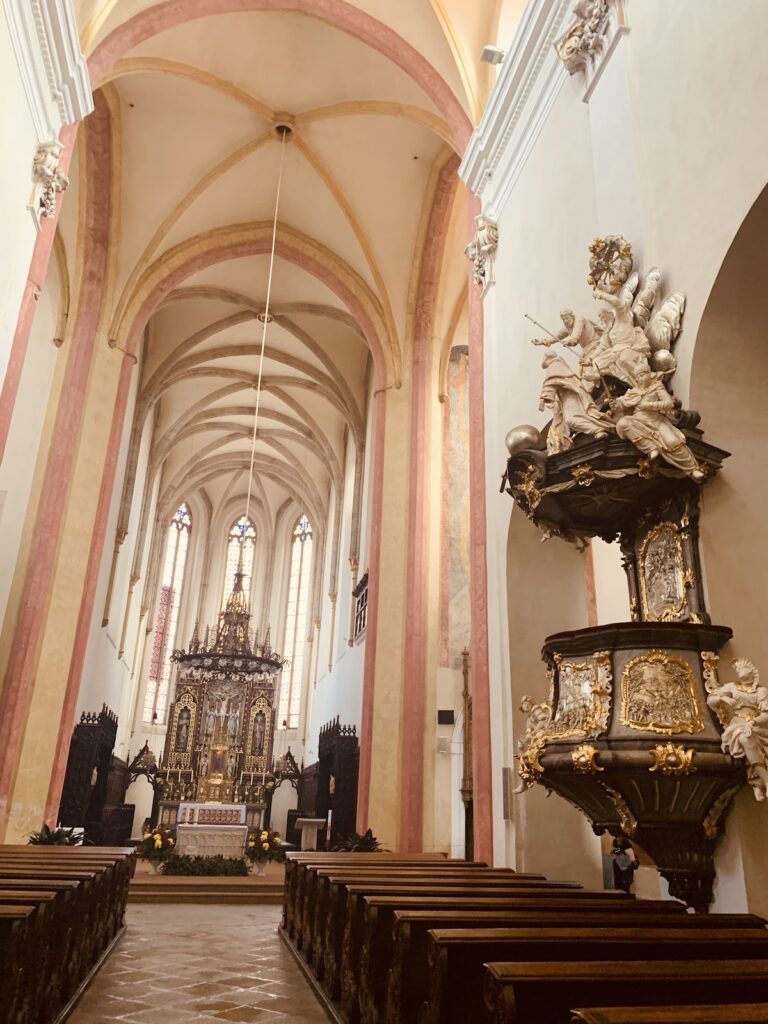
After the foundation of 1367, the earlier parish church was replaced by the two-nave Gothic hall church. Its presbytery was completed around 1380, and the interior received its two-nave vaulting in the following years. The building contains Gothic windows with elaborate tracery and wall paintings dating from the late fourteenth to the sixteenth centuries. A mural decoration survives on the church walls, including a Last Judgment fresco in the choir.
The church’s principal artistic treasure is the Třeboň Altarpiece, a major late-fourteenth-century work of International Gothic panel painting by the anonymous Master of the Třeboň Altarpiece. International Gothic was a refined artistic style known for elegant figures, rich color, linear detail, and courtly imagery. The church originally held a Gothic painted cycle on its main altar. During the Baroque remodeling after the 1781 fire, its panels were distributed among surrounding churches, and individual panels are now held by the National Gallery in Prague.
Most of the church’s altars and other furnishings are Baroque works from the first half of the eighteenth century. The pulpit dates from 1791. At the entrance from the choir to the sacristy, part of a fresco from around the turn of the fourteenth and fifteenth centuries depicts the arrival of the first Augustinian canons from Roudnice to Třeboň. The church tower was remodeled in the Gothic Revival style during repairs to the monastery and church in 1897–1903, replacing the Baroque cupola added after the 1781 fire.
Cloister and inner court
The cloister has broad pointed arcades, narrow balustrades, polychrome ribbed vaults, and wall paintings. Most of its paintings date from the fifteenth century, including work from the early part of that century. The cloister surrounds the square inner garden, or paradise court, whose center contains a well. A stone fountain dating from the late seventeenth century stands in the middle of the monastery courtyard.
Chapel of St John the Evangelist
The Chapel of St John the Evangelist occupies the center of the cloister’s east wing and stands on its original foundations. Its position within the cloister forms part of the convent’s late-medieval internal arrangement.
Chapel of St Vincent and later buildings
A building on the south side of the courtyard contains the Gothic Chapel of St Vincent on its ground floor. Peter II of Rosenberg ordered its construction before 1380, initially as a chapel for the Rosenberg family, and it was transferred to the monastery in 1395. The courtyard buildings were erected mainly in the eighteenth century in the Baroque style, with the late-Baroque buildings dated to about 1750.
Nearby sites