Strancally Castle: A Gothic Revival Country House in County Waterford
Site at a Glance
- Popularity
- Medium
- Country
- Ireland
- Primary era
- Modern
- Eras represented
- Modern
- Civilizations
- British
- Site type
- Domestic
- Remains
- Castle
On this page7 sections
History
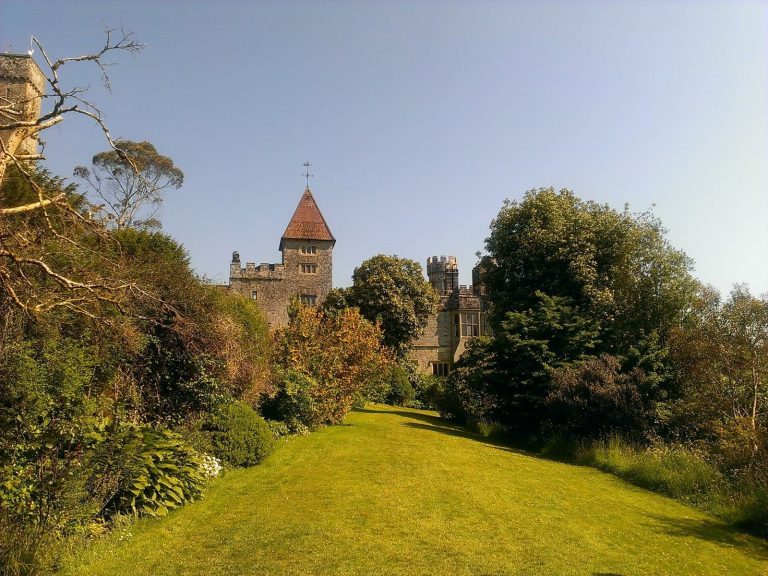
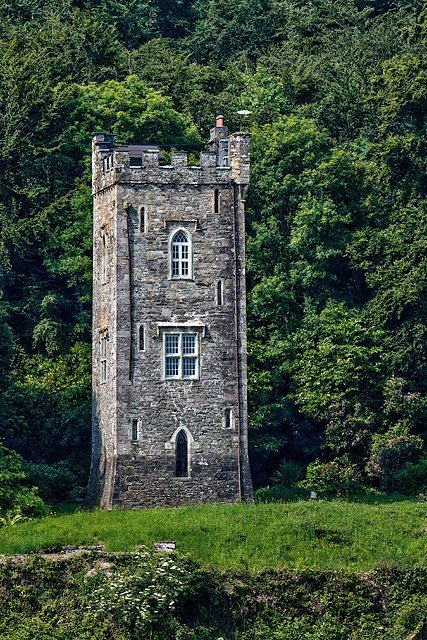
Strancally Castle is a three-storey Gothic Revival country house overlooking the River Blackwater near Tallow and Youghal in County Waterford, Ireland. Built around 1830 for John Kiely, it stands about 4.5 km upriver from a ruined medieval predecessor.
Medieval origins and the Desmond lands
The earlier castle is reputed to have been built in the late twelfth century by Raymond “le Gros” Fitzgerald during the Anglo-Norman invasion, the expansion into Ireland of Norman-led forces from Britain. By the sixteenth century, the FitzGeralds, also known as the Geraldines, controlled the surrounding lands as Earls of Desmond.
James Fitzjohn FitzGerald, the castle’s last Geraldine owner, was executed after the Desmond Rebellion of 1579, a conflict in Munster between the Earls of Desmond and the English Crown. The Crown then confiscated the FitzGerald lands. A local legend tells that Spaniards seized the old castle and invited local landowners to a peace banquet. A concealed trapdoor supposedly dropped the guests into a flooded cave. After learning of the killings, local people captured the castle, defeated its garrison and destroyed it.
In his 1791 account of Irish antiquities, Francis Grose described the old castle as a prison used by an Earl of Desmond. He said the government ordered the cave and castle demolished because of the treatment of prisoners, and that blasting destroyed half the castle.
The nineteenth-century house and estate
James Pain and George Richard Pain designed the present house for Kiely, who represented Clonmel in Parliament and served as High Sheriff of County Waterford, a senior county official, in 1819–1820. In 1837, the estate around the house was described as richly planted and larger than 1,000 acres. George Whitelocke Lloyd bought the house and an estate of about 5,000 acres in 1856. He later served as High Sheriff of the county in 1859–1860.
The Lloyd family retained the property into the early twentieth century. Their residence at Strancally appears in the censuses of 1901, 1911 and 1926.
Changes in ownership and restoration
After Irish independence, the Irish Land Commission, a state body involved in acquiring and redistributing land, took over the estate and sold its land in separate parcels. The house was later sold with 160 acres remaining. Edward Parke Seaton appears to have owned it for a time after the Second World War; toward the end of the twentieth century, Friedrich Billensteiner and his family held the property.
Around 2000, Giancarla Forte and Michael Alen-Buckley bought the house and restored it over the next two decades. In 2026, Mark Zuckerberg acquired the castle and a 440-acre estate in a private sale for more than €50 million.
Remains
The site includes the ruined predecessor and the later country house, which stands about 4.5 km upriver. The surviving house has a castellated, three-storey form in the Gothic Revival style.
Earlier castle
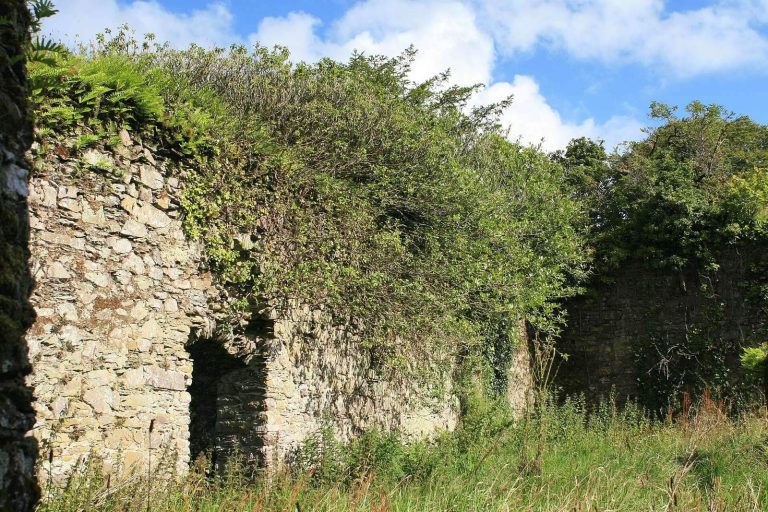
The earlier castle stood on a rock directly above the River Blackwater and is now ruined. Grose described an opening cut through the rock, comparing it to a portcullis, or heavy gate lowered to secure an entrance. He said prisoners’ bodies were thrown through this opening.
Present house
The house is built of sandstone and limestone, cut into regular blocks. Its castellated exterior gives the country house its Gothic Revival character.