Stolzenburg (Eifel): A Medieval Hill Castle in Germany


Site at a Glance
- Rating
- 4.4
- Popularity
- Very Low
- Country
- Germany
- Primary era
- Medieval
- Eras represented
- Medieval
- Civilizations
- Holy Roman Empire
- Site type
- Military
- Remains
- Castle
On this page10 sections
History
Stolzenburg (Eifel) is a ruined medieval hill castle in Germany, situated above the Urft valley near Kall. Built during the medieval period, it occupied a defensible height between Sötenich and Urft. The Roman Eifel aqueduct, a water-supply system carrying water through the Eifel region, passed below the castle, while ceramic finds indicate medieval settlement at the site.
Origins and changing interpretations
The remains were once interpreted as those of a Roman watchtower. Adlung advanced this view, but Ernst Wackenroder rejected it and identified the site as a medieval castle. He proposed that its lords may have belonged to the family of Johann von Sötenich, who was recorded around 1405.
The local historian and priest Nikolaus Reinartz later questioned this attribution after finding the name Stolzenburg in a 1643 file from the Reich Chamber Court, the central judicial institution of the Holy Roman Empire. The document indicates that the castle was probably the ancestral seat of the Knights of Dalbenden. Their family later moved to Dalbenden, a more comfortable moated castle surrounded partly or wholly by a water-filled ditch.
Later traditions and landscape protection
A Tranchot map, part of a detailed topographic map series covering western Germany and nearby regions, labels Stolzenburg as a ruined Templar monastery. This identification is considered incorrect. Older Eifel castles were often popularly connected with the Knights Templar, a medieval religious-military order associated with protecting Christian pilgrims and territories in the eastern Mediterranean.
The castle is surrounded by the nature reserve Meadows and Slopes along the Urft and Gillesbach, protected since the mid-twentieth century. Its south-facing steep slopes support distinctive vegetation. Local traditions tell of the noble knight Arno, who supposedly chose death rather than submit to his territorial lord, and of cruel robber knights who built a leather bridge to Bielstein Castle, played skittles with loaves of bread, and tormented hungry subjects until divine punishment destroyed both castles. The Devil was then said to guard the lord’s treasure.
Other legends speak of a treasure guarded by a black dog with glowing eyes. One story concerns the crusader Raimund, who left the castle lady Aspasia to travel to the Holy Land. Returning years later as a disfigured beggar-pilgrim, he was taken in by Aspasia, who eventually married him. Fairies called Juffern were also said to cause trouble along the Urft below the castle.
Remains
Enclosure and defenses
Oval castle enclosure
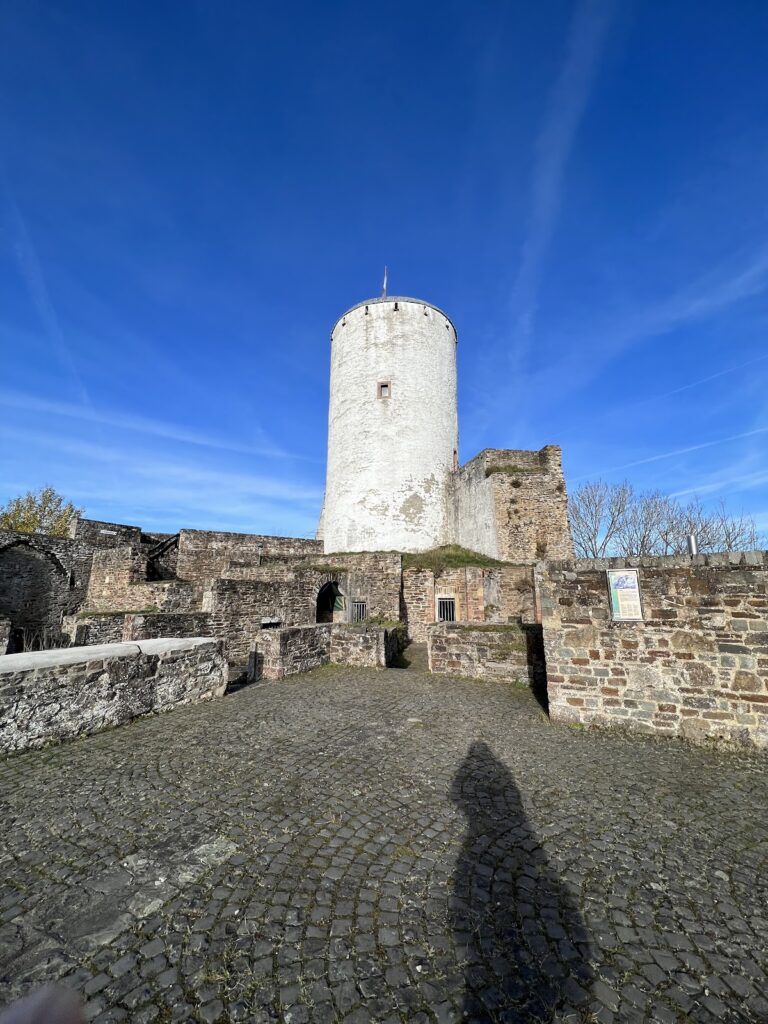
Stolzenburg occupied a high position in the Urft valley and formed an oval enclosure approximately 75 metres long. The castle survives as a ruin, with wall remains indicating residential rooms and probably gate towers.
Walls, rampart, and ditch
The enclosure was defended by a wall, rampart, and ditch. On the western side, the extremely steep slope served as a natural defense. This arrangement allowed the terrain to reinforce the built fortifications around the castle.
Subterranean spaces and Roman infrastructure
Cellar tunnels
Additional tunnels remain within the site. They were probably used as cellar spaces and form part of the surviving evidence for the castle’s domestic arrangements.
Eifel aqueduct
The Roman Eifel aqueduct ran below Stolzenburg. The Roman Canal hiking trail passes the site, following the line of this ancient water-supply system through the Eifel landscape.