St. Cyriacus (Weyer): A Medieval Parish Church in Germany
Site at a Glance
- Rating
- 4.4
- Popularity
- Very Low
- Country
- Germany
- Primary era
- Medieval
- Eras represented
- Medieval, Early Modern
- Civilizations
- Holy Roman Empire
- Site type
- Religious
- Remains
- Church
On this page15 sections
History
St. Cyriacus is the Catholic parish church of Weyer in Germany, a district of Mechernich, whose earliest known church building was a high-Romanesque foundation of the twelfth century. The church was first mentioned around 1187, when it was incorporated into Steinfeld Abbey, a major medieval religious institution in the Eifel whose churches were institutionally attached to the abbey. Standing over a Frankish burial ground, it occupies a site with religious use reaching back beyond the surviving medieval structure.
Early church and medieval transformation
Early medieval stone-slab graves have repeatedly been found around the church, while the date of the first building on the site remains unknown. Weyer itself appears as “Wiere” in an early medieval property register of Prüm Abbey. The medieval church was a small Romanesque building, probably with a tower inherited from that earlier form. Around 1500, two building phases transformed it into a lower Late Gothic hall church with a three-sided choir termination. The church was under the patronage of the Duke of Arenberg.
Early modern religious life
A Five Wounds Brotherhood was introduced at Weyer in 1650. The eighteenth-century wooden emblems associated with the brotherhood survive in the church, although they have been removed from their original arrangement. The church also preserves an epitaph for Hermann von Hambroich, who died in 1614. He had served as an Amtmann, an administrative official acting for a territorial lord or institution, at Liedberg and was associated with Christiane Krümmel of Nettersheim.
Later alterations and preservation
The west tower was altered and renewed between 1788 and 1794, probably preserving a structure inherited from the small Romanesque church. Renovation in 1991 exposed remains of the Romanesque building and revealed a well-preserved second-century stone dedicated to the Matrons, Gallo-Roman female divinities associated with fertility, protection, and local communities. The stone had been reused in the main altar and may have originated at a Matron sanctuary in the forest between Nöthen and Pesch, about four kilometres away. St. Cyriacus is a protected historic monument, and the parish church received a new altar for liturgical celebration in 2002.
Remains
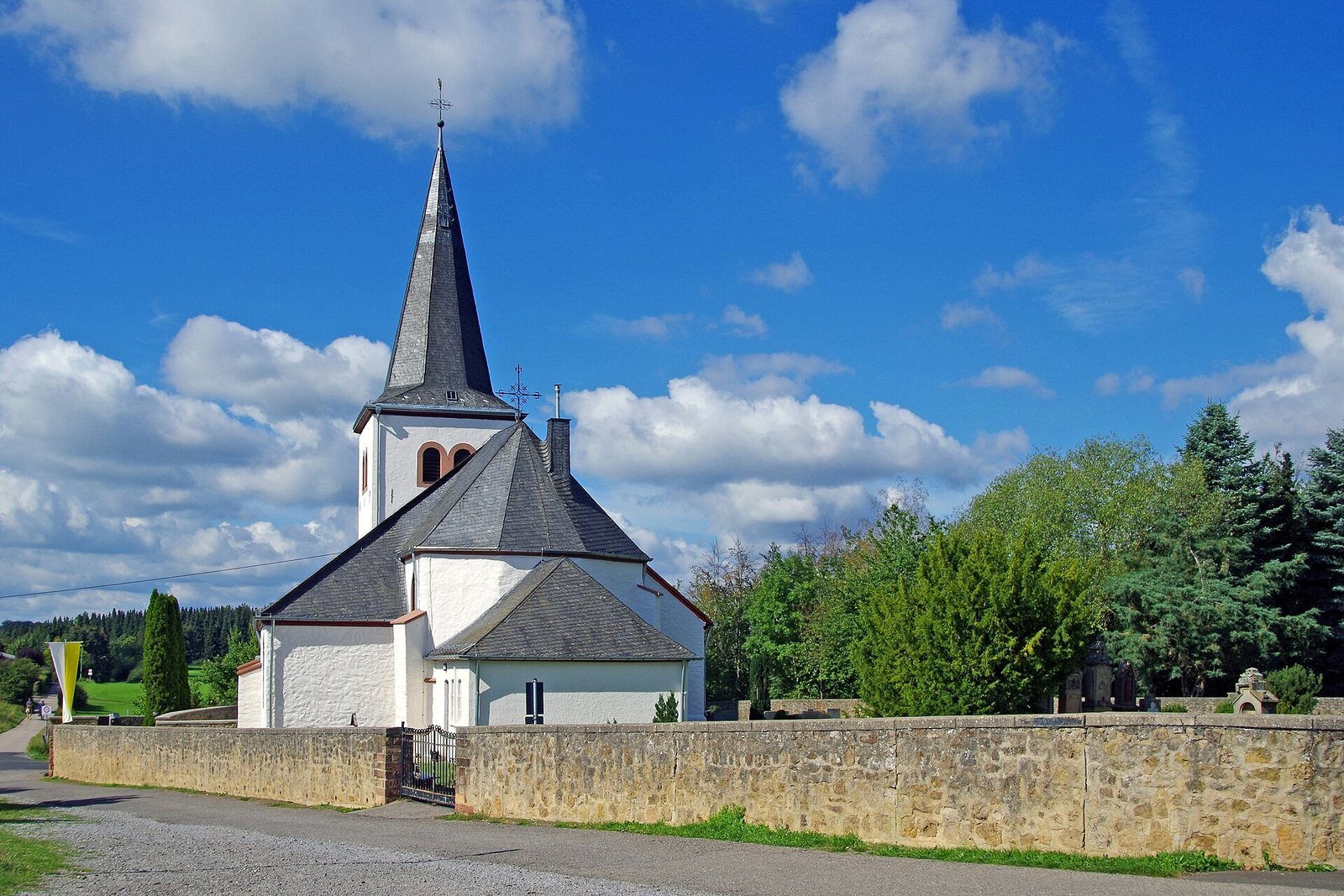
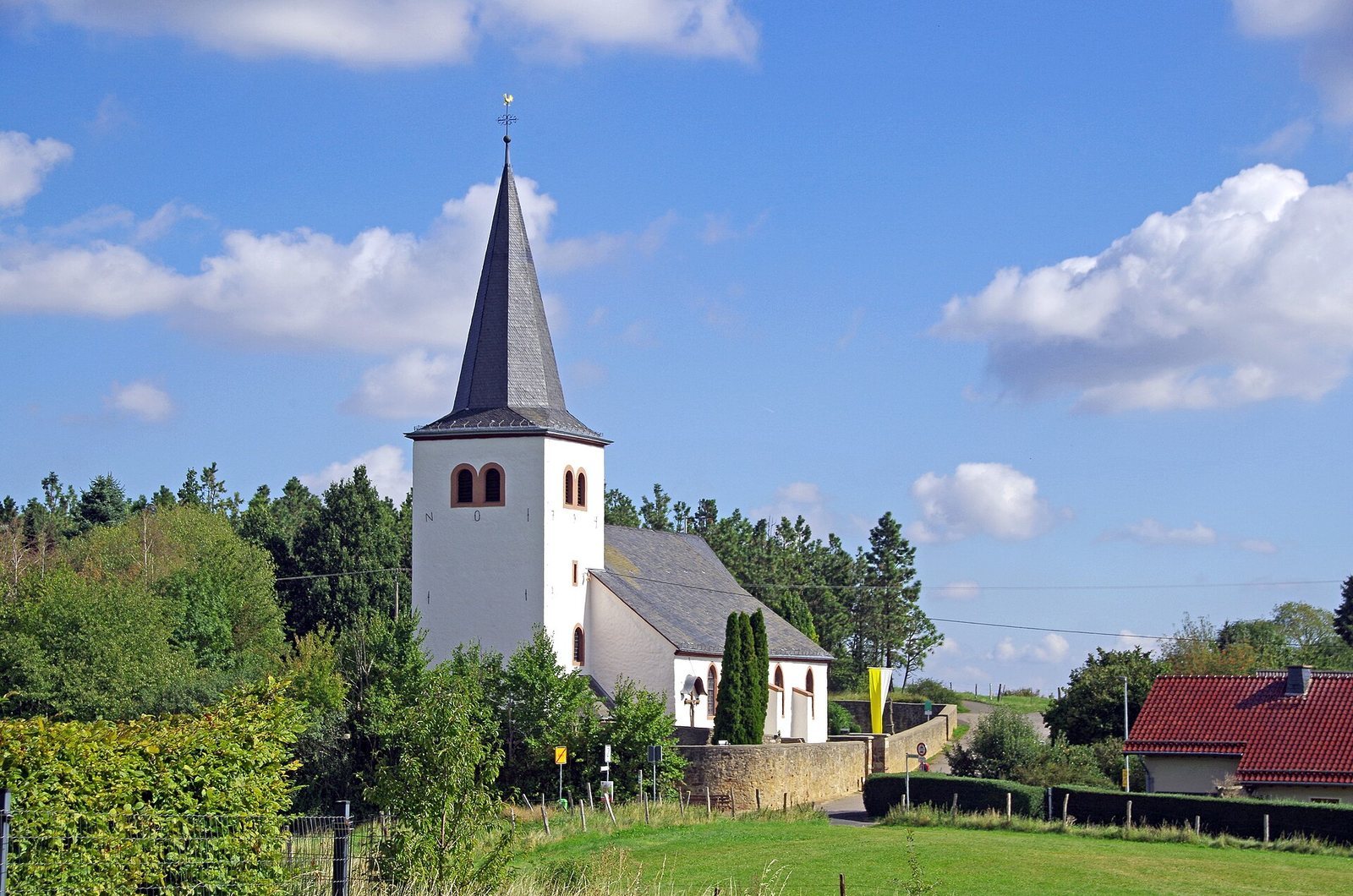
The church stands on a hill at the edge of present-day Weyer and is enclosed by a walled cemetery. Its surviving fabric brings together a three-aisled Romanesque pillar basilica, meaning a church with a higher central nave and lower side aisles, and the later Late Gothic hall church, whose aisles are approximately equal in height to the central space. The west tower, the medieval walls, later vaults, furnishings, sculpture, inscriptions, and bells preserve successive phases of the church’s development.
Romanesque and Gothic fabric
Medieval nave and choir
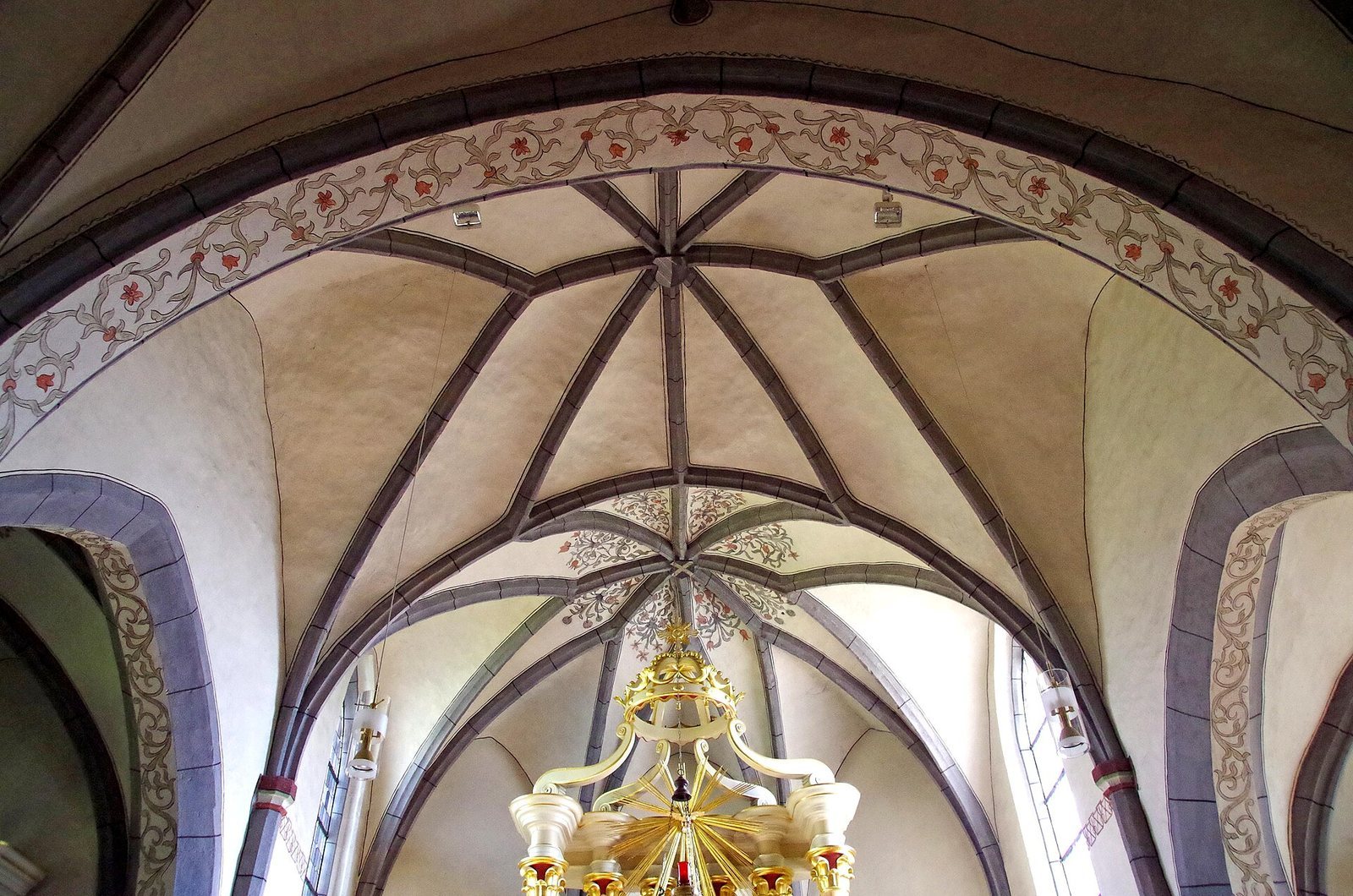
The earlier church was a three-aisled Romanesque pillar basilica with a transept, the cross arm extending across the main axis, and a projecting west tower. Blocked round-arched clerestory windows, the upper windowed section of a nave wall, remain visible in the present building. Some are partly overlapped by the Late Gothic vaulting, while irregularly shaped pillars also survive from the Romanesque structure. The later hall church has pointed-arched windows, a star and net vault in the main nave, rib vaults in the side aisles, and a three-sided choir termination.
West tower
The surviving west tower is built of plastered rubble stone and has little external articulation. Its tower hall contains a groin vault supported by angular corner piers. A pointed spire crowns the tower, and paired round-arched windows open on all sides. The tower was altered and renewed between 1788 and 1794.
Churchyard and furnishings
Exterior features and baptismal font
A Crucifixion group is attached to the south wall, and an old cross forms part of the churchyard wall. Inside, a sixteenth-century baptismal font is carved from bluestone in a broad cup form. Its base has a Late Gothic angular transition.
Altars and organ case
The eighteenth-century wooden tabernacle altar incorporates the receptacle traditionally used in Catholic churches to reserve the Eucharist. Six tall freestanding columns surround it and support a large crown with spiral-shaped volutes, forming a baldachin, or canopy over the altar. The two side altars also date from the eighteenth century and have freestanding columns. The organ case is attributed to the seventeenth century and is said to have come from Steinfeld Abbey. A Communion rail, pulpit, pews, and two confessionals have Neo-Gothic forms.
Wooden figures and brotherhood emblems
Several eighteenth-century wooden figures survive in the church and sacristy. They represent Francis, 1.20 metres high; Rochus in shepherd’s dress, 1.00 metre; Matthias, 1.05 metres; a Madonna remodelled as Saint Cecilia, 0.69 metre; Sebastian, 1.06 metres; Hermann Joseph, 0.93 metre; and Cyriacus, 1.00 metre. The figure of Cyriacus holds an open book with the sentence, “In my name they drive out demons,” from the Gospel of Mark. The wooden emblems connected with the Five Wounds Brotherhood also survive, though no longer in their original arrangement.
Inscriptions, ancient stone, and bells
Epitaph and Matron stone
The side-aisle wall contains a red-sandstone epitaph for Hermann von Hambroich measuring 0.95 by 2.40 metres. The Matron stone in the church vestibule is a well-preserved second-century spolia block, an earlier architectural or sculptural element reused in a later building. It depicts three Matrons, and its inscription states that Lucius Caldinius Firminius dedicated the votive stone to the Vaccalinehian Matrons. Five crosses and a recess for a relic were cut into its reverse side when it was reused in a Christian setting.
Bell collection
The oldest bell has the strike note G-sharp and was cast at Weyer in 1584 by Heinrich van Collen. Its decoration includes an inscription, an ornamental band, and three reliefs depicting biblical scenes. A larger bell inscribed “Maria Regina Pacis” and a smaller one inscribed “St. Matthias O.P.N.” date from 1949. A bell-casting pit associated with the Cyriacus bell has been identified at Weyer.