Stift Keppel: A Women’s Religious Foundation and School in Hilchenbach, Germany
Site at a Glance
- Popularity
- Medium
- Country
- Germany
- Primary era
- Medieval
- Eras represented
- Medieval, Early Modern, Modern
- Civilizations
- German, Holy Roman Empire
- Site type
- Religious
- Remains
- Monastery
On this page16 sections
History
Stift Keppel, founded before 1236 as a community of Premonstratensian canonesses, is a former women’s religious foundation and a present-day school in Hilchenbach, Germany. Canonesses were women belonging to a religious order, and the Premonstratensian order was founded by Norbert of Xanten. Friedrich vom Hain, a Nassau vassal, established the convent on his estate. Its church dates to 1275 and was built in the Romanesque style. A necrology at Arnstein already refers to a head of the Keppel community before 1236. The first documentary mention comes in a 1239 charter, when Count Heinrich II of Nassau transferred revenues from the parish of St Martin at Netphen to the monastery at Friedrich’s request.
Medieval foundation
From early in its history, the convent also provided for unmarried daughters of local noble families. A convent rule of 1392 described Count Johann I of Nassau as both protector and founder. He selected the collegiate church as the burial place for himself and his wife, Margarethe, Countess of Mark. His mother, Adelheid, Countess of Vianden, led the foundation during the later years of her widowhood.
Reformation and education
Count Wilhelm “the Rich” introduced the Reformation in his lands by 1536 and established a school at Keppel in 1549. Before the Thirty Years’ War, about 350 boys and girls from noble and upper-bourgeois families studied there. Pupils included members of the Nassau, Wittgenstein, Sayn, Solms, Waldeck, Isenburg, and Wied families, as well as children of commoners and of local officials, advocates, professors, and pharmacists.
In 1594, Wilhelm’s son, Count Johann VI, converted the monastery into a Protestant collegiate foundation, a community of canonesses that was not a conventional monastery. During the Thirty Years’ War, Keppel briefly came under the control of the Jesuit college in Siegen. After the Peace of Westphalia, Maria von Effern, the foundation’s head, secured its re-establishment in 1650. Under the Catholic-convert Count Johann the Younger, it became a shared institution with four Reformed and four Catholic canonesses. Catholic and Reformed abbesses took turns leading it, while the two confessions maintained separate households.
Dissolution and Prussian rule
Until the nineteenth century, the counts and princes of Nassau-Orange protected the foundation; the Prussian royal house later assumed that role. In 1808, Joachim Murat, the new ruler of the Duchy of Berg, imposed Isabella Marquise de Meslé as abbess. The foundation was dissolved in 1812 under Napoleonic rule, after most noble families of the Siegerland had died out. Following the Congress of Vienna, Keppel became part of Prussia in 1815 with the Principality of Nassau-Siegen. The Prussian king continued to appoint canonesses, though they no longer had to live at Keppel. The poet Katharina Diez was among those appointed.
Hilchenbach’s Evangelical Reformed congregation used the collegiate church from 1839 to 1846. From 1844 to 1900, the Catholic mission of St Augustine was based at Keppel and ran an elementary school in the convent hall.
School foundation and growth
In 1871, the foundation’s chief administrator, Piper, and its treasurer, Manger, established the Keppel School and Educational Institution for girls, including a boarding school. Queen Dowager Elisabeth served as patron, and King Wilhelm I provided financial support. The school opened on 10 September 1871. Elisabeth appointed Nanny von Monbart, a teacher from Droyßig, as the foundation’s first head. A teacher-training college for women followed in 1872. Day pupils came from Siegerland, while boarders arrived from elsewhere in Prussia and from England, France, and Italy.
Anna von Ciriacy-Wantrup became the foundation’s second head in 1899. The school gained recognition as a girls’ secondary school and upper-level girls’ secondary school in 1910. In 1926, women at Keppel took the Abitur, the German school-leaving examination that qualifies students for university study, for the first time. After Piper left office, departmental chiefs in Arnsberg represented the foundation’s fund. Carl Freiherr von Wittgenstein became its curator, or guardian, in 1923 and remained in the post until 1962.
Twentieth century to the present
After the Nazi seizure of power in 1933, Keppel became a women’s secondary school, and the foundation’s head, Cornelia van Senden, was removed from office. The foundation was slated for nationalization in 1944, and the site served as an emergency hospital at the end of the Second World War. In 1946, von Wittgenstein secured the reversal of nationalization. The foundation’s fund then became the school’s owner and operator. Teaching resumed under difficult conditions, and coeducation began in 1977 alongside extensive expansion of the school buildings.
Stift Keppel is now a public, foundation-run Gymnasium, an academically oriented German secondary school that prepares pupils for higher education. It is supported by the united foundations of Geseke and Keppel, held as a special fund of the State of North Rhine-Westphalia. Renate Shimada was the last school head also to hold the title of head of the foundation.
Remains
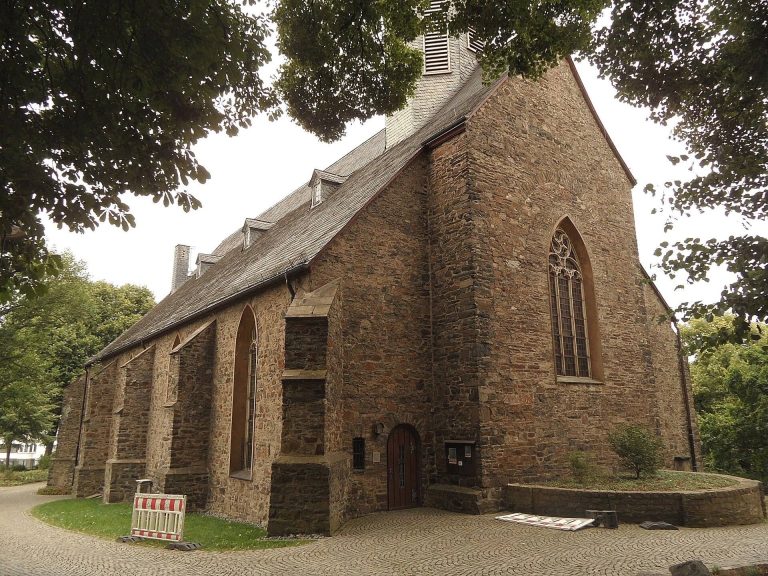
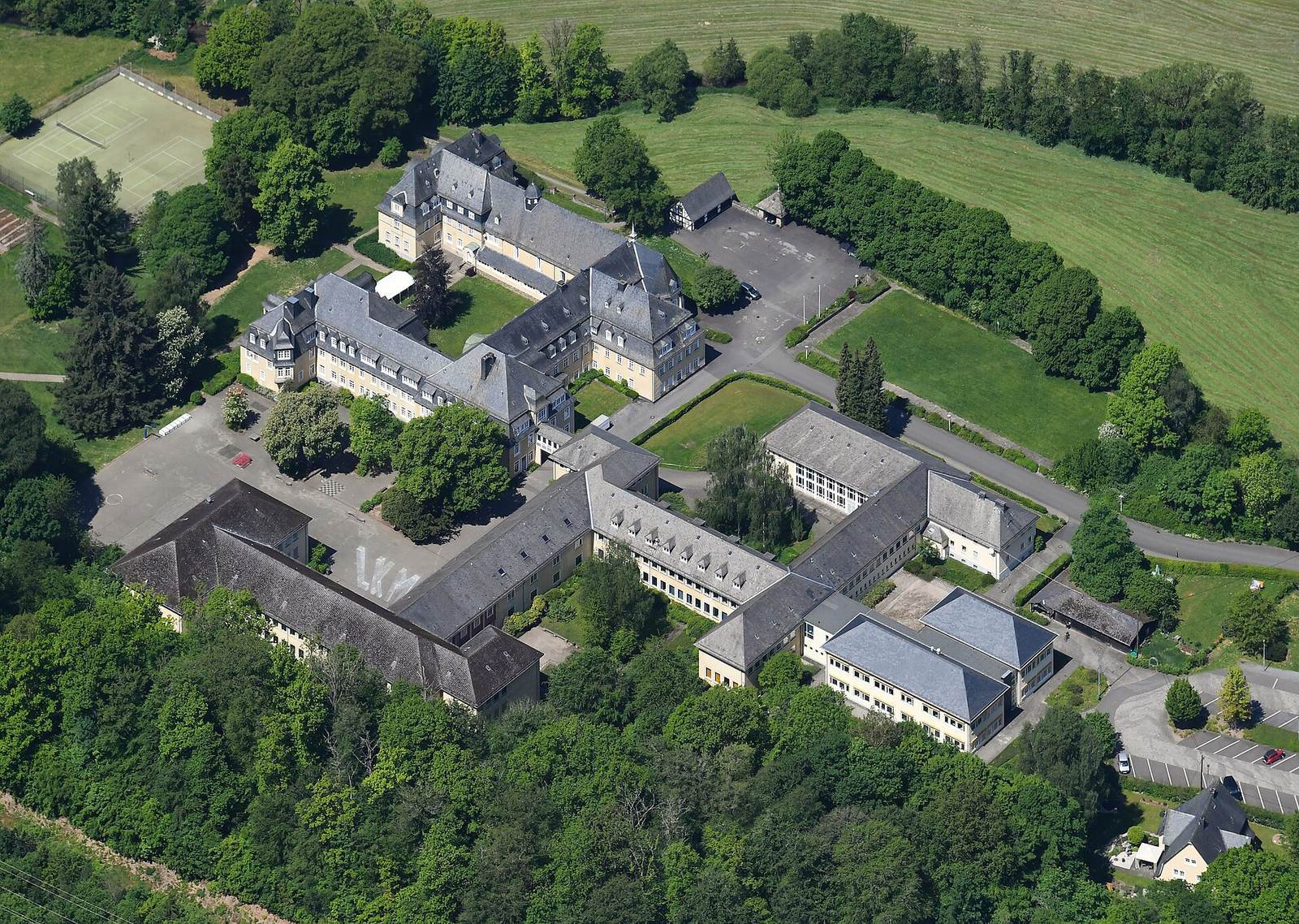
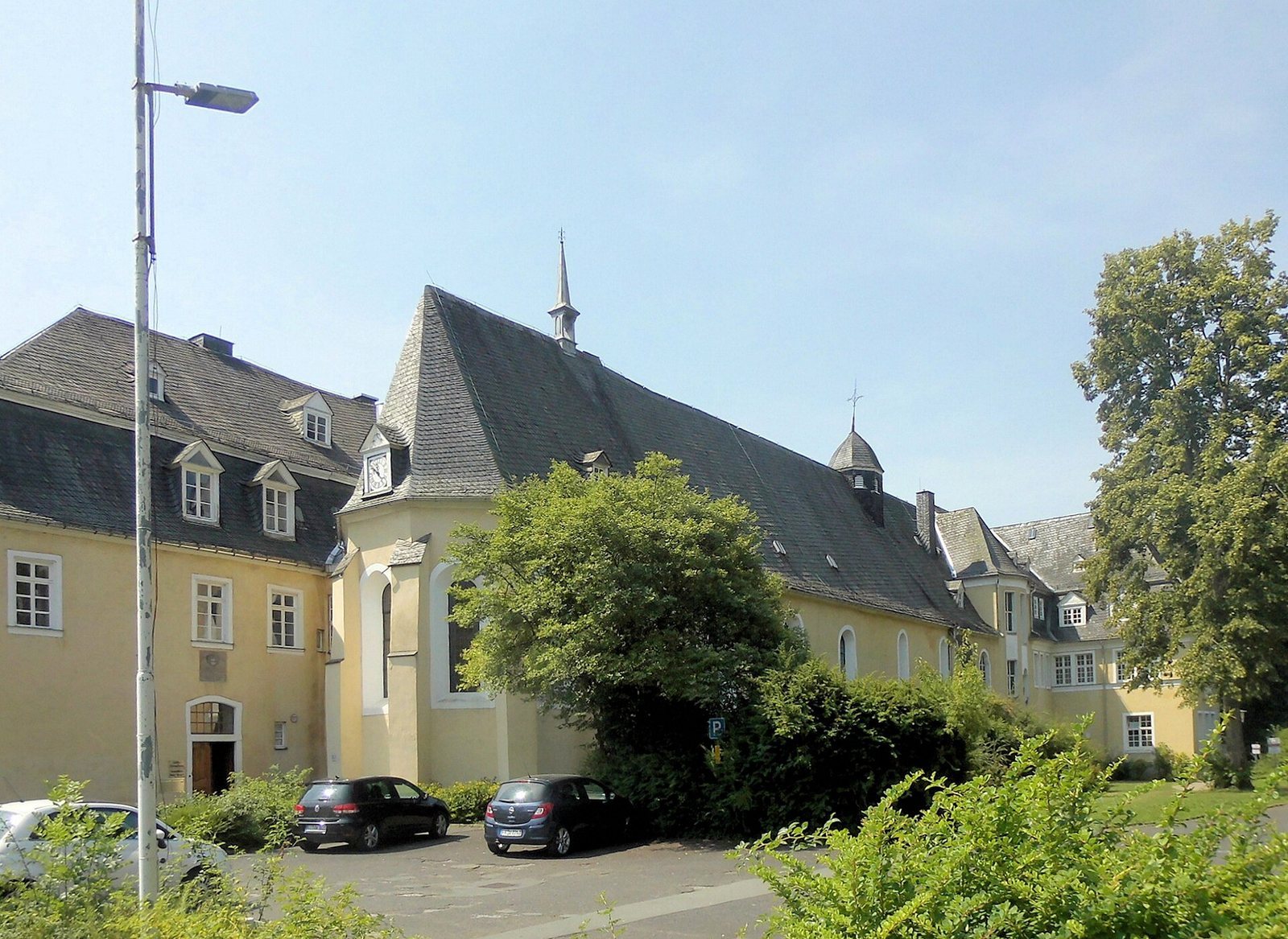
The surviving complex brings together the church, convent buildings, and successive school additions in the Ferndorftal, between Allenbach and Dahlbruch, districts of Hilchenbach. The church retains its three-part arrangement of choir, lay church, and gallery for the canonesses.
The church
Plan and architectural form
The church of St Mary and St John the Evangelist was built in 1275 over an earlier building that burned in the mid-thirteenth century. Its Romanesque structure has a simple rectangular choir, the area around the altar, later extended with a Gothic end formed by several angled sides. The division into choir, worship space for laypeople, and the canonesses’ gallery reflects the church’s use by a Premonstratensian women’s community.
Funerary memorials and stalls
Eighteen funerary memorials in the choir date from 1464 to 1748. They include memorials to Johann von Bruch (1464), Philippe von der Hees (1501), Anna von Schnellenberg (1562), Katharina von Zweifel (1572), and Sophie Charlotte von Bottlenberg, called Kessel (1748). Late-Gothic choir stalls also survive. The church’s patrons are John the Evangelist and Elizabeth of Thuringia. Elizabeth died at Marburg in 1231 and was canonized in 1235; she was associated with Arnstein Abbey and the House of Nassau.
Altars, pulpit, and organ
Abbess Johanna Maria von und zu Holdinghausen donated the altar stone in 1677 and the Baroque pulpit in 1682. Abbess Anna Elisabeth von der Hees gave the church its multi-tiered altarpiece, dated 1701, and the organ on the canonesses’ gallery, dated 1695.
Convent and school buildings
New House and Hall Building
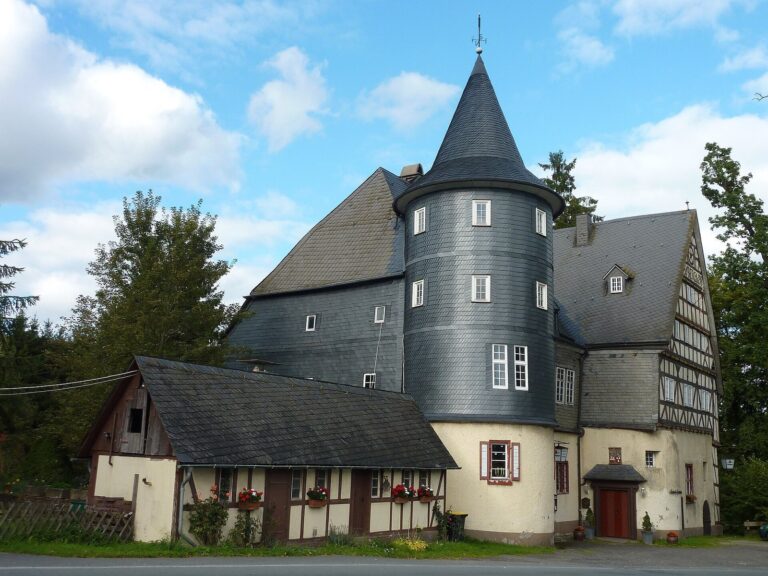
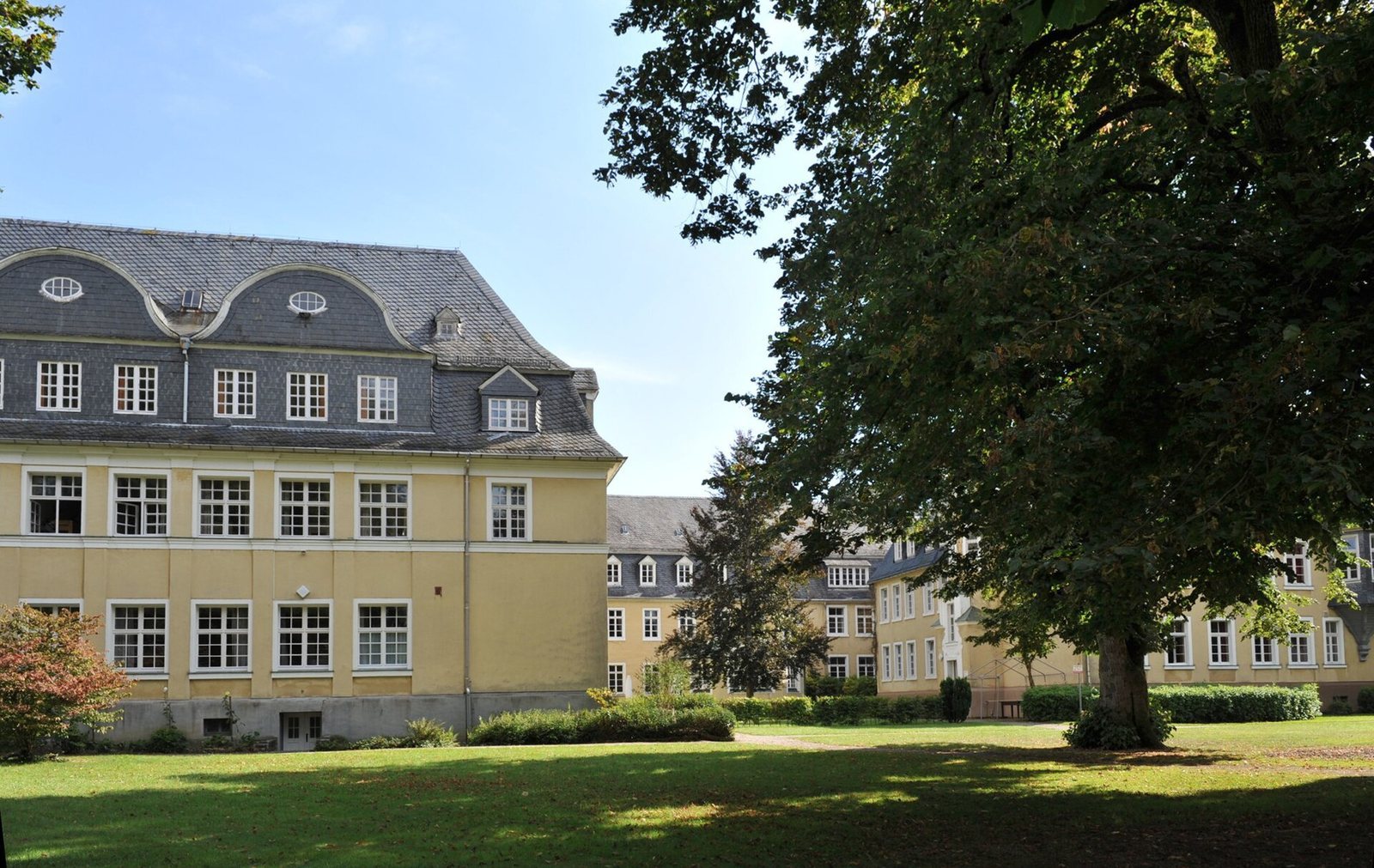
The New House was built in 1733, followed by the adjoining Hall Building in 1752. The two structures stand along the cloister, the covered passage of the convent, and were erected under Abbesses Sophie Charlotte von Bottlenberg, called Kessel, and Elisabeth von Neuhoff, called Ley. The Hall Building contains an elaborately decorated convent hall.
Early twentieth-century wings
Between 1903 and 1911, a new south wing was built on the site of the abbey wing. The church wing was also enlarged in the area of the former dormitory. The expansion and the senior teacher’s house were designed by Herborn architect Ludwig Hofmann.
Later school buildings
Buildings added from the 1950s to the 1970s include the heraldic hall, science classrooms, a gymnastics hall, the present-day auditorium, teachers’ houses, and a new boarding-school building with tennis courts. A large multi-purpose sports hall was built beside the sports field in 1991.
Other foundation properties
The foundation’s other buildings include houses in the Ferndorftal and the old railway station.