Statue-menhir of Mollet: A Neolithic Carved Standing Stone in Spain
Site at a Glance
- Popularity
- Medium
- Country
- Spain
- Primary era
- Stone Age
- Eras represented
- Stone Age, Modern
- Civilizations
- Unclassified
- Site type
- Civic
- Remains
- Megalithic Monument
On this page11 sections
History
The Statue-menhir of Mollet is a large standing stone carved with a human figure in Mollet del Vallès, Spain. Its style places it broadly in the Late Neolithic, the later phase of the Neolithic prehistoric period, between 3300 and 2200 BCE. It is estimated to be about 5,000 years old and is described as Europe’s largest known statue-menhir, though the stone itself cannot be directly dated to the time of carving.
Dating and displacement
Stylistic comparisons suggest that the raised face may date to between about 3500 and 2400 BCE. A yoke-like engraving resembles designs on the Pedra de Llinàs and Castellruf menhirs, which are dated to about 4500 BCE. One proposed sequence places the engravings in the Middle Neolithic, a middle phase of the prehistoric period, and the face later, perhaps in the Late Neolithic. Charcoal in sediment covering the monument dates to 2290–1960 BCE; that date belongs to the sediment, not the carving.
The stone is thought to have fallen, accidentally or deliberately, sometime in the latter half of the third millennium BCE or possibly the second millennium BCE, and was not raised again. It may later have been moved to the wetland where it was found, after losing its original significance, and covered by river deposits. The flood-prone plain was considered unsuitable for lasting prehistoric settlement, so the findspot is probably not the monument’s original position. Its size, difficulty of transport and lack of wear suggest that its earlier location was nearby.
Possible social and religious meanings
One proposed interpretation places monuments of this kind in Middle Neolithic communities experiencing population growth and developing forms of leadership while maintaining cooperation between groups. Shared works such as standing stones, dolmens, large gathering hearths and communal tombs may have expressed those relationships. A further hypothesis suggests that unstable climate and crop failures brought famine and unrest, prompting alliances under influential leaders and the creation of human-form monuments.
The Mollet stone’s purpose remains uncertain. Some archaeologists have proposed that it had a religious role and represented a deity associated with river water and rain, whose worship may have been intended to temper destructive floods. Interpretations influenced by studies of Breton monuments read shield-like designs as a female fertility deity, the yoke-like motif as a related male bull deity, and the serpent as a sign of change and renewal. A connection with the exercise of power has also been suggested. The imagery has been understood as combining Mediterranean traditions of Late Neolithic standing stones and stone statues with Atlantic motifs resembling megalithic art from Brittany.
Discovery and modern recognition
The monument was uncovered in April 2009 during construction of a car park at Pla de les Pruneres, about eight metres beneath the present ground surface. It was taken to Catalonia’s Centre for the Restoration of Movable Cultural Heritage in Valldoreix, where conservation work took place in 2010. In Catalonia it is protected as a Cultural Asset of National Interest in the historic-monument category.
Remains
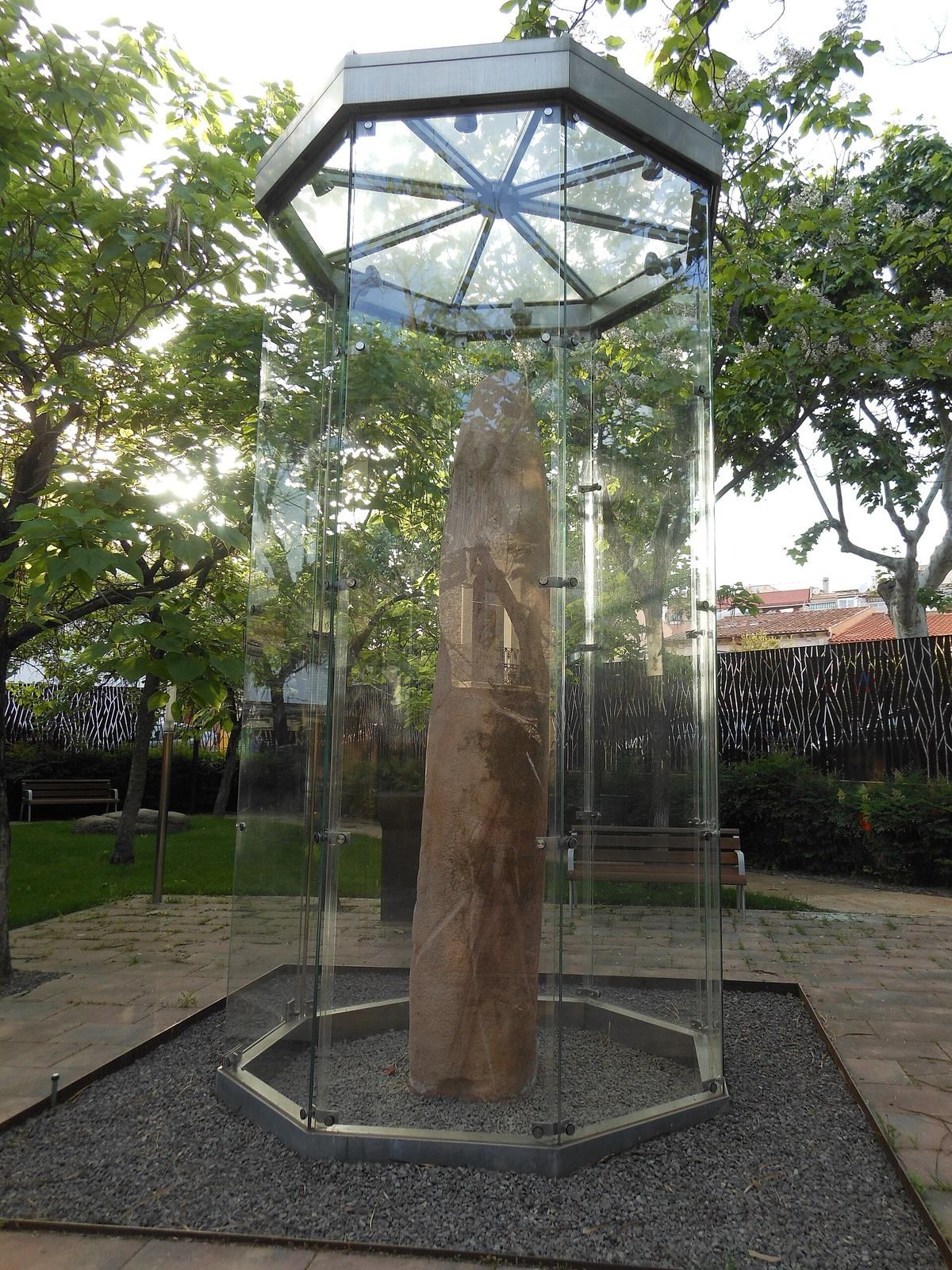
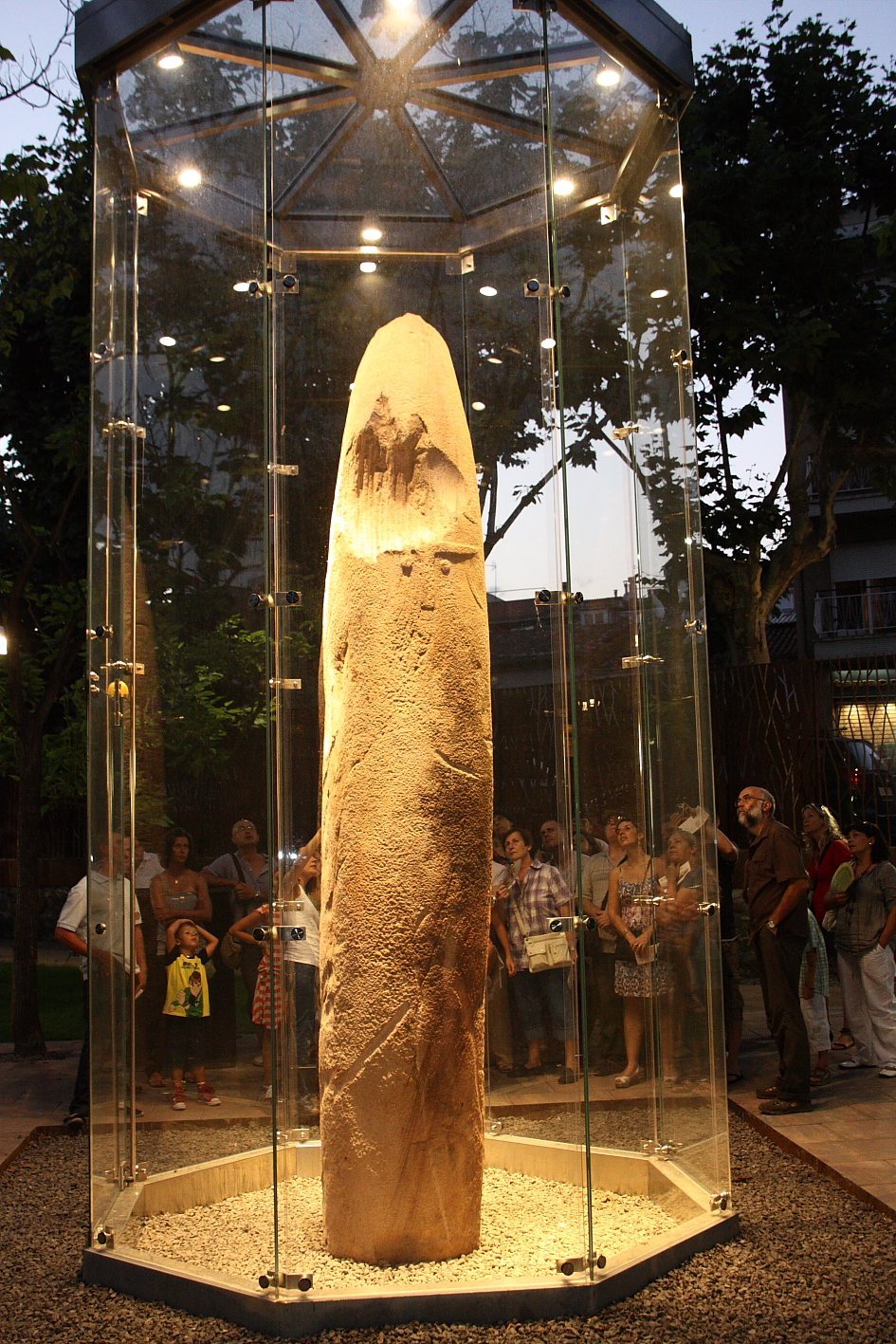
The monument is a single block shaped like a rectangular prism, with rounded edges and one pointed end. Its two decorated surfaces are the narrow sides of the stone rather than its broad faces.
Form and stone
The block is about 4.90 metres high, with a cross-section measuring approximately 1.10 by 0.69 metres, and weighs around six tonnes. It is made of arkose, a sedimentary rock rich in grains derived from granite. Because the stone’s geology differs from that of the findspot, it was brought to the Vallès plain from elsewhere; the Serralada Litoral and the mountain of Figaró have been proposed as possible origins.
Carving techniques
Repeated blows from a hard, rounded-pointed tool regularized much of the stone’s surface. The face was shaped by hammering, leaving its features raised above the surrounding surface. The designs on the other side were cut into the stone; their U-shaped grooves suggest stone rather than metal tools. They may have been made by repeated blows directly on the stone or through an intermediate implement. The decorated sides therefore preserve contrasting approaches to carving.
Decorated sides
Raised human face
One narrow side bears a face in raised relief. A straight nose and straight brow ridges form a T shape, while the outer ends of the brows extend down into forms resembling earrings or bull horns. These features frame raised circular eyes with carefully carved irises. An incomplete raised motif above the brows was damaged during discovery. Features at the brow ends remain visible on the left; natural erosion has obscured them on the right, though they can be made out in angled light. They may depict arms held vertically beside the face. A hole above the brows was made by modern drilling.
Incised designs
The opposite narrow side carries a long, winding line descending from its upper end. Below it is a crosswise design compared to the letter M, a yoke or bull horns. Two opposed, upside-down D-shaped or shield-like forms sit one above the other farther down. A pair of broad curves around head height may represent shoulder blades. Lower marks are difficult to interpret.
Damage, conservation and display
Drilling and machinery during removal chipped the stone, particularly near its upper end, where carved details were also lost, and left crosswise scratches on one side. Burial had left uneven soil deposits, possible salts and areas of weakened surface. One face also carried a strongly attached black coating identified as desert varnish, formed by bacterial activity under extreme environmental conditions. Conservation removed surface soil mechanically and removed salts from the buried area. For display, the lower part was wrapped in plastic film, protective fabric and another layer of film, then set into a concrete base without external anchors. Neoprene beneath the stone and expanded polystyrene around its sides helped prevent adhesion and allow some reversibility. The original stands in the courtyard of the Can Mulà library, while a full-size replica marks the findspot at Pla de les Pruneres.