St. Nicholas Church in Kolding: A Medieval Parish Church
Site at a Glance
- Popularity
- Low
- Country
- Denmark
- Primary era
- Modern
- Eras represented
- Medieval, Early Modern, Modern
- Civilizations
- Danish, Denmark–Norway
- Site type
- Religious
- Remains
- Church
On this page22 sections
History
Medieval origins
St. Nicholas Church in Kolding is a medieval church in Denmark, probably built around 1250 and later rebuilt in the Neo-Gothic style, a revival of medieval Gothic forms. A wooden church may have preceded it, though this possibility remains uncertain. The building was first known as Kolding Church. After Christ Church was established in 1925, the older church took the name of its patron saint, Nicholas, a fourth-century bishop of Myra venerated in Christian traditions. A view by Braun and Hogenberg dated 1587 is the earliest known depiction of the church.
Eighteenth-century restoration
By the 1750s, the church had deteriorated and its vaulted ceilings were thought to be in danger of collapse. An extensive restoration raised the ceiling and enlarged the windows to bring in more light, giving the interior a higher, brighter appearance.
Nineteenth-century changes
Kolding’s Old Cemetery came into use in 1806. The churchyard closed in 1825 and was converted into a square. When Kolding Town Hall was enlarged in 1873, workers found skeletons in the former burial ground.
Discussions about restoring the church continued through the 1870s. A critical inspection took place in 1876, and a restoration plan prepared the following year was initially rejected. Work began in May 1885 and was completed in 1886, establishing the church’s present appearance. The reconstruction followed the Neo-Gothic style. The church now generally uses the Old Cemetery, Southern Cemetery, completed in 1913, and Northern Cemetery, completed in 1958.
Twentieth-century events
A chapel was added in 1933. In 1943, consul Christian Eff gave the church a carillon, a set of tuned bells played in sequence; it is now at the Danish Bell Museum.
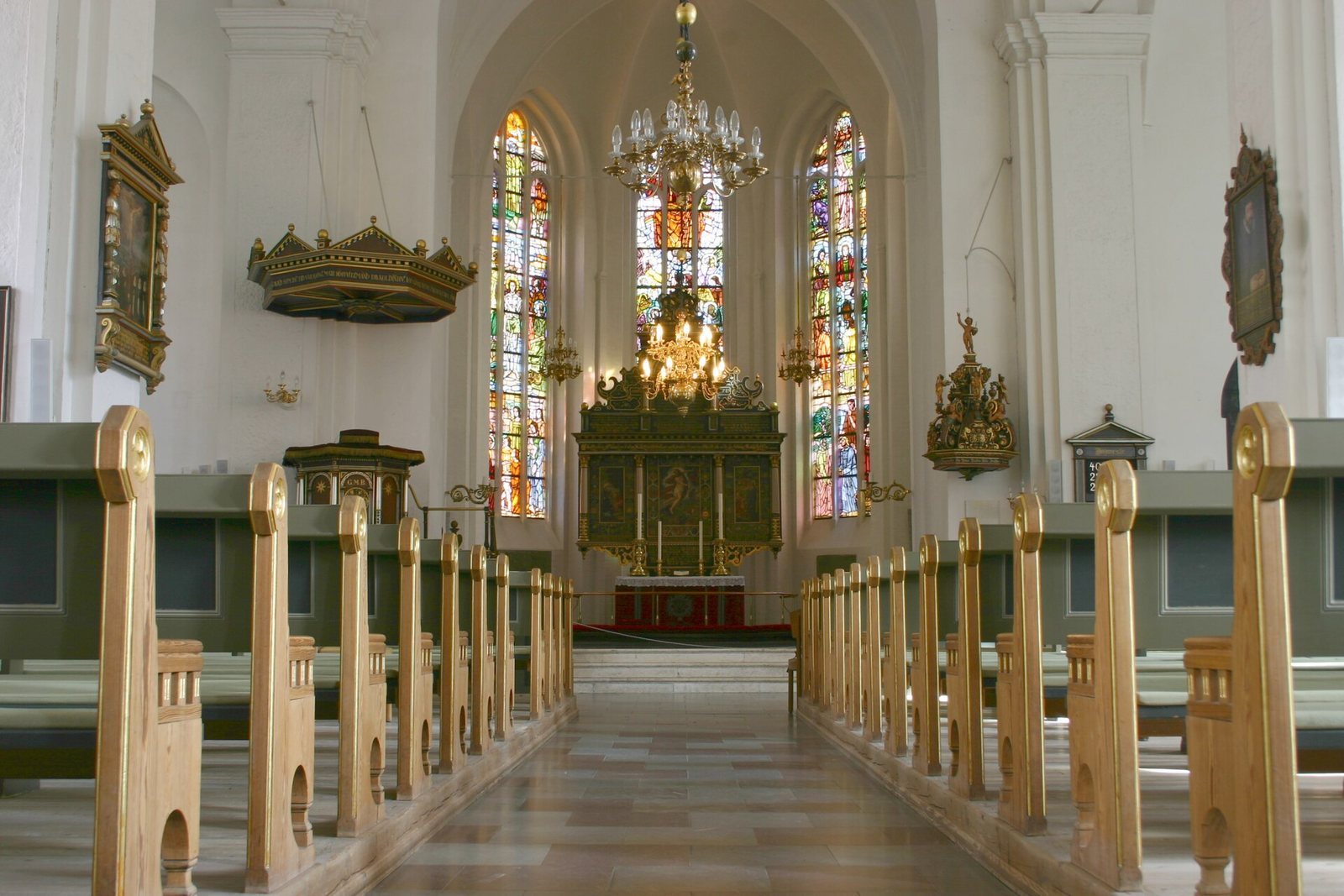
On 19 March 1945, a sabotage attack apparently aimed at Kolding Town Hall destroyed stained glass in the church. Five replacement windows by Kræsten Iversen were dedicated in 1950 during the church’s 700th-anniversary celebration, attended by King Frederik IX and Queen Ingrid.
Remains
Plan and exterior
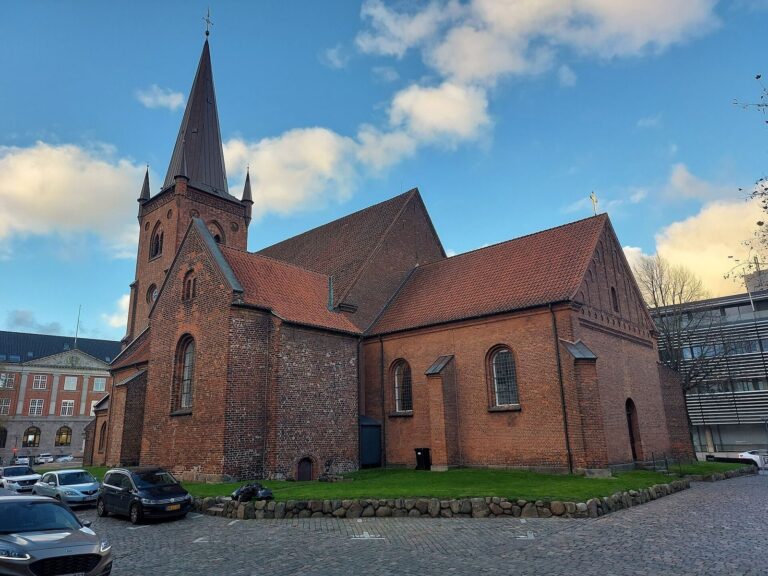
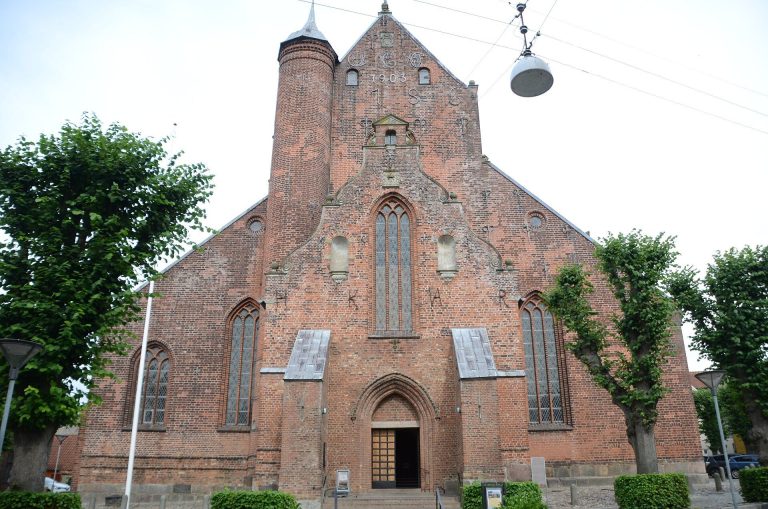
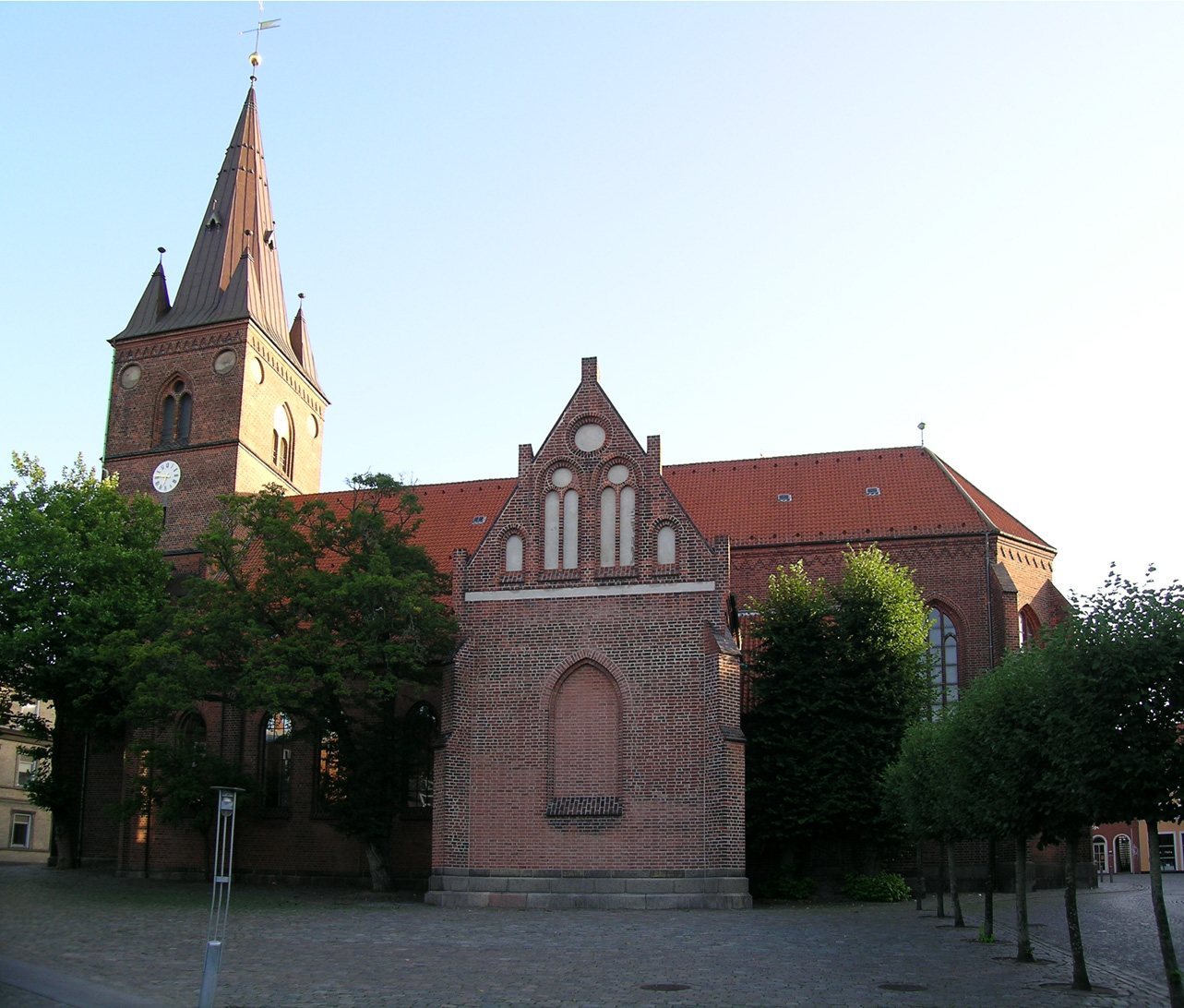
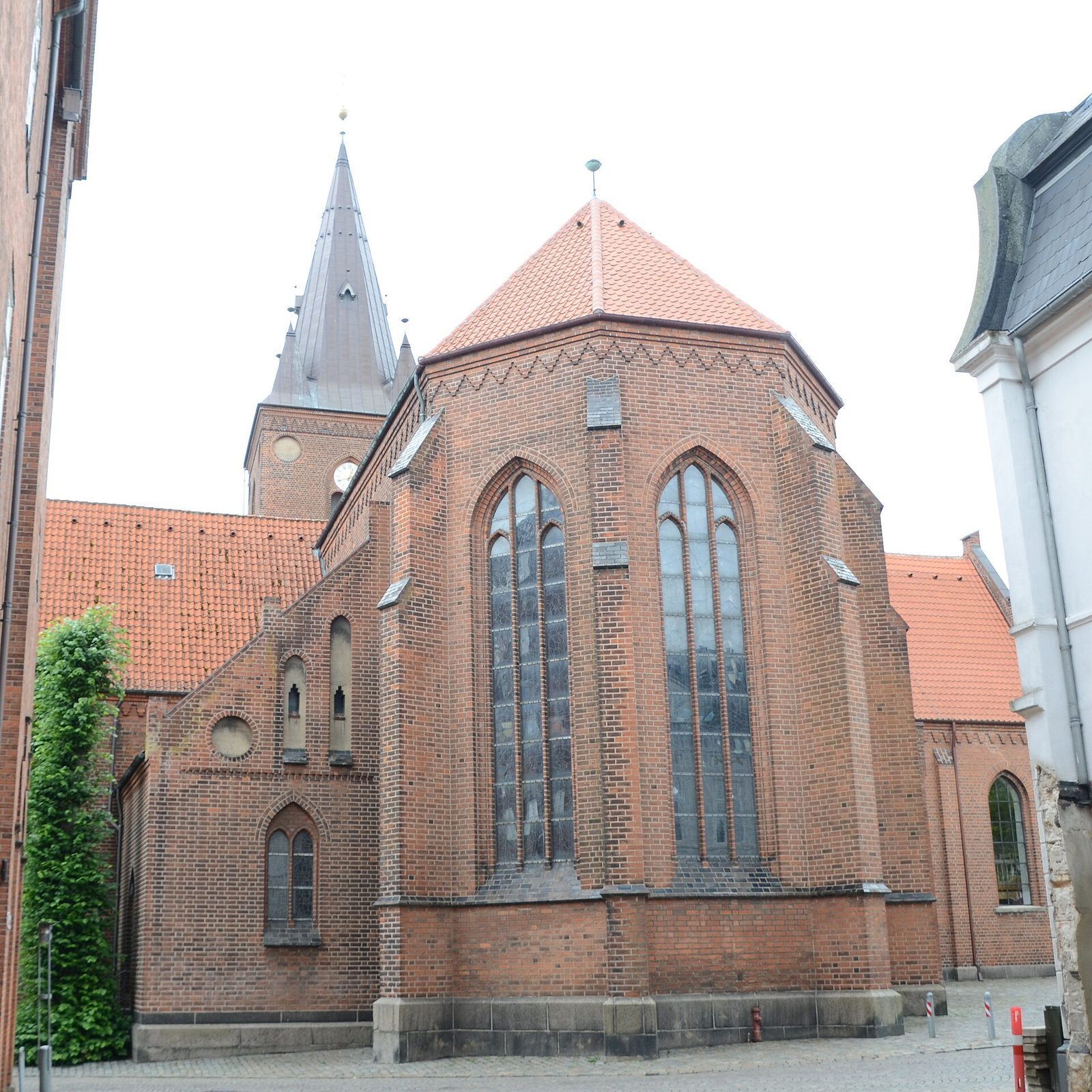
The church stands about 100 metres southwest of Koldinghus. Its red-brick, three-aisled plan has a broad central nave flanked by two narrower aisles, with crosswise arms, a choir, a tower, a sacristy, and a chapel. The exterior was once plastered; during the major rebuilding the plaster was removed and the walls were faced with red brick.
Nave and choir
The choir was originally smaller than its present form. It was rebuilt to the roof height, and the church’s windows were given pointed arches. Six large stained-glass windows were installed as part of the rebuilding. The former men’s and women’s entrances on the north and south sides were closed.
Transepts
The church’s crosswise arms are called transepts. The south transept may belong to the original church or may have been added later in the Middle Ages, possibly alongside a tower and sacristy. Once called St Anne’s Chapel, it probably contained an altar dedicated to Anne, traditionally regarded as the mother of Mary.
The north transept was added in 1575 as a private chapel for King Frederick II of Denmark and Norway. It also served as a place of prayer for him and Queen Sophie. A sandstone tablet on its west wall carries their coats of arms and a Latin inscription.
Tower
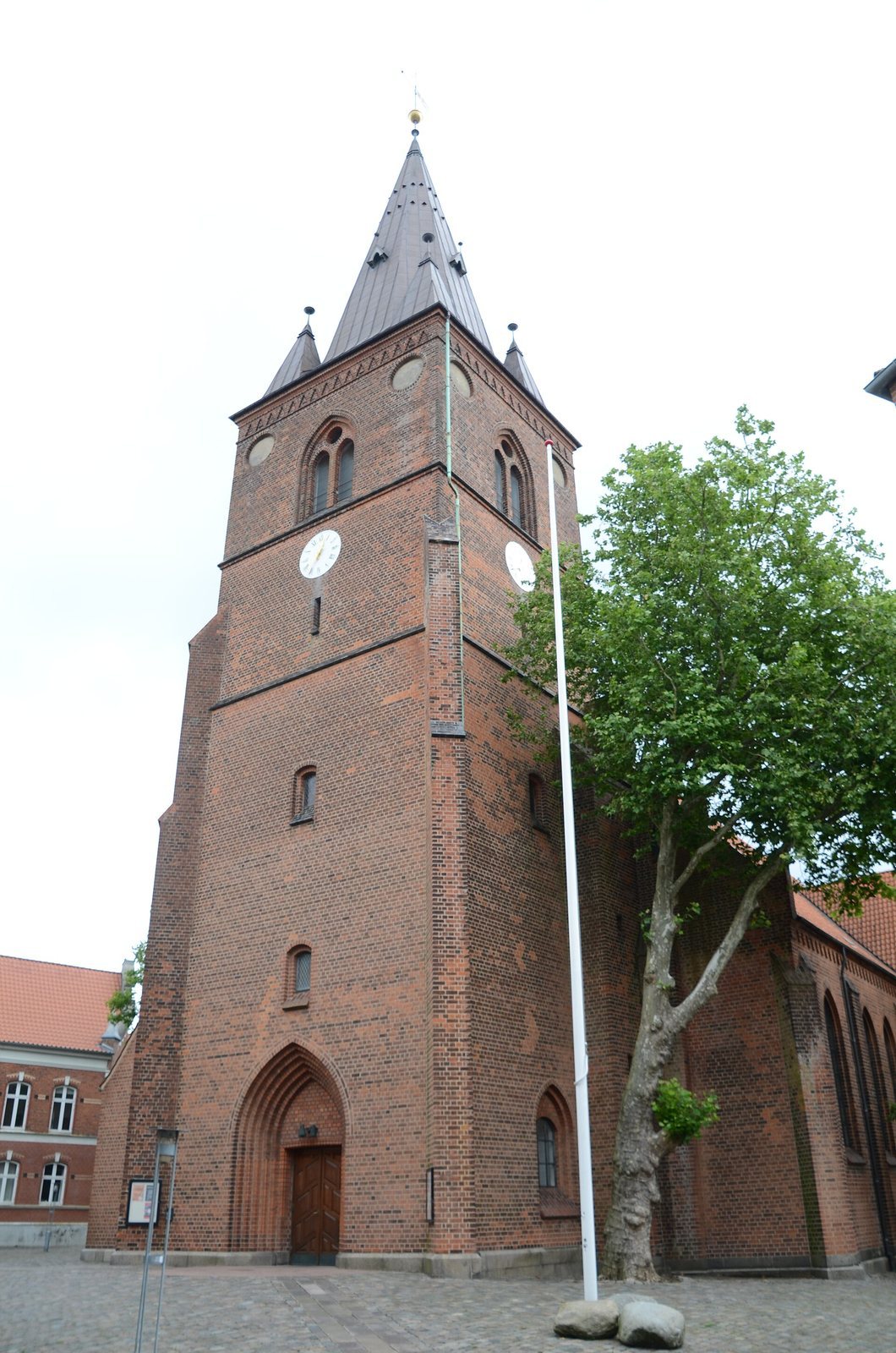
The tower was probably added in the late Middle Ages. Its entrance opens into the vestibule, or entrance hall. During the rebuilding, an earlier tower about 25 Danish ells high was replaced by one 46 ells high, topped by an octagonal copper spire 30 ells high and a 9-ell weathervane pole. The stated height of the tower is 53.3 metres.
Sacristy and chapel
A late-Gothic sacristy, a room used by clergy to prepare and store vestments and church vessels, stands north of the choir. The chapel is on its south side.
Furnishings
A sandstone plaque dated 1591 is fixed to the church’s north side. The altarpiece, donated by Caspar Markdanner, a royal official at Koldinghus, was made in 1589 and installed the following year. Markdanner also gave the church its pulpit and canopy in 1591. The pulpit is in the High Renaissance style, the mature phase of Renaissance art, and its panels bear his arms and monogram. Since 1858 it has stood north of the choir opening. The baptismal font was made in 1619 by Claus Lauritzen of Kolding. Its biblical figures and symbols include Luke and Mark, traditionally identified as authors of two New Testament Gospels.
Memorials and burial chapels
Graves and memorial tablets
The church contains graves, memorial tablets, and gravestones, including many burials beneath the floor. Many of the stones are badly worn, and their inscriptions are difficult to read. A memorial tablet erected in 1865 commemorates people killed in the Battle of Kolding.
Transept and choir memorials
Three memorial tablets to male members of the Anchersen family hang on the end wall of the south transept. They commemorate Ancher Anchersen (1644-1701), Mathias Anchersen (1682-1741), and Joachim Anchersen (1721-1785). On the north side of the choir, a 1595 memorial honors Caspar Markdanner’s 14-month-old son. It shows an angel holding an hourglass and an inverted torch, symbols of death.
Nave and vestibule epitaphs
An epitaph, a memorial inscription or monument, in the vestibule dates to about 1650. It depicts alderman and merchant Peder Udsen, his wife Dorthe Povelsdatter, and their eleven children, of whom only four were alive when the image was painted. A memorial on a central-nave column was painted in 1597 for Jens Søffrensøn’s 50th birthday. It records his successive roles as rector in Kolding, chaplain, parish priest, and dean.
Another column memorial depicts grain clerk Tyge Nielsøn, who worked at Koldinghus, his wife Maren Pedersdatter, and their children kneeling before the cross. The painting was made before Tyge’s death in 1607; Maren had died in 1594.
Family burial chapels
A small chapel in the northwest corner holds five coffins belonging to families of Chancery Councillor Roed and Mayor Riis, with an epitaph above them. In the southwest corner, another chapel holds the coffin of Claus Löwencrones, who died in 1676. Other members of his family, including his father Poul Beenfeldt, lie beneath the floor. An epitaph with portrait paintings hangs above the coffins.
Bells, clocks, and organ
Bells
The oldest bell, dating to about 1350, is known as the Swedish bell. It probably came to Kolding as Swedish war booty during the Kalmar War, a conflict between Denmark-Norway and Sweden in the early seventeenth century. Other bells include a storm bell from 1613, a prayer bell from 1615, a noon bell from 1840, and one donated in 1973 by the Saxildhus Charity Fund in memory of Jenny and Bertram Knudsen. A separate carillon of 48 bells was made in 1973 by the Dutch firm Petit & Fritsen.
Clocks
The tower’s first clockwork is mentioned in the 1630s and may be older. A clockwork from 1874 is preserved there. The current Bodet clockwork, supplied by Jermin Larsen during 1975-77, has black Roman numerals on white faces pointing north, south, and west.
Organ
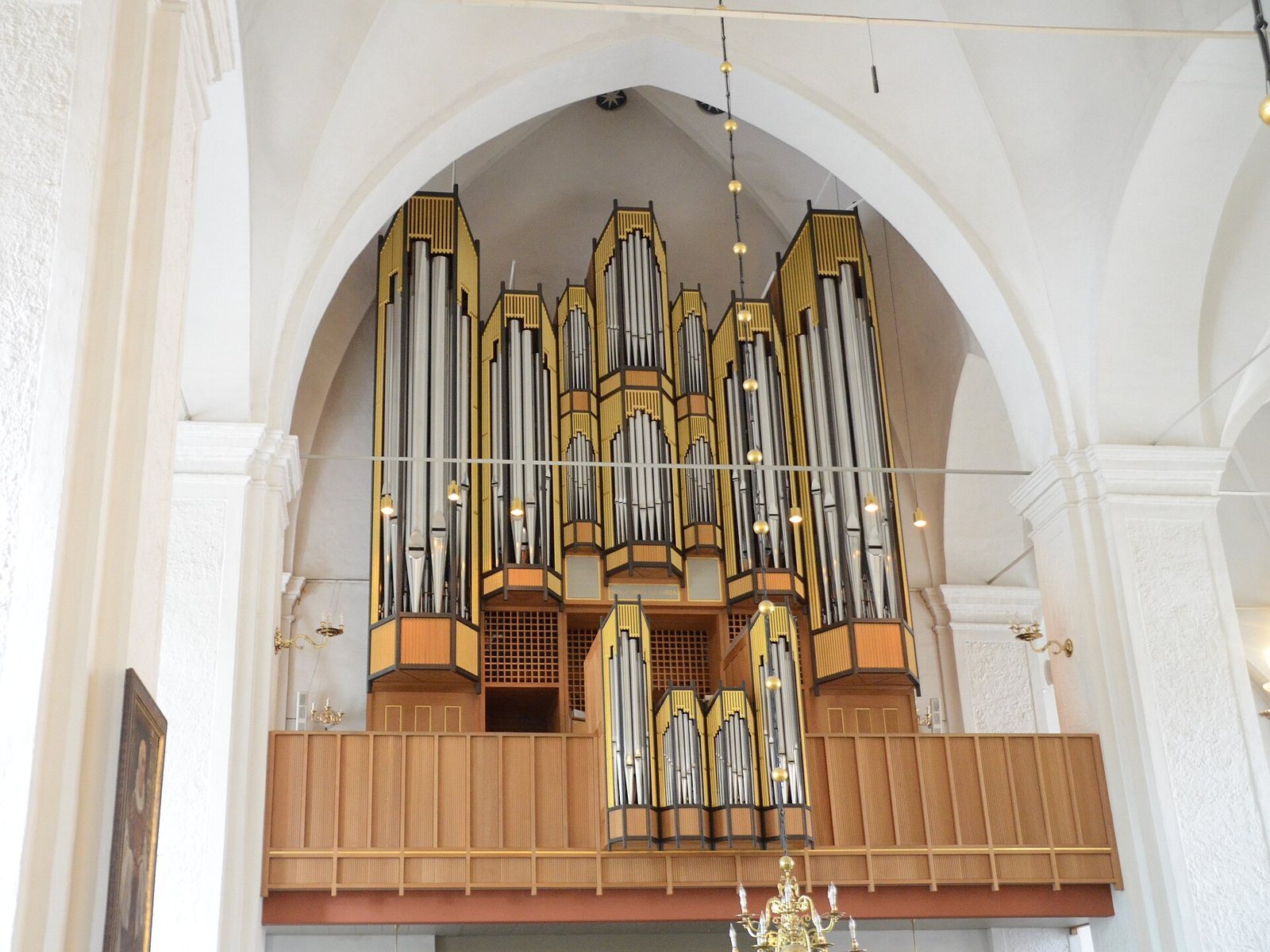
The church acquired its first organ in the sixteenth century. New organs were installed during restorations in the 1750s, in 1858, and in 1921. The current organ dates from 1977 and was made by Marcussen & Søn.
Former churchyard
The former churchyard is now a square surfaced with cobblestones and containing a few trees. Burial remains may still lie beneath it.