Stari Most: The Ottoman Stone Bridge in Mostar
Site at a Glance
- Country
- Bosnia and Herzegovina
- Primary era
- Early Modern
- Eras represented
- Early Modern, Modern
- Civilizations
- Ottoman
- Site type
- Infrastructure
- Remains
- Bridge
On this page9 sections
History
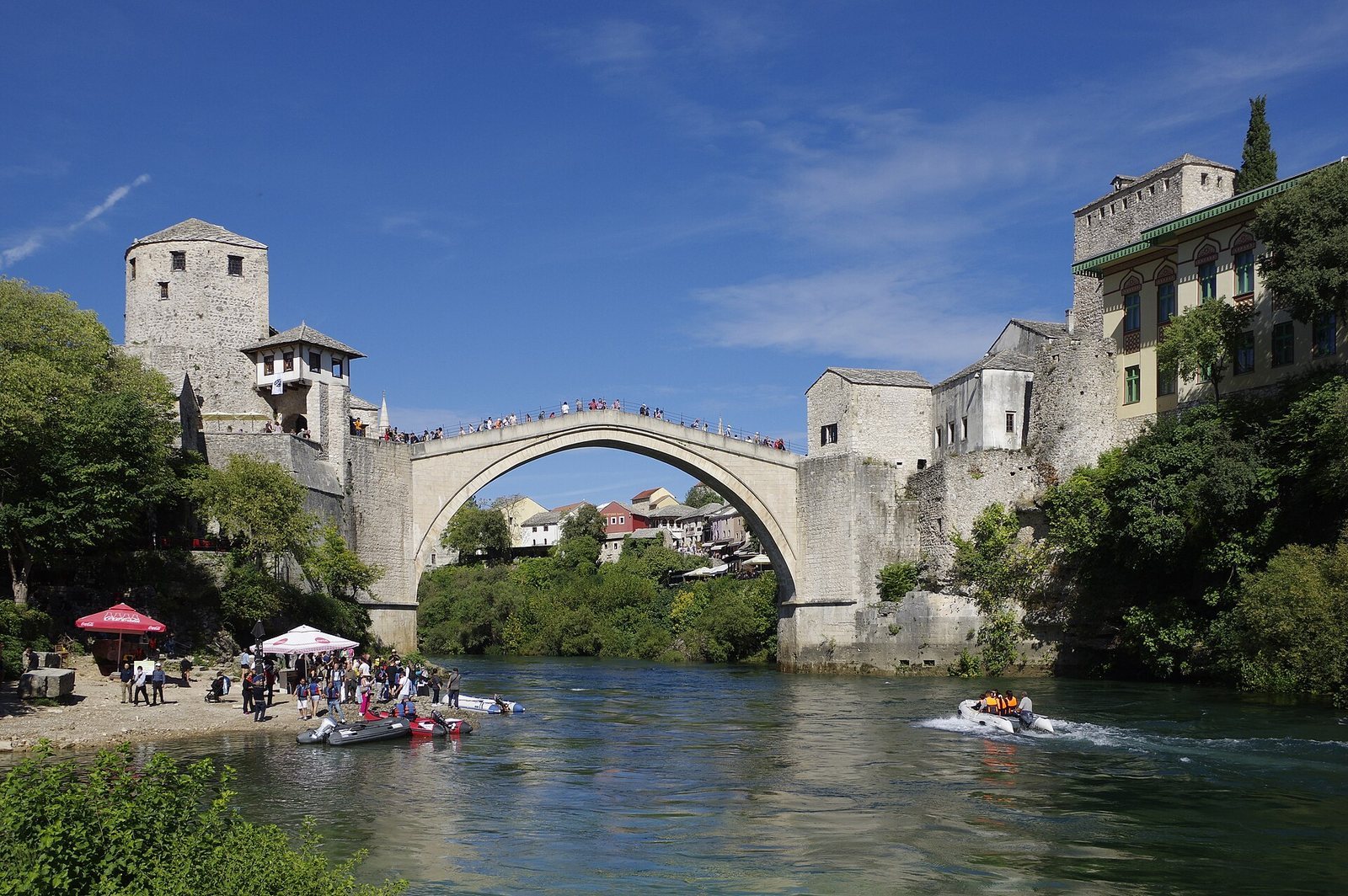
Stari Most is a 16th-century Ottoman stone arch bridge over the Neretva River in Mostar, Bosnia and Herzegovina. Commissioned in 1557 by Suleiman the Magnificent, it replaced an earlier wooden crossing and connected the city’s two sides.
From wooden crossing to Ottoman bridge
A wooden suspension bridge, probably built by Ottoman soldiers in 1463, crossed the river before Stari Most. It hung from chains and was considered unstable. As Mostar grew in economic and administrative importance under the Ottoman Empire, a state centered in Anatolia that ruled across southeastern Europe, western Asia, and North Africa, the military needed a more dependable crossing. The Ottoman geographer Katip Çelebi later described the wooden bridge as swaying so much that people crossed it in fear.
Suleiman the Magnificent, an Ottoman sultan whose reign lasted from 1520 to 1566, commissioned the stone bridge in 1557. Its designer was Mimar Hayruddin, an Ottoman architect and apprentice of Mimar Sinan, a leading Ottoman architect of the 16th century. Karagoz Mehmet Bey, Suleiman’s son-in-law, supervised the work. Construction lasted nine years. An inscription dates completion to AH 974, a year in the Islamic calendar spanning 19 July 1566 to 7 July 1567.
The project was said to cost 300,000 silver coins, raised through an extraordinary regional tax paid by Christian peasants rather than from state funds. Some materials came from Istanbul, while stoneworkers arrived from different parts of the Balkans and used varied building methods. Two towers were built alongside the bridge. Local tradition says Hayruddin tested his design first on nearby Kriva Ćuprija, a smaller bridge. Other stories say egg whites were mixed into the mortar and that Hayruddin prepared for his funeral, fearing the bridge would collapse when its scaffolding came down. At its completion, the bridge was said to have the world’s widest human-made arch.
Use and alterations
Stari Most was sometimes called Suleiman’s Bridge or the Turkish Bridge. The name Roman Bridge was also used, reportedly because it resembled nearby bridges from the Roman period, although Stari Most itself dates to Ottoman rule. Bridge keepers, called mostari, guarded it during that period, and their title is associated with the name Mostar. The bridge linked the city’s two sides and was also described as separating its Muslim and Croat quarters. The 17th-century traveler Evliya Çelebi praised its rainbow-like arch between the cliffs and its height among the bridges he had seen.
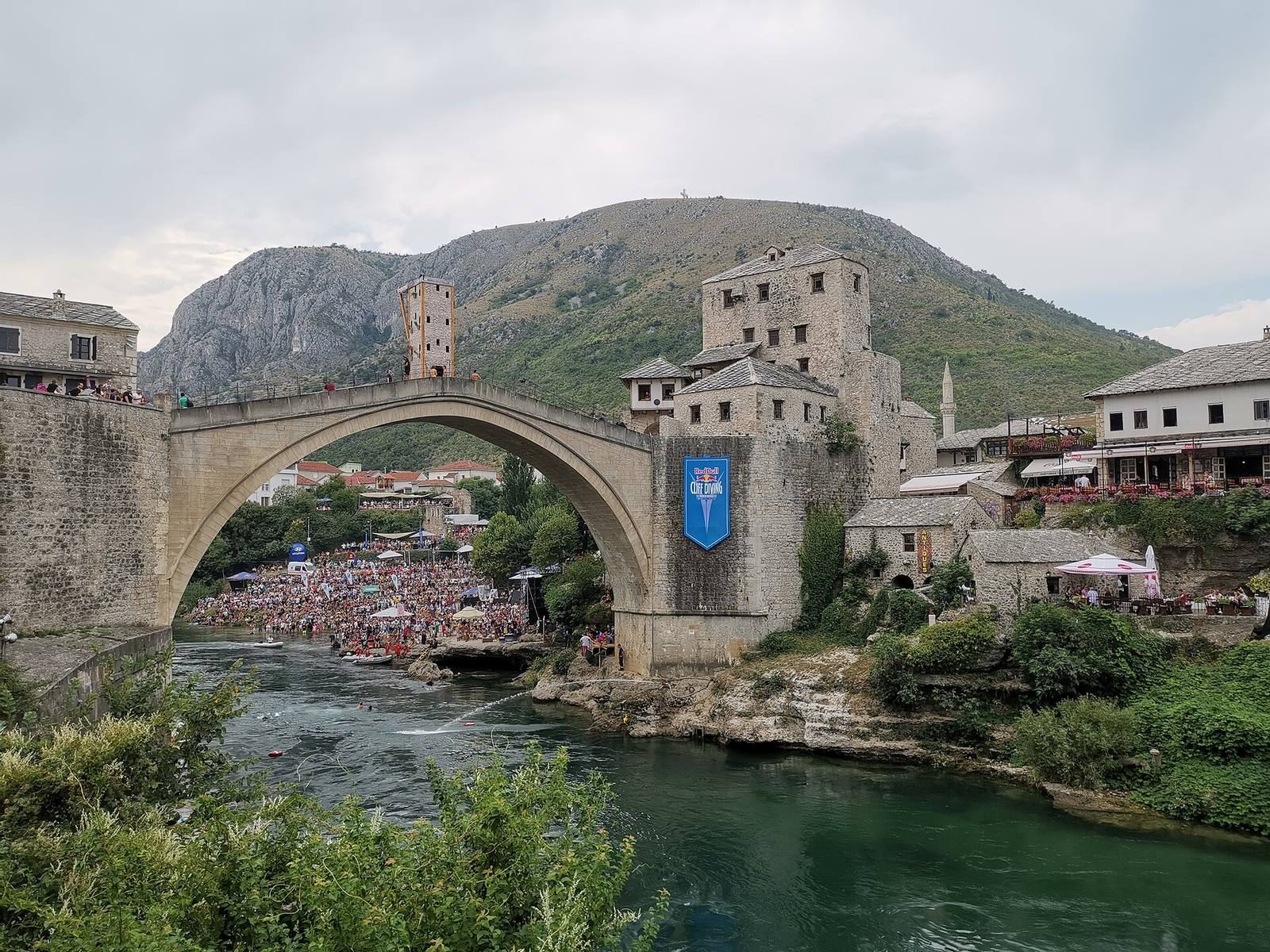
A substantial reconstruction took place in 1737. In 1854, a higher railing was installed after people had frequently fallen into the river because the original barrier was low. A leap from the bridge is recorded as early as 1664, and a formal annual diving competition began in 1968. Traditionally, young men from Mostar make the risky jump into the cold Neretva in midsummer, usually in late July, a feat requiring skill and training. The bridge is also depicted on the flags of Mostar and the Herzegovina-Neretva Canton.
War and destruction
During the Bosnian War (1992–1995), a conflict in Bosnia and Herzegovina, Stari Most became, for a time, the only link between the two parts of Mostar after other bridges were destroyed. It came under repeated shelling, and a temporary protective structure was erected above it for people crossing. During the Croat–Bosniak conflict between Croat and Bosniak forces, the Army of the Republic of Bosnia and Herzegovina (ARBiH) used the bridge to supply Bosniaks on the besieged western bank.
An attempt to destroy the bridge was made on 8 November 1993. It collapsed the next day after shelling by the Croatian Defence Council (HVO). HVO commander Slobodan Praljak ordered its destruction; two tank shots, fired about a minute apart, brought it down. More than 60 shells may have struck it before the collapse. Praljak later claimed that a remotely detonated charge or mine beneath the bridge contributed to its fall, a claim most historians reject. Wartime Croatian media blamed the ARBiH, while scholars argued that the bridge had little military value and that its destruction deliberately attacked shared cultural heritage. Historian András Riedlmayer described the demolition as “killing memory,” a phrase for the destruction of heritage as an assault on shared historical memory.
Proceedings at the International Criminal Tribunal for the former Yugoslavia (ICTY) examined the bridge’s military use and destruction. The 2013 trial judgment treated it as a military target but found its destruction disproportionate. Praljak and Milivoj Petković were convicted in the broader ICTY case. A video released on 6 April 2023 shows the trajectories of more than 50 projectiles fired at the bridge by an HVO tank; voices identified as HVO soldiers can be heard cheering as the projectiles hit.
Temporary crossing and reconstruction
Spanish military engineers serving with UNPROFOR built a temporary bridge at the site in three days. It was upgraded three times, eventually providing a more secure cable-stayed crossing, supported by cables linked directly to towers, until the permanent bridge was rebuilt.
After the war, the World Bank, UNESCO, the Aga Khan Trust for Culture, and the World Monuments Fund formed a coalition to oversee the reconstruction of Stari Most and Mostar’s historic centre. Support also came from Italy, the Netherlands, Turkey, Croatia, the Council of Europe Development Bank, and the government of Bosnia and Herzegovina. UNESCO established an international expert committee in October 1998, and the reconstruction began on 7 June 2001. The plan was to reproduce the original as closely as possible with its materials and building methods. Hungarian army engineers recovered material from the river, and Spanish engineers removed the temporary bridge. A consortium led by the Turkish construction company Er-Bu rebuilt Stari Most using Ottoman techniques.
Bosnia and Herzegovina designated the bridge a Category 0 cultural property in 2004. In 2005 it became part of the UNESCO World Heritage Site “Old Bridge Area of the Old City of Mostar.”
Remains
Stari Most is a single-span, hump-backed stone arch spanning the Neretva in Mostar’s old town. The bridge is about 30 metres long and 4 metres wide, and rises roughly 24 metres above the river. Its surviving form includes the arch, supporting structures, associated towers, and a stairway leading onto the bridge.
Arch and deck
The arch rises about 12 metres. At its centre, the bridge stands about 3.45 metres above one side and 3.15 metres above the other. A moulding 0.32 metres high marks where the arch begins. Clearance beneath the bridge is about 20 metres at mid-span and varies with the river level. Irregularities in the arch’s inner curve have been attributed to deformation. More than 450 stone blocks were used in the original construction, with stone, limestone, and marble among the materials identified.
Supports and masonry
The bridge rests on limestone abutments, supports at its ends, joined to side walls that run along the riverside cliffs. Measured from a summer water level of 40.05 metres, the abutments rise 6.53 metres before the arch begins. Their thickness varies, with upper and lower measurements of 1.89 metres and 1.25 metres. The rebuilt bridge uses fine-grained local limestone called Tenelia. A small number of stones recovered from the original structure were incorporated into it; most recovered stones were too damaged to reuse.
Towers and access
Two fortified towers are associated with the bridge. Halebija stands to the northeast and Tara to the southwest; both were built to protect the crossing. A stairway provides access to the bridge.