St. Peter: A Medieval Roman Catholic Church and Former Benedictine Monastery in Germany


Site at a Glance
- Rating
- 4.7
- Popularity
- Low
- Country
- Germany
- Primary era
- Medieval
- External website
- Open
- Eras represented
- Medieval
- Civilizations
- Carolingian, Holy Roman Empire
- Site type
- Religious
- Remains
- Church
On this page9 sections
History
St. Peter is a Roman Catholic medieval church in Petersberg, Germany, founded within the Benedictine monastic community associated with Fulda during the Carolingian period of the eighth and ninth centuries. Its construction developed in the 830s, and the church became an important religious center through its connection with Saint Lioba and the former monastery on Petersberg.
Foundation and dedication
A first church was probably built under Baugulf, abbot of Fulda, at the turn of the eighth and ninth centuries. Timber used in the construction has been dated to 834–835. During the 830s, Rabanus Maurus, the abbot of Fulda and later archbishop of Mainz, commissioned a three-nave basilica and established a Benedictine monastery near the monastery of Fulda. The church was dedicated to Saint Peter on 28 September in 836, 837, or 838.
For the dedication, Rabanus Maurus transferred the remains of Saint Lioba to the church crypt from the collegiate church of Fulda. A collegiate church is served by a community of clergy organized as a chapter. Lioba, an eighth-century Anglo-Saxon Benedictine missionary and religious leader associated with the Christianization of the Frankish lands, gave the church its later popular name, the Lioba Church.
Damage, parish use, and later history
The Petersberg complex was destroyed and burned during a Hungarian raid in 915. Haicho, abbot of Fulda, restored the damaged buildings. Further destruction or damage affected the church in 1327–1331, during the German Peasants’ War, and during the Thirty Years’ War, the seventeenth-century conflict that caused widespread devastation across much of Central Europe.
In 1298, an independent parish was formed at Petersberg from parts of the large parish of Margretenhaun. The former monastery church then also served as the parish church, while its landed property formed the Petersberg provostry, an ecclesiastical district administered by a provost. The date when Lioba’s remains were returned to the collegiate church of Fulda is unknown, but the association with her continued to shape the church’s religious life.
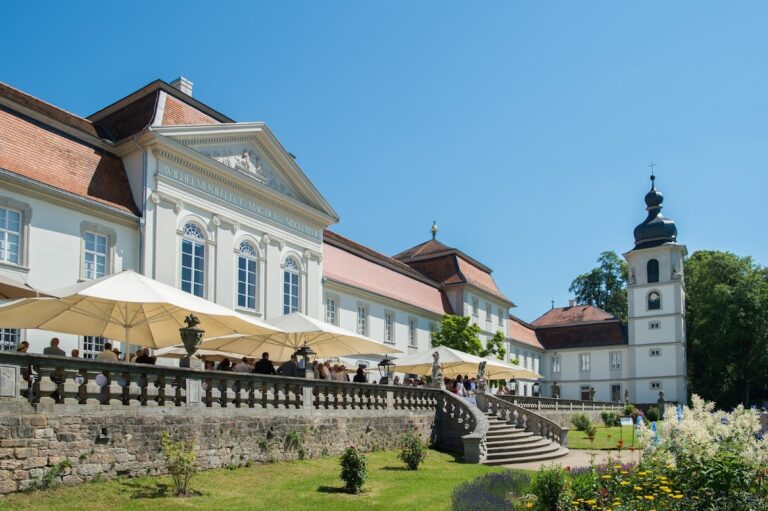
The monastery was dissolved in 1802 during secularization, when ecclesiastical institutions and their property were transferred to secular authority. Only the orangery survived from the old monastery buildings. The parish continued, although the Rabanus Maurus Church became its principal church in 1957, while St. Peter remained a parish church.
Restoration and renewed Benedictine presence
Baroque modernization of the interior was partly reversed through restoration campaigns in 1889, 1907, 1930, 1954, 1974, and from 2002 to 2007. In September 2007, the Cella St. Lioba was founded on the remains of the former orangery as a new settlement of the Benedictine Sisters of Saint Lioba. Its foundation commemorated the 1,225th anniversary of Lioba’s death.
Remains
Hilltop setting and Carolingian structure
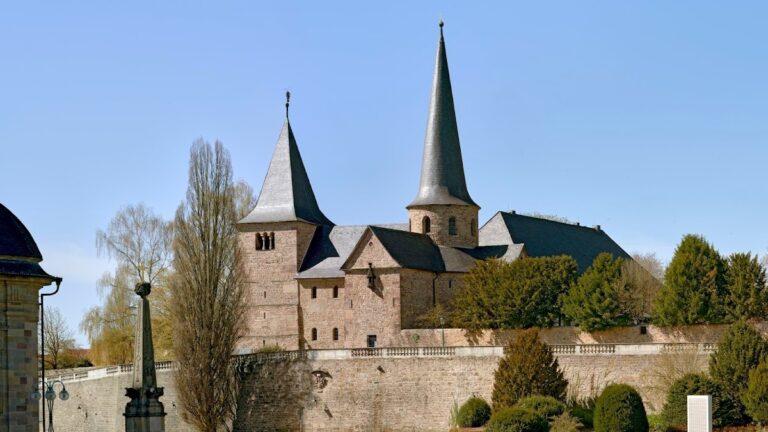
The church stands on isolated Petersberg, a basalt hill in the center of the municipality of Petersberg near Fulda. Its exposed position provides broad views across the Fulda basin, the Fulda River, Fulda, Petersberg, Künzell, surrounding settlements, the western foothills of the Rhön, and the Hessian Kuppenrhön.
Substantial sections of Carolingian-period masonry survive in the three-part choir, the crossing, and the three-part crypt. The Carolingian period was the era of the Frankish dynasty established by Charlemagne and his successors. St. Peter’s vaults are among the oldest surviving above-ground church vaults in Germany, preserving an early stage in the development of monumental medieval church construction.
Crypt and Lioba memorials
The crypt contains three apses, each with its own altar. Behind the central altar is Saint Lioba’s empty stone sarcophagus. The sarcophagus became associated with expected miraculous cures and was later known popularly as the “Scream Stone.” Until the practice was prohibited in 1915, mothers placed the clothing of sick children, and for a short time the children themselves, inside the cold, dark sarcophagus while seeking Lioba’s intercession and healing.
Lioba’s skull reliquary was returned to the crypt in 1995. Both the reliquary and the lid of the sarcophagus, dated to 836, were made by Lioba Munz, a Benedictine nun of Fulda. A Baroque wall painting in the crypt depicts the healing ritual connected with the empty sarcophagus.
Nave, towers, and roofs
The original church had three naves. In 1479, its Romanesque nave was replaced by a single-nave Late Gothic hall. Romanesque architecture is characterized by massive masonry, rounded arches, and substantial towers, while Late Gothic describes the later medieval phase of Gothic building. The church now has six independent roofs, including the oldest roofs over the church hall, sacristy, and side choir, which date from 1478–1480.
The choir tower and western bell tower are Romanesque elements of the surviving building. Together with the Carolingian choir, crossing, and crypt, they reflect the church’s accumulated structural history from the early medieval foundation through its later medieval rebuilding.
Paintings, sculpture, tomb, and organ
Construction-period wall paintings survive within the church and are described as the oldest surviving wall paintings in Germany. Eight Romanesque stone reliefs from the second half of the twelfth century are also preserved. The tomb and grave slab of Apollo von Vilbel, a Fulda chronicler and former provost of Petersberg who later became abbot of Limburg Abbey in the Palatinate, commemorate his death in 1536.
The church organ was built in 1895 by Wilhelm Sauer of Frankfurt an der Oder as opus 523. It has mechanical cone-chest action, a pedal coupler, a manual coupler, and a collective pedal operated by foot controls.