Alte Heilig-Geist-Kirche: Former Parish Church of Pullach im Isartal


Site at a Glance
- Rating
- 4.6
- Popularity
- Very Low
- Country
- Germany
- Primary era
- Medieval
- External website
- Open
- Eras represented
- Medieval, Early Modern, Modern
- Civilizations
- Duchy of Bavaria, Holy Roman Empire
- Site type
- Religious
- Remains
- Church
On this page21 sections
History
The Alte Heilig-Geist-Kirche is the former Roman Catholic parish church of Pullach im Isartal, Germany, built in the late fifteenth century in the Late Gothic style. It stands within the historic center above the western bank of the Isar Valley. The present building replaced an earlier church, and its history reflects the changing religious administration, patronage, and growth of the community.
Earlier church and medieval dedication
The earliest written reference to a church at Pullach appears in the Freising diocesan registers of 1315. At that time, Pullach was a filial church of Sendling-Thalkirchen, meaning that it remained dependent on that larger parish for pastoral care. Sendling-Thalkirchen belonged to the Munich deanery, and its six filial churches served settlements along the western bank of the Isar between Pullach and Schwabing. Pullach had around 200 inhabitants and continued to receive pastoral care from Sendling for centuries.
The lower part of the present tower contains older ashlar masonry, and fifteenth-century records mention purchases, gifts, and endowed Masses connected with an earlier building. These details establish that a predecessor stood on the site before the present church, although its construction date is unknown. The church may originally have been dedicated to Saint Stephen. An annual Stephaniritt, a religious riding procession associated with Saint Stephen, continued until 1828, and the church was still occasionally called Saint Stephen’s Church in the eighteenth century.
A frequently repeated claim connects Pullach with a Carolingian baptismal church mentioned in 804. Specialist scholarship does not accept this identification, because the record refers to a place called Pohloc in Forstern rather than to Pullach. The dedication probably changed from Saint Stephen to the Holy Spirit during the period of the Lords of Baierbrunn, a medieval noble family associated with property in the Pullach area. Their line ended in 1333. The family venerated the Holy Spirit, supported the Heilig-Geist Hospital in Munich, and still possessed property at Pullach at that time.
Benefice and late-medieval patronage
In 1472, the cleric Lienhart Sewer established a benefice for Pullach. A benefice was an endowed ecclesiastical office whose revenues supported the appointed cleric and helped provide for the upkeep of the church. Sewer held the Pötschner benefice at the Saint Anna altar in Munich’s Peterskirche. He reserved the right to nominate the holder of the Pullach benefice and directed that the Munich city council should exercise this right after his death.
The Wittelsbachs, the ruling dynasty of Bavaria, were landlords in Pullach. From 1488, control of the church’s finances belonged to the Wittelsbach territorial ruler. A ducal coat of arms inside the church may be associated with a donation authorized by a prince in 1472. Duke Sigismund has been proposed as a donor and as a possible adviser on the building’s construction and furnishings, but this attribution remains uncertain.
Balthasar Pötschner was another donor connected with the church. His family belonged to Munich’s wealthy urban patriciate and had built its wealth and status through the salt trade. An expenditure book from 1469 records his purchase of a window and a heraldic shield for the Holy Spirit Church at Pullach. Families including the Barth, Ridler, Schrenk, and Schluder patrician households may also have contributed to the construction and decoration. The farming community, then numbering about 250 people, supported the work through payments in produce and money as well as labor services owed to the landlords.
The Munich coat of arms inside the church represents the city and its council, which was to receive the right of presentation to the Pullach benefice after Sewer’s death. In later centuries, the right to appoint the benefice holder was exercised alternately by the territorial ruler, represented by the Bavarian king in the nineteenth century, and by the Munich city magistrate.
Parish development and later changes
The church survived the Thirty Years’ War, although farmsteads around it were destroyed. Repairs in the seventeenth and eighteenth centuries introduced Baroque elements. During the nineteenth century, a regothicization, meaning a restoration that reintroduced or imitated Gothic forms, brought the building and its furnishings closer to a Gothic appearance. The parish priest Franziskus Festing, who served from 1884 to 1890, led this effort with support from the Munich architect Gabriel von Seidl and private donors. Missing components were supplemented in the Neo-Gothic style.
In 1875, the growing population of Sendling led to the separation of the southern part of the parish, and Pullach’s Heilig Geist became an independent parish. Its associated churches and chapels included Saint John the Baptist in Solln, the Trinity Chapel in Großhesselohe, the Mary Chapel in Höllriegelskreuth, the chapel of Schwaneck Castle, and the Ignatius Chapel in Warnberg.
Solln became an independent parish in 1920. By then, the old village church at Pullach was too small for the community, which planned a new parish church. Before the new building was completed, services were transferred to the chapel of Berchmans College. The new Heilig Geist parish church was inaugurated in 1956. The old church then became a subsidiary church and continued as a place of spiritual life for successive generations.
The church is dedicated to the Holy Spirit, the third person of the Christian Trinity, and celebrates Pentecost as its patronal feast. Pentecost commemorates the descent of the Holy Spirit upon the Apostles. The Alte Heilig-Geist-Kirche is listed as a protected monument in the Bavarian monument register.
Remains
Setting and exterior
The church occupies a high position on the steep western bank of the Isar Valley and forms part of Pullach’s historic center. A small disused cemetery surrounds it, with wrought-iron grave and memorial crosses. The cemetery wall also forms part of the surviving setting and provides views across the valley and, in clear weather, toward the mountains.
The late-fifteenth-century building has a rectangular nave under a gabled roof. At the eastern end, the roof becomes hipped over the three-sided, closed choir. A square tower occupies the southwest corner, where it is incorporated into the west facade and the western bay of the nave. Four triangular gables support an octagonal pointed spire, which is topped by a Baroque onion dome with a cross and orb. This unusual tower profile and its dome are regarded as a landmark of Pullach.
Crucifixion group and later additions
A monumental Early Gothic Crucifixion group with Mary and John is attached to the south side of the tower. The church’s later additions include the sacristy on the south side and a small western vestibule. The vestibule has a gabled roof and a wooden ceiling decorated with floral painting. A prayer by Niklaus von Flüe, a fifteenth-century Swiss religious figure, frames the decoration. Nineteenth-century double-leaf wooden entrance doors are reinforced with iron bands.
Interior architecture
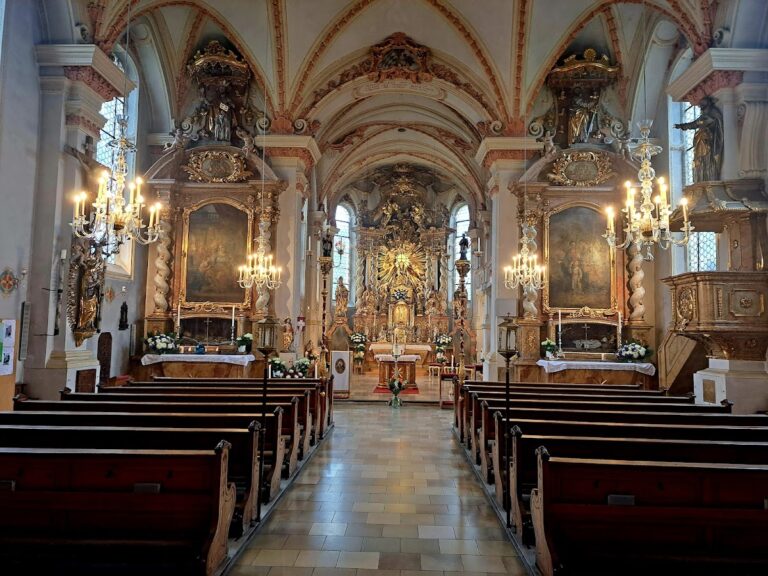
Entry leads beneath the organ gallery, positioned north of the tower, and through a wrought-iron grille into the main interior. The sanctuary is deep, has a five-eighths termination, and is as wide as the nave. A five-eighths termination is a polygonal choir end formed from five sides of an imagined eight-sided figure. Seven pointed-arch windows with simple tracery illuminate the space, while low-set star vaults cover the altar and congregational areas. Transverse arches divide the vaulting into three bays, and painted ribs rise between the windows from buttresses and corbels.
Vaults and principal altar
Vault bosses and heraldry
Painted reliefs on the vault bosses include the Throne of Mercy, an image of God the Father presenting or supporting the crucified Christ, often with the Holy Spirit shown as a dove. Three heraldic images accompany it. They include the lozenged and quartered arms of Bavaria-Munich and the Counts Palatine of the Rhine, the Pötschner arms with a salt vessel on a three-peaked mount, and the Munich arms with the Munich Child, the monk-like figure in the city’s coat of arms. The Munich Child resembles the coat of arms carved by Erasmus Grasser in 1477 for the vault of Munich’s Old Town Hall.
Pentecost altarpiece
The main altar contains a painted carved representation of Pentecost, with Mary among the Apostles as the first Christian community. The work dates to around 1480 and has been associated with Erasmus Grasser or his circle. More recent studies have attributed it to Jörg Schnitzer, identified as Grasser’s second associate. Beneath the scene, the predella, the lower section beneath an altarpiece, contains a panel showing Christ’s Veil of Veronica. This extra-biblical image type had been used in Christian art since the twelfth century, and the panel dates from around 1500.
Stained glass behind the altar
The central upper window behind the main altar contains a stained-glass image of the Throne of Mercy and the risen Christ. It dates from around 1470 and may be connected with Balthasar Pötschner’s 1469 expenditure entry for a window. The altar superstructure almost conceals the glass, while the surviving image remains part of the sanctuary’s late-medieval decoration.
Sanctuary sculptures and nave paintings
Resurrection images
Two representations of the risen Christ in the sanctuary date from the beginning of the sixteenth century. On the left, a painted wooden sculpture shows Christ standing with a victory banner. He displays the wounds of the Passion and raises his right hand in blessing. The group on the right presents Christ as a half-figure with Mary and three angels. Crowned with thorns as the Man of Sorrows, he points to the wound in his side. This image of Christ as a wounded healer is popularly known as the Merciful Savior.
Scenes of Saint Stephen and Saint Vitus
Paintings on the south wall of the nave depict the martyrdoms of Saint Stephen and Saint Vitus in several scenes combined within simultaneous compositions. One panel bears the date 1489, and the paintings came from the workshop of Jan Polack, a prominent Late Gothic painter active in Bavaria. They probably belonged originally to side altars dedicated to the church’s secondary patrons, Stephen and Vitus.
North-wall crucifix
A large crucifix from the sixteenth century is mounted on the north wall of the nave. The figure of the Mater Dolorosa, a devotional representation of Mary mourning Christ, stands in front of it.
Side altars and later furnishings
Right side altar
The right side altar contains a painted wooden Christ represented as the Salvator mundi, or Savior of the World. Christ bears the wounds of the Passion, wears a draped outer garment and tunic, blesses with his right hand, and holds a globe topped by a cross in his left.
Left side altar
The superstructure of the left side altar contains Saint Vitus holding a vessel with a flame and Saint Stephen holding stones. Its shrine presents the Coronation of Mary by God the Father and God the Son. The predella contains a Lamentation of Christ, with Christ supported by Mary and accompanied by John and Mary Magdalene, who holds an ointment vessel. These works date from around 1500.
Baroque Marian figure and Neo-Gothic renewal
A statue of Mary wearing a crown and holding a scepter, with the blessing Child, stands on the south wall of the nave. It is based on the Madonna on Munich’s Marian Column and probably survived from the church’s Baroque furnishings. During the regothicization at the end of the nineteenth century, the shrine and superstructure of the main and side altars were renewed in the Neo-Gothic style, along with almost all of the stained-glass windows.
Organ
The organ is itself listed as a protected monument. Franz Borgias Maerz of Munich built it in 1902 as opus 416. It has six stops, one manual, and a pedal, preserving a later musical element within the historic church.
Nearby sites