St. Nicholas Fortress: A Venetian Maritime Fortress in Croatia


Site at a Glance
- Rating
- 4.6
- Popularity
- Medium
- Country
- Croatia
- Primary era
- Early Modern
- External website
- Open
- Eras represented
- Early Modern
- Civilizations
- Venetian
- Site type
- Military
- Remains
- Fort
On this page10 sections
History
St. Nicholas Fortress is a Venetian maritime fortress in Croatia, positioned near Šibenik at the entrance to the St. Anthony Channel. Built between 1540 and 1547 in the Renaissance period, it was designed to protect the city’s harbor from Ottoman naval incursions and to deter hostile ships from reaching the port.
Venetian-Ottoman frontier
The fortress took its name from a Benedictine monastery of St. Nicholas that once stood on Ljuljevac Island. The monastery was demolished for the new defensive work, while its church was replaced by a chapel within the fortress. The island occupied a crucial position on the maritime approach to Šibenik and its harbor.
The political circumstances were shaped by the Ottoman capture of Scardona in 1522. That conquest provided the Ottomans with a useful base for maritime communications and trade, increasing pressure on Venetian possessions along the Adriatic coast. The Republic of Venice, a maritime state dependent on fortified ports and controlled sea routes, responded by strengthening the entrance to Šibenik.
The first proposal for a fortress on Ljuljevac dates from 1524. On 30 April 1525, Venetian captain Aloisio De Canal decided, at the request of Šibenik’s inhabitants, to build a fort that would prevent Ottoman ships from entering the port. Before this project, two medieval towers stood on opposite sides of the channel. An iron-bladed chain could be stretched between them to block unauthorized vessels, but both towers were later demolished as the new defenses were established.
Construction and Venetian command
Construction began in 1540 after the Venetian military engineer and architect Michele Sanmicheli and his nephew Giangirolamo Sanmicheli arrived in Dalmatia. Giangirolamo laid the foundations and designed the defensive system, which was completed in 1547. The work formed part of Šibenik’s wider defensive network, alongside the land fortifications of St. Michael, St. John, and Barone.
The fortress was armed and garrisoned from its early years. Its first castellano, the military governor of a fortress, was appointed in 1546. In 1553, the garrison comprised 25 soldiers and five artillerymen, selected from the Venetian nobility for two-year terms. They were forbidden to leave the fortress under threat of the death penalty.
Although the castellano held the military rank of captain, the garrison’s duties had a largely political character. St. Nicholas Fortress was meant not only to engage an attacker but also to discourage attack through its height, mass, and imposing appearance. Its military capabilities were never tested in a defensive battle. The only recorded attempted attack came from a Spanish ship near Zlarin. Its cannonball fell a few metres short after the wooden gun platform supporting the fortress’s artillery disintegrated.
Later military history and preservation
Over the centuries, the fortress served different armies and was repeatedly altered as military technology changed. It was withdrawn from military use in 1979, when the Yugoslav People’s Army abandoned it. Reconstruction and renovation followed, including a two-year restoration campaign that helped secure the surviving structure.
In 2017, St. Nicholas Fortress became part of the transnational UNESCO World Heritage property Venetian Works of Defence between the 16th and 17th Centuries: Stato da Terra – Western Stato da Mar. UNESCO World Heritage status recognizes cultural properties judged to have outstanding universal value under the World Heritage Convention. The fortress is also included in Croatia’s Register of Cultural Goods.
Remains
The fortress occupies most of Ljuljevac Island and follows a ridge that partly uses the island’s exposed bedrock. It faces the entrance to the St. Anthony Channel and the maritime approach to Šibenik. Its Renaissance plan is triangular, with three defensive bastions at the front. The shape may have been dictated by the island’s form and limited space, while also offering an economical and relatively quick construction.
Triangular fortification
St. Nicholas Fortress is distinctive for its triangular arrangement and its lack of forward towers. Triangular fortifications were rare in Croatia and Europe. The walls, bastions, and circular rear section rise as a single massive structure, giving the fortress the strongly unified form intended to deter hostile ships.
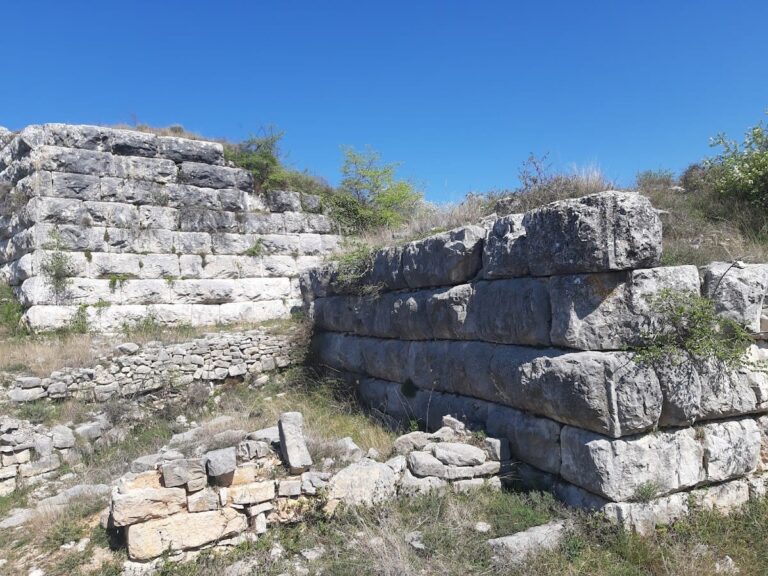
The lower portions, including the foundations and the sections below and immediately above sea level, are made of stone or limestone. The upper walls were built of brick, an unusual and innovative choice for Dalmatian fortifications at the time. Brick was regarded as more resilient and elastic under cannon fire, and as better able to absorb the impact of explosive projectiles than some alternative materials.
Rear defenses and chapel
Hornwork
At the rear is a hornwork, an exterior defense with projecting arms, also described as a tenaille, an angular or pincer-shaped work. This arrangement is considered the earliest known example of the feature in Venetian military architecture. It extends the defensive system beyond the main triangular body of the fortress.
Chapel and circular section
The circular section, which Michele Sanmicheli called the torion, forms a small square containing the chapel. The chapel occupies the northwestern corner of the fortress terrace and probably stands on the site of the former monastery church that gave the fortress its name.
Artillery installations
The fortress was equipped with 32 cannons. Its artillery stood on wooden platforms, including the platform that broke apart during the attempted Spanish attack. The surviving combination of heavy masonry, brick upper works, bastions, and artillery positions makes St. Nicholas Fortress one of the most valuable and best-preserved examples of Renaissance military architecture in Dalmatia, alongside the Venetian fortifications of Zadar.
Nearby sites