Saint Elisabeth Fortress: A Russian Imperial Frontier Stronghold in Ukraine


Site at a Glance
- Rating
- 4.4
- Popularity
- Low
- Country
- Ukraine
- Primary era
- Early Modern
- Eras represented
- Early Modern, Modern
- Civilizations
- Russian
- Site type
- Military
- Remains
- Fort
On this page17 sections
History
Saint Elisabeth Fortress is an eighteenth-century Russian imperial frontier stronghold in Kropyvnytskyi, Ukraine. Founded in 1754 as a star-shaped earthwork, it became the administrative and military center of New Serbia, an imperial settlement for Balkan colonists, and the New Sloboda Cossack settlement. The fortress was built on former Zaporizhian Cossack lands to protect the southern frontier and nearby settlements from Crimean Tatar and Ottoman raids. It was named for Saint Elisabeth, the patron saint of Empress Elizabeth Petrovna.
Foundation and construction
Elizabeth Petrovna signed the Senate decree establishing New Serbia and providing for the fortress on 4 January 1752. The decree led to a charter for Ivan Horvat and instructions to General of Artillery Ivan Glebov. Glebov selected the site under an instruction issued on 3 February 1752. The Senate approved the location on 21 March and 1 April 1753.
The position was approximately equidistant from Arkhangelsk Fortress on the Syniukha River and Mishurin Rog Fortress on the Dnieper. Together with New Serbian entrenchments and Cossack outposts, these positions formed a defensive line across the southern borderlands. Political tensions delayed construction. The order to begin work was issued on 3 March 1754, the ceremonial foundation took place on 18 June, and Lieutenant Colonel of Engineers L. I. Mentselius directed the building campaign.
Between June and October 1754, the Hadiach-Myrhorod Cossack Regiment supplied 1,390 men for the principal construction effort. Seventy-two died, 233 became ill, and 855 fled to the Sich. Work was suspended in mid-October while the fortress’s location was discussed with the Ottoman Empire. The defensive embankments had largely been raised, although they had not reached their planned height. An Ottoman inspection in 1755 described the fortress as strongly and reliably built, while noting that sections of the ramparts were only about two arshins high or lower. Construction resumed in 1756 as tension on the southern frontier increased.
Frontier command and urban development
From 1753 to 1764, Saint Elisabeth Fortress was the seat of the highest Russian military command in southern Ukraine and the headquarters of the New Sloboda Cossack Regiment, later transformed into the Elisavetgrad Pikiner Regiment. A commission investigating Haidamaka cases operated there from 1756. Haidamakas were irregular Cossack and peasant rebels active in parts of eighteenth-century Ukraine.
A town developed within the fortifications. The wooden Holy Trinity Church stood at the center and served as a cathedral from 1755 to 1801. Barracks were designed for 2,200 soldiers, and the garrison included three battalions together with artillery and engineering commands. Military, administrative, and industrial buildings included the commandant’s, general’s, and archpriest’s houses, powder magazines, smithies, wells, a supply store, guardhouses, and other structures.
The fortress also became an institutional center. A school for officers’ children opened in 1763, and the first civil-type printing press in Ukraine was established there in 1764. In 1787 and 1788, Grigory Potemkin founded one of the earliest medical educational institutions in Ukraine at the fortress. Efrem Mukhin graduated from it and later became a prominent surgeon and one of Nikolai Pirogov’s teachers. Pirogov subsequently worked in the fortress hospital during the Crimean War of 1853 to 1856.
War and the end of frontier importance
The fortress took part directly in combat only during the Russo-Turkish War of 1768 to 1774, a conflict between the Russian and Ottoman empires over influence and territory around the Black Sea and southeastern Europe. On 4 January 1769, approximately 70,000 Turks and Crimean Tatars under Khan Qirim Giray crossed into Elisavetgrad Province and reached the fortress on 7 January.
Provincial head Major General Oleksandr Isakov took refuge there with the garrison and local residents. Artillery fire deterred an assault, while the attacking force raided and burned surrounding villages, captured more than 1,000 inhabitants, seized livestock, and withdrew beyond the Dniester. The fortress played a role in the failure of this last Tatar invasion of Ukraine.
In the summer of 1769, the Don Cossack Regiment of Yefim Kuteynikov was stationed at the fortress. Yemelyan Pugachev served in it as a cornet. General-in-Chief Pyotr Panin was also present and received a ceremonial welcome with an artillery salute in 1770 after the capture of Bendery. Mikhail Kutuzov stayed at the fortress frequently and for extended periods between 1773 and 1794.
In late May 1775, forces commanded by Lieutenant General Pyotr Tekeli departed from Saint Elisabeth Fortress to destroy the Zaporizhian Sich, the fortified political and military center of the Zaporizhian Cossacks. The force included 100,000 cavalry, infantry, hussar, pikey, and Don Cossack troops. The Sich was destroyed on 15 June 1775, ending its existence as an autonomous Cossack institution. Archives, weapons, and other property belonging to the abolished Sich were stored at the fortress for a time.
Transformation into an internal city
After the destruction of the Sich, Saint Elisabeth Fortress lost its principal defensive importance. Catherine II’s rescript of 10 February 1784 declared that it lay inside the state and could no longer be considered a frontier fortress. It was converted into an internal city. Its artillery was gradually removed, chiefly to Kherson, and the fortress was stripped of official fortress status on 15 March 1805. The garrison was disbanded, although three invalid companies remained in the barracks for several years.
The settlement began developing into the city of Elisavetgrad in 1785 and became the administrative center of Novorossiya Governorate from 1797 to 1801. Grigory Potemkin first visited in 1782 and later stayed in a fourteen-room residence at the fortress. Between 1787 and 1788, the building accommodated ambassadors traveling between Saint Petersburg and Constantinople. Alexander Suvorov visited between 1786 and 1792, Ivan Gudovich stayed there during the Russo-Turkish War of 1787 to 1791, and the Austrian field marshal Charles-Joseph de Ligne visited in 1788 and later described the period in his memoirs.
Repression, war, and commemoration
After the October Revolution and during the Soviet-Ukrainian War, the former fortress was used as a prison for political opponents. Those held there included atamans of the Kholodny Yar movement and supporters of the Ukrainian People’s Republic. In 1918, weapons and valuables formerly belonging to the Zaporizhian Cossacks were evacuated from the fortress to Kyiv.
During the Holodomor, the catastrophic famine imposed in Soviet Ukraine in 1932 and 1933, and during the Stalinist repressions, OGPU and NKVD personnel carried out secret burials in mass graves at the site. The OGPU and NKVD were Soviet state-security and internal-affairs agencies involved in political repression. During the German occupation from 1941 to 1944, Nazi forces and local collaborators executed about 3,000 people at the fortress, including Jewish civilians and partisans.
After the city’s liberation, people killed or tortured during the occupation and the war were buried at the fortress. A memorial complex called the Pantheon of Eternal Glory was established there in 1950. It commemorates victims of the occupation and wartime dead, including Soviet Heroes and soldiers of the Second Ukrainian Front, a major Soviet Army formation on the eastern front during the Second World War. The grounds also served as a place of political repression during the Soviet period. Dissidents from Kirovohrad Oblast were allegedly tortured in the former hospital. A memorial to Holodomor victims was erected in 2016.
Archaeological work led by Mykola Tupchienko exposed remains of the commandant’s house in 1994. In 2003, Tupchienko and colleagues found eighteenth-century coins and pottery from the Scythian period. The fortress is included in Ukraine’s cultural-heritage monument list, and its outline forms the basis of Kropyvnytskyi’s coat of arms. It now functions principally as a park and military memorial cemetery rather than as an active defensive installation.
Remains
Saint Elisabeth Fortress survives as a large regular hexagonal earthwork. Its six bastion fronts, outer defenses, dry moats, and covered fortress road formed a planned star fort, whose projecting bastions and angled defenses allowed overlapping fire along the ramparts. The perimeter, including the external defenses, reached up to six versts, approximately 6.3 kilometers. About 85 percent of the fortress structures survive, including all six bastions and most of the ravelins, escarps, curtains, and glacis. The earthworks are in very poor condition and require major restoration.
Earthworks and outer defenses
Bastions and ramparts
The main fortification consisted of six earthen bastions, each pentagonal and open toward the central parade ground. Their double flanks supported the defensive layout. Arranged clockwise from the Trinity Gate, the bastions were dedicated to Peter, Alexis, Andrew the First-Called, Alexander Nevsky, the Archangel Michael, and Catherine. The principal rampart was 19 feet high and 18 feet thick. Its lowered flanks measured 7.5 to 9 feet high.
Ravelins, moats, and glacis
Six ravelins stood before the connecting ramparts. These outer defensive works were irregularly rhomboid and open to the rear, allowing the fortress to fire on them if captured. Deep dry moats surrounded the system, reaching 18 to 21 feet in depth. A covered fortress road ran outside the moats behind six glacis, sloping banks intended to shield the fortifications from attackers. The ravelins reached 16 feet in height, while the glacis rose 7 feet.
The ravelins were dedicated to Anne, Natalia, John, the Saints of the Caves, Nicholas, and Theodore. In 1756, a palisade was installed along sections of the covered road that lacked parapets. Chevaux-de-frise, rows of defensive obstacles, were placed at salient angles and bastion flanks. Guns and newly raised parapets were added to the bastion faces and ravelin fronts.
Gates and Saint Sergius entrenchment
Three gates were equipped with guard towers and guardhouses. The Trinity Gate was the principal entrance and led toward present-day Novo-Oleksiivka. The other entrances were the Prechistensky and All Saints gates. A separate hornwork, an outlying fortification protecting an exposed approach or strategic feature, stood on the bank of the Inhul River. Known as the Saint Sergius entrenchment, it lay 175 sazhen from the main fortress.
Artillery and internal buildings
Weapons and magazines
The fortress artillery originally included 120 guns, 12 mortars, six falconets, and 12 howitzers. In 1794, it still held 162 guns served by 277 artillerymen. Most weapons and artillery supplies were removed after the fortress ceased to function as a frontier installation. Two guns remained and were mounted on stone pedestals at the former Prechistensky Gate.
A powder magazine in the Saint Peter Bastion was investigated by Kirovohrad archaeologists in 1994. The same year, excavation exposed the remains of the commandant’s house, one of the buildings that formed the administrative core of the fortress.
Church, barracks, and services
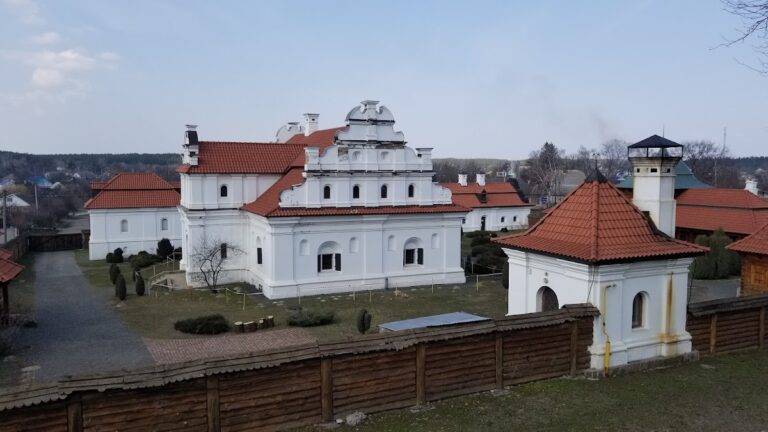
Internal buildings included the wooden Holy Trinity Church, soldiers’ barracks, the commandant’s, general’s, and archpriest’s houses, powder magazines, smithies, wells, a supply store, guardhouses, a hospital, and other urban and military structures. These buildings occupied the interior of the earthwork alongside the parade ground and the fortress’s administrative and industrial facilities.
Memorial landscape
Pantheon and wartime burials
The fortress grounds contain memorial features associated with twentieth-century warfare and repression. The Pantheon of Eternal Glory stands among graves of soldiers and local underground fighters. The site also includes the Wall of Memory, a memorial to victims of Nazi persecution on the Catherine Bastion, and associated mass graves described as filled-in trenches containing bodies.
Later memorials
Stone slabs were installed over graves in the 1960s. The statue known as the Sorrowing Motherland was erected in 1981 and 1982. A bust of Nikolai Pirogov stands near the former fortress hospital, linking the surviving memorial landscape with the medical institution that operated within the former stronghold.