St. Nicholas Church (Veles): A Medieval Orthodox Chapel in North Macedonia


Site at a Glance
- Rating
- 5
- Popularity
- Very Low
- Country
- North Macedonia
- Primary era
- Medieval
- Eras represented
- Medieval
- Civilizations
- Serbian
- Site type
- Religious
- Remains
- Church
On this page6 sections
History
Medieval origins
St. Nicholas Church is a medieval Orthodox church in North Macedonia, built and fresco-painted during the fourteenth century. Its construction method and the artistic style of its murals place the surviving building in that period. The church is affiliated with the Macedonian Orthodox Church–Ohrid Archbishopric and the Povardar Diocese, an Orthodox ecclesiastical jurisdiction serving the Vardar region.
An earlier origin has also been proposed. The church may have begun as early as the tenth century and may have been restored in 1341, although the connection between this possible predecessor and the surviving building remains uncertain. It may once have formed part of a monastery, probably the nearby Monastery of St. Demetrius. A fragmentary, interrupted, and distorted inscription identifies the dedication to St. Nicholas, a major Christian saint associated in Eastern Orthodox tradition with charitable acts and episcopal ministry. The name of the benefactor cannot be determined.
Disuse and modern restoration
During the Ottoman period, the centuries when the Ottoman Empire ruled large parts of southeastern Europe, the church fell into disuse. Its condition worsened much later when a stone quarry was opened nearby during construction of the Thessaloniki–Skopje–Pristina railway. The building was adapted as a warehouse for railway workers’ tools, and this use contributed substantially to its deterioration.
Major restoration and repainting took place in 1921. Further repainting and renovation followed in 1939 and 1940. These later works appear to have covered the last traces of earlier frescoes from the Serbian period, a phase associated with Serbian rule in the region. The building is protected as a cultural monument. It now serves as a chapel, in a manner comparable to Markova Meana.
Remains
Setting and structure
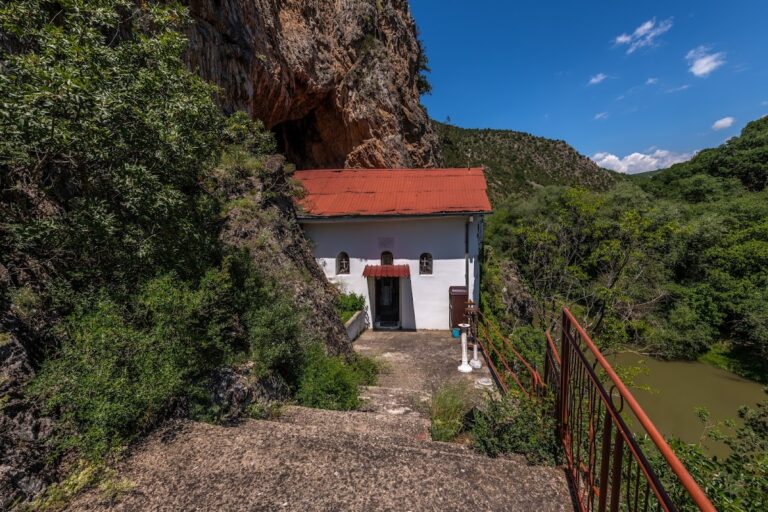
The church stands south of Veles, immediately beside the road to Gradsko and the Vardar River, with the building on the road’s right-hand side. It is approximately one hundred metres south of the Monastery of St. Demetrius and overlooks the road. The structure is small and single-nave, meaning that it has one principal longitudinal interior space. Its eastern end terminates in a three-sided apse, the polygonal sanctuary end of the church, while the entrance is placed on the west. A porch was added to the western side in a later period.
The walls are made of rough stone arranged with alternating horizontal and vertical courses of dressed tuff and brick. Tuff is a relatively soft stone formed from compacted volcanic ash. Part of the apse has been rebuilt, and the church is considerably damaged. These surviving construction elements preserve the building’s compact medieval form while also showing the effects of later alteration.
Frescoes and interior decoration
Two original fresco compositions remain relatively well preserved in the apse. One is the Virgin Mary composition known as “Wider than the Heavens”; the other is the Communion of the Apostles. Together they represent the principal surviving medieval painted decoration in the sanctuary area.
In 1939, images of St. Nicholas and the Archangel Michael were painted in niches on the southern and northern sides of the nave and on the door of the iconostasis, the screen separating the sanctuary from the main worship space in an Eastern Orthodox church. This repainting covered the remaining traces of the church’s medieval painted decoration outside the original apse compositions.